
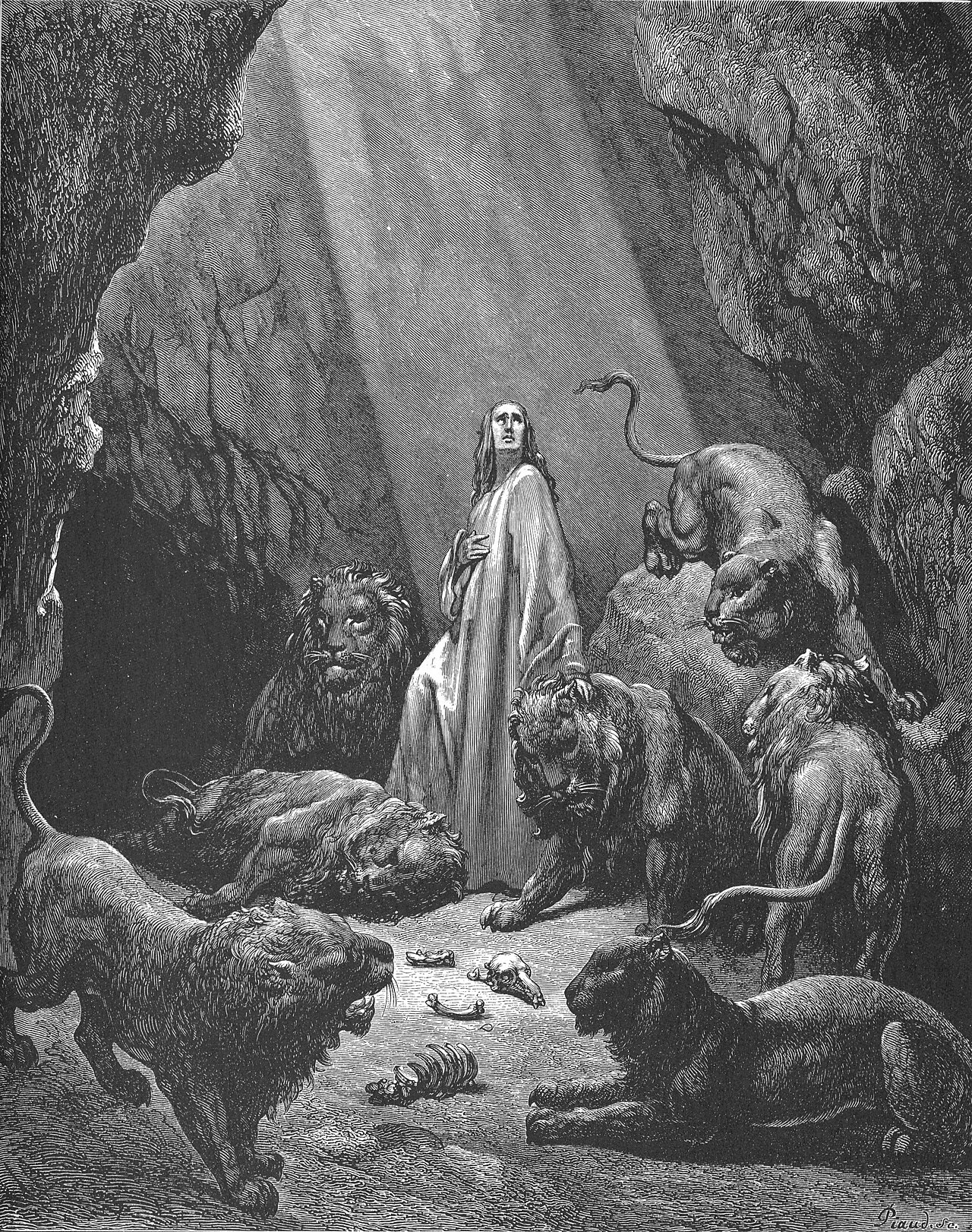
Danielchapter 6
28 verses · Daniel, by tradition · 6th century BC · The Prophets
Now when Daniel learned that the document had been signed, he went into his house, where the windows of his upper room opened toward Jerusalem, and three times a day he got down on his knees, prayed, and gave thanks to his God, just as he had done before.
Introduction
Daniel, by tradition, The Prophets, Daniel Overview.
This chapter was written for exiles serving a second empire, who learned that a change of rulers did not end the pressure on them. It is set in the first year of Persian rule over Babylon, when an old servant of the fallen kingdom still held high office. Its danger comes through the law itself, from men who could find no fault in Daniel's work. Listen for how carefully the trap is built and for what Daniel does when he hears of it. Listen last to the decree the king sends to every nation, which answers the decree that began the trouble.
Context
- Who
- Exiles now serving a second empire, learning that a change of masters does not change the pressure
- What
- A narrative of the decree against prayer, Daniel's faithfulness to his daily prayers, his night in the den of lions and his deliverance.
- Where
- The Persian government in Babylon, Daniel's house with its windows open toward Jerusalem, and the king's den of lions.
- When
- The first year of Persian rule over Babylon, about 539 to 538 BC, under the ruler the book calls Darius the Mede.
- Why
- To show that God keeps those who stay faithful under unjust laws, and that His kingdom endures when every human kingdom passes.
Historical context
Who "Darius the Mede" was is an open question. He is not Darius I, who came to the throne years later. Proposals include Gubaru, the officer Cyrus installed over Babylon, and Cyrus himself under a second title. No inscription has settled it, and the chapter works the same either way.
Show the rest of the historical context, 4 more paragraphs
The administration described is Persian to the core. The empire was divided into satrapies, large provinces, each under a satrap who collected tribute, kept order, and answered to the king. Layering presidents over the satraps to audit them is exactly the sort of anti-corruption plumbing a new regime installs. Daniel, a holdover from the previous government, was good enough at it to be resented.
The trap depends on a rule this book states twice and Esther states again: a decree sealed with the king's ring could not be revoked, not even by the king. No Persian document outside the Bible describes that rule, so historians argue about whether it was law, court etiquette, or the storyteller's shorthand. It drives the crisis in Esther the same way, a death sentence on the Jews that cannot be cancelled and has to be answered with a second decree, and the chapter works the same whichever it was.
The lions were royal property. Assyrian and Persian kings kept big cats for the hunt, and palace reliefs from Nineveh show lions released from cages for the king to shoot. Feeding a condemned man to them was a use of the royal menagerie, not a fairy tale.
Notice what Daniel does not do. He does not argue, protest, or hide. He goes home, opens the windows toward Jerusalem, and prays three times a day exactly as he always had.
Significance
Exiles reading this were living under laws they had no vote in and no way to change. The chapter does not promise them a friendly government. It shows a good law-abiding servant framed by his colleagues using a legal system that could not be appealed.
Show the rest of the significance, 1 more paragraph
The windows toward Jerusalem are the heart of it. Daniel was praying toward a ruined city, in a foreign capital, under a law that made it a capital crime, and God shut the lions' mouths. Then a pagan king wrote a decree telling the whole empire that the God of Daniel is the living God whose kingdom does not end.
This chapter in Jewish lifeWhat this chapter is in Jewish life and reading.
What is done
The lions' den is not read in the synagogue. Probed for this lane, the site's own table in src/lib/hebraic/readings.ts printed parashot total 0 and haftarah uses total 0 for Daniel, and no festival reading. The site's book dossier records that Daniel stands among the Writings in the Hebrew Bible rather than among the Prophets, so no weekly portion is drawn from it and no Haftarah either.
The corpus numbers this chapter by the Hebrew text, which begins it one verse earlier than an English Bible does. Its first verse is the last verse of chapter 5 in English, and every verse number below stands one higher than the English count. The chapter's weight in Jewish life falls on prayer. Under the Hebrew eleventh verse, the tenth in English, where Daniel kneels three times a day with his windows open toward Jerusalem, the corpus carries Berakhot 31a:19 and 31a:20 and Avot DeRabbi Natan 4:5. Under the verse before it, it carries Chullin 91b:10, Jerusalem Talmud Berakhot 4:1:3 and Ein Yaakov (Glick Edition), Berakhot 5:20. The corpus cites these passages without their text, so what they rule is not reported here.
How it is read
Rashi is the one commentator on this chapter with English in the corpus, quoted from The Judaica Press complete Tanach with Rashi, translated by A. J. Rosenberg, which Sefaria reports as CC-BY at fifty words or fewer.
Rashi explains why the verse counts Darius's years. It tells "on the day that Nebuchadnezzar entered the Heichal in the days of Jehoiachin, his adversary, Darius, was born". He then works the sixty-two years out from the reigns, citing Seder Olam, chapter 28, and Megillah 11b (Rashi on Daniel 6:1:1).
The stone over the den draws the chapter's longest note. Babylon had bricks and no stones, so Rashi reports that "there are no stones in Babylon, but for the occasion, angels brought it [a stone] from the land of Israel." The king's reason for the seal follows: "From the lions I cannot take him away. I shall be careful with him that no man hurt him, and if the miracle comes, let it come." Rashi adds that the passage does not appear in some editions (Rashi on Daniel 6:18:1). Daniel's answer from the den he glosses in one line: "No unseemly or false act have I committed" (Rashi on Daniel 6:23:1).
His other notes follow the plot against Daniel. The officials were "seeking a pretext to find about Daniel in matters of the kingdom so that they could inform on him" (Rashi on Daniel 6:5:1). The decree is the thing "What the king decrees and ratifies, no man can alter" (Rashi on Daniel 6:16:1).
The corpus carries twenty-four commentary entries on this chapter, the cap its fetch sets, and they stop at the twenty-fourth verse, so what the commentators say on the verses after it is not reported here. The corpus carries five further notes on this chapter without an English text, each marked linked because Sefaria holds no English version of the ref. They stand cited and unquoted: Ibn Ezra on Daniel 6:2:1 and Daniel 6:21:1 and Metzudat David on Daniel 6:10:1, Daniel 6:17:1 and Daniel 6:22:1.
What the rabbis say
The corpus carries thirty-eight rabbinic locators on this chapter. Nine of them stand in the Talmud and its minor tractates and the rest in the Midrash. The corpus carries the text of none, so each is cited by ref here and never quoted.
On the first verse it holds Ein Yaakov, Megillah 1:23. On the second verse it holds Megillah 11b:4. On the third verse it holds Yalkut Shimoni on Torah 110:6 and Yalkut Shimoni on Torah 186:8. On the fourth verse it holds Ein Yaakov, Pesakhim 10:18, Pesachim 113b:16 and Ruth Rabbah (Lerner) 7:3:3. On the ninth verse it holds Yalkut Shimoni on Torah 76:7. On the tenth verse it holds Chullin 91b:10 and Jerusalem Talmud Berakhot 4:1:3.
On the span Daniel 6:10 to 11 it holds Ein Yaakov (Glick Edition), Berakhot 5:20. On the eleventh verse it holds Avot DeRabbi Natan 4:5, Berakhot 31a:19 and Berakhot 31a:20. On the fifteenth verse it holds Bereshit Rabbati, Parashat Vayechi 17 and Jerusalem Talmud Peah 1:1:51. On the span Daniel 6:16 to 23 it holds Midrash Tanchuma Buber, Vayeshev 17:7. On the sixteenth verse it holds Pirkei DeRabbi Eliezer 16:2. On the seventeenth verse it holds Ein Yaakov (Glick Edition), Berakhot 1:31 and Ein Yaakov (Glick Edition), Megillah 1:32.
On the eighteenth verse it holds Bamidbar Rabbah 14:3 and Midrash Tehillim 24:8. On the twentieth verse it holds Otzar Midrashim, Midrashim of Rabbi Akiba, The Small Letters and their Purposes 25. On the twenty-first verse it holds Avot DeRabbi Natan, Recension B 43:18 and Bereshit Rabbah 68:13. On the twenty-third verse it holds Aggadat Bereshit 15:1 and Aggadat Bereshit 4:3. On the twenty-fourth verse it holds Midrash Shmuel 5:14 and Midrash Tehillim 31:1. On the twenty-fifth verse it holds Midrash Shmuel 11:6 and Midrash Shmuel 21:4.
On the span Daniel 6:26 to 28 it holds Bamidbar Rabbah 13:4. On the twenty-sixth verse it holds Ein Yaakov (Glick Edition), Megillah 1:17. On the twenty-seventh verse it holds Sifrei Devarim 306:37 and Yalkut Shimoni on Torah 942:31. On the twenty-eighth verse it holds Midrash Tehillim 56:1. On the twenty-ninth verse it holds Midrash Tanchuma, Miketz 3:3. On the span Daniel 5:30 to 6:1 it holds Bereshit Rabbah 85:2.
Sefaria also files two links for this chapter to Learning to Read Midrash, a modern study rather than a rabbinic source. They are named among the sources and left out of the count above. What each locator teaches is a saying of the rabbis, and it is reported as theirs wherever this site quotes one. The quotations wait on a fetch that carries the text.
Sources: Rashi, Rashi on Daniel 6:1:1 to Daniel 6:24:1, The Judaica Press complete Tanach with Rashi, translated by A. J. Rosenberg, reported CC-BY; Ibn Ezra, Ibn Ezra on Daniel 6:2:1 and Daniel 6:21:1, cited by ref because the corpus carries no English text; Metzudat David, Metzudat David on Daniel 6:10:1, Daniel 6:17:1 and Daniel 6:22:1, cited by ref because the corpus carries no English text; Learning to Read Midrash, Learning to Read Midrash, Appendix; Hebrew Sources 14:3 | Learning to Read Midrash, Chapter 14; The Meaning of a Chronological Problem; Connecting Yosef and Yehuda 40, linked by Sefaria under Midrash, cited by ref; The Sefaria corpus, scripts/data/sources/sefaria/daniel/6.json, the 38 Talmud and Midrash locators of this chapter; The site's own files, src/lib/hebraic/readings.ts, probed for this book and printing daniel parashot total 0 and haftarah uses total 0, and src/components/book/dossier-content/daniel.ts on the place of Daniel among the Writings.
The heads below are this chapter's scenes. The numbered points under each are its verses.
An edict crafted to trap one faithful man
Daniel 6:1-3
appoint 120 satraps to rule: Darius appoints “120 satraps” with “three administrators, including Daniel,” over them, the ordinary administration of a conqueror organizing new territory. Daniel rises “by his extraordinary spirit,” the phrase the queen used of him in chapter 5. Gill notes that Daniel was likely past eighty by this time.
Daniel 6:1
“It pleased Darius to set over the kingdom - Evidently over the kingdom of Babylon, now united to that of Media and Persia. As this was now subject to him, and tributary to him, it would be natural to appoint persons over it in whom he could confide, for the administration of justice, for the collection of revenue, etc. Others however, suppose that this relates to the whole kingdom of Persia, but as the reference here is mainly to what was the kingdom of Babylon, it is rather to be presumed that this is what is particularly alluded to.”
1 more voice on this verseWhat preachers and commentators have said about this verse, in their own words.
Daniel 6:1
“It pleased Darius to set over the kingdom an hundred and twenty princes,.... This is the same Darius mentioned in the latter part of the preceding chapter; who, as soon as he took the kingdom of Babylon, divided it into a hundred and twenty provinces, as Jacchiades observes; as was the manner of the Medes and Persians.”
three administrators, including Daniel: Adam Clarke reckoned that each administrator was set over forty satraps. John Calvin noted that Daniel had briefly been third ruler under Belshazzar, and such honour under a new king might stir envy. Theodoret of Cyrus observed that a new king seldom trusts the officials of the king before him.
Daniel 6:2
“Three presidents - Each having forty of these presidents accountable to him for their administration. Daniel was first - As being established over that part where was the seat of government. He was confirmed in his offices by Darius.”
Adam Clarke · Commentary on the Bible (1810-1826)evangelical
1 more voice on this verse
Daniel 6:2
“We must notice, in the context of this history, how Daniel alone was chosen by Darius one of these three superior officers. He was the third in rank under king Belshazzar, although for a moment, yet it might occasion envy under the new king that so great an honor was conferred upon him.”
John Calvin · Commentaries (1554)reformed
by his extraordinary spirit: Matthew Henry reckoned that Daniel had been an exile from Judah for more than seventy years. Jamieson, Fausset and Brown saw the king's plan to set him over the kingdom as fitting a king who handed affairs to favoured men. Adam Clarke traced the charges against Daniel to this favour.
Daniel 6:3
“Hence the very expression used by the queen mother on that occasion (Da 5:12) is here used, "because an excellent spirit was in him." king thought to set him over the whole realm--Agreeing with Darius' character, weak and averse to business, which he preferred to delegate to favorites.”
Jamieson, Fausset & Brown · Commentary Critical and Explanatory on the Whole Bible (1871)reformed
1 more voice on this verse
Daniel 6:3
“We must take notice of it, to the glory of God, that, though Daniel was now very old (it was above seventy years since he was brought a captive to Babylon), yet he was as able as ever for business both in body and mind, and that he who had continued faithful to his religion through all the temptations of the foregoing reigns in a new government was as much respected as ever.”
Matthew Henry · Commentary on the Whole Bible (1707-1721)puritan
Daniel 6:4-5
sought a charge against Daniel: The administrators and satraps search Daniel's record and “could find no charge or corruption, because he was trustworthy”. Their words concede it: “We will never find any charge against this Daniel, unless we find something against him concerning the law of his God”. The plot turns on that law.
Daniel 6:4
“Accordingly, after this happened, the governors and satraps were stirred with jealousy and sought to find a pretext against Daniel, so that they might take some occasion against him and accuse him and kill him. In which manner the word was fulfilled, which we spoke a little before, that a pious man or one who fears God and has grace and wisdom from God is hated by the rest of men because they also were not honored with the same gift.”
Hippolytus of Rome · written before 235 · Commentary on Daniel 3.19.3-6patristic
1 more voice on this verse
Daniel 6:4
“Sought to find occasion against Daniel - But they found no blemish in his administration, for he was faithful to his king: this was a virtue. But he was also faithful to his God: this they hoped to construe into a crime, and make it the cause of his ruin.”
Adam Clarke · Commentary on the Bible (1810-1826)evangelical
Matthew Henry observed that the men, finding no charge against Daniel, still did not hire false witnesses. Jamieson, Fausset and Brown called it the highest witness to godly life when enemies find a charge only in obedience to the law of God. Jerome called such a life blessed.
Daniel 6:5
“It is observable that, when Daniel's enemies could find no occasion against him concerning the kingdom, they had so much sense of justice left that they did not suborn witnesses against him to accuse him of crimes he was innocent of, and to swear treason upon him, wherein they shame many that were called Jews and are called Christians.”
Matthew Henry · Commentary on the Whole Bible (1707-1721)puritan
Daniel 6:6-9
King Darius, may you live forever!: The plotters bring a decree that anyone who petitions “any god or man except you, O king” will be thrown to the lions. They press Darius to sign it under “the law of the Medes and Persians, which cannot be repealed”, the same unchangeable law in Esther.
Daniel 6:6
“Then these presidents and princes assembled together - Margin, came tumultuously. The margin expresses the proper meaning of the original word - רגשׁ râgash - to run together with tumult. Why they came together in that manner is not stated. Bertholdt suggests that it means that they came in a procession, or in a body, to the king; but there is undoubtedly the idea of their doing it with haste, or with an appearance of great earnestness or excitement.”
thrown into the den of lions: Albert Barnes and Jamieson, Fausset and Brown suspected that the officials claimed all the royal administrators had agreed when not all had. Jamieson, Fausset and Brown marked the change of penalty from a furnace in Babylon to the den of lions. They tied it to the Persians' worship of fire.
Daniel 6:7
“But it was much worse, and an impudent affront to all religion, to forbid asking a petition of any god. It is by prayer that we give glory to God, fetch in mercy from God; and so keep up our communion with God; and to interdict prayer for thirty days is for so long to rob God of all the tribute he has from man and to rob man of all the comfort he has in God.”
Matthew Henry · Commentary on the Whole Bible (1707-1721)puritan
2 more voices on this verse
Daniel 6:7
“They evidently exaggerated the case of the weak king, as if their request was that of all the officers in the empire. den of lions--an underground cave or pit, covered with a stone. It is an undesigned proof of genuineness, that the "fiery furnace" is not made the means of punishment here, as in Da 3:20; for the Persians were fire-worshippers, which the Babylonians were not.”
Jamieson, Fausset & Brown · Commentary Critical and Explanatory on the Whole Bible (1871)reformed
Daniel 6:7
“All the presidents of the kingdom, the governor ... - Several functionaries are enumerated here who are not in the previous verses, as having entered into the conspiracy. It is possible, indeed, that all these different classes of officers had been consulted, and had concurred in asking the enactment of the proposed law; but it is much more probable that the leaders merely represented or affirmed what is here said in order to be more certain of the enactment of the law.”
Jamieson, Fausset and Brown held the decree of a Persian king could not be changed, for the king was held infallible as representative of Ormuzd. Adam Clarke thought it meant only that the decree was established and recorded by the legal forms of the Medes and Persians.
Daniel 6:8
“According to the law of the Medes and Persians - I do not think that this is to be understood so as to imply that whatever laws or ordinances the Medes or Persians once enacted, they never changed them. This would argue extreme folly in legislators in any country. Nothing more appears to be meant than that the decree should be enacted, written, and registered, according to the legal forms among the Medes and Persians; and this one to be made absolute for thirty days.”
Adam Clarke · Commentary on the Bible (1810-1826)evangelical
King Darius signed the written decree: John Gill gave three motives: the pressure of officials, the appeal of being honoured as a god, and a wish to win over his peoples. Darius, he added, missed the snare. Jamieson, Fausset and Brown observed that laws against the servants of God are always made on false grounds.
Daniel 6:9
“Wherefore King Darius signed the writing and the decree. Moved to it by the number and importunity of his principal men; and chiefly through affectation of deity, which this law gave him; and that he might have an opportunity of ingratiating himself into his new subjects by his munificence and liberality, not being aware of the snare laid for his favourite, Daniel.”
1 more voice on this verse
Daniel 6:9
“Such a despotic decree is quite explicable by remembering that the king, as the incarnation of Ormuzd, might demand such an act of religious obedience as a test of loyalty. Persecuting laws are always made on false pretenses.”
Jamieson, Fausset & Brown · Commentary Critical and Explanatory on the Whole Bible (1871)reformed
Windows open toward Jerusalem, three times a day
Daniel 6:10-11
the windows of his upper room: After the decree Daniel keeps his windows “opened toward Jerusalem”. He keeps his old habit and changes nothing. Praying toward Jerusalem answers Solomon's prayer at 1 Kings 8:48 that exiles would pray toward the land and the house built for God's name.
Daniel 6:10
“Now when Daniel knew that the writing was signed - He saw what was designed, and he knew whom he served. His windows being open - He would not shut them to conceal himself, but “kneeled down with his face turned toward Jerusalem, and prayed thrice each day, giving thanks to God as usual.” When the Jews were in distant countries, in prayer they turned their faces towards Jerusalem; and when in Jerusalem, they turned their faces towards the temple.”
Adam Clarke · Commentary on the Bible (1810-1826)evangelical
3 more voices on this verse
Daniel 6:10
“Cornelius was a man that prayed in his house, Acts x. Note, Every house not only may be, but ought to be, a house of prayer; where we have a tent God must have an alter, and on it we must offer spiritual sacrifices. (2.) In every prayer he gave thanks.”
Matthew Henry · Commentary on the Whole Bible (1707-1721)puritan
Daniel 6:10
“To Christ in the heavenly temple let us turn our eyes in prayer, from this land of our captivity (1Ki 8:44, 48; Ps 5:7). chamber--the upper room, where prayer was generally offered by the Jews (Ac 1:13). Not on the housetop (Ac 10:9), where he would be conspicuous. upon his knees--Humble attitudes in prayer become humble suppliants. three times a day-- (Ps 55:17).”
Jamieson, Fausset & Brown · Commentary Critical and Explanatory on the Whole Bible (1871)reformed
Daniel 6:10
“Toward Jerusalem - The temple was the place where the Lord placed his name, and promised to appear, and accept his people, all being a type of Christ, through whom only sinners are accepted. As he did aforetime - He did not abate his prayers for the king's command, nor did he break the law purposely, because he did no more than he was wont to do in serving his God.”
John Wesley · Explanatory Notes upon the Old Testament (1765)evangelical
went as a group: John Gill thought the men knew the times and place where Daniel prayed and came as a group to catch him. Jerome noted that Daniel prayed in his own house, in private. He drew the lesson that believers should avoid needless danger where they can.
Daniel 6:12-13
The plotters make Darius restate his decree before they name the offender, so his words, “the order stands, and it cannot be repealed,” bind him. They then call Daniel “one of the exiles from Judah” and Clarke notes that Belshazzar used the same label of Daniel in chapter 5.
Daniel 6:12
“Shall be cast into the den of lions - Either this was the royal menagerie, like that place in the Tower of London, where wild beasts are kept for the king’s pleasure, and the public amusement; or they were kept for the purpose of devouring certain criminals, which the laws might consign to that kind of death. This is most likely, from the case before us.”
Adam Clarke · Commentary on the Bible (1810-1826)evangelical
one of the exiles from Judah: Albert Barnes saw craft in naming Daniel as an exile, passing over his high office to make his offence look worse. Matthew Henry noticed they left God out of the charge. They said only that he makes his petition, lest the king admire his piety.
Daniel 6:13
“That excellent spirit which Daniel was endued with, and that established reputation which he had gained, could not protect him from these poisonous darts. They do not say, He makes his petition to his God, lest Darius should take notice of that to his praise, but only, He makes his petition, which is the thing the law forbids. The great concern the king was in hereupon.”
Matthew Henry · Commentary on the Whole Bible (1707-1721)puritan
Daniel 6:14-15
labored until sundown to rescue him: Darius is “deeply distressed,” sets “his mind on delivering Daniel,” and “labored until sundown to rescue him”. His search fails against the law he signed, and the plotters press it again: “no decree or ordinance established by the king can be changed”. The older commentators set this king beside Pilate.
no decree or ordinance established: Albert Barnes noted that the Aramaic verb is the one in verse 6, meaning the men came together to the king in a throng. Hippolytus of Rome saw God closing every human way of escape so that the rescue would be seen as the work of the living God.
Daniel 6:15
“Then these men assembled unto the king - The Chaldee here is the same as in Dan 6:6, “they came tumultuously.” They were earnest that the law should be executed, and they probably apprehended that if the king were allowed to dwell upon it, the firmness of his own mind would give way, and that he would release Daniel. Perhaps they dreaded the effect of the compunctious visitings which he might have during the silence of the night, and they, therefore, came tumultuously to hasten his decision.”
1 more voice on this verse
Daniel 6:15
“We are not told what Daniel said; the king himself is his advocate, he needs not plead his own cause, but silently commits himself and it to him that judges righteously.”
Matthew Henry · Commentary on the Whole Bible (1707-1721)puritan
Sealed in the den, and a king who cannot sleep
Daniel 6:16-17
threw him into the den: The king says to Daniel, “May your God, whom you serve continually, deliver you!”, words from the king who has just condemned him. The stone is sealed “with his own signet ring and with the rings of his nobles, so that nothing concerning Daniel could be changed”.
Daniel 6:16
“He is sure that his God can deliver him, for he believes him to be an almighty God, and he has reason to think he will do it, having heard of his delivering Daniel's companions in a like case from the fiery furnace, and concluding him to be always faithful to those who approve themselves faithful to him.”
Matthew Henry · Commentary on the Whole Bible (1707-1721)puritan
his own signet ring: The double seal guarded against both sides. Jerome read the king's ring as protection from Daniel's enemies, and Hippolytus of Rome read the nobles' rings as their guard against a secret rescue. Adam Clarke and Matthew Henry compared the sealed stone to the sealing of Christ's tomb.
Daniel 6:18-20
spent the night fasting: Darius “spent the night fasting,” with no entertainment, and “sleep fled from him”. At dawn he “hurried to the den of lions” and “cried out in a voice of anguish”. He calls God “the living God” and asks whether He has “been able to deliver you from the lions”.
Daniel 6:18
“He is sorry for the evil which he himself had caused, yet takes no steps to remedy it. There are many such halters between good and bad, who are ill at ease in their sins, yet go forward in them, and are drawn on by others.”
Jamieson, Fausset & Brown · Commentary Critical and Explanatory on the Whole Bible (1871)reformed
God sent his angel and shut the lions' mouths
At the first light of dawn: Theodoret of Cyrus took the first light of dawn to mean the dark before sunrise, when lamps were still needed. Jerome held that the king hurried, believing Daniel was living. Albert Barnes named the king's anxiety, his remorse and his hope as the reasons he got up so early.
servant of the living God: Albert Barnes and Jamieson, Fausset and Brown thought Darius learned the title living God from Daniel himself. The latter heard doubt mixed with hope in his question. Theodoret of Cyrus noted that the king calls Daniel God's servant, where he might have called him his own.
Daniel 6:20
“He cried with a lamentable voice - His heart, full of grief, affected his speech. Servant of the living God - The king was convinced that, unless his God saved him, his destruction was inevitable.”
Adam Clarke · Commentary on the Bible (1810-1826)evangelical
2 more voices on this verse
Daniel 6:20
“Able to deliver - What he doubted of, we are sure of, that the servants of the living God, have a master who is able to deliver them and bear them out in his service.”
John Wesley · Explanatory Notes upon the Old Testament (1765)evangelical
Daniel 6:20
“THE empire of Babylonia and Chaldea passed into the hands of a new dynasty and king Belshazzar was slain in a night-assault upon his capital. On that very night, he had clothed Daniel in scarlet and made him the third ruler in the Kingdom. This was Providential, for, had Daniel been in obscurity, he would have been little likely to attract the notice of Darius. But, observing him in the palace, clothed in scarlet, Darius would naturally ask who he was and enquire into his antecedents.”
Charles Spurgeon · written before 1892 · The Metropolitan Tabernacle Pulpit, Sermon No. 2859: “The Lions' Den” (lightly modernized text, CCEL edition)Particular Baptist
Daniel 6:21-23
Daniel gives the deliverance to God: “My God sent His angel and shut the mouths of the lions”. The older commentators read this beside the angel in chapter 3. The text gives the reason: “no wounds whatsoever were found on him, because he had trusted in his God”.
Daniel 6:21
“Then said Daniel unto the king,.... Whose voice he knew, though the tone of it was so much altered: O king, live for ever; he does not reproach him for delivering him into the hands of his enemies, and suffering him to be cast into that place, which he might have prevented, had he had more resolution; he knew it was done with reluctance, though with weakness; which he does not upbraid him with, but freely forgives him, and wishes him health, long life, and prosperity.”
1 more voice on this verse
Daniel 6:21
“The same bright and glorious being that was seen in the form of the Son of God with the three children in the fiery furnace had visited Daniel, and, it is likely, in a visible appearance had enlightened the dark den, and kept Daniel company all night, and had shut the lions' mouths, that they had not in the least hurt him.”
Matthew Henry · Commentary on the Whole Bible (1707-1721)puritan
I was found innocent: Jerome held that God sent His angel as a reward for Daniel's good works more than as grace. Jamieson, Fausset and Brown held that the verse gives no ground for works meriting salvation. Adam Clarke read the shut mouths of the lions as public proof that Daniel was found innocent.
Daniel 6:22
“My God hath sent his angel - Such a one as that who attended Shadrach, Meshach, and Abed-nego, in the fiery furnace, and blew aside the flames, so that they could not hurt them. Before him innocency was found in one - Because I was innocent God has preserved me; and now that I am preserved, my innocence is fully proved.”
Adam Clarke · Commentary on the Bible (1810-1826)evangelical
1 more voice on this verse
Daniel 6:22
“His angel - The same that was with the three children in the fiery furnace, whose presence made even the lion's den a strong- hold, his palace, his paradise. See the power of God over the fiercest creatures! See the care God takes of his faithful servants, especially when they are called to suffer for him!”
John Wesley · Explanatory Notes upon the Old Testament (1765)evangelical
he had trusted in his God: Jamieson, Fausset and Brown and John Chrysostom linked Daniel, lifted out of the den with no wounds, to the faith praised in Hebrews 11:33. Daniel trusted without counting on a miracle, the former added. He was sure God would deliver him in a better life, if not in this one.
Daniel 6:23
“The lesson that was read today invites you to the true faith, by setting before you the way in which you also must please God. It affirms that "without faith it is impossible to please him." For when will an individual resolve to serve God, unless he believes that "he is a giver of reward"? When will a young woman choose a virgin life, or a young man live soberly, if they do not believe that for chastity there is "a crown that does not fade away"? Faith is an eye that enlightens every conscience and imparts understanding.”
Cyril of Jerusalem · written before 386 · Catechetical Lecture 5:4patristic
The men who accused Daniel are thrown to the lions, “they and their children and wives”. Eastern law gave false accusers the penalty they sought for the accused and by custom extended it to their households. Clarke notes that the text reports the sentence as a fact of ancient law.
Daniel 6:24
“Then, "the king spoke and they brought the men who accused Daniel and they themselves and their sons and their wives were cast into the den of lions, and they did not reach the bottom of the den before the lions mastered them, and they ground all their bones." [Daniel 6:24] And so they who have trusted in a human king and in wealth, they themselves dug a trench, and they fell in it for their destruction.”
Hippolytus of Rome · written before 235 · Commentary on Daniel 3.30.1-6patristic
1 more voice on this verse
Daniel 6:24
“They brought those men - It was perfectly just that they should suffer that death to which they had endeavored to subject the innocent; but it was savage cruelty to destroy the women and children who had no part in the transgression.”
Adam Clarke · Commentary on the Bible (1810-1826)evangelical
Darius decrees that the living God be feared
Daniel 6:25-27
Darius writes “to the people of every nation and language,” as Nebuchadnezzar did, and decrees that men “tremble in fear before the God of Daniel”. He names Him “the living God,” whose “kingdom will never be destroyed,” who “performs signs and wonders in the heavens and on the earth”.
Daniel 6:25
“Then king Darius wrote unto all people ... - Compare the note at Dan 2:47; Dan 3:29; Dan 4:1. If there is a probability that Nebuchadnezzar would make such a proclamation as he did, there is no less probability that the same thing would be done by Darius. Indeed, it is manifest on the face of the whole narrative that one great design of all that occurred was to proclaim the knowledge of the true God, and to secure his recognition.”
before the God of Daniel: Albert Barnes and Adam Clarke set this decree beside Daniel 3:29. Matthew Henry observed that this was one decree fit to be unalterable under the law of the Medes and Persians. Barnes noted that the empire joined Media, Persia and Babylonia, so the decree reached several kingdoms.
Daniel 6:26
“I make a decree that - men tremble and fear before the God of Daniel - As in the case of the three Hebrews, Dan 3:29. The true God was known by his servants, and by the deliverances he wrought for them. See his characters in this decree. 1. He is the living God, the Author and Giver of life; all others are dead gods. 2. He is steadfast for ever. All things change; but he is unchangeable. 3. He has a kingdom; for as he made all things, so he governs all things.”
Adam Clarke · Commentary on the Bible (1810-1826)evangelical
2 more voices on this verse
Daniel 6:26
The foundation and strength of hope and faith is fear. In Psalm 111: "The fear of the Lord is the beginning of wisdom." Of the same thing in the Wisdom of Solomon, … in the Proverbs, … in Isaiah, … in Genesis, … and in Psalm 2, … Then Darius the king wrote, "To all peoples, tribes and languages that are in my kingdom, peace be to you from my face. I decree and ordain that all those who are in my kingdom shall fear and tremble before the Most High God whom Daniel serves."
Cyprian · written before 258 · Treatise XII. Three Books of Testimonies Against the Jews 3:20patristic
Daniel 6:26
“He gives honour to God by a decree published to all nations, by which they are required to fear before him. And this is a decree which is indeed fit to be made unalterable, according to the laws of the Medes and Persians, for it is the everlasting gospel, preached to those that dwell on the earth, Rev. xiv. Fear God, and give glory to him.”
Matthew Henry · Commentary on the Whole Bible (1707-1721)puritan
He delivers and rescues: Matthew Henry distinguished the two verbs: God delivers His servants from trouble and rescues them out of it. Albert Barnes thought this attribute came first to Darius because he had just watched it at work. Barnes compared Daniel 4:2-3.
Daniel 6:27
“He delivereth and rescueth - As in the case of Daniel. This attribute would of course be prominent in the view of Darius, since so remarkable an instance of his power had been recently manifested in rescuing Daniel. And he worketh signs and wonders ... - Performs miracles far above all human power. If he had done it on earth in the case of Daniel, it was fair to infer that he did it also in heaven. Compare the notes at Dan 4:2-3. The power of the lions - Margin, hand. The hand is the instrument of power.”
1 more voice on this verse
Daniel 6:27
“He delivers his faithful servants from trouble and rescues them out of trouble; he works signs and wonders, quite above the utmost power of nature to effect, both in heaven and on earth, by which it appears that he is sovereign Lord of both.”
Matthew Henry · Commentary on the Whole Bible (1707-1721)puritan
prospered during the reign of Darius: The chapter closes on “So Daniel prospered during the reign of Darius and the reign of Cyrus the Persian,” the last of the court narratives. Gill notes naming Cyrus ties the verse to the seventy years in Jeremiah's prophecy, since Cyrus is the king whose decree will end the captivity.
Daniel 6:28
“So this Daniel prospered - He had served fine kings: Nebuchadnezzar, Evil-merodach, Belshazzar, Darius, and Cyrus. Few courtiers have had so long a reign, served so many masters without flattering any, been more successful in their management of public affairs, been so useful to the states where they were in office, or have been more owned of God, or have left such an example to posterity. Where shall we find ministers like Samuel and Daniel? None so wise, so holy, so disinterested, so useful, have ever since appeared in the nations of the earth.”
Adam Clarke · Commentary on the Bible (1810-1826)evangelical
1 more voice on this verse
Daniel 6:28
“So this Daniel prospered in the reign of Darius,.... This Daniel, of whom so much has been said all the preceding chapters, and who had been so lately and so wonderfully delivered from the lions' den, the same flourished throughout the reign of Darius the Mede; continued a favourite with the king; retained his honour and dignity; and kept his posts and places of trust and profit. Darius the Mede reigned two years; though Jarchi says he reigned but one, and was slain in war; for which he refers to Joseph ben Gorion, who has not a word of it.”
Keep studying
Studies9
Places1
Words12
Subjects1
Sources for this chapter
The summary
Jamieson, Fausset & Brown, Commentary Critical and Explanatory; John Calvin, Commentaries; John Wesley, Notes on the Old Testament and Matthew Henry, Complete Commentary.
The exposition
Adam Clarke, Commentary on the Bible; Albert Barnes; Carl Friedrich Keil, Biblical Commentary on the Book of Daniel; Hippolytus of Rome; Jamieson, Fausset & Brown, Commentary Critical and Explanatory on the Whole Bible; Jamieson, Fausset, and Brown, Commentary Critical and Explanatory on the Whole Bible; Jerome, St. Jerome, Commentary on Daniel, CHAPTER SIX; John Calvin, Commentaries; John Chrysostom, ON THE EPISTLE TO THE HEBREWS, HOMILY 27:4; John Gill; Matthew Henry, Commentary on the Whole Bible and Theodoret of Cyrus.