
Daniel 6:16
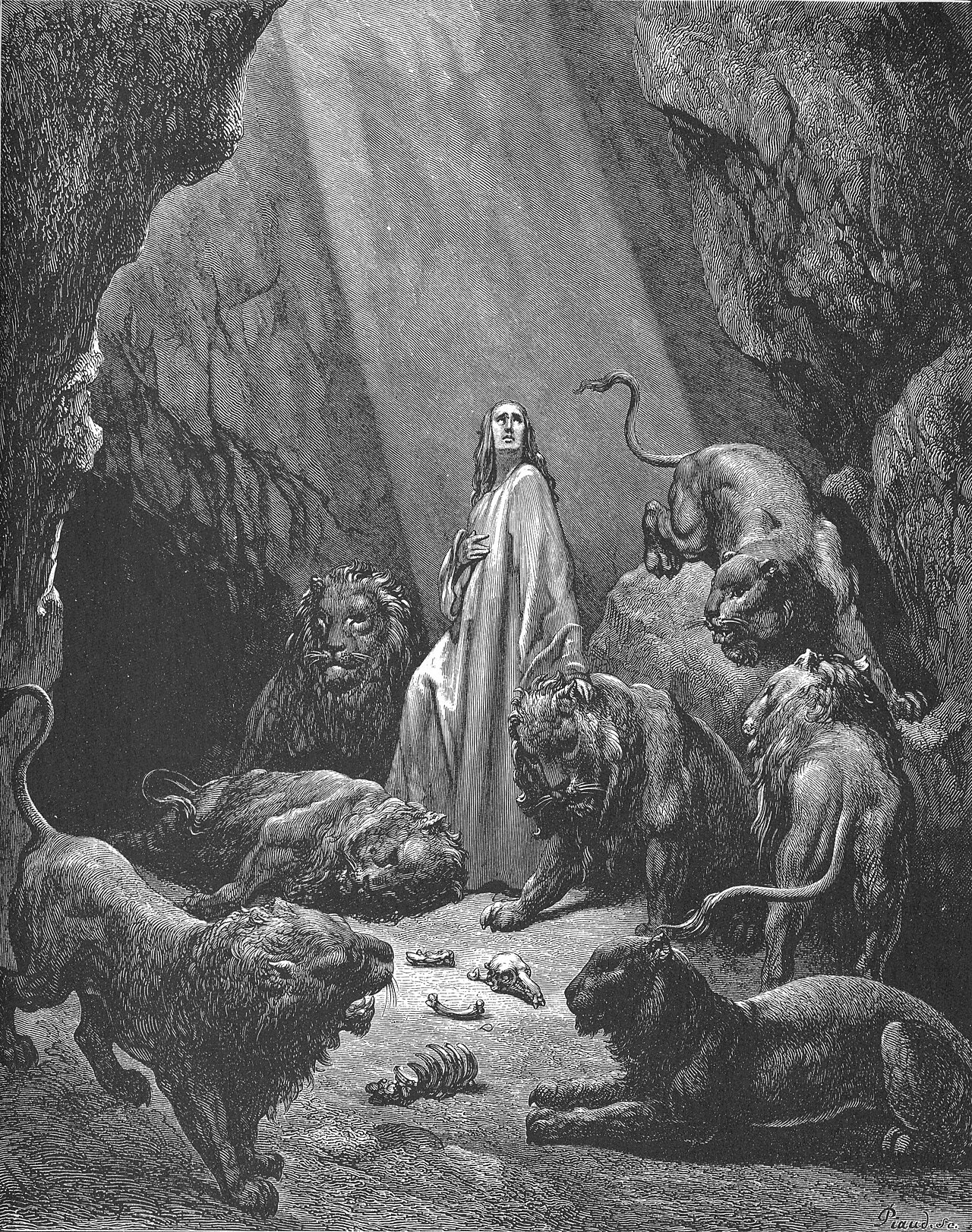
in Daniel 6So the king gave the order, and they brought Daniel and threw him into the den of lions. The king said to Daniel, “May your God, whom you serve continually, deliver you!”
BSB
The same verse in ASV and KJV ▾
ASV
Then the king commanded, and they brought Daniel, and cast him into the den of lions. Now the king spake and said unto Daniel, Thy God whom thou servest continually, he will deliver thee.
KJV
Then the king commanded, and they brought Daniel, and cast him into the den of lions. Now the king spake and said unto Daniel, Thy God whom thou servest continually, he will deliver thee.
⋯
This verse in Daniel 6
Commentary
13 notes on this verseVerse 16. "Then the king gave order, and they brought Daniel and cast him into the pit of lions. And the king said to Daniel: 'Thy God whom thou dost ever serve will Himself deliver thee.'" He gives way to the crowd and dares not to withhold from his plotting adversaries the death of his friend, and he commits to the power of God the purpose which he himself was unable to attain.
This site's exposition
threw him into the den
on Daniel 6:16-17
The king says to Daniel, “May your God, whom you serve continually, deliver you!”, words from the king who has just condemned him. The stone is sealed “with his own signet ring and with the rings of his nobles, so that nothing concerning Daniel could be changed”.
The record, by era
The Church Fathers5 voices
A commentator
Apostolic ConstitutionsCONSTITUTIONS OF THE HOLY APOSTLES 7:37 · Written before 380.
proposed
Lord, who fulfilled your promises made by the prophets, and had mercy on Zion and compassion on Jerusalem, by exalting the throne of David, your servant … by the birth of Christ, who was born of his seed according to the flesh, of a virgin alone; please, O Lord God, accept the prayers that proceed from the lips of your people which are of the Gentiles, which call on you in truth, as you accepted the gifts of the righteous in their generations. In the first place you respected the sacrifice of Abel … of Ezra at the return; of Daniel in the den of lions; of Jonah in the whale's belly.
A commentator
Apostolic ConstitutionsCONSTITUTIONS OF THE HOLY APOSTLES 8:1 · Written before 380.
proposed
Let not, therefore, any one that works signs and wonders judge any one of the faithful who is not granted the same: for the gifts of God that are bestowed by him through Christ are various; and one person receives one gift and another another.… For neither did the wise Daniel, who was delivered from the mouths of the lions, nor the three children, who were delivered from the furnace of fire, despise the rest of their fellow Israelites: for they knew that they had not escaped these terrible miseries by their own might but by the power of God did they both work miracles and were delivered from miseries. Wherefore let none of you exalt himself against his brother, though he is a prophet or though he is a worker of miracles.
For what shall we say? Was Daniel cast into the den of lions by those who feared God? Were Ananias and Azarias and Mishael shut up in a furnace of fire by those who observed the great and glorious worship of the Most High? Far from us be such a thought! Who, then, were they that did such things? The hateful, and those full of all wickedness, were roused to such a pitch of fury that they inflicted torture on those who served God with a holy and blameless purpose [of heart], not knowing that the Most High is the defender and protector of all such as with a pure conscience venerate his all-excellent name.… But they who with confidence endured [these things] are now heirs of glory and honor and have been exalted and made illustrious by God in their memorial for ever and ever.
A commentator
Ignatius of AntiochEpistle of Pseudo-Ignatius to the Tarsians · Written before 108.
proposed
From Syria even unto Rome I fight with beasts, not that I am devoured by brute beasts, for these, as ye know, by the will of God, spared Daniel, but by beasts in the shape of men, in whom the merciless wild beast himself lies hid, and pricks and wounds me day by day. But none of these hardships "move me, neither count I my life dear unto myself," in such a way as to love it better than the Lord. Wherefore I am prepared for [encountering] fire, wild beasts, the sword or the cross, so that only I may see Christ my Saviour and God, who died for me. I therefore, the prisoner of Christ, who am driven along by land and sea, exhort you: "stand fast in the faith," and be ye steadfast, "for the just shall live by faith;" be ye unwavering, for "the Lord causes those to dwell in a house who are of one and the same character."
Then accordingly, Darius, not being able to further contradict the satraps, said for Daniel to be brought and they cast him into the den of lions. And the king, answering said to him, "Your God whom you serve perpetually, he himself will rescue you" urging him to be of good cheer. "For since, even though I wish to help, I am not able even though I am king, but God whom you serve will rescue you," [Daniel 6:16] in order to show that what is impossible for men is possible with God. [Luke 18:27]
6 more voices on this verse
The Puritans and the Awakening3 voices
He is sure that his God can deliver him, for he believes him to be an almighty God, and he has reason to think he will do it, having heard of his delivering Daniel's companions in a like case from the fiery furnace, and concluding him to be always faithful to those who approve themselves faithful to him.
One cannot think of it without the utmost compassion to the gracious sufferer and the utmost indignation at the malicious prosecutors. To make sure work, the stone laid upon the mouth of the den is sealed, and the king (an over-easy man) is persuaded to seal it with his own signet (
quarantine:debris (2026-07-29) — unbalanced-parens
Then the king commanded,....
The Nineteenth Century3 voices
A commentator
Jamieson, Fausset & Brown1802–1910
Commentary Critical and Explanatory on the Whole Bible (1871)
Thy God . . . will deliver thee--The heathen believed in the interposition of the gods at times in favor of their worshippers. Darius recognized Daniel's God as a god, but not the only true God.
Then the king commanded - With a heavy heart he was obliged to warrant this murderous conspiracy. But when passing sentence his last words were affecting: “Thy God, whom thou servest continually, he will deliver thee.” He is thy God; thou servest him, not occasionally, but continually; therefore “he will deliver thee.” Daniel had now the same kind of opportunity of showing his fidelity to God, as his three Hebrew companions before. The lions were not less terrible than the fiery furnace.
A commentator
Albert Barnes1798–1870
Notes, Explanatory and Practical, on the Old and New Testaments (1832-1869)
proposed
Then the king commanded ... - See the note at Dan 6:7. Some recent discoveries among the ruins of Babylon have shown that the mode of punishment by throwing offenders against the laws to lions was actually practiced there, and these discoveries may be classed among the numerous instances in which modern investigations have tended to confirm the statements in the Bible. Three interesting figures illustrating this fact may be seen in the Pictorial Bible, vol. iii. p. 232. The first of those figures, from a block of stone, was found at Babylon near the great mass of ruin that is supposed to mark the site of the grand western palace. It represents a lion standing over the body of a prostrate man, extended on a pedestal which measures nine feet in length by three in breadth. The head has been lately knocked off; but when Mr. Rich saw it, the statue was in a perfect state, and he remarks that “the mouth had a circular aperture into which a man might introduce his fist.” The second is from an engraved gem, dug from the ruins of Babylon by Captain Mignan. It exhibits a man standing on two sphinxes, and engaged with two fierce animals, possibly intended for lions. The third is from a block of white marble found near the tomb of Daniel at Susa, and thus described by Sir Robert Ker Porter in his Travels (vol. ii. p. 416): “It does not exceed ten inches in width and depth, measures twenty in length, and is hollow within, as if to receive some deposit. Three of its sides are cut in bass-relief, two of them with similar representations of a man apparently naked, except a sash round his waist, and a sort of cap on his head. His hands are bound behind him. The corner of the stone forms the neck of the figure, so that its head forms one of its ends. Two lions in sitting postures appear on either side at the top, each having a paw on the head of the man.” See Pict. […]
How the passage was read
What the Jewish commentators add
On the verses either side of this one
when..heard the thing [as translated,] when he heard the thing.
This section is reception history: how the passage was read and kept in the Jewish tradition. Where a reading parts from an essential of the Christian faith, the section says so at that point.
Texts and citation data: Sefaria; each excerpt follows its version’s licence. 2 further sources are cited on this chapter that carry no English text this site may quote or only restate the verse.
The words behind it
21 Hebrew wordsEvery Hebrew word of this verse in the order it stands, with what it means and the door to its own study. The last column counts the times a word stands in the whole Bible: the rarer the word, the more the places it appears belong together.
| Hebrew | Sound | Meaning | Word study | In the Bible |
|---|---|---|---|---|
| בֵּאדַ֜יִן | bedayin | <in> then | H116 → | 57 times |
| מַלְכָּ֣א | malka' | king the | H4430 → | 180 times |
| אֲמַ֗ר | ʾamar | he said | H560 → | 71 times |
| וְהַיְתִיו֙ | vehaytiv | and they brought | H858 → | 16 times |
| לְדָ֣נִיֵּ֔אל | ledaniyel | <obj.> Daniel | H1841 → | 57 times |
| וּרְמ֕וֹ | uremo | and they threw [him] | H7412 → | 12 times |
| לְגֻבָּ֖א | leguba' | to den the | H1358 → | 10 times |
| דִּ֣י | di | of | H1768 → | 345 times |
| אַרְיָוָתָ֑א | ʾaryavata' | lions the | H744 → | 10 times |
| עָנֵ֤ה | ʾaneh | [was] replying | H6032 → | 30 times |
| מַלְכָּא֙ | malka' | king the | H4430 → | 180 times |
| וְאָמַ֣ר | veamar | and [was] saying | H560 → | 71 times |
| לְדָנִיֵּ֔אל | ledaniyel | to Daniel | H1841 → | 57 times |
| אֱלָהָ֗ךְ | ʾelahakh | God your | H426 → | 95 times |
| דִּ֣י | di | whom | H1768 → | 345 times |
| אַ֤נְתְּ | ʾantah | you | H607 → | 15 times |
| פָּֽלַֽח־ | palach- | [are] paying reverence | H6399 → | 10 times |
| לֵהּ֙ | leh | to him | ||
| בִּתְדִירָ֔א | bitdira' | in <the> continuance | H8411 → | |
| ה֖וּא | hu' | he | H1932 → | 22 times |
| יְשֵׁיזְבִנָּֽךְ׃ | yesheizevinakh | may he deliver you | H7804 → | 9 times |
בֵּאדַ֜יִן<in> then
bedayinH116 →57 times
מַלְכָּ֣אking the
malka'H4430 →180 times
אֲמַ֗רhe said
ʾamarH560 →71 times
וְהַיְתִיו֙and they brought
vehaytivH858 →16 times
לְדָ֣נִיֵּ֔אל<obj.> Daniel
ledaniyelH1841 →57 times
וּרְמ֕וֹand they threw [him]
uremoH7412 →12 times
לְגֻבָּ֖אto den the
leguba'H1358 →10 times
דִּ֣יof
diH1768 →345 times
אַרְיָוָתָ֑אlions the
ʾaryavata'H744 →10 times
עָנֵ֤ה[was] replying
ʾanehH6032 →30 times
מַלְכָּא֙king the
malka'H4430 →180 times
וְאָמַ֣רand [was] saying
veamarH560 →71 times
לְדָנִיֵּ֔אלto Daniel
ledaniyelH1841 →57 times
אֱלָהָ֗ךְGod your
ʾelahakhH426 →95 times
דִּ֣יwhom
diH1768 →345 times
אַ֤נְתְּyou
ʾantahH607 →15 times
פָּֽלַֽח־[are] paying reverence
palach-H6399 →10 times
לֵהּ֙to him
leh
בִּתְדִירָ֔אin <the> continuance
bitdira'H8411 →
ה֖וּאhe
hu'H1932 →22 times
יְשֵׁיזְבִנָּֽךְ׃may he deliver you
yesheizevinakhH7804 →9 times
A shaded row is a word that stands 400 times or fewer in the Bible.
The walk
8 stopsEach card is a verse this one points to, and under it the verses that one points to in turn. Where several paths arrive at the same place, that place is listed first: the text keeps returning to it.
Through
Isaiah 43:2When you pass through the waters, I will be with you; and when you go through the rivers, they will not overwhelm you. When you walk through the fire, you will not be scorched;…
it leads to
- Isaiah 41:10
Do not fear, for I am with you; do not be afraid, for I am your God. I will strengthen you; I will surely help you; I will uphold you with My right hand…
- Joshua 1:9
Have I not commanded you to be strong and courageous? Do not be afraid; do not be discouraged, for the LORD your God is with you wherever you go.”
- Psalms 66:12
You let men ride over our heads; we went through fire and water, but You brought us into abundance.
- Psalms 23:4
Even though I walk through the valley of the shadow of death, I will fear no evil, for You are with me; Your rod and Your staff, they comfort me.
- Daniel 3:25–27
“Look!” he exclaimed. “I see four men, unbound and unharmed, walking around in the fire—and the fourth looks like a son of the gods!”
- Isaiah 41:10
Through
Job 5:19He will rescue you from six calamities; no harm will touch you in seven.
it leads to
- Psalms 34:19
Many are the afflictions of the righteous, but the LORD delivers him from them all.
- 1 Corinthians 10:13
No temptation has seized you except what is common to man. And God is faithful; He will not let you be tempted beyond what you can bear. But when you are tempted, He will…
- Psalms 91:3–10
Surely He will deliver you from the snare of the fowler, and from the deadly plague.
- Psalms 34:19
Where this verse is studied
On this page
About Daniel
Who and where
1 name in this verse with a page on the site.
This page draws on 13 works. Open the list of works
This page draws on Adam Clarke, Commentary on the Bible; Albert Barnes, Notes, Explanatory and Practical, on the Old and New Testaments (1832-1869); Apostolic Constitutions, CONSTITUTIONS OF THE HOLY APOSTLES 7:37; Apostolic Constitutions, CONSTITUTIONS OF THE HOLY APOSTLES 8:1; Carl Friedrich Keil, Biblical Commentary on the Book of Daniel; Clement of Rome, 1 CLEMENT 45; Hippolytus of Rome, Commentary on Daniel 3.27.1-2; Ignatius of Antioch, Epistle of Pseudo-Ignatius to the Tarsians; Jamieson, Fausset & Brown, Commentary Critical and Explanatory on the Whole Bible; Jamieson, Fausset, and Brown, Commentary Critical and Explanatory on the Whole Bible; Jerome, St. Jerome, Commentary on Daniel, CHAPTER SIX; John Gill, Exposition of the Old Testament (1748-1763) and Matthew Henry, Commentary on the Whole Bible.