
2 Samuelchapter 21
22 verses · BSB2 Samuel book hub →
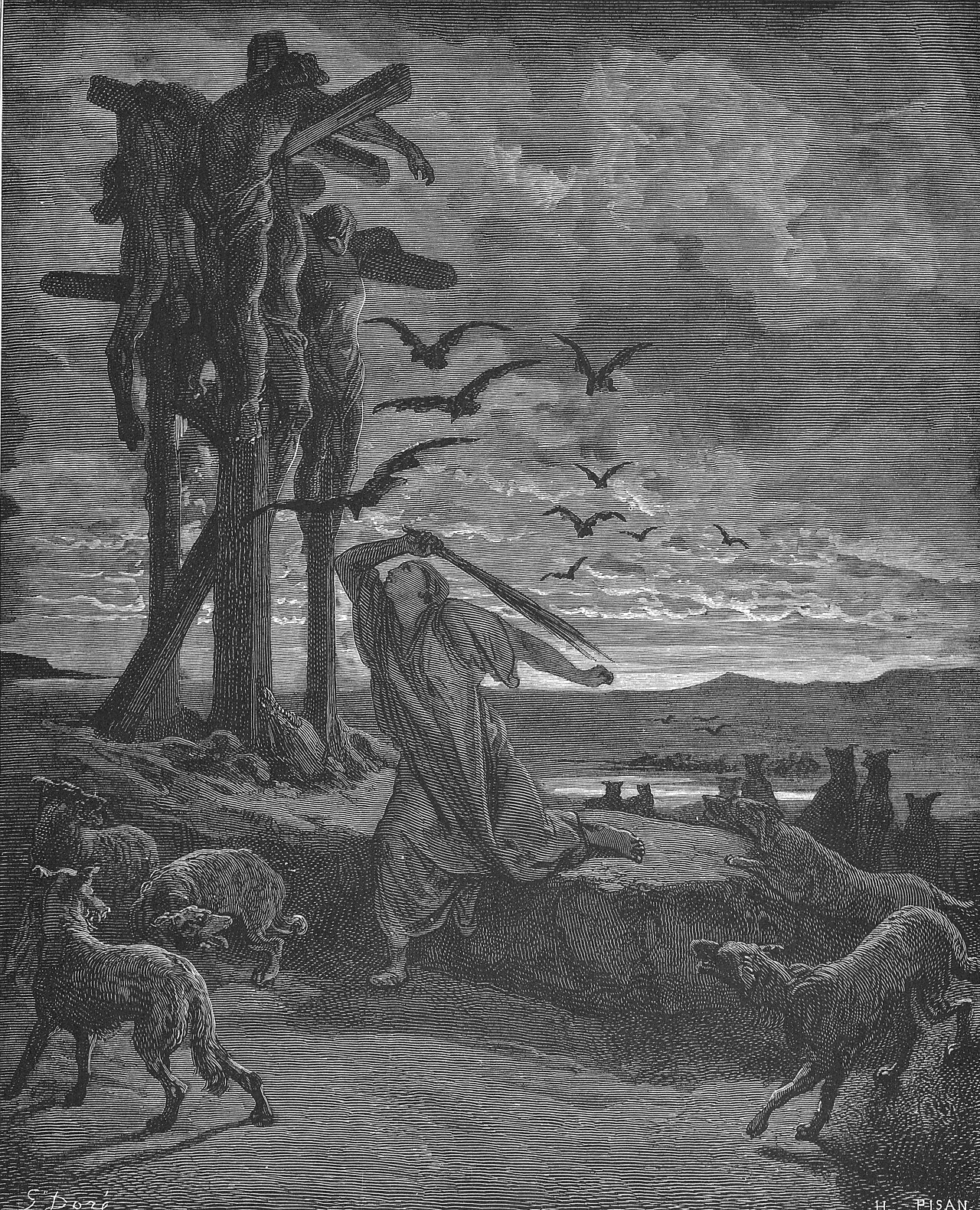
Rizpah’s Kindness toward the Dead, Gustave Doré, Doré's English Bible (1866), public domain
Key verse
And there was still another battle at Gath, where there was a man of great stature with six fingers on each hand and six toes on each foot—twenty-four in all. He too was descended from Rapha,
It stands in scene C of the chapter, verses 15 to 22.
The chapter
Chapter summary
Two appendices of famine and giants. A three-year famine is traced to Saul's slaughter of the Gibeonites, who ask not silver but seven of Saul's sons; David spares Mephibosheth for Jonathan's oath and gives up the rest. Then Rizpah, mother of two of them, spreads sackcloth on the rock and keeps the birds off by day and the beasts by night, from harvest until water dropped out of heaven, a vigil that shames the king into burying the bones of Saul and Jonathan in Zela. Four more battles follow against the sons of the giant, one of them a man with six fingers and six toes on each limb; after David nearly falls, his men swear he shall go out no more, that thou quench not the lamp of Israel.
Context
History · Nathan, Gad · 2 Samuel overview
Where the chapter sits
2 Samuel 21 falls in Consequences: Amnon, Absalom, Sheba, the census (chapters 13–24). Tamar's violation; Amnon murdered; Absalom's rebellion; David's flight; Absalom's death; Sheba's revolt; the census and plague; the threshing floor of Araunah.
Before it: The Fall: Bathsheba and Uriah, chapters 11–12.
The whole shape of 2 Samuel→The world behind itThe date, the place, the people, and the works this site draws the setting from.
The history
The last four chapters of 2 Samuel are an appendix, arranged by theme rather than date. This one opens with a three-year famine and a king asking why, inquiring of God about a national disaster was the normal first step, and the answer points back to an oath sworn in Joshua's day.
The Gibeonites were Canaanites who had tricked Israel into a treaty, and Israel had sworn by the LORD to spare them. Saul broke it. In that world an oath sworn in a god's name bound the whole nation, and the injured party, not the king, named the terms of settlement. They refuse money and ask for seven of Saul's male descendants.
Rizpah's vigil is the heart of the chapter and it is measured in months. The bodies are exposed at the beginning of barley harvest, in April, and she spreads sackcloth on the rock and drives off birds by day and animals by night until the rains come in October. Leaving a body unburied was the deepest disgrace available, and one woman refused to let it stand.
The Philistine notes at the end list four giant warriors of Gath, one with six fingers on each hand. One of them is called Goliath the Gittite, killed by Elhanan, which sits awkwardly beside the famous duel of David's youth. The parallel in Chronicles reads 'Lahmi the brother of Goliath,' and the two common explanations are a copying slip in one line or that Goliath was a title borne by more than one champion of Gath. The text is not hiding the tension.
What it meant to them
For the first hearers this said that a promise made three centuries earlier still had force, even a promise obtained by deception, even one made to Canaanites.
And it ends with a king moved by a grieving woman to gather the bones of the man who hunted him, and bury Saul and Jonathan in their father's tomb. The famine lifted after the debt was paid and the dead were honored.
Sources cited
- Roland de Vaux, Ancient Israel: Its Life and Institutions
- Keil & Delitzsch, Biblical Commentary on the Books of Samuel
A. Three years of famine and the Gibeonites' price
1. (vv. 1-2)
a.Three years of famine drive David to enquire of the Lord rather than assume a cause, continuing the pattern of a king who asks before he acts. The answer reaches back to Joshua 9, where Israel swore an oath to the Gibeonites and was bound to keep it even though the Gibeonites had gained it by deceit. Saul's zeal against them, an act nowhere else told in Scripture, breaks that sworn oath a generation later, and the guilt falls on the whole land for one king's private violence. The parenthesis in verse 2 names the Gibeonites for what they were, not Israelites but the remnant of the Amorites, spared only by a promise Israel could not honestly break.
The wording quoted in this note is the King James Version.
2 Samuel 21:1, 3 voicesWhat preachers and commentators have said about these verses, in their own words.
2 Samuel 21:1-2
“The Gibeonites met the children of Israel, and although other nations were slaughtered, they were kept for hewers of wood and drawers of water. And of such value were they in God's eyes that the family of Saul was destroyed for the wrong done to them. Where would you put them? Among the goats? But they were not slain, and they were avenged by the determination of God. Among the sheep? But holy Scripture says they were not of the same merit as the Israelites.”
Jerome· written before 420· Against Jovinianus 2.33patristic
2 Samuel 21:1
“There is no note of time whatever, nor any clue as to what part of David’s reign the events of this chapter ought to be assigned. Enquired of the Lord - Hebrew “sought the face of the Lord,” quite a different phrase from that so often used in Judges (e. g. Jdg 1:1) and the Books of Samuel, and probably indicating that this chapter is from a different source; an inference agreeing with the indefinite “in the days of David,” and with the allusion to the slaughter of the Gibeonites, which has not anywhere been narrated.”
2 Samuel 21:1
“And indeed that this was done, and Saul's seven sons hanged by David's order before that time, seems to be intimated by that passage, chap. xvi, 8, where he is charged with the blood of the house of Saul: for which there was not the least colour 'till this time.”
John Wesley· Explanatory Notes upon the Old Testament (1765)evangelical
2 Samuel 21:2, 1 voice
2 Samuel 21:2
“The remnant of the Amorites - The Gibeonites were Hivites, not Amorites, as appears from Jos 11:19: but Amorites is a name often given to the Canaanites in general, Gen 15:16; Amo 2:9, and elsewhere.”
Adam Clarke· Commentary on the Bible (1810-1826)evangelical
2. (vv. 3-4)
a.David treats the famine as guilt requiring atonement rather than a misfortune to wait out, and he leaves the terms to the party that was wronged instead of setting them himself. The Gibeonites refuse silver and gold, for money was never the ancient payment for shed blood, and the law of Numbers 35 forbids ransoming a life for a price. What they ask is not vengeance on the nation but on Saul's own house, and they say so plainly, that no man in Israel besides Saul's line need answer for it. The distinction holds the rest of the chapter together, for this is Saul's house answering for Saul, not Israel punished in Saul's place.
2 Samuel 21:3, 2 voices
2 Samuel 21:3
“Wherewith shall I make the atonement - It is very strange that a choice of this kind should be left to such a people. Why not ask this of God himself?”
Adam Clarke· Commentary on the Bible (1810-1826)evangelical
2 Samuel 21:3
“It is sad for any family or nation to have the prayers of oppressed innocency against them, and therefore the expense of a just restitution is well bestowed for the retrieving of the blessing of those that were ready to perish, Job xxix.”
Matthew Henry· Commentary on the Whole Bible (1707-1721)puritan
2 Samuel 21:4, 2 voices
2 Samuel 21:4
“No silver, nor gold ... - Money payments as a compensation for blood-guilt were very common among many nations. The law, too, in Num 35:31-32, presupposes the existence of the custom which it prohibits. In like manner the speech of the Gibeonites implies that such a payment as they refuse would be a not unusual proceeding. Neither ... shalt thou kill any man in Israel - They mean that it is not against the nation of Israel, but against the individual Saul, that they cry for vengeance.”
2 Samuel 21:4
“Note, Money is no satisfaction for blood, see Num. xxxv. It is the ancient law that blood calls for blood ( Gen. ix. 6 ); and those over-value money and under-value life, that sell the blood of their relations for corruptible things, such as silver and gold.”
Matthew Henry· Commentary on the Whole Bible (1707-1721)puritan
3. (vv. 5-7)
a.The Gibeonites name the offense precisely, a plan to remove them from every part of Israel's land, the same complete destruction Israel itself had once been bound by oath not to bring on them. Seven of Saul's line are handed over to be hanged at Gibeah, Saul's own town, before the Lord, and David grants the number without argument. Verse 7 then draws a line the chapter will not cross: Mephibosheth, Jonathan's son, is spared, and the reason is given in full, the Lord's oath that stood between David and Jonathan. One oath sworn to enemies costs seven lives to keep, and one oath sworn to a friend saves a life from the same reckoning, and the text lets both oaths bind the king equally.
2 Samuel 21:6, 1 voice
2 Samuel 21:6
“Let seven men of his sons be delivered unto us, and we will hang them up unto the Lord in Gibeah of Saul--The practice of the Hebrews, as of most Oriental nations, was to slay first, and afterwards to suspend on a gibbet, the body not being left hanging after sunset.”
Jamieson, Fausset & Brown· Commentary Critical and Explanatory on the Whole Bible (1871)reformed
2 Samuel 21:7, 2 voices
2 Samuel 21:7
“The Lord’s oath - The calamity brought upon Israel by Saul’s breach of the oath to the Gibeonites would make David doubly careful in the matter of his own oath to Jonathan.”
2 Samuel 21:7
“Spared - For the Gibeonites desiring only such a number, it was at David's choice whom to spare. Of Jonathan - This is added, to distinguish him from the other Mephibosheth, ver. 8.”
John Wesley· Explanatory Notes upon the Old Testament (1765)evangelical
4. (vv. 8-9)
a.The seven are named by mother, two sons of Rizpah, Saul's concubine, and five sons of Michal, though Clarke points out that Michal was never given to Adriel and that 1 Samuel 18:19 names her sister Merab as his wife, so the text likely means Michal raised sons she did not bear. Handed to the Gibeonites, all seven are hanged in the hill before the Lord and die together at the start of barley harvest, the same season in which Ruth once gleaned this land. The narrator fixes the date with a precision the rest of the chapter does not need, because the season is about to matter again.
The wording quoted in this note is the King James Version.
2 Samuel 21:8, 1 voice
2 Samuel 21:8
“Five sons of Michal - whom she brought up - Michal, Saul’s daughter, was never married to Adriel, but to David, and afterwards to Phaltiel; though it is here said she bore ילדה yaledah, not brought up, as we falsely translate it: but we learn from 1Sa 18:19, that Merab, one of Saul’s daughters, was married to Adriel.”
Adam Clarke· Commentary on the Bible (1810-1826)evangelical
2 Samuel 21:9, 1 voice
2 Samuel 21:9
“In the first days - The barley harvest (about the middle or toward the end of April) was earlier than the wheat harvest Exo 9:31; Rth 1:22.”
B. Rizpah's sackcloth on the rock, from harvest until rain
1. (vv. 10-11)
a.Rizpah pitches sackcloth on the bare rock and keeps a vigil the law did not require of her, driving off carrion birds by day and wild animals by night across the months from barley harvest until the autumn rain finally falls. Wesley reads her vigil as evidence the bodies had to stay exposed rather than be buried at once, until God's judgment against the land was answered. Word of her watch reaches David, and Gill reads the report as moving him to compassion rather than offense, since a grieving mother's faithfulness could not be mistaken for a grudge against the throne. One woman's unbroken watch over the dead becomes the reason a king finally remembers the unburied bones of a whole family.
2 Samuel 21:10, 3 voices
2 Samuel 21:10
“Rizpah - took sackcloth - Who can read the account of Rizpah’s maternal affection for her sons that were now hanged, without feeling his mind deeply impressed with sorrows? Did God require this sacrifice of Saul’s sons, probably all innocent of the alleged crime of their father? Was there no other method of averting the Divine displeasure? Was the requisition of the Gibeonites to have Saul’s sons sacrificed to God, to be considered as an oracle of God? Certainly not; God will not have man’s blood for sacrifice, no more than he will have swine’s blood.”
Adam Clarke· Commentary on the Bible (1810-1826)evangelical
2 Samuel 21:10
“Spread it - As a tent to dwell in: being informed that their bodies were not to be taken away speedily, as the course of the law was in ordinary cases, but were to continue there until God was intreated, and removed the present judgment.”
John Wesley· Explanatory Notes upon the Old Testament (1765)evangelical
2 Samuel 21:10
“He that is thus left hanged is accursed; therefore ordinary malefactors must not be so abused; but therefore these must, because they were sacrificed, not to the justice of the nation, but for the crime of the nation (no less a crime than the violation of the public faith) and for the deliverance of the nation from no less a judgment than a general famine.”
Matthew Henry· Commentary on the Whole Bible (1707-1721)puritan
2 Samuel 21:11, 1 voice
2 Samuel 21:11
“David - Who heard it with so much approbation, that he thought fit to imitate her piety, being by her example provoked to do what hitherto he had neglected, to bestow an honourable interment on the remains of Saul and Jonathan, and, with them, upon those that are now put to death, that the honour done to them herein, might be some comfort to this disconsolate widow.”
John Wesley· Explanatory Notes upon the Old Testament (1765)evangelical
2. (vv. 12-14)
a.David finally does what Rizpah's vigil moved him to do, closing a debt owed since Saul's death: he sends for the bones the men of Jabesh-gilead had stolen from the wall of Beth-shan the night after Gilboa, an act of loyalty told in full at 1 Samuel 31:11-13. The bones of the seven who were hanged are gathered too, and all are buried together in the family tomb of Kish at Zelah, in Benjamin's own territory rather than left where the Gibeonites' justice had put them. Clarke notes David may have sent messengers rather than travel the distance himself, since Gill records the route at some fifty miles. The chapter's last clause closes the famine that opened it in one line, after that God was intreated for the land, the oath kept and the guilt answered.
The wording quoted in this note is the King James Version.
2 Samuel 21:12, 1 voice
2 Samuel 21:12
“And David went and took the bones of Saul, and the bones of Jonathan his son, from the men of Jabeshgilead,.... Which, according to Bunting (t), was fifty two miles from Jerusalem; though perhaps David did not go thither in person to fetch them, but by his messengers, see 2Sa 21:14, which had stolen them from the street of Bethshan, where the Philistines had hanged them, when the Philistines had slain Saul in Gilboa; the history of all which see in 1Sa 31:8. (t) Travels, &c. p. 122, 143.”
2 Samuel 21:13, 1 voice
2 Samuel 21:13
“And he brought up from thence the bones of Saul, and the bones of Jonathan his son,.... Which had been buried there under an oak, 1Ch 10:12, and they gathered the bones of them that were hanged; the seven sons of Saul, who had been lately hanged; who either had hung so long that their flesh was consumed, and the bones dropped upon the ground, from whence they gathered them; or they took them down and burnt the flesh off of them, and took the bones to bury them, which was not usually done (u). (u) Lipsins de Cruce, l.”
2 Samuel 21:14, 1 voice
2 Samuel 21:14
“After that - After those things were done which were before related; that is, after they were hanged up: for by that God was pacified, and not by their burial.”
John Wesley· Explanatory Notes upon the Old Testament (1765)evangelical
C. Four giants of Gath, and the lamp of Israel kept burning
1. (vv. 15-16)
a.War with the Philistines resumes, and this time David himself grows faint in the field, an old soldier's admission the text states without embarrassment. Ishbi-benob, one of the giant's line, moves to kill him while he is weakened, carrying a spear of three hundred shekels of brass and armed with a new sword. The threat lands at the point where David is most exposed, worn from decades of exactly this kind of war, the same war that began at Gath a generation earlier with one shepherd and one stone.
The wording quoted in this note is the King James Version.
2 Samuel 21:15, 2 voices
2 Samuel 21:15
“This, like the preceding paragraph 2Sa 21:1-14, is manifestly a detached and unconnected extract. It is probably taken from some history of David’s wars, apparently the same as furnished the materials for 2 Sam. 5; 8; 23:8-39. There is no direct clue to the time when the events here related took place, but it was probably quite in the early part of David’s reign, while he was still young and active, after the war described in 2 Sam.”
2 Samuel 21:15
“David, though old, desired not a writ of ease from the public service, but he went down in person to fight against the Philistines (Senescit, non segnescit -- He grows old, but not indolent ), a sign that he fought not for his own glory (at this age he was loaded with glory, and needed no more), but for the good of his kingdom.”
Matthew Henry· Commentary on the Whole Bible (1707-1721)puritan
2 Samuel 21:16, 1 voice
2 Samuel 21:16
“Being girded with a new sword - As the word sword is not in the original, we may apply the term new to his armor in general; he had got new arms, a new coat of mail, or something that defended him well, and rendered him very formidable: or it may mean a strong or sharp sword.”
Adam Clarke· Commentary on the Bible (1810-1826)evangelical
2. (v. 17)
a.Abishai kills the Philistine before he can kill David, and David's men respond with an oath of their own: he will fight beside them no more. Clarke reads the light of Israel as the lamp by which the whole nation finds its way, so that David's death in a skirmish would leave the kingdom in a darkness he alone had learned to hold back. The oath marks a hinge in the king's own story, the warrior who once ran toward Goliath is now the man his own soldiers must protect from running at all.
2 Samuel 21:17, 2 voices
2 Samuel 21:17
That thou quench not the light of Israel - David is here considered as the lamp by which all Israel was guided, and without whom all the nation must be involved in darkness. The lamp is the emblem of direction and support. Light is used in this sense by Homer: - Ουδε τι Πατροκλῳ γενομην φαος, αυδ’ ἑταροισι Τοις αλλοις, οἱ δη πολεες δαμεν Ἑκτορι διῳ. Iliad, lib. xviii. ver. 102. “I have neither been a Light to Patroclus nor to his companions, who have been slain by the noble Hector.”
Adam Clarke· Commentary on the Bible (1810-1826)evangelical
2 Samuel 21:17
“They had easily persuaded him not to fight against Absalom ( ch. xviii. 3 ), but against the Philistines he would go, till, having had this narrow escape, it was resolved in council, and confirmed with an oath, that the light of Israel (its guide and glory, so David was) should never be put again into such hazard of being blown out.”
Matthew Henry· Commentary on the Whole Bible (1707-1721)puritan
3. (vv. 18-19)
a.Two more giants fall at Gob, one to Sibbechai and one to Elhanan, and the second name carries the chapter's hardest textual question. The King James reads that Elhanan slew the brother of Goliath, with the words the brother of supplied by the translators to close a gap the Hebrew does not fully explain, while 1 Chronicles 20:5 names the man Elhanan killed as Lahmi, Goliath's brother, plainly. Keil and Delitzsch and most of the bench read the Chronicles text as preserving what Samuel's own text lost in copying, while others hold that Goliath was a title borne by more than one champion of Gath. Barnes states the difficulty as plainly as any of them, that the Hebrew text at this point is corrupt, and the chapter itself settles nothing beyond naming both men dead.
The wording quoted in this note is the King James Version.
2 Samuel 21:18, 1 voice
2 Samuel 21:18
“A battle - at Gob - Instead of Gob, several editions, and about forty of Kennicott’s and De Rossi’s MSS., have Nob; but Gezer is the name in the parallel place, 1Ch 20:4.”
Adam Clarke· Commentary on the Bible (1810-1826)evangelical
2 Samuel 21:19, 1 voice
2 Samuel 21:19
“The Hebrew text is manifestly very corrupt. First, for “Jaare-oregim,” 1Ch 20:5 gives us the reading Jair. “Oregim” has evidently got in by a transcriber’s error from the line below, where “oregim” is the Hebrew for “weavers.” Again, the word the “Bethlehemite” is very doubtful.”
4. (vv. 20-21)
a.A third giant appears at Gath itself, a man of great stature with six fingers on each hand and six toes on each foot, twenty-four in all, and the text says plainly he also was born to the giant, the same phrase used of the others in this section. Jonathan, son of David's brother Shimea, kills him when he defies Israel, the same verb Goliath used at 1 Samuel 17:10 and the same word David answered there. Clarke notes the trait recurs elsewhere in later history and is not unique to this family, but the text's own interest is not the anatomy. It is that four such men stood against Israel in one generation, all out of Gath, the town Joshua had left unconquered at Joshua 11:22.
The wording quoted in this note is the King James Version.
2 Samuel 21:20, 1 voice
2 Samuel 21:20
“On every hand six fingers - This is not a solitary instance: Tavernier informs us that the eldest son of the emperor of Java, who reigned in 1648, had six fingers on each hand, and six toes on each foot. And Maupertuis, in his seventeenth letter, says that he met with two families near Berlin, where sedigitism was equally transmitted on both sides of father and mother.”
Adam Clarke· Commentary on the Bible (1810-1826)evangelical
2 Samuel 21:21, 1 voice
2 Samuel 21:21
“And when he defied Israel,.... The armies of Israel, as Goliath had done some years ago, 1Sa 17:10, Jonathan the son of Shimea the brother of David slew him; this brother of David is called Shammah, 1Sa 16:9; and Shimma, 1Ch 2:13; this son of his is another man from Jonadab his son, who was famous for his subtlety as this was for his valour, 2Sa 13:3. The Jews say (d) this was Nathan the prophet, a son of Shammah. (d) Hieron. Trad. Heb. fol. 76. D.”
5. (v. 22)
a.The chapter closes a count that opened at Gath a generation before: four men born to the giant, and all four now fallen, one by David's own hand at the valley of Elah and three by the hands of his servants here. Henry reads the pairing as deliberate, David began his conquest with one giant and this record closes it with four, the hardest enemies kept for the last conflict. The line of Anakim left in Gath at Joshua 11:22 runs through Goliath to these four and ends in this verse, the last giants named in the historical books.
The wording quoted in this note is the King James Version.
2 Samuel 21:22, 2 voices
2 Samuel 21:22
“These four were born to the giant in Gath,.... Not to Goliath, for one of them was his brother, but to some giant or another of that place, for which it was famous; they were all of them of the race of the giants; and so the Septuagint version, they were"the offspring of the giants in Gath, whose family was Repha;''and this Repha, or Arepha, as the Vulgate Latin version, according to Abarbinel, was a woman of the daughters of the giants; the Talmudists (e) make her to be the same with Orpah, Rth 1:”
2 Samuel 21:22
“Four - Not necessarily meaning that they were brothers, but that they were all of the race of the Giant, all Rephaim. The word “four” is omitted in the parallel passage, only the three last being mentioned in that chapter.”
Threads running through this chapter
- The giants left in GathPattern, vv. 20 to 22
The text of this chapter
This page carries no textual note on 2 Samuel 21. Where this site has examined a place the manuscripts differ, the examination is in the manuscripts room. Every place this site examines →
This page draws on 11 works. Open for the list.
This page draws on Adam Clarke; Albert Barnes; Chuck Missler, Learn the Bible in 24 Hours; Jamieson Fausset and Brown, Commentary Critical and Explanatory on the Whole Bible; Jamieson, Fausset & Brown, Commentary Critical and Explanatory on the Whole Bible (1871); Jerome, Against Jovinianus 2.33; John Gill; John Wesley; Keil and Delitzsch, Biblical Commentary on the Books of Samuel; Matthew Henry and Michael Heiser, The Unseen Realm.
Keep studying
On this page
Studies5
On this chapter
On this book