
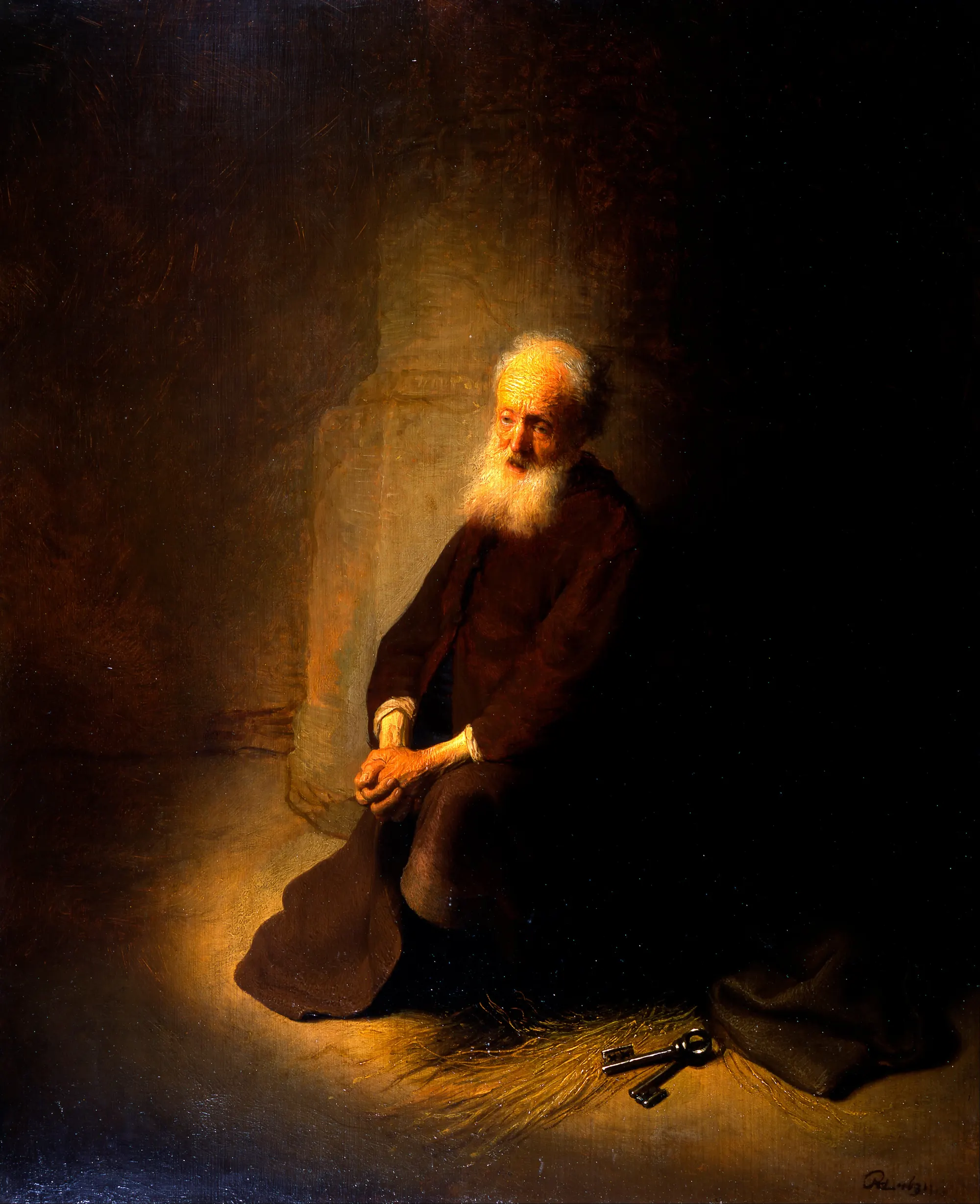
1 Peterchapter 3
22 verses · Peter · AD 62 to 64 · The general letters
who disobeyed long ago when God waited patiently in the days of Noah while the ark was being built. In the ark a few people, only eight souls, were saved through water.
Introduction
Peter, The general letters, 1 Peter Overview.
Peter wrote this chapter for households where faith divided a family, and for churches that were being questioned and mocked by their neighbours. A wife who had turned to Christ in a pagan home had no easy standing, and the chapter speaks to her first. It then speaks to husbands and to the whole church. Listen for how often the chapter speaks of conduct that others watch. Listen also for Noah and the flood near the end, in a passage the church has read in more than one way. Read it as counsel for people asked to explain their hope.
Context
- Who
- Wives whose husbands had not converted, and a church asking about the spirits in prison
- What
- Instructions to wives and husbands, a call to the whole church to repay insult with blessing, and teaching on Christ's suffering, rising and reign.
- Where
- Written from Babylon, most likely Rome, to churches in the provinces of Asia Minor.
- When
- About AD 62 to 64, before Nero's persecution of the church.
- Why
- To show believers how to live and answer questions under suspicion, and to assure them that Christ's victory covers their suffering.
Historical context
A wife was expected to worship her husband's gods. Roman writers said so plainly, and a woman who took up a foreign religion on her own was seen as insubordinate and possibly dangerous to the household. That is the exact situation behind the instruction about winning a husband without a word.
Show the rest of the historical context, 3 more paragraphs
The comment on hair, gold, and clothing addresses a live status contest among women of the period, and Peter's alternative, a gentle and quiet spirit, precious in God's sight, reverses the whole scale of value used in her street.
Verses 19-20 speak of Christ proclaiming to spirits in prison who disobeyed in the days of Noah. The house reading takes these as the angelic beings of Genesis 6, the Watchers, whose imprisonment is described in the book of 1 Enoch, a book MannaFest treats as a labeled study resource rather than Scripture, and whose story 2 Peter and Jude both echo. On that reading Christ's proclamation is a declaration of victory over rebels already held, not an offer of salvation.
The main alternatives are named honestly: that Christ preached through Noah to the people of that generation, who are now spirits in prison; or that he preached to the human dead of the flood. The Watchers reading is preferred here because the chapter ties the spirits to Noah's day, and because 2 Peter 2 and Jude 6 place angels and the flood side by side in the same order.
Significance
The first hearers included wives risking their marriages and everyone risking their neighbors. The instruction to always be ready to give an answer, with gentleness and respect, assumes they were being asked, and were afraid.
Show the rest of the significance, 1 more paragraph
The flood section lands as encouragement, not puzzle. Eight people were the whole faithful remnant in their world, and they came through the water; a scattered handful of believers in a hostile province is told the same thing.
The heads below are this chapter's scenes. The numbered points under each are its verses.
Wives, Husbands, and the Hidden Adorning of the Heart
1 Peter 3:1-2
submit yourselves to your husbands: Believing wives of unbelieving husbands are told that husbands who refuse to believe the word may be won over without words. The verb, kerdaino, means gained, and the means is conduct, your pure and reverent demeanor.
1 Peter 3:1
“Likewise, ye wives, be in subjection to your own husbands,.... As well as subjects to princes, and servants to masters; though not with the same sort of subjection, but what is suitable to the relation they stand in to their husbands; See Gill on Eph 5:22. See Gill on Col 3:18. that if any obey not the word; any husband who is an unbeliever, has no love for the Gospel, and gives no credit to it, but despises, disbelieves, and rejects it, the word of truth, of faith, of righteousness, reconciliation, and salvation.”
4 more voices on this verseWhat preachers and commentators have said about this verse, in their own words.
1 Peter 3:1
“Likewise, ye wives, be in subjection to your own husbands - On the duty here enjoined, see the 1Co 11:3-9 notes, and Eph 5:22 note. That, if any obey not the word - The word of God; the gospel. That is, if any wives have husbands who are not true Christians. This would be likely to occur when the gospel was first preached, as it does now, by the fact that wives might be converted, though their husbands were not. It cannot be inferred from this, that after they themselves had become Christians they had married unbelieving husbands.”
1 Peter 3:1
“If these things may happen to those women also who, having attained the faith while in (the state of) Gentile matrimony, continue in that state, still they are excused, as having been "apprehended by God" in these very circumstances; and they are bidden to persevere in their married state, and are sanctified, and have hope of "making a gain" held out to them.”
Tertullian · written before 220 · To His Wife Book IIpatristic
1 Peter 3:1
“The apostle having treated of the duties of subjects to their sovereigns, and of servants to their masters, proceeds to explain the duty of husbands and wives. Lest the Christian matrons should imagine that their conversion to Christ, and their interest in all Christian privileges, exempted them from subjection to their pagan or Jewish husbands, the apostle here tells them, 1.”
Matthew Henry · Commentary on the Whole Bible (1707-1721)puritan
1 Peter 3:1
"Unspoken acting is more powerful than unperformed speaking" [Å’CUMENIUS]. "A soul converted is gained to itself, to the pastor, wife, or husband, who sought it, and to Jesus Christ; added to His treasury who thought not His own precious blood too dear to lay out for this gain" [LEIGHTON].
Jamieson, Fausset & Brown · Commentary Critical and Explanatory on the Whole Bible (1871)reformed
pure and reverent demeanor: Adam Clarke takes the reverence as the fear of God or as respect owed to a husband. Albert Barnes reads pure as covering all conduct, with chastity only one part. Hilary of Arles says husbands are won by sight.
1 Peter 3:2
“Actions speak louder than words, and the husbands will be persuaded by what they see, not by what they hear from their wives.”
Hilary of Arles · written before 449 · Introductory Commentary on 1 Peterpatristic
2 more voices on this verse
1 Peter 3:2
“Chaste conversation - with fear - While they see that ye join modesty, chastity, and the purest manners, to the fear of God. Or perhaps fear, φοβος, is taken, as in Eph 5:33, for the reverence due to the husband.”
Adam Clarke · Commentary on the Bible (1810-1826)evangelical
1 Peter 3:2
“While they behold your chaste conversation,.... Cheerful subjection, strong affection, and inviolable attachment to them, and strict regard to the honour of the marriage state, and to the preserving of the bed undefiled with lusts and adulteries: coupled with fear; with reverence of their husbands, giving them due honour, and showing all proper respect; or with the fear of God, which being before their eyes, and upon their hearts, engages them to such an agreeable conversation.”
1 Peter 3:3-4
should not come from outward adornment: Beauty is placed in the inner disposition of your heart, set against braided hair or gold jewelry or fine clothes, as in 1 Timothy 2:9. The ornament named precious in God’s sight is a gentle and quiet spirit.
1 Peter 3:3
“For what is a crown on the head of a woman, but beauty made seductive, but mark of utter wantonness,-a notable casting away of modesty, a setting temptation on fire? Therefore a woman, taking counsel from the apostles' foresight, will not too elaborately adorn herself, that she may not either be crowned with any exquisite arrangement of her hair.”
Tertullian · written before 220 · De Coronapatristic
2 more voices on this verse
1 Peter 3:3
“Three things are here expressly forbidden: curling the hair, wearing gold, (by way of ornament,) and putting on costly or gay apparel. These, therefore, ought never to be allowed, much less defended, by Christians.”
John Wesley · Explanatory Notes upon the New Testament (1755)evangelical
1 Peter 3:3
“Whose adorning - Whose ornament. The apostle refers here to a propensity which exists in the heart of woman to seek that which would be esteemed ornamental, or that which will appear well in the sight of others, and commend us to them. The desire of this is laid deep in human nature and therefore, when properly regulated is not wrong. The only question is, what is the true and appropriate ornament? What should be primarily sought as the right kind of adorning?”
a gentle and quiet spirit: The adornment Peter commends is inner, the disposition of the heart. Matthew Henry notes that clothing wears out while the grace of God grows brighter the longer it is worn. A gentle and quiet spirit is precious to God.
1 Peter 3:4
“Under costly attire there may be a humble mind. "Great is he who uses his earthenware as if it were plate; not less great is he who uses his silver as if it were earthenware" [SENECA in ALFORD]. hidden--inner man, which the Christian instinctively hides from public view. of the heart--consisting in the heart regenerated and adorned by the Spirit.”
Jamieson, Fausset & Brown · Commentary Critical and Explanatory on the Whole Bible (1871)reformed
4 more voices on this verse
1 Peter 3:4
“Secondly, The ornament prescribed. It must, in general, be something not corruptible, that beautifies the soul, that is, the graces and virtues of God's Holy Spirit. The ornaments of the body are destroyed by the moth, and perish in the using; but the grace of God, the longer we wear it, the brighter and better it is.”
Matthew Henry · Commentary on the Whole Bible (1707-1721)puritan
1 Peter 3:4
“But afterwards, in reading the epistle of the Apostle Peter, I perceived that every wise man is also rich: and this he says without distinction of sex, for he writes that all a woman's ornaments consist in a virtuous life, not in costly jewels, Whose adorning, he says, is not that outward adorning of plaiting the hair, and, of wearing of gold, or of putting on of apparel, but the hidden man of the heart.”
Ambrose of Milan · written before 397 · Letter 38patristic
1 Peter 3:4
“The hidden man of the heart - Ὁ κρυπτος της καρδιας ανθρωπος. This phrase is of the same import with that of St. Paul, Rom 7:22, ὁ εσω ανθρωπος, the inner man; that is, the soul, with the whole system of affections and passions. Every part of the Scripture treats man as a compound being: the body is the outward or visible man; the soul, the inward, hidden, or invisible man. The term ανθρωπος, man, is derived, according to the best etymologists, from ανα τρεπων ωπα, turning the face upward. This derivation of the word is beautifully paraphrased by Ovid.”
Adam Clarke · Commentary on the Bible (1810-1826)evangelical
1 Peter 3:4
"I do not regard these things," is often said by those whose hearts are wrapped up in them: but offer to take them away, and you touch the very idol of their soul. Some, indeed only dress elegantly that they may be looked on; that is, they squander away their Lord's talent to gain applause: thus making sin to beget sin, and then plead one in excuse of the other.
John Wesley · Explanatory Notes upon the New Testament (1755)evangelical
1 Peter 3:5-6
the holy women of the past: are the pattern, and Sarah called him lord in Genesis 18:12. Believing women become her children if you do what is right and refuse to give way to fear, so the submission commended is fearless.
1 Peter 3:5
“For after this manner, in the old time - The allusion here is particularly to the times of the patriarchs, and the object of the apostle is to state another reason why they should seek that kind of ornament which he had been commending. The reason is, that this characterized the pious and honored females of ancient times - those females who had been most commended of God, and who were most worthy to be remembered on earth. Who trusted in God - Greek, “Who hoped in God;” that is, who were truly pious.”
called him lord: Peter points to Genesis 18:12, where Sarah speaks of Abraham as her lord. Jamieson, Fausset and Brown note that Gentile wives become Sarah's children by faith, as Abraham is father of all who believe. Doing right without panic marks her daughters.
1 Peter 3:6
“Even as Sara obeyed - Almost the same words are in Rab. Tanchum, fol. 9, 3: “The wife of Abraham reverenced him, and called him lord, as it is written, Gen 18:12: And my lord is old.” The words of the apostle imply that she acknowledged his superiority, and her own subjection to him, in the order of God. Whose daughters ye are - As Abraham is represented the father of all his male believing descendants, so Sara is represented as the mother of all her believing female posterity.”
Adam Clarke · Commentary on the Bible (1810-1826)evangelical
3 more voices on this verse
1 Peter 3:6
“Whose children ye are - In a spiritual as well as natural sense, and entitled to the same inheritance, while ye discharge your conjugal duties, not out of fear, but for conscience' sake.”
John Wesley · Explanatory Notes upon the New Testament (1755)evangelical
1 Peter 3:6
Let the husbands love their wives, remembering that, at the creation, one woman, and not many, was given to one man. Let the wives honour their husbands, as their own flesh; and let them not presume to address them by their names. Let them also be chaste, reckoning their husbands as their only partners, to whom indeed they have been united according to the will of God. Ye parents, impart a holy training to your children. Ye children, "honour your parents, that it may be well with you."
Ignatius of Antioch · written before 108 · Epistle of Pseudo-Ignatius to the Antiochianspatristic
1 Peter 3:6
“Sara--an example of faith. calling him lord-- (Ge 18:12). ye are--Greek, "ye have become": "children" of Abraham and Sara by faith, whereas ye were Gentile aliens from the covenant. afraid with any amazement--Greek, "fluttering alarm," "consternation." Act well, and be not thrown into sudden panic, as weak females are apt to be, by any opposition from without.”
Jamieson, Fausset & Brown · Commentary Critical and Explanatory on the Whole Bible (1871)reformed
treat your wives with consideration: Husbands owe consideration to a delicate vessel and honor as fellow heirs of the gracious gift of life, the inheritance held jointly. A husband's treatment of his wife reaches his prayers, so that your prayers will not be hindered.
1 Peter 3:7
“He does not take into account the case of an unbelieving wife, as she might yet believe. grace of life--God's gracious gift of life (1Pe 1:4, 13). that your prayers be not hindered--by dissensions, which prevent united prayer, on which depends the blessing.”
Jamieson, Fausset & Brown · Commentary Critical and Explanatory on the Whole Bible (1871)reformed
2 more voices on this verse
1 Peter 3:7
“That your prayers be not hindered - On the one part or the other. All sin hinders prayer; particularly anger. Anything at which we are angry is never more apt to come into our mind than when we are at prayer; and those who do not forgive will find no forgiveness from God.”
John Wesley · Explanatory Notes upon the New Testament (1755)evangelical
1 Peter 3:7
“Likewise, ye husbands - On the general duty of husbands, see the notes at Eph 5:25 ff. Dwell with them - That is, “Let your manner of living with them be that which is immediately specified.” According to knowledge - In accordance with an intelligent view of the nature of the relation; or, as becomes those who have been instructed in the duties of this relation according to the gospel.”
Ready Always to Give an Answer for Your Hope
1 Peter 3:8-12
Finally, all of you, be like-minded: The household addresses close on the whole church, which repays insult with blessing and so will inherit a blessing. Psalm 34:12 to 16, the psalm echoed at 2:3, grounds it: the eyes of the Lord are on the righteous.
1 Peter 3:8
“For as it is enjoined on them, "to be subject to their masters with all fear, not only to the good and gentle, but also to the froward," as Peter says; so fairness, and forbearance, and kindness, are what well becomes the masters. For he says: "Finally, be ye all of one mind, having compassion one of another; love as brethren, be pitiful, be humble," and so forth, "that ye may inherit a blessing," excellent and desirable.”
Clement of Alexandria · written before 215 · The Instructor Book 3patristic
1 more voice on this verse
1 Peter 3:8
“Be ye all of one mind - Unity, both in the family and in the Church, being essentially necessary to peace and salvation. See on Rom 12:16 (note); Rom 15:5 (note). Having compassion - Συμπαθεις· Being sympathetic; feeling for each other; bearing each other’s burdens. Love as brethren - Φιλαδελφοι· Be lovers of the brethren. Pitiful - Ευσπλαγχνοι· Tender-hearted; let your bowels yearn over the distressed and afflicted. Courteous - Φιλοφρονες· Be friendly-minded; acquire and cultivate a friendly disposition.”
Adam Clarke · Commentary on the Bible (1810-1826)evangelical
insult with insult: Jamieson, Fausset and Brown distinguish evil done in deed from insult given in word. The call to inherit a blessing works both ways: believers receive blessing from God and pass it on to those who revile them. John Wesley adds that by blessing them they imitate God.
1 Peter 3:9
“Not rendering evil for evil - See the Mat 5:39, Mat 5:44 notes; Rom 12:17 note. Or railing for railing - See the notes at 1Ti 6:4. Compare Mar 15:29; Luk 23:39. But contrariwise blessing - In a spirit contrary to this. See the notes at Mat 5:44. Knowing that ye are thereunto called, that ye should inherit a blessing - “Knowing that you were called to be Christians in order that you should obtain a blessing infinite and eternal in the heavens. Expecting such a blessing yourselves, you should be ready to scatter blessings on all others.”
1 more voice on this verse
1 Peter 3:9
“Be courteous - To all men. Courtesy is such a behaviour toward equals and inferiors as shows respect mixed with love. Ye are called to inherit a blessing - Therefore their railing cannot hurt you; and, by blessing them, you imitate God, who blesses you.”
John Wesley · Explanatory Notes upon the New Testament (1755)evangelical
keep his tongue from evil: Peter quotes Psalm 34:12 to 16, as Adam Clarke notes. The first thing the psalm asks of one who would love life and see good days is a guarded tongue. Speech free of evil and deceit comes first.
1 Peter 3:10
“For he that will love life - This is a quotation from Psa 34:12-16, as it stands in the Septuagint; only the aorist of the imperative is changed from the second into the third person, etc. He who wishes to live long and prosperously, must act as he is here directed. 1. He must refrain from evil-speaking, lying, and slandering. 2. He must avoid flattery and fair speeches, which cover hypocritical or wicked intentions. 3. He must avoid evil, keep going away εκκλινατω, from evil. 4. He must do good; he must walk in the way of righteousness.”
Adam Clarke · Commentary on the Bible (1810-1826)evangelical
1 more voice on this verse
1 Peter 3:10
“James also said: "If anyone is never at fault in what he says, he is a perfect man, able to keep his whole body in check." It is a great thing to be able to control the tongue, for failure to do so is the greatest of evils.”
Cyril of Alexandria · written before 444 · CATENApatristic
Cross references
1 Peter 3:10
- QuotingPsalms 34:12“Who is the man who delights in life, who desires to see good days?”
'He that will love life... let him refrain his tongue from evil'
seek peace and pursue it: Turning from evil comes first, then doing good. Jamieson, Fausset and Brown note that pursue pictures peace as a thing that flees and must be followed hard. Basil of Caesarea says that one who seeks peace seeks Christ, the peace of His people.
1 Peter 3:11
“Exhortations and encouragements to godliness are of fundamental importance. It is essential to turn away from the tendency toward evil and from the evil path of acquiescence in wickedness, so as to reach out to what is good. We must first distance ourselves completely from everything evil if we want to enjoy genuine health, free from all disease. The person who seeks peace seeks Christ, for he is our peace, who made us both—Jew and Gentile—one new man, bringing peace by the blood of his cross.”
Basil of Caesarea · written before 379 · CATENApatristic
1 more voice on this verse
1 Peter 3:11
“In oldest manuscripts, Greek, "Moreover (besides his words, in acts), let him." eschew--"turn from." ensue--pursue as a thing hard to attain, and that flees from one in this troublesome world.”
Jamieson, Fausset & Brown · Commentary Critical and Explanatory on the Whole Bible (1871)reformed
the eyes of the Lord are on the righteous: The psalm ends on two ways God looks. Matthew Henry notes that the wronged can bring their complaint to a Father whose ears are always attentive. Jamieson, Fausset and Brown add that the Lord watches evildoers closely so they cannot do lasting harm to His people.
1 Peter 3:12
"For the eyes of the Lord," he says, "are upon the righteous, and His ears on their prayers:" he means the manifold inspection of the Holy Spirit. "The face of the Lord is on them that do evil;" that is, whether judgment, or vengeance, or manifestation.
Clement of Alexandria · written before 215 · From the Latin Translation of Cassiodoruspatristic
2 more voices on this verse
1 Peter 3:12
“The Lord's eyes are ever over them for good. ears . . . unto their prayers-- (1Jo 5:14, 15). face . . . against--The eyes imply favorable regard; the face of the Lord upon (not as English Version, "against") them that do evil, implies that He narrowly observes them, so as not to let them really and lastingly hurt His people (compare 1Pe 3:13).”
Jamieson, Fausset & Brown · Commentary Critical and Explanatory on the Whole Bible (1871)reformed
1 Peter 3:12
“His ears are open to their prayers; so that if any injuries be offered to them they have this remedy, they may complain of it to their heavenly Father, whose ears are always attentive to the prayers of his servants in their distresses, and who will certainly aid them against their unrighteous enemies.”
Matthew Henry · Commentary on the Whole Bible (1707-1721)puritan
1 Peter 3:13-14
Who can harm you: Doing good disarms most harm, and the exception is blessed: even if you should suffer for what is right, the beatitude of Matthew 5:10. Do not fear what they fear quotes Isaiah 8:12, and verse 15 takes its answer from Isaiah's next line.
1 Peter 3:13
“We have as a limit the cross of the Lord, by which we are fenced and hedged about from our former sins. Therefore, being regenerated, let us fix ourselves to it in truth, and return to sobriety, and sanctify ourselves; "for the eyes of the Lord are on the righteous, and His ears are open to their prayer; but the face of the Lord is against them that do evil." And who is he that will harm us, if we be followers of that which is good?”
Clement of Alexandria · written before 215 · The Instructor Book 3patristic
1 more voice on this verse
1 Peter 3:13
“And who is he that will harm you, if ye be followers of that which is good? - This question is meant to imply, that as a general thing they need apprehend no evil if they lead an upright and benevolent life. The idea is, that God would in general protect them, though the next verse shows that the apostle did not mean to teach that there would be absolute security, for it is implied there that they might be called to suffer for righteousness” sake.”
you are blessed: Those who suffer for what is right are blessed. Adam Clarke hears Matthew 5:10 in the words. John Wesley reads the next line, from Isaiah 8:12, as a call to fear God and be shaken by nothing else.
1 Peter 3:14
“But and if ye suffer - God may permit you to be tried and persecuted for righteousness’ sake, but this cannot essentially harm you; he will press even this into your service, and make it work for your good. Happy are ye - This seems to refer to Mat 5:10, etc. Blessed or happy, are ye when men persecute you, etc. It is a happiness to suffer for Christ; and it is a happiness, because if a man were not holy and righteous the world would not persecute him, so he is happy in the very cause of his sufferings.”
Adam Clarke · Commentary on the Bible (1810-1826)evangelical
3 more voices on this verse
1 Peter 3:14
“But if ye should suffer - This is no harm to you, but a good. Fear ye not their fear - The very words of the Septuagint, Isaiah viii, 12, 13. Let not that fear be in you which the wicked feel.”
John Wesley · Explanatory Notes upon the New Testament (1755)evangelical
1 Peter 3:14
“Secondly, To suffer for righteousness sake is the honour and happiness of a Christian; to suffer for the cause of truth, a good conscience, or any part of a Christian's duty, is a great honour; the delight of it is greater than the torment, the honour more than the disgrace, and the gain much greater than the loss.”
Matthew Henry · Commentary on the Whole Bible (1707-1721)puritan
1 Peter 3:14
“But and if--"But if even." "The promises of this life extend only so far as it is expedient for us that they should be fulfilled" [CALVIN]. So he proceeds to state the exceptions to the promise (1Pe 3:10), and how the truly wise will behave in such exceptional cases.”
Jamieson, Fausset & Brown · Commentary Critical and Explanatory on the Whole Bible (1871)reformed
Cross references
1 Peter 3:14
- QuotingIsaiah 8:12“Do not call conspiracy everything these people regard as conspiracy. Do not fear what they fear; do not live in dread.
'Be not afraid of their terror, neither be troubled'
1 Peter 3:15-17
sanctify Christ as Lord: Isaiah 8:13 tells Israel to hold the LORD of hosts holy, and Peter writes sanctify Christ as Lord, applying Isaiah's LORD to Jesus. Every believer is to give a defense, apologia, for the hope that is in you, and to give it with gentleness and respect.
1 Peter 3:15
“But sanctify the Lord God in your hearts - In Isaiah Isa 8:13 this is, “sanctify the Lord of hosts himself;” that is, in that connection, regard him as your Protector, and be afraid of him, and not of what man can do. The sense in the passage before us is, “In your hearts, or in the affections of the soul, regard the Lord God as holy, and act toward him with that confidence which a proper respect for one so great and so holy demands.”
4 more voices on this verse
1 Peter 3:15
“But sanctify the Lord God in your hearts - Have an holy fear, and a full trust in his wise providence. The hope - Of eternal life. With meekness - For anger would hurt your cause as well as your soul.”
John Wesley · Explanatory Notes upon the New Testament (1755)evangelical
1 Peter 3:15
“The one who decides to do this is not doing anything new, nor is he making up some new explanation. Rather he is making clear to those who ask him what his faith in Christ is all about.”
Cyril of Alexandria · written before 444 · LETTERS 40.8patristic
1 Peter 3:15
“There may be a good reason given for religion; it is not a fancy but a rational scheme revealed from heaven, suited to all the necessities of miserable sinners, and centering entirely in the glory of God through Jesus Christ. Thirdly, Every Christian is bound to answer and apologize for the hope that is in him.”
Matthew Henry · Commentary on the Whole Bible (1707-1721)puritan
1 Peter 3:15
“This refutes Rome's dogma, "I believe it, because the Church believes it." Credulity is believing without evidence; faith is believing on evidence. There is no repose for reason itself but in faith.”
Jamieson, Fausset & Brown · Commentary Critical and Explanatory on the Whole Bible (1871)reformed
keeping a clear conscience: John Wesley warns that a believer who knows he is in the right can be drawn into anger; a clear conscience needs gentleness and respect. Good behavior in Christ answers the slander. Those who slander are put to shame.
1 Peter 3:16
“Having a good conscience - So much the more beware of anger, to which the very consciousness of your innocence may betray you. Join with a good conscience meekness and fear, and you obtain a complete victory. Your good conversation in Christ - That is, which flows from faith in him.”
John Wesley · Explanatory Notes upon the New Testament (1755)evangelical
3 more voices on this verse
1 Peter 3:16
“Do not get angry or threaten anyone. Your conscience is the part of you which embraces what is good and which rejects evil. It is like the doorkeeper of a house which is open to friends and closed to enemies.”
Hilary of Arles · written before 449 · Introductory Commentary on 1 Peterpatristic
1 Peter 3:16
“Having a good conscience - The testimony of God in your own soul, that in simplicity and godly sincerity you have your conversation in the world. See on the term conscience at the end of Hebrews. Whereas they speak evil of you - See the same sentiment in 1Pe 2:11 and the note there.”
Adam Clarke · Commentary on the Bible (1810-1826)evangelical
1 Peter 3:16
“It is translated, "despitefully use," Mt 5:44; Lu 6:28. conversation--life, conduct. in Christ--who is the very element of your life as Christians. "In Christ" defines "good." It is your good walk as Christians, not as citizens, that calls forth malice (1Pe 4:4, 5, 14).”
Jamieson, Fausset & Brown · Commentary Critical and Explanatory on the Whole Bible (1871)reformed
to suffer for doing good than for doing evil: Theophylact reads the verse as the reason for the blessing promised in verse 14. Albert Barnes notes God may see suffering as needed for the good of His people, since some fruit in the soul grows no other way. Verse 18 then turns to Christ, who suffered for good.
1 Peter 3:17
“For it is better, if the will of God be so - That is, if God sees it to be necessary for your good that you should suffer, it is better that you should suffer for doing well than for crime. God often sees it to be necessary that his people should suffer. There are effects to be accomplished by affliction which can be secured in no other way; and some of the happiest results on the soul of a Christian, some of the brightest traits of character, are the effect of trials.”
Alive in the Spirit: The Spirits in Prison
suffered for sins once for all: The letter's counsel on suffering rests here: Christ suffered for sins once for all, the righteous for the unrighteous, to bring you to God. He was put to death in the body but made alive in the Spirit, and the next verses hang on that clause.
1 Peter 3:18
“Christ also hath once suffered - See the notes on Rom 5:6; Heb 9:28 (note). Put to death in the flesh - In his human nature. But quickened by the Spirit - That very dead body revived by the power of his Divinity. There are various opinions on the meaning of this verse, with which I need not trouble the reader, as I have produced that which is most likely.”
Adam Clarke · Commentary on the Bible (1810-1826)evangelical
2 more voices on this verse
1 Peter 3:18
“Now Christ suffered once - To suffer no more. For sins - Not his own, but ours. The just for the unjust - The word signifies, not only them who have wronged their neighbours, but those who have transgressed any of the commands of God; as the preceding word, just, denotes a person who has fulfilled, not barely social duties, but all kind of righteousness.”
John Wesley · Explanatory Notes upon the New Testament (1755)evangelical
1 Peter 3:18
"To God," is Greek dative (not the preposition and case), implying that God wishes it [BENGEL]. put to death--the means of His bringing us to God. in the flesh--that is, in respect to the life of flesh and blood. quickened by the Spirit--The oldest manuscripts omit the Greek article.
Jamieson, Fausset & Brown · Commentary Critical and Explanatory on the Whole Bible (1871)reformed
1 Peter 3:19-20
went and preached to the spirits: Christ went and preached to the spirits in prison who disobeyed long ago in Noah's day. They are read as the angels of Genesis 6, with 2 Peter 2:4 and Jude 6, or Noah's hearers, or the dead in Hades.
1 Peter 3:19
“This Body it was that was laid in a grave, when the Word had left it, yet was not parted from it, to preach, as Peter says, also to the spirits in prison [1 Peter 3:19]. And this above all shows the foolishness of those who say that the Word was changed into bones and flesh. For if this had been so, there were no need of a tomb. For the Body would have gone by itself to preach to the spirits in Hades.”
Athanasius of Alexandria · written before 373 · Letter 59, Sections 5-6patristic
3 more voices on this verse
1 Peter 3:19
“By which Spirit he preached - Through the ministry of Noah. To the spirits in prison - The unholy men before the flood, who were then reserved by the justice of God, as in a prison, till he executed the sentence upon them all; and are now also reserved to the judgment of the great day.”
John Wesley · Explanatory Notes upon the New Testament (1755)evangelical
1 Peter 3:19
“By which - Evidently by the Spirit referred to in the previous verse - ἐν ᾧ en hō - the divine nature of the Son of God; that by which he was “quickened” again, after he had been put to death; the Son of God regarded as a Divine Being, or in that same nature which afterward became incarnate, and whose agency was employed in quickening the man Christ Jesus, who had been put to death.”
1 Peter 3:19
“It was for this reason, too, that the Lord descended into the regions beneath the earth, preaching His advent there also, and [declaring] the remission of sins received by those who believe in Him. Now all those believed in Him who had hope towards Him, that is, those who proclaimed His advent, and submitted to His dispensations, the righteous men, the prophets, and the patriarchs, to whom He remitted sins in the same way as He did to us, which sins we should not lay to their charge, if we would not despise the grace of God.”
Irenaeus · written before 202 · Against Heresies Book IVpatristic
in the days of Noah: John Wesley counts God's patience as the hundred and twenty years the ark was being built, while Noah warned his neighbours. Eight people came through the water. Augustine and Jamieson, Fausset and Brown read the preaching of verse 19 as given in Noah's own day.
1 Peter 3:20
“When the longsuffering of God waited - For an hundred and twenty years; all the time the ark was preparing: during which Noah warned them all to flee from the wrath to come.”
John Wesley · Explanatory Notes upon the New Testament (1755)evangelical
ConnectionsGenesis 6:14
1 Peter 3:21-22
And this water symbolizes the baptism: The flood water pictures the baptism that now saves you also, which the text calls the pledge of a clear conscience toward God. Its power comes through the resurrection of Jesus Christ, read by the traditions as instrument or as sign.
1 Peter 3:21
“The like figure whereunto, even baptism, doth also now save us - There are some various readings here in the Greek text, but the sense is not essentially varied. Some have proposed to read (ῷ hō) to which instead of (ὅ ho) which, so as to make the sense “the antitype to which baptism now also saves us.” The antecedent to the relative, whichever word is used, is clearly not the ark, but water; and the idea is, that as Noah was saved by water, so there is a sense in which water is made instrumental in our salvation.”
3 more voices on this verse
1 Peter 3:21
“The antitype whereof - The thing typified by the ark, even baptism, now saveth us - That is, through the water of baptism we are saved from the sin which overwhelms the world as a flood: not, indeed, the bare outward sign, but the inward grace; a divine consciousness that both our persons and our actions are accepted through him who died and rose again for us.”
John Wesley · Explanatory Notes upon the New Testament (1755)evangelical
1 Peter 3:21
"Why are they then baptized for the dead," he asks, unless the bodies rise again which are thus baptized? For it is not the soul which is sanctified by the baptismal bath: its sanctification comes from the "answer." "And why," he inquires, "stand we in jeopardy every hour? " -meaning, of course, through the flesh.
Tertullian · written before 220 · On the Resurrection of the Fleshpatristic
1 Peter 3:21
“As Christ's death unto sin is the source of the believer's death unto, and so deliverance from, sin's penalty and power; so His resurrection life is the source of the believer's new spiritual life.”
Jamieson, Fausset & Brown · Commentary Critical and Explanatory on the Whole Bible (1871)reformed
at the right hand of God: The passage ends with Christ gone into heaven, at the right hand of God. Adam Clarke calls it the place of highest honor. Angels, authorities and powers are subject to the Christ who suffered, and those who suffer for Him share His victory.
1 Peter 3:22
"Wherefore, girding up your loins," "serve the Lord in fear" and truth, as those who have forsaken the vain, empty talk and error of the multitude, and "believed in Him who raised up our Lord Jesus Christ from the dead, and gave Him glory," and a throne at His right hand. To Him all things in heaven and on earth are subject. Him every spirit serves. He comes as the Judge of the living and the dead. His blood will God require of those who do not believe in Him.
Polycarp of Smyrna · written before 155 · Epistle to the Philippians 2patristic
3 more voices on this verse
1 Peter 3:22
“Who is gone into heaven - Having given the fullest proof of his resurrection from the dead, and of his having accomplished the end for which he came into the world. On the right hand of God - In the place of the highest dignity, honor, and influence.”
Adam Clarke · Commentary on the Bible (1810-1826)evangelical
1 Peter 3:22
“If the advancement of Christ was so glorious after his deep humiliation, let not his followers despair, but expect that after these short distresses they shall be advanced to transcendent joy and glory. Jesus Christ, after he had finished his labours and his sufferings upon earth, ascended triumphantly into heaven, of which see Acts i.”
Matthew Henry · Commentary on the Whole Bible (1707-1721)puritan
1 Peter 3:22
“Literally, "is on the right hand of God, having gone into heaven." The oldest manuscripts of the Vulgate and the Latin Fathers, add what expresses the benefit to us of Christ's sitting on God's right hand, "Who is on the right hand of God, having swallowed up death that we may become heirs of everlasting life"; involving for us A STATE OF LIFE, saved, glorious, and eternal.”
Jamieson, Fausset & Brown · Commentary Critical and Explanatory on the Whole Bible (1871)reformed
How this psalm is built
The form: The household instructions finished for wives and husbands at verses 1 to 7, a charge to all at verses 8 to 17, and a passage on Christ's suffering and victory at verses 18 to 22, as Henry classes it.
The patterns in this chapter
| Device | What it does | Where to see it |
|---|---|---|
| In the same way | The phrase in the same way opens the word to wives at verse 1 and to husbands at verse 7, as it opens the word to young men at 5:5. It ties each group to the submission asked of all at 2:13. Matthew Henry reads the chapter as carrying on from subjects and servants to husbands and wives.Matthew Henry, Commentary on the Whole Bible, on 1 Peter 3:1. | 1 Peter 3:1, 1 Peter 3:7 |
| Psalm 34 quoted | Verses 10 to 12 quote Psalm 34:12 to 16 in its Greek form. Adam Clarke notes the source and the change of person. The psalm had already stood behind 2:3, so the letter returns to it.Adam Clarke, Commentary on the Bible, on 1 Peter 3:10. | 1 Peter 3:10, 1 Peter 3:11, 1 Peter 3:12 |
| The flood as a figure of baptism | Verses 20 and 21 set the eight saved through water in the ark beside the baptism that now saves. John Wesley reads baptism as the thing the ark figured, and Albert Barnes explains the phrase like figure in his note on verse 21.John Wesley, Explanatory Notes upon the New Testament, on 1 Peter 3:21. | 1 Peter 3:20, 1 Peter 3:21 |
The debated reading: the spirits in prison
9 more paragraphs on the patterns
Verses 19 and 20 say Christ went and preached to the spirits in prison who disobeyed in the days of Noah. The passage has been read three main ways. John Wesley holds that Christ preached by His Spirit through Noah to the men before the flood, who are now in prison (Explanatory Notes upon the New Testament, on 1 Peter 3:19). Augustine of Hippo asks whether the passage speaks of Noah's own time and has no reference to hell (Letters 164).
Irenaeus teaches that the Lord went down to the regions under the earth and preached His coming there (Against Heresies IV). Thomas Aquinas sets the passage among the texts on Christ's descent into hell (Summa Theologiae III, Question 52, Article 2).
The site's chapter summary reads the spirits as the fallen angels of Genesis 6, bound as 2 Peter 2:4 and Jude 6 describe them. The Berean text of verse 19 names the going and the preaching and leaves the message unstated.
Baptism that now saves
Verse 21 says baptism now saves, and then defines it as the pledge of a clear conscience toward God through the resurrection of Jesus Christ. John Wesley reads the outward sign and the inward grace together (Explanatory Notes upon the New Testament, on 1 Peter 3:21). Theophylact of Ohrid reads the pledge as an earnest request for a good conscience before God (Commentary on 1 Peter, on 1 Peter 3:21).
Ready to give a reason
Verse 15 quotes Isaiah 8:13 and asks for a defence of the hope within. Albert Barnes traces the line to Isaiah (Notes, Explanatory and Practical, on 1 Peter 3:15). Cyril of Alexandria holds that the one who answers invents nothing new and explains what faith in Christ is (Letters 40.8).
What the chapter hands forward
Christ's suffering in the body at verse 18 is taken up at 4:1, where the readers are told to arm themselves with the same resolve. The judgment of the living and the dead at 4:5 and the gospel preached to the dead at 4:6 return to the questions of verses 19 and 20.
Keep studying
Studies22
Sources for this chapter
The summary
Jamieson, Fausset & Brown, Commentary Critical and Explanatory; John Calvin, Commentaries; John Wesley, Explanatory Notes Upon the New Testament and Matthew Henry, Complete Commentary.
The context
John Wesley, Explanatory Notes upon the New Testament and Matthew Henry, Commentary on the Whole Bible.
The form and classifications
Matthew Henry, Commentary on the Whole Bible, on 1 Peter 3:1.
The exposition
Adam Clarke, Commentary on the Bible; Albert Barnes; Augustine of Hippo, Letters 164; Basil of Caesarea, Catena; Hilary of Arles, Introductory Commentary on 1 Peter; Jamieson, Fausset & Brown, Commentary Critical and Explanatory on the Whole Bible; John Gill, Exposition of the New Testament; John Wesley, Explanatory Notes upon the New Testament; Matthew Henry, Commentary on the Whole Bible and Theophylact of Ohrid, Commentary on 1 Peter.