
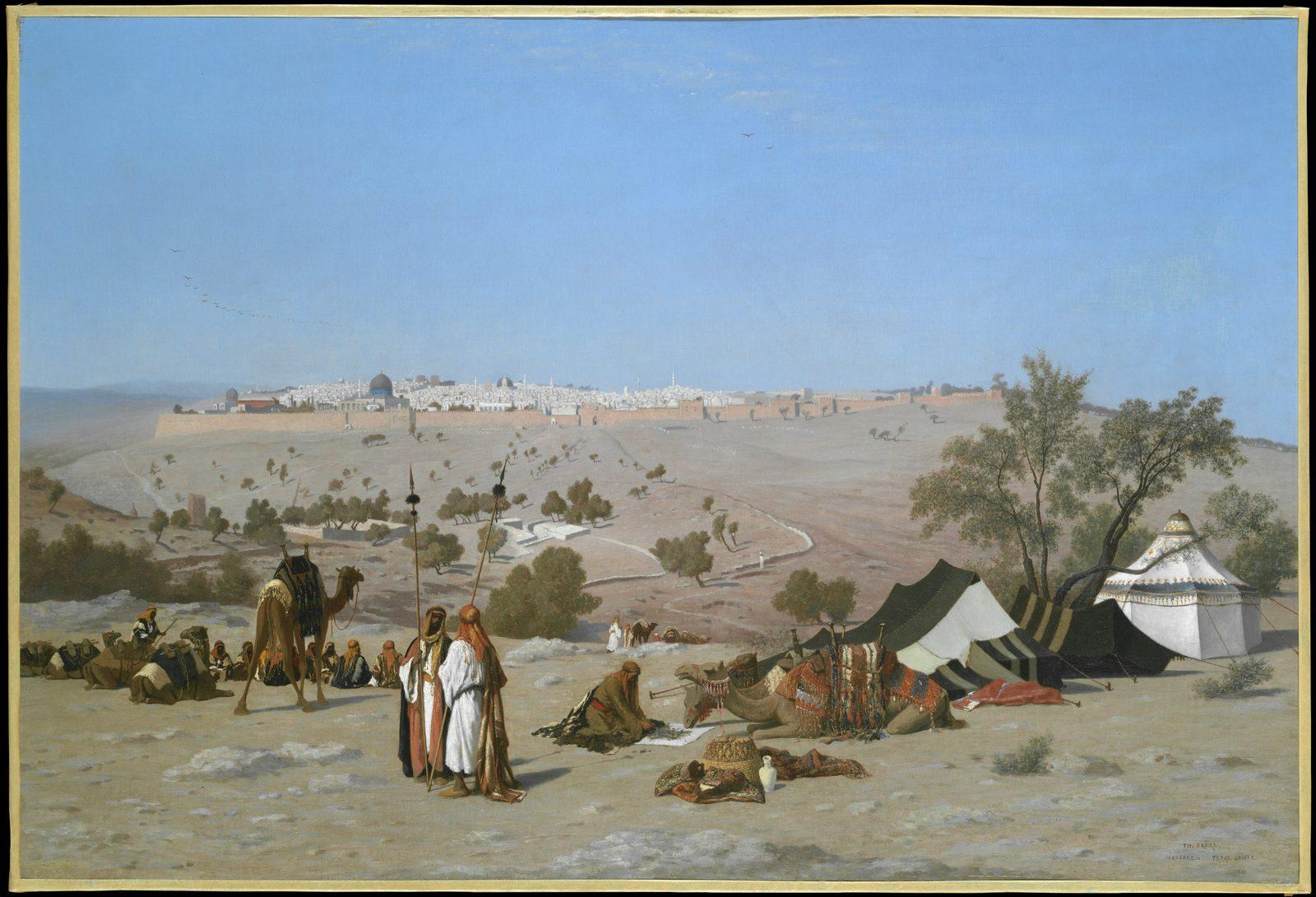
Théodore Frère, Jerusalem from the Mount of Olives, by 1880. Public domain.
Zechariah 14:1 to 11 · Place · Featured Study
The Mount of Olives on the Day of the LORD
Zechariah names the Mount of Olives as the mountain that splits in two to open a valley.
On that day His feet will stand on the Mount of Olives, east of Jerusalem, and the Mount of Olives will be split in two from east to west, forming a great valley, with half the mountain moving to the north and half to the south.
- Today
- Jebel et-Tur
- Region
- East of Jerusalem, across the Kidron Valley
- First named
- Zechariah 14:4 “…feet will stand on the Mount of Olives,…”
- Last named
- Acts 1:12 “…returned to Jerusalem from the Mount of Olives,…”
Three readings of one chapter place its day in the future, in the first century and in the church.
Summary
In the last chapter of Zechariah the nations gather against Jerusalem and the LORD goes out to fight them. The mountain east of the city is where the prophet sets the LORD's feet.
- Living water flows from the city toward two seas.
- The chapter gives no date for the day.
- Each reading is given with its holders and the case for it.
His Feet Will Stand
Zechariah 14:3 to 4 sends the LORD out to battle and sets His feet on the mountain.
Then the LORD will go out to fight against those nations, as He fights in the day of battle.The battle the mountain's verse belongs to.
The Mountain and the Two Seas
The map sets the mountain beside the city and the two seas the chapter names.
The mountain stands just east of the city, and the two seas lie on either side of the land.
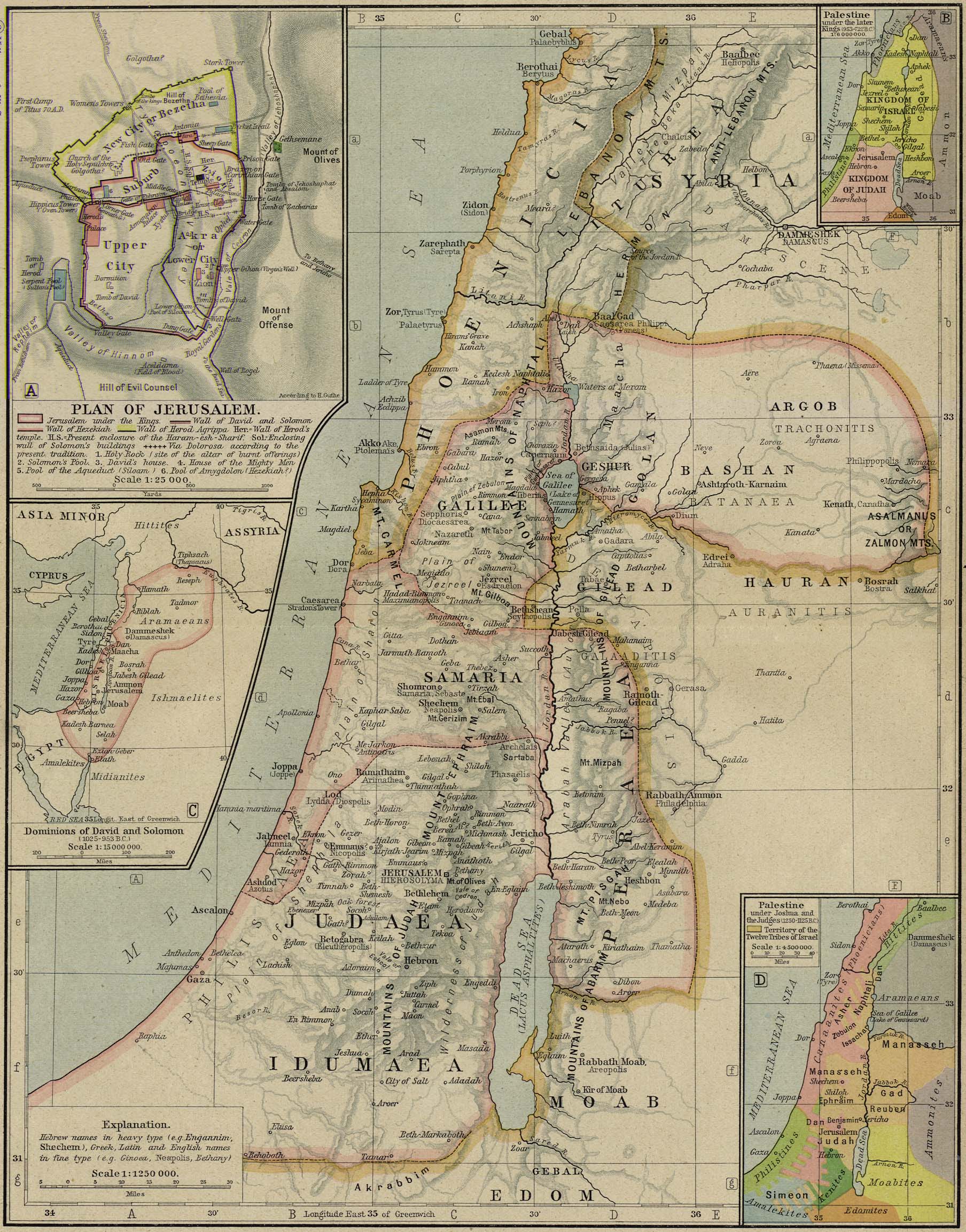
about 50 km (31 miles)
- Known: a score of 800 or more
- Proposed: a score under 500
- 1Jerusalem, The nations gather against the city Zechariah 14:2
- 2The Mount of Olives, The ridge across the Kidron Valley from the city Zechariah 14:4
- 3The Dead Sea, Half the living water flows to the eastern sea Zechariah 14:8
- 4The Mediterranean Sea, Half the living water flows to the western sea Zechariah 14:8
- 5?Azal, OpenBible score 86, The valley of the split mountain reaches to Azal Zechariah 14:5
Base map: Reference map of ancient Palestine, Rand McNally reference map (1926), public domain. Places with a place page stand at its coordinates and the others at the point cited for each, set on the plate by Jerusalem and Damascus, as the plate prints them.
Five places, each with its verse. At this scale the mount and the city share one point. Each ring follows the OpenBible.info identification score out of 1,000, as the key gives it.
Adam Clarke took the eastern and western seas as the Dead Sea and the Mediterranean, and called them metaphors.
What the Chapter Leaves Unsaid
Zechariah 14 gives the place of the day and gives no date for it.
The chapter calls it a day of the LORD, a day known only to the LORD.
Jesus replied, “It is not for you to know times or seasons that the Father has fixed by His own authority.Jesus answers the question of times in the New Testament.
How Zechariah 14 Has Been Read
Barnes, Clarke and Wesley each gave the chapter's day a different time.
A day still to come, at the Lord's returnAlbert Barnes, Notes, Explanatory and Practical, on the Old and New Testaments, on Zechariah 14:4; Jamieson, Fausset and Brown (1871), on Acts 1:11
Barnes cited Acts 1:11 and called not improbable the old opinion that the Lord will come again to judge the earth where He left it. Jamieson, Fausset and Brown read Acts 1:11 as a return in person and in sight.
The Roman war and the spread of the gospelAdam Clarke, Commentary on the Bible (1832), on Zechariah 14:1, Zechariah 14:4 and Zechariah 14:8
Clarke read the day of Zechariah 14:1 as the war in which Jerusalem was finally destroyed. He read the living waters as the knowledge of salvation carried by the apostles from Jerusalem to the nations.
On Zechariah 14:4 he gave both a future restoration of the Jews and the readers who refer the verse to the Romans, whose army Titus posted on the mount.
The church, the spiritual JerusalemJohn Wesley, Explanatory Notes upon the Old Testament (1765), on Zechariah 14:7 and Zechariah 14:8
Wesley took the living waters for the saving truths of the gospel and Jerusalem as the church of Christ. He read the one day of Zechariah 14:7 as God working for the full salvation of His spiritual Jerusalem.
King Over All the Earth
The chapter turns from the mountain to the LORD's reign over every land.
On that day the LORD will become King over all the earth—the LORD alone, and His name alone.The verse names the end the chapter moves toward.
Sources
Scripture is the Berean Standard Bible.
- Albert Barnes, Notes, Explanatory and Practical, on the Old and New Testaments, on Zechariah 14:4.
- Adam Clarke, Commentary on the Bible (1832), on Zechariah 14:1, 14:3, 14:4 and 14:8.
- John Wesley, Explanatory Notes upon the Old Testament (1765), on Zechariah 14:7 and 14:8.
- Jamieson, Fausset and Brown, Commentary Critical and Explanatory on the Whole Bible (1871), on Acts 1:11.
- OpenBible.info, Bible-Geocoding-Data, ancient.jsonl, entries Salt Sea (score 1000), Great Sea (score 1000) and Azal 1 (score 86)
Keep Studying
People and groups1
Doctrines1