
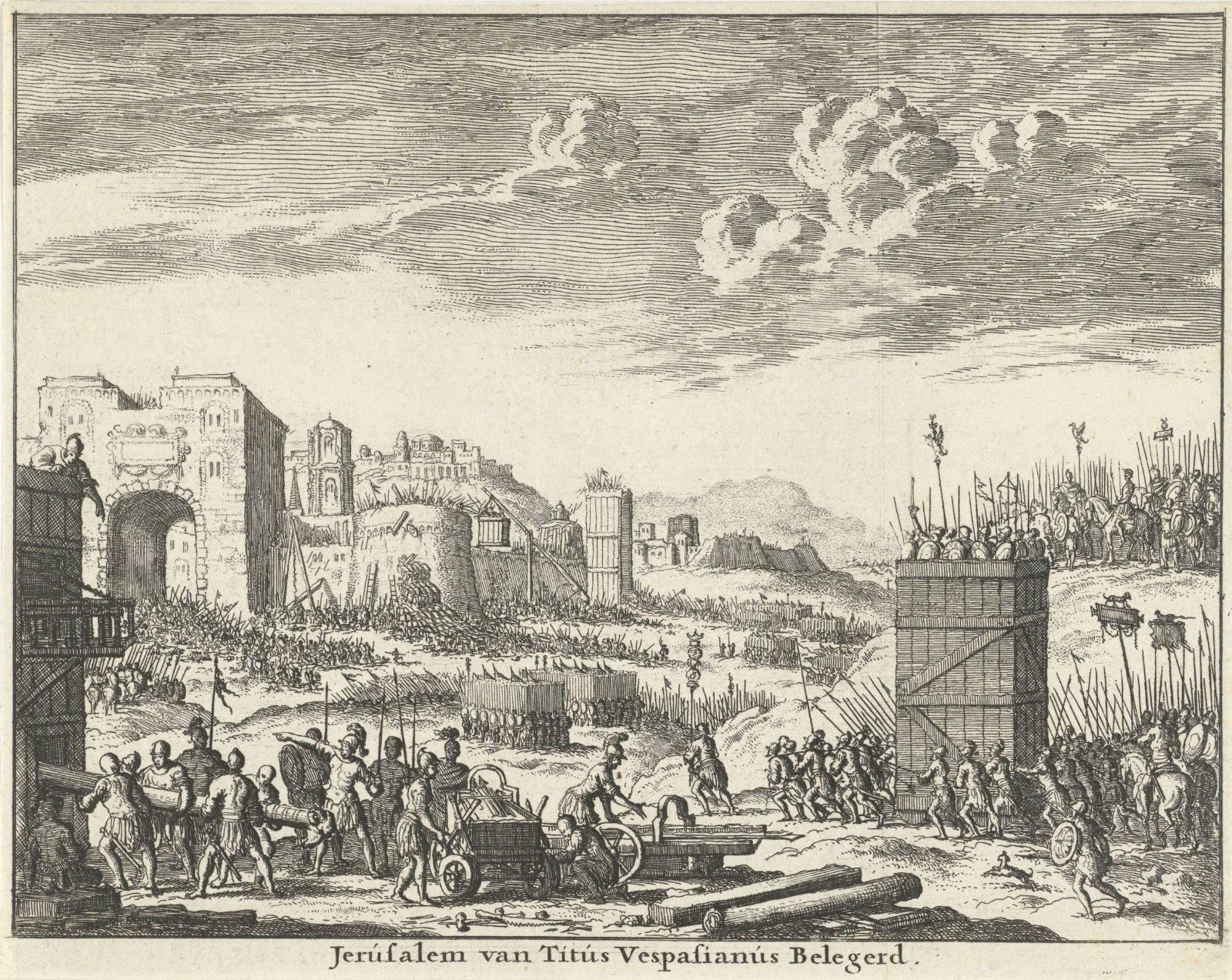
Jan Luyken, Jerusalem Besieged by Titus Vespasian, 1682. Public domain.
Luke 21:20 · Subject · Featured Study
The Jewish Wars and the Fall of Jerusalem
Judea rose against Rome in AD 66, and in AD 70 the Roman army took Jerusalem and burned the temple.
But when you see Jerusalem surrounded by armies, you will know that her desolation is near.
- Book
- Luke
- Hold in memory
- Luke 21:20, Luke 19:43
Josephus counts the day the temple burned as the same day of the year the Babylonians had burned the first one.
Summary
Josephus told the story of this war in his book The Wars of the Jews. The Roman writers Tacitus and Dio give their own counts of the people.
- Josephus counted 97,000 captives taken in the whole war.
- Dio counted 580,000 men killed in the second war, under Hadrian.
- Harnack and Plummer differ on whether Luke wrote before or after the city fell.
Jesus Weeps over the City
As Jesus came near Jerusalem, He wept over it and spoke of a siege to come.
For the days will come upon you when your enemies will barricade you and surround you and hem you in on every side.These words open the warnings over Jerusalem that Luke gathers in chapters 19 and 21.
Six Turns of the Wars with Rome
The rows follow Josephus for the first war and Eusebius for the second.
Six events run from the refusal of Caesar's sacrifice to the fighting at Bether.
- AD 66The priests refuse the sacrifice for Caesar, and the war begins
- AD 66Cestius Gallus retreats from Jerusalem with heavy losses
- AD 70Titus besieges Jerusalem
- AD 70The temple burns
- After AD 70Nine hundred and sixty die at Masada
- Hadrian's 18th yearThe war is fiercest at Bether
A timeline of six events in the Jewish wars with Rome, from Josephus and Eusebius.
How the Revolt Began
Josephus dates the start of the war to the twelfth year of the emperor Nero.
Eleazar, the son of the high priest Ananias, was then governor of the temple. He persuaded the priests to accept no gift or sacrifice from a foreigner.
So they rejected the sacrifice offered for Caesar, and Josephus called this the true beginning of the war with Rome.
Later that year the Roman commander Cestius Gallus fell back from Jerusalem and left his siege engines behind. Josephus counts 5,300 Roman foot soldiers and 380 horsemen killed.
The Church Leaves for Pella
Eusebius's Church History tells where the Jerusalem church went.
He wrote that a revelation given to approved men among them told the people to settle in Pella, a town of Perea.
The Wall, the Famine and the Fire
Titus closed the city in, and famine and fire followed.
Josephus gives the wall's length as thirty-nine furlongs, with thirteen garrison posts, and says it was finished in three days.
Famine then spread through whole houses and families, and the streets of the city filled with the bodies of the old.
On the seventeenth of the month Panemus the daily sacrifice failed, because no men were left to offer it.
“As for what you see here, the time will come when not one stone will be left on another; every one will be thrown down.”Jesus spoke these words of the temple that burned in the second year of Vespasian.
The temple burned on the tenth day of Lous, the month Whiston's translation marks as Ab.
Josephus counts 1,100,000 dead in the siege. Many had come up for the feast of unleavened bread and were shut in by the army.
The Roman historian Tacitus heard that 600,000 people of every age were under siege.
Masada and the Revolt under Hadrian
Josephus tells of Masada near the end of his history.
At the fortress of Masada 960 people died on the fifteenth day of Xanthicus, the women and children among them.
Under Hadrian a leader called Barcocheba, a name meaning star, led a new revolt. Eusebius puts its fiercest fighting in Hadrian's eighteenth year, at the fortress of Bether near Jerusalem.
After it, Hadrian forbade the Jews to go up to the country around Jerusalem, or even to see it from a distance.
Dio Cassius writes that Hadrian founded a new city in place of the one razed to the ground, with a temple to Jupiter on the temple's site.
Was Luke Written Before AD 70?
Harnack and Plummer dated Luke's Gospel from different evidence.
Written in Paul's lifetimeAdolf Harnack, The Date of the Acts and of the Synoptic Gospels, translated by J. R. Wilkinson (1911), page 162
Harnack concluded that Mark, Luke and Acts were written while Paul was still alive, and Matthew a few years later.
Plummer doubted that any of the Gospels, as we have them, was written as early as AD 63.
Written between AD 75 and 80Alfred Plummer, A Critical and Exegetical Commentary on the Gospel According to S. Luke, 10th edition (1914), page xxxi
Plummer judged that a date of AD 75 to 80 has much more to recommend it.
He pointed to Luke 19:43 to 44 and Luke 21:10 to 24, which tell of the city's fall more definitely than Mark and Matthew do.
Harnack's earlier date rests on Acts, which ends while Paul is still living in Rome.
Jerusalem Trodden Down
Eusebius records what became of the city's name.
They will fall by the edge of the sword and be led captive into all the nations. And Jerusalem will be trodden down by the Gentiles, until the times of the Gentiles are fulfilled.Jesus' words reach past the siege to the later history of the city.
Eusebius wrote that the Roman city built there took the name Aelia, after the emperor Aelius Hadrian.
Sources
Scripture is the Berean Standard Bible.
- Flavius Josephus, The Wars of the Jews, 2.14.4, 2.17.2, 2.19.9, 5.12.2 to 3, 6.2.1, 6.4.5, 6.4.8, 6.9.3 and 7.9.1, translated by William Whiston, with his notes.
- Eusebius, Church History 3.5.3 and 4.6.2 to 4, translated by Arthur Cushman McGiffert, Nicene and Post-Nicene Fathers, second series, volume 1.
- Tacitus, Histories 5.13, translated by Clifford H. Moore, Loeb Classical Library (1931)
- Dio Cassius, Roman History 69.12.1 and 69.14.1, translated by Earnest Cary, Loeb Classical Library (1925)
- Adolf Harnack, The Date of the Acts and of the Synoptic Gospels, translated by J. R. Wilkinson (London: Williams and Norgate, 1911), page 162.
- Alfred Plummer, A Critical and Exegetical Commentary on the Gospel According to S. Luke, International Critical Commentary, 10th edition (New York: Scribner, 1914), Introduction, section 4.
Keep Studying
Read it1
People and groups1
Doctrines1
Go further1