
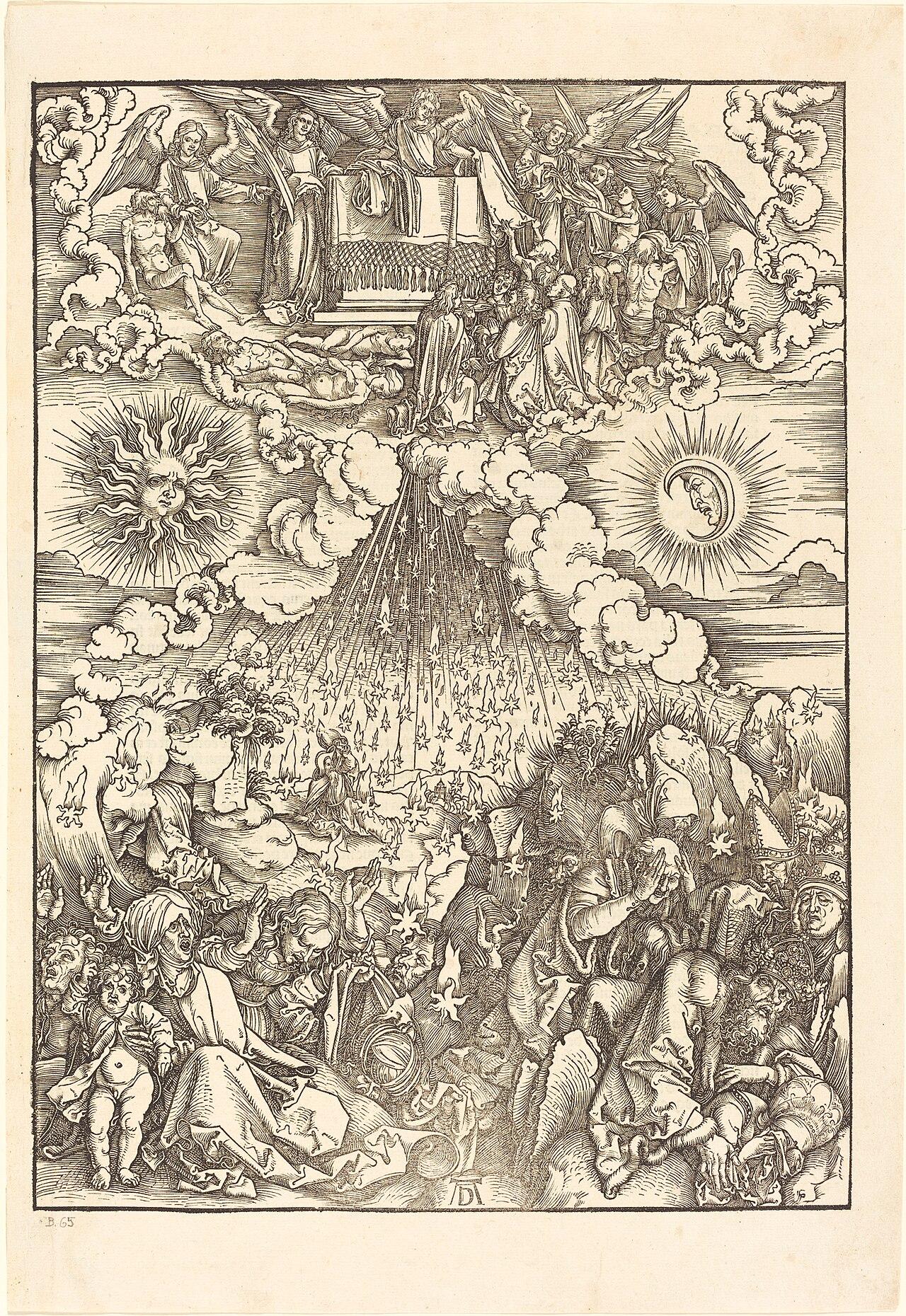
Albrecht Dürer, The Opening of the Fifth and Sixth Seals, 1498. CC0.
From Stephen to 1973 · Subject · Featured Study
The Cloud of Witnesses
The church has kept a dated line of its witnesses since Stephen.
The Book of Acts ends with Paul still preaching in Rome, and the church's records of its witnesses go on from there for nineteen centuries.
Therefore, since we are surrounded by such a great cloud of witnesses, let us throw off every encumbrance and the sin that so easily entangles, and let us run with endurance the race set out for us.
Therefore, since we are surrounded by such a great cloud of witnesses, let us throw off every encumbrance and the sin that so easily entangles, and let us run with endurance the race set out for us.
- Books
- Hebrews, Revelation
- Hold in memory
- Hebrews 12:1, Hebrews 11:38
Summary
Hebrews 12:1 calls the faithful of chapter 11 a great cloud of witnesses. The line goes on after Acts, one dated station at a time. It runs from Jerusalem to the twentieth century.
- Hebrews 11 ends with believers who were flogged, chained, stoned and killed by the sword.
- Stephen, James and Antipas are the witnesses killed in the New Testament.
- The church at Smyrna wrote down how Polycarp died, about 155. Perpetua kept her own diary in prison before she died in 203.
- Later stations include William Tyndale in the 1500s and four witnesses of the 1900s.
The Verses of the Cloud
Hebrews names the cloud, and Revelation shows the slain under the altar.
The writer to the Hebrews ends his roll of faith with the nameless faithful who suffered, then turns to the reader. Revelation sees the same company from the other side of death.
Hebrews 11 and 12
Still others endured mocking and flogging, and even chains and imprisonment. They were stoned, they were sawed in two, they were put to death by the sword. They went around in sheepskins and goatskins, destitute, oppressed, and mistreated. The world was not worthy of them. They wandered in deserts and mountains, and hid in caves and holes in the ground.
The writer leaves these sufferers unnamed after naming Abel, Abraham, Moses and Rahab earlier in the chapter.
These were all commended for their faith, yet they did not receive what was promised. God had planned something better for us, so that together with us they would be made perfect.
The chapter ends by joining the faithful of old to the readers of the letter in one company.
Let us fix our eyes on Jesus, the author and perfecter of our faith, who for the joy set before Him endured the cross, scorning its shame, and sat down at the right hand of the throne of God.
The race of chapter 12 looks past the cloud to Jesus, who endured the cross.
Hebrews 12:2BSB
Revelation
And when the Lamb opened the fifth seal, I saw under the altar the souls of those who had been slain for the word of God and for the testimony they had upheld. And they cried out in a loud voice, “How long, O Lord, holy and true, until You avenge our blood and judge those who dwell upon the earth?” Then each of them was given a white robe and told to rest a little while longer, until the full number of their fellow servants, their brothers, were killed, just as they had been killed.
John sees this at the opening of the fifth seal, and Dürer cut the scene at the top of his woodcut of 1498.
Revelation 6:9 to 11
The Stations of the Line
The line starts at Jerusalem and runs through Smyrna, Carthage, Vilvoorde and Wuding.
The record of witnesses killed for the faith runs without a break from Stephen in Acts 7 to Wang Zhiming in 1973.
- Stephen is stoned at JerusalemActs 7Acts 7:54 to 60
- James, the brother of John, is put to death by HerodActs 12Acts 12:1 to 2
- Antipas is killed at PergamumBefore Revelation was writtenRevelation 2:13
- Ignatius is taken to Rome and killedWithin a few years of AD 110MannaFest, Ignatius on the Road to Rome
- Polycarp is burned at SmyrnaAbout 155The letter of the church at Smyrna, with MannaFest's Polycarp page
- Perpetua and Felicity die at Carthage7 March 203MannaFest, Perpetua and Felicity
- Decius orders the empire to sacrificeAD 250MannaFest, The Decian Certificates
- The church at Nicomedia is razed23 February 303MannaFest, The Great Persecution, 303
- William Tyndale dies at Vilvoorde1536MannaFest, William Tyndale, from Foxe
- John Rogers is burned at Smithfield4 February 1555MannaFest, The English Martyrs Under Mary
- Dirk Willems is sentenced at Asperen16 May 1569MannaFest, Dirk Willems
- Manche Masemola dies in South AfricaOn or near 4 February 1928MannaFest, Manche Masemola
- Lucian Tapiedi dies in Papua1942MannaFest, Lucian Tapiedi
- Esther John dies at Chichawatni2 February 1960MannaFest, Esther John
- Wang Zhiming is executed at Wuding29 December 1973MannaFest, Wang Zhiming
A timeline of fifteen stations, each row naming the witness, the date and the record that fixes it.
Decius orders the empire to sacrifice, The church at Nicomedia is razed, William Tyndale dies at Vilvoorde, John Rogers is burned at Smithfield, Dirk Willems is sentenced at Asperen, Manche Masemola dies in South Africa, Lucian Tapiedi dies in Papua, Esther John dies at Chichawatni and 1 more
The era of the martyrs' church holds the wider story of the first three centuries.
How the Line Is Dated
Scripture names the first stations, and later ones rest on letters, diaries and court records.
Acts and Revelation give no years for Stephen, James and Antipas, so the timeline gives each its chapter.
Polycarp's church dated his death by a day and a month, the second of Xanthicus, and gave no year. A note to the English of the Ante-Nicene Fathers says that “great obscurity hangs over the chronology here indicated,” and the estate gives about 155.
Perpetua wrote the first part of her own passion, and the editor who finished it says she left it “described by her own hand and with her own mind.”
The later stations rest on the records each person page names, from Foxe's account of Tyndale to the court sentence of Dirk Willems.
In Their Own Words
Polycarp of Smyrna (died 155)
The Martyrdom of Polycarp, chapter 9
Polycarp would not revile the King who saved him.
“Eighty and six years have I served Him, and He never did me any injury: how then can I blaspheme my King and my Saviour?”
Early Church
About this saying1 paragraph
About 155 the proconsul told the old bishop to swear by Caesar and revile Christ, and the letter of his church gives his answer.
Perpetua of Carthage (182 to 203)
The Passion of Perpetua and Felicity, her own narrative, chapter 2, section 2
Perpetua answered the governor in one word.
“I am a Christian.”
Early church martyr
About this saying1 paragraph
In 203 Hilarianus asked whether she was a Christian, and she wrote her reply in her own diary.
William Tyndale (1494 to 1536)
Foxe, Acts and Monuments, volume 5, at the stake
Tyndale prayed for the king who let him die.
“Lord! open the king of England's eyes.”
Reformation translator
About this saying1 paragraph
Foxe gives these words at the stake in 1536 and names no witness.
John Rogers (died 1555)
in John Foxe, Acts and Monuments, the story of John Rogers, volume 6, page 611
Rogers would seal his preaching with his blood.
“That which I have preached I will seal with my blood.”
Marian martyr
About this saying1 paragraph
In 1555, the first year of the burnings under Queen Mary, Rogers held to his preaching, as Foxe records.
Spectators or Witnesses
Readers of Hebrews 12:1 differ on whether the cloud watches the race or testifies to faith.
Albert Barnes and Adam Clarke read the verse through the ancient games, where crowds filled the seats and watched the runners. On that reading the faithful of chapter 11 look on as the church runs.
The strongest objection is that Hebrews 11:39 calls them those who were commended, which makes them people whose faith was attested and leaves their watching unstated.
Theodoret of Cyrus read the cloud as models of godliness, set on every side in such numbers that they testify to the power of faith. Clement of Rome, in his letter to the church at Corinth, set the great examples before the church in the same way, as patterns to follow.
“Thus the humility and godly submission of so great and illustrious men have rendered not only us, but also all the generations before us, better; even as many as have received His oracles in fear and truth. Wherefore, having so many great and glorious examples set before us, let us turn again to the practice of that peace which from the beginning was the mark set before us; and let us look steadfastly to the Father and Creator of the universe, and cleave to His mighty and surpassingly great gifts and benefactions of peace.”
Clement of Rome · Letter to the Corinthians (Clement) · on Hebrews 12:1Patristic
The strongest objection is the picture itself, since the word surrounded and the race both point to the stands of a stadium.
Books to Read Next
The Martyrdom of Polycarp
The church at Smyrna, in the Ante-Nicene Fathers, volume 1 · 1885
It tells the old bishop's arrest, trial and burning, pages 39 to 44.
Free at the Christian Classics Ethereal LibraryThe Passion of the Holy Martyrs Perpetua and Felicitas
Perpetua and an unnamed editor, translated by R. E. Wallis · 1885
Perpetua's own diary stands inside it, in volume 3 of the Ante-Nicene Fathers from page 699.
Free at the Christian Classics Ethereal LibraryThe Line Goes On
Hebrews says the faithful of old would be made perfect together with those who came after them. Each station of the timeline joined that company in its own year and place.
Sources
Scripture is the Berean Standard Bible.
- The Holy Bible, Berean Standard Bible (read 2026)
- The Martyrdom of Polycarp, Ante-Nicene Fathers, volume 1 (originally printed 1885), pages 39 to 44, chapters IX, XIV and XXI with the translators' note 477.
- The Passion of the Holy Martyrs Perpetua and Felicitas, translated by R. E. Wallis, Ante-Nicene Fathers, volume 3 (1885), chapter I, pages 699 to 700.
- Albert Barnes, Notes, Explanatory and Practical (1832 to 1869), on Hebrews 12:1.
- Adam Clarke, Commentary on the Bible (1832), on Hebrews 12:1.
- Theodoret of Cyrus, Interpretation of Hebrews, on Hebrews 12:1, in a modern English translation, cited and not quoted.
- Clement of Rome, Letter to the Corinthians, Ante-Nicene Fathers, volume 1 (1885)
- John Foxe, Acts and Monuments, edited by George Townsend, volume 5 (1838), the Life of William Tyndale.
- John Foxe, Acts and Monuments, the story of John Rogers, volume 6, page 611.
Keep Studying
People and groups8
Subjects13
Church history7
Trials of life1