
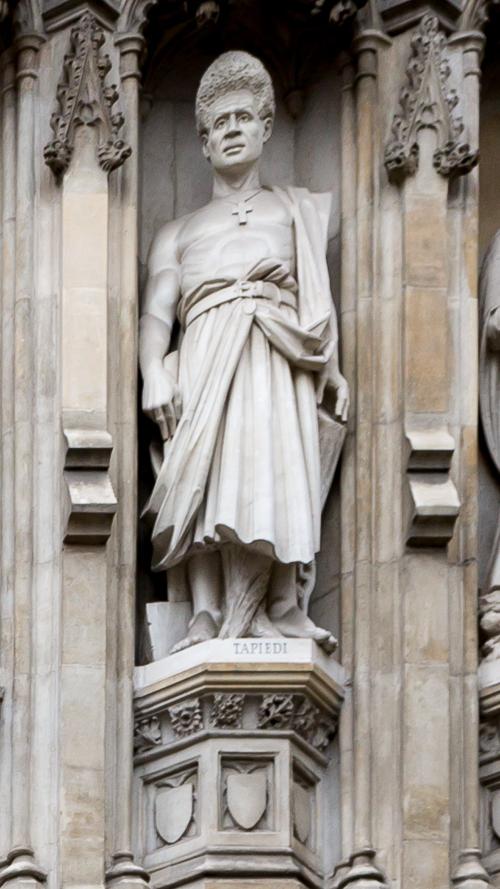
CEphoto, Uwe Aranas, 2013. CC BY-SA 3.0.
Papua, to 1942 · Person · Featured Study
Lucian Tapiedi
He taught and preached at an Anglican mission station in Northern Papua until the Japanese invasion.
When the Japanese landed, a young Papuan teacher would not leave the missionaries.
For whoever wants to save his life will lose it, but whoever loses his life for My sake and for the gospel will save it.
For whoever wants to save his life will lose it, but whoever loses his life for My sake and for the gospel will save it.
- Born
- 1921 or 1922, at Taupota, on the north coast of Papua (probable)
- Died
- 1942, near Kurumbo, in Northern Papua (probable)
- Places
- Taupota, Sangara, Kurumbo, Embi
Summary
Lucian Tapiedi was a Papuan who taught at the Anglican mission of Sangara. When the Japanese landed in Northern Papua in 1942 he went into hiding with the missionaries. A man of the Orokaiva people killed him on the way. He lies at Sangara beside two Australian women of the mission.
- A chaplain who stood at his grave told his death another way.
- His statue stands among ten over the west door of Westminster Abbey.
- His killer later became a Christian and built a church at Embi in his honour.
The Love That Stays
Jesus spoke of laying down life for friends, and of losing life for His sake.
The Abbey writes that he was determined to stay with the missionaries he worked with. The question of this life is what that choice cost him, since the witnesses tell his death two ways.
Greater love has no one than this, that he lay down his life for his friends.Jesus spoke this to the disciples on the night before He died.
The Life in Order
The life stands on the Abbey, and the call and the grave on the bishop's own papers.
He served at Sangara for about a year before the invasion.
- 1921 or 1922Birth at TaupotaThe Abbey
- 1939Entry to St Aidan's teacher training collegeThe Abbey
- 1941Teacher and evangelist at SangaraThe Abbey
- January 1942The bishop's broadcast to the mission staffStrong
- July 1942The invasion of the north coastThe Abbey; Warren
- Days after the invasionHis deathThe Abbey
- Months after his deathHis body laid at SangaraStrong; Bell
- 1998His statue unveiled at Westminster AbbeyThe Abbey
Each step of the life stands with its witness.
Months after his death, 1998
From Taupota to the Kurumbo Stream
A sorcerer's son became a teacher of the mission and went into hiding with its staff.
His father was a sorcerer who died while his sons were young. Lucian was taught at mission schools and trained as a teacher, and at college he was known as diligent and cheerful, fond of games and of music.
Japan attacked Pearl Harbor in December 1941, invaded Malaya that month and took Singapore in February. The missionaries of New Guinea watched and feared the worst, and many of them had already refused calls to leave.
When the Japanese came ashore, three of the staff at Gona fled inland and were caught, and the two women among them were killed. In the north a second group tried to escape capture, and Lucian went with them, unwilling to abandon the missionaries he served. Within a few days the party had grown to ten.
At an Orokaiva village the party was taken in charge by men of the place. One of them, Hivijapa, killed Lucian near a stream by Kurumbo village. The rest of the party died soon after at Japanese hands.
The Bishop's Call
Philip Strong told his staff by radio that they would stay, and he later stood at the graves.
Some eight weeks after Pearl Harbor, Philip Strong, the Anglican bishop of New Guinea, spoke by radio to his mission staff. He told them that no one had ordered them to leave, and he said, "We shall not leave. We shall stand by our trust. We shall stand by our vocation."
M. A. Warren, introducing Bell's account, wrote that no order was issued for the evacuation of missionaries. He added that some would always hold that the military or the bishop should have moved the women to safety sooner.
In a letter of June the following year Strong wrote that Lucian's body had lately been brought up from the place of his martyrdom. It had been laid beside the graves of the two women, outside their fence, and Strong had the railing extended to take in his grave and a cross set up with his name.
The Abbey prints one saying as his, with no date, place or source: "I will stay with the Fathers and Sisters". The two papers by Strong and the account by Bell do not print it.
In Their Own Words
His bishop spoke of him in 1947, and two of the mission staff killed after the landing wrote these lines from the bush in 1942.
Philip Strong
Philip Strong, "Out of Great Tribulation", the Presidential Address and Charge to his Diocesan Conference at Dogura, Papua, 30 June 1947, page 96, on Lucian Tapiedi
In the hour of trial
“by his adherence to the white missionaries in the hour of trial by his upholding their cause as being the cause of Christ before people of his own race, and suffering death at their hands because of this.”
Anglican
About this saying1 paragraph
Philip Strong said this of him at Dogura on 30 June 1947, five years after his death.
Vivian Redlich
Ruth Henrich, compiler, South Sea Epic: War and the Church in New Guinea (London: Society for the Propagation of the Gospel, 1944), chapter VIII, Missionaries Killed, page 68, his last letter to his father
To do my job faithfully
“I'm trying to stick whatever happens. If I don't come out of it just rest content that I've tried to do my job faithfully.”
Anglican
About this saying1 paragraph
Vivian Redlich, his priest, wrote this in pencil to his father in England on 27 July 1942, a few days after the Japanese landing.
Mavis Parkinson
Ruth Henrich, compiler, South Sea Epic: War and the Church in New Guinea (London: Society for the Propagation of the Gospel, 1944), chapter VIII, Missionaries Killed, page 61, her letter of 5 August 1942 to her parents
If thoughts can comfort
“I know how terribly worried you all must be, but if thoughts can comfort, I know you must be comforted.”
Anglican
About this saying1 paragraph
Mavis Parkinson, the teacher of the Gona school, beside whose grave at Sangara he was laid, wrote this to her parents from a hideout in the bush on 5 August 1942.
The People Around Him
The witnesses name the women he lies beside, his bishop, his priest, a chaplain and his killer.
The man who killed him later took his name.
| Person | Tie to Lucian | The witness |
|---|---|---|
| May Hayman | A sister of the mission at Gona; her grave is beside his. | The Abbey; Warren |
| Mavis Parkinson | An Australian woman of the Gona station, killed with Hayman. | The Abbey; Warren |
| Philip Strong | Bishop of New Guinea, who blessed his grave. | Strong, 1943 |
| Vivian Redlich | The priest of Sangara, where Lucian taught. | Strong, 1943; Warren |
| Arthur Bell | An army chaplain who went with the bishop to Sangara. | Bell, 1943 |
| Hivijapa | An Orokaiva man who killed him, and later a Christian. | The Abbey |
The Places of His Life
His life ran along the north coast of Papua and inland to the mission stations.
He died within a few days' walk of the station where he taught.
| Place | What the witnesses say | The witness |
|---|---|---|
| Taupota | His home village on the north coast. | The Abbey |
| Sangara | His station from 1941, and his grave. | The Abbey; Strong, 1943 |
| Gona | The mission station by the coast where the invasion began. | The Abbey; Warren |
| Popondetta | Scene of the murder of Hayman and Parkinson. | The Abbey |
| Kurumbo | The village by the stream where he died; a shrine marks the place. | The Abbey |
| Buna | The beach where six of his party were beheaded. | The Abbey; Warren |
| Embi | Site of the church his killer built. | The Abbey |
What Followed
His killer became a Christian, and a chaplain read his grave as a sign of the Papuan church.
The Abbey writes that Hivijapa later turned to Christ, took the name Hivijapa Lucian, and built a church in memory of the man he had killed.
Arthur Bell, at the graves, wrote of the Papuan church, "It produces its own martyrs". The Abbey counts 333 Christians of many churches who died in New Guinea under the invasion and occupation, 198 of them Roman Catholics.
How the Key Verse Was Taught
Gregory the Great and Matthew Henry read the life lost for Christ's sake.
Gregory the Dialogist (died 604)
Forty Gospel Homilies, Homily 32
Gregory the Great likened the life given for Christ to grain sown in a field.
“For he that will save his life shall lose it; and he that shall lose his life for my sake and the gospel's shall save it. Thus it is said to the faithful: He that will save his life shall lose it; and he that shall lose his life for my sake shall save it. As if it were said to the farmer: If you keep your grain, you lose it; if you sow it, you renew it. For who does not know that when grain is cast as seed, it perishes from sight, it fails in the earth?”
on Mark 8:35Patristic
Matthew Henry (1662 to 1714)
Commentary on the Whole Bible
Matthew Henry set the reward of Christ above any honour a country gives its dead.
“It is looked upon to be some kind of recompence to those who lose their lives in the service of their prince and country, to have their memories honoured and their families provided for; but what is that to the recompence which Christ makes in eternal life to all that die for him?”
on Mark 8:35Puritan
What the Witnesses Leave Open
The witnesses differ on how he died, on the day of the landing and on who betrayed the missionaries.
How he diedArthur Bell (1943); Westminster Abbey
Bell wrote in 1943 that Lucian "had given his life in the defence of two of the sisters" and had used his own body to shield them. The Abbey writes that an Orokaiva man killed him while the party was being led away, and it names the killer.
The day of the landingWestminster Abbey; M. A. Warren (1943)
The Abbey puts the Japanese landing near Gona on 21 July 1942. Warren's introduction to Bell puts it on 22 July.
Who gave the missionaries upM. A. Warren (1943); Westminster Abbey
Warren wrote that hostile villagers, led by a notorious criminal, told the Japanese where the Sangara missionaries were, and that five were later sentenced to death. The Abbey writes only that men of the Orokaiva led the party away.
Books to Read Next
Among the Ruins: New Guinea Epic
Arthur Bell, with an introduction by M. A. Warren · 1943
A chaplain described the bishop's visit to the graves in 1943.
Read it free at Project CanterburyLetter from the Bishop of New Guinea
Philip Strong · 1943
The bishop reports his own visit to the ruined stations.
Read the letter free at Project CanterburyWhat Lucian Tapiedi Left
He left a grave inside the railing at Sangara and a church at Embi built in his memory. He was about twenty years old.
Sources
Scripture is the Berean Standard Bible.
- The Holy Bible, Berean Standard Bible (read 2026)
- Westminster Abbey, "Lucian Tapiedi", the Abbey's commemoration page.
- Philip Strong, Message to Mission Staff, 31 January 1942, radio broadcast, from The New Guinea Diaries of Philip Strong, 1936 to 1945, edited by David Wetherell, appendix B, pages 222 to 223.
- Philip Strong, "Out of Great Tribulation", the Presidential Address and Charge to his Diocesan Conference at Dogura, Papua, 30 June 1947, page 96.
- Ruth Henrich, compiler, South Sea Epic: War and the Church in New Guinea (London: Society for the Propagation of the Gospel, 1944), chapter VIII, Missionaries Killed, pages 61 and 68, the letters of Mavis Parkinson (5 August 1942) and Vivian Redlich (27 July 1942)
- Philip Strong, Letter from the Bishop of New Guinea, 26 June 1943 (Sydney: Anglican Board of Missions, 1943)
- Arthur Bell, Among the Ruins: New Guinea Epic, with an introduction by M. A. Warren (Sydney: Australian Board of Missions, 1943)
- Gregory the Great, Forty Gospel Homilies, homily 32, on Mark 8:35.
- Matthew Henry, Commentary on the Whole Bible (1710), on Mark 8:35.
Keep Studying
Studies1
People and groups4