
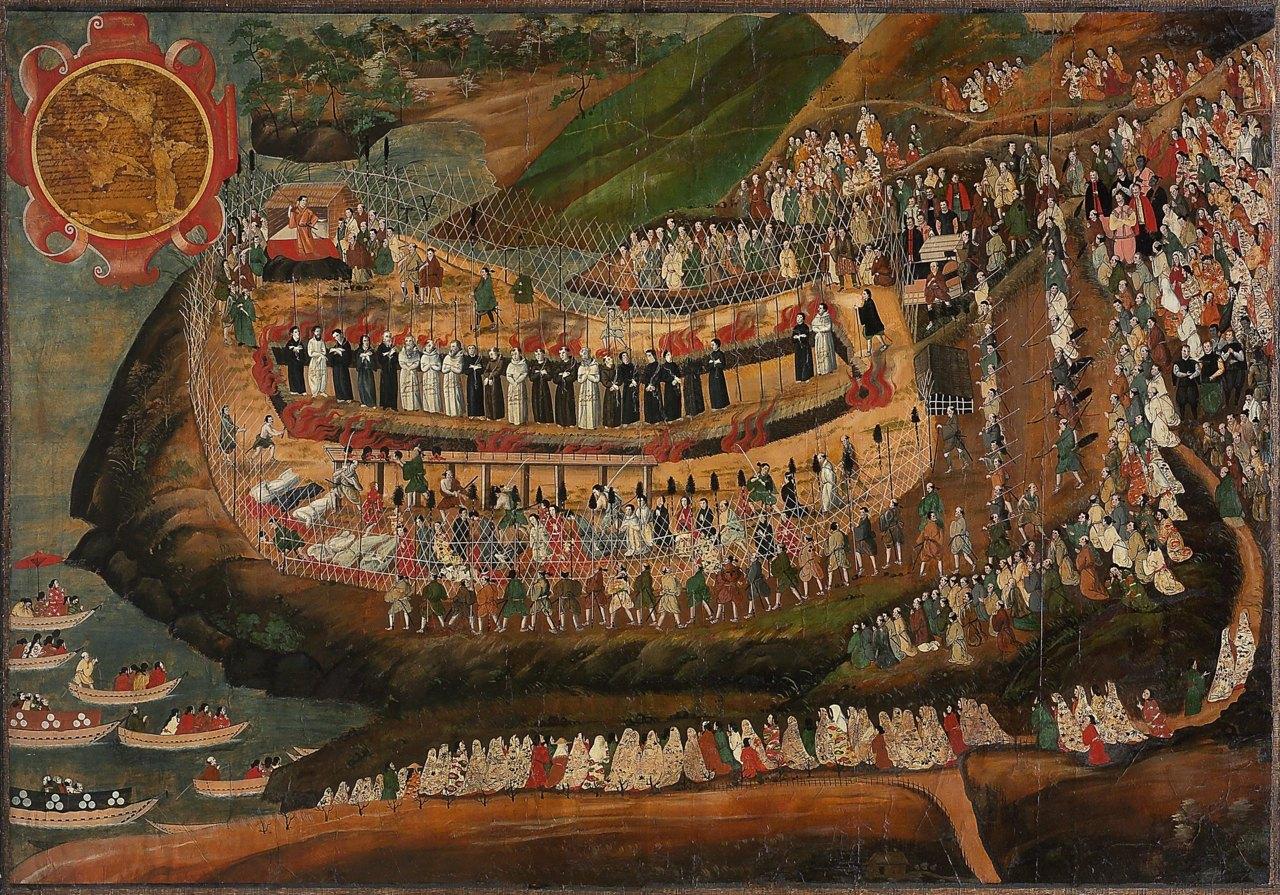
Unidentified painter, The Great Martyrdom of Nagasaki, 1622. Public domain.
Acts 8 to 1865 · Subject · Featured Study
The Blood of the Martyrs
Tertullian told Rome's governors that killing Christians made more of them, and the record shows the church both growing and nearly vanishing under the sword.
- Books
- Acts, John
- Hold in memory
- Acts 8:4, John 12:24
Tertullian ended a sentence with four Latin words that the church has quoted ever since, and the version most people know is a paraphrase.
Those who had been scattered preached the word wherever they went.
Summary
Tertullian told the rulers of the Roman Empire that killing Christians only made more of them. Two records put his words to the test. One is from Scripture and one is from Japan.
- His Latin reads semen est sanguis Christianorum, the blood of Christians is seed.
- In Acts the church was scattered after Stephen died, and those who were scattered preached wherever they went.
- In Japan a decree of 1614 began what Otis Cary calls the apparent extirpation of Christianity.
- Hidden believers at Nagasaki made themselves known to a priest. That was 251 years after the decree.
The Bible's Own Case
Acts records a persecution that carried the word from Jerusalem to Antioch.
Luke tells what followed Stephen's death in two places, eleven chapters apart. Jesus had spoken of a seed that bears fruit only when it dies, of His own death.
The scattering, Acts 8 and 11
And Saul was there, giving approval to Stephen’s death. On that day a great persecution broke out against the church in Jerusalem, and all except the apostles were scattered throughout Judea and Samaria. God-fearing men buried Stephen and mourned deeply over him. But Saul began to destroy the church. Going from house to house, he dragged off men and women and put them in prison.
Luke dates the persecution to the day of Stephen's death and tells how Saul began to destroy the church.
Meanwhile those scattered by the persecution that began with Stephen traveled as far as Phoenicia, Cyprus, and Antioch, speaking the message only to Jews. But some of them, men from Cyprus and Cyrene, went to Antioch and began speaking to the Greeks as well, proclaiming the good news about the Lord Jesus. The hand of the Lord was with them, and a great number of people believed and turned to the Lord.
Luke traces the same scattering as far as Phoenicia, Cyprus and Antioch, where some spoke to Greeks and a great number believed.
The seed
Truly, truly, I tell you, unless a kernel of wheat falls to the ground and dies, it remains only a seed; but if it dies, it bears much fruit.
Jesus said this when Greeks came asking to see Him, as His hour drew near.
John 12:24BSB
John 12:24
Where the Church Nearly Vanished
In Japan the sword drove the church underground for more than two centuries.
Japan's Christians fell from a reported three hundred thousand to a hidden remnant.
- Bishop Cerqueira reports that the Christians may have reached three hundred thousandBefore the war of 1600Page 149
- Ieyasu issues his decree against Christianity27 January 1614Page 176
- The rising at Shimabara endsApril 1638Page 227
- Portuguese ships are forbidden to come to Japan1639Page 229
- Believers from Urakami make themselves known to Father Petitjean at Nagasaki17 March 1865Page 282
A timeline of five dated steps from Otis Cary's history of 1909, each with its page.
Cary notes that the bishop's figure is well below the numbers given in many books, and that by the bishop's own reports the Christians numbered about two hundred thousand when he wrote.
Cary titles his chapter on the years from 1616 to 1715 “Apparent Extirpation of Christianity.”
By the end of 1865, Petitjean put the number of hidden Christians in and around Nagasaki at twenty thousand.
Three Forms of the Sentence
The Latin, the English of 1885 and the popular line say different things.
Tertullian wrote of the blood of Christians as seed, and the popular line adds martyrs and the church.
| Form | The words | Its source |
|---|---|---|
| Tertullian's Latin | Plures efficimur quotiens metimur a uobis; semen est sanguis Christianorum. | Mayor's edition, Cambridge, 1917, page 144, lines 32 to 33 |
| Thelwall's English | The oftener we are mown down by you, the more in number we grow; the blood of Christians is seed. | Ante-Nicene Fathers, volume 3 (1885), page 55 |
| The popular paraphrase | The blood of the martyrs is the seed of the church. | A paraphrase in common use, with no source in Tertullian's text |
The Latin names Christians and seed. The paraphrase narrows the Christians to martyrs and names the church as what grows, which Tertullian left unsaid.
Who Wrote the Sentence, and Why
Tertullian addressed the Apology to the governors who tried Christians.
The Apology opens with an address to the “Rulers of the Roman Empire” who sat in judgment on the charges made against the Christians.
Its date is disputed. The editors of the Ante-Nicene Fathers note that Mosheim placed it in AD 198 and Kaye in AD 204.
In the last chapter Tertullian tells the governors to torture and condemn as they please, since their injustice proves the Christians innocent. Their cruelty, he says, is rather an attraction to the sect.
Where the Saying Held
A Roman governor wrote that the faith had spread to the villages despite the trials.
Pliny the Younger tried Christians in his province and wrote to the Emperor Trajan for advice. He reported that the faith was found among people of every rank and age, in the villages and the country as well as the cities.
Pliny also reported that his trials were bringing people back to the temples, a sign that persecution could check the faith as well as spread it.
In Their Own Words
Tertullian (died 220)
Apology, chapter 50
Tertullian told the governors that their cruelty multiplied the Christians.
“The oftener we are mown down by you, the more in number we grow; the blood of Christians is seed.”
Early Church
About this saying1 paragraph
Tertullian closed his Apology with this sentence, in AD 198 by Mosheim's date or AD 204 by Kaye's.
Pliny the Younger
Letters, book X, to the Emperor Trajan, on the Christians, book X, the letter on the Christians
Pliny told Trajan the temples were filling again.
“The temples, at least, which were once almost deserted, begin now to be frequented; and the sacred rites, after a long intermission, are again revived; while there is a general demand for the victims, which till lately found very few purchasers.”
Roman governor
About this saying1 paragraph
Pliny wrote to Trajan about AD 111 to 112, while he was trying Christians in his province.
Bernard Petitjean
his account of 17 March 1865, as printed in Otis Cary, A History of Christianity in Japan: Roman Catholic and Greek Orthodox Missions, page 282
The hidden believers told the priest their hearts were his.
“The hearts of all of us here do not differ from yours.”
Roman Catholic
About this saying1 paragraph
Bernard Petitjean, a missionary priest at Nagasaki, told the story of that day in 1865 in his own words, and Cary prints them in English.
A Law of History or a Hope
Readers take the sentence as a rule of history or as a hope the record sometimes keeps.
The popular use treats the sentence as a rule, so that persecution of the church always yields its growth. Tertullian claimed as much for his own day, and Acts 8 and 11 give the case in Scripture.
The strongest objection is the record of Japan, where the church under the sword shrank for more than two centuries and survived in hiding.
The second reading takes the sentence as a hope that the record has often kept and did not keep in every land. Cary's record supports it, since the faith outlived the decree and its keepers were found at Nagasaki.
The strongest objection is that Tertullian wrote with no such limit, and that the Japanese remnant also survived under the sword, which the first reading counts as the seed kept alive.
Books to Read Next
Apologeticus, the text of Oehler annotated
Tertullian, edited by John E. B. Mayor, translated by Alexander Souter · 1917
It prints the Latin with an English translation and notes, chapter 50 on page 144.
Read the free scan at the Internet ArchiveA History of Christianity in Japan: Roman Catholic and Greek Orthodox Missions
Otis Cary · 1909
It tells the rise, the persecution and the hidden survival of the Japanese church from the records of the missions.
Free at the Internet ArchiveWhat the Record Shows
Tertullian's sentence held in Acts and in the province Pliny governed, and it failed as a forecast for Japan for more than two centuries. In both places believers were found holding the faith after the sword had done its work.
Sources
Scripture is the Berean Standard Bible.
- The Holy Bible, Berean Standard Bible (read 2026)
- Tertullian, Apology, translated by S. Thelwall, Ante-Nicene Fathers, volume 3 (1885), chapter I with the editors' note 77 on page 17, and chapter 50 on page 55.
- Tertullian, Apologeticus, the text of Oehler annotated by John E. B. Mayor, with a translation by Alexander Souter (Cambridge University Press, 1917), page 144, lines 32 to 33.
- Pliny the Younger, Letters, translated by William Melmoth, revised by F. C. T. Bosanquet, book X, the letter to the Emperor Trajan on the Christians.
- Otis Cary, A History of Christianity in Japan: Roman Catholic and Greek Orthodox Missions (New York: Fleming H. Revell, 1909), pages 149, 176, 227, 229, 282 and 288, and chapter VII.
- Tertullian, Apology, chapter 50, in Thelwall's English.
Keep Studying
People and groups1
Church history5
Trials of life1