
1597 to 1688 · Subject · The Cloud of Witnesses
The Witnesses of the Seventeenth Century
Japan crucified and burned its Christians and then closed itself to the world. In Scotland the Covenanters died on the scaffold and in the sea.
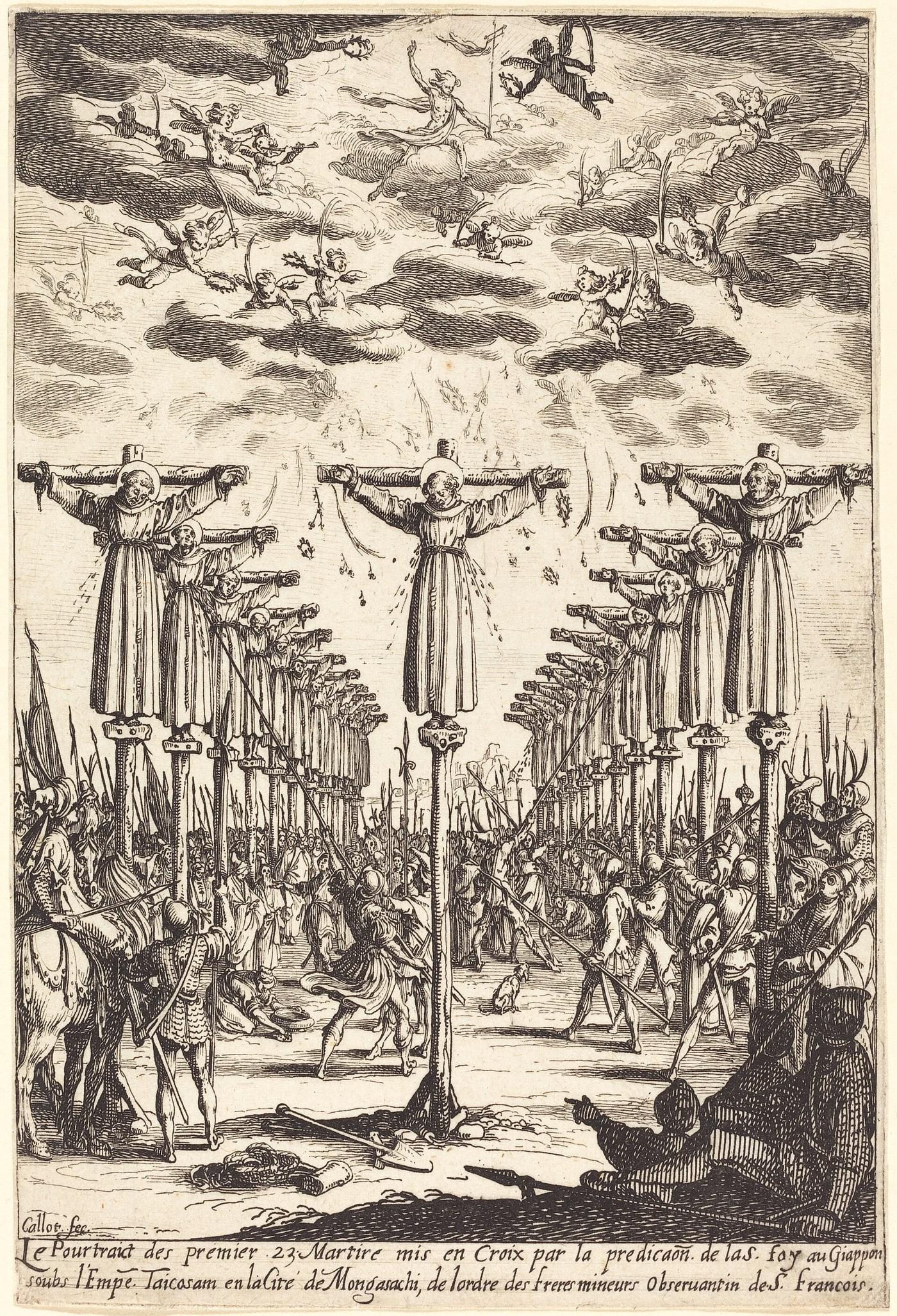
A Japanese Jesuit forgave the men who condemned him from his cross at Nagasaki.
Do not fear what you are about to suffer. Look, the devil is about to throw some of you into prison to test you, and you will suffer tribulation for ten days. Be faithful even unto death, and I will give you the crown of life.
- Books
- Matthew, Revelation
- Hold in memory
- Matthew 10:32 to 33, Revelation 2:10
Summary
In this century Japan put thousands of Christians to death and then shut its doors for two hundred years. In Europe Christians killed Christians in the valleys of Piedmont and in Scotland. The records of each were kept by their own churches.
- Twenty-six Christians were crucified at Nagasaki on 5 February 1597.
- Japan banned the faith in 1614 and closed its ports after 1640.
- The Waldensians of Piedmont were massacred at Easter 1655.
- The Scottish Covenanters died from 1680 until James Renwick's execution in 1688.
The Verses These Witnesses Held
Japan's yearly trial asked Christians to deny Christ in public, and the Covenanters died for his crown.
Japan's yearly trial of the cross set the words of Jesus about confessing and denying him before every Christian there.
Confessing Christ
Therefore everyone who confesses Me before men, I will also confess him before My Father in heaven. But whoever denies Me before men, I will also deny him before My Father in heaven.
A Christian who trod on the cross denied Christ before men, and one who refused confessed him.
Then Jesus called out in a loud voice, “Father, into Your hands I commit My Spirit.” And when He had said this, He breathed His last.
Kenners reports that he died on his cross with these words of Jesus.
Luke 23:46BSB
They have conquered him by the blood of the Lamb and by the word of their testimony. And they did not love their lives so as to shy away from death.
The verse joins the blood of the Lamb to the word of the witnesses' testimony, and the Covenanters' book prints their testimonies.
The Stations from Nagasaki to Edinburgh
Each row names the record that fixes its date.
In ninety-one years the record runs from the crosses of Nagasaki to the last Covenanter put to death in Edinburgh.
- Hideyoshi's first crosses5 February 1597The Catholic Encyclopedia, volumes 8 and 9 (1910)
- Ieyasu's edict against the faith1614The Catholic Encyclopedia, volume 8 (1910)
- The great martyrdom at NagasakiSeptember 1622Two articles of 1910, which disagree on the day
- The rising at Shimabara1637The Catholic Encyclopedia, volume 8 (1910)
- The massacre in the valleys of PiedmontEaster 1655Alexis Muston, The Israel of the Alps (1853)
- Cargill hanged at the Cross of Edinburgh27 July 1681A Cloud of Witnesses, page 6
- The two Margarets at Wigtown11 May 1685The kirk-session minutes of 1711
- James Renwick in the Grassmarket17 February 1688A Cloud of Witnesses, pages 482 to 483
A timeline of eight stations.
The two Margarets at Wigtown, James Renwick in the Grassmarket
The era of the Puritans and the Pietists holds the wider story of the church in this century.
Nagasaki and the Closing of Japan
Hideyoshi crucified twenty-six Christians, and the Tokugawa rulers later banned the faith and sealed the country.
In 1596 a Spanish ship, the San Felipe, ran aground in Tosa. Its captain was reported to have said that the missionaries came to prepare a conquest, and Hideyoshi had nine religious arrested on 9 December.
The twenty-six crucified at Nagasaki were six Franciscan missionaries and twenty native Christians, as the Catholic Encyclopedia of 1910 counts them. Two of the Japanese were boys of thirteen and twelve.
The same work says they “died preaching and singing to the end.” Paul Miki, one of three Jesuits among them, had been born in Japan and joined the Society of Jesus in 1586.
In 1614 Ieyasu Tokugawa published what the encyclopedia calls “the edict of destruction,” and Hidetada renewed it in 1616.
One article of 1910 counts fifty-two dead at Nagasaki on 2 September 1622, twenty-seven beheaded and the rest burned alive. A second article gives 10 September and another count.
The encyclopedia says that the Christians who held the fortress of Shimabara in 1637 numbered 37,000 and were slain to the last one. It gives no method for that count.
After 1640 Japan was closed for two centuries, and “each year every Japanese was called upon to trample the cross under foot.”
The Catholic Encyclopedia's list of Japan's martyrs known by name and place holds 1,648 names. With the groups reported by missionaries and Dutch travellers to 1660, its total reaches 3,125.
Piedmont, 1655, and the Covenanters of Scotland
The dead of Piedmont and Scotland were Protestants put to death by other Christians.
On 25 January 1655 Andrea Gastaldo, Conservator General of the Holy Faith, gave an order to the Reformed families of nine places in Piedmont. They were to leave within three days. In Muston's account the attack on the Waldensians that followed was planned to celebrate Easter.
Muston gives no count, and the number killed that year is unknown. The Waldensians were Christians killed at the order of other Christians.
The last speeches of the Covenanters who suffered in Scotland were gathered as A Cloud of Witnesses for the Royal Prerogatives of Jesus Christ. Thomson, a minister, reprinted them from the original editions in 1871.
Donald Cargill preached with Richard Cameron until the fight at Airsmoss on 22 July 1680. John Potter told Patrick Walker that before the fight Cameron prayed three times, “Lord, spare the green and take the ripe.”
Cargill and those who suffered with him were executed at Edinburgh. Their heads were set on the Netherbow Port and the West Port of the city.
Two parish records, written twenty-six years later, tell of Margaret Maclauchlan and Margaret Wilson, then eighteen. They say both were tied to stakes in the tide below Wigtown and drowned. Sir Robert Grier of Lagg had sentenced them.
Renwick wrote his last speech the day before he suffered in the Grassmarket. The monument at Moniaive calls him the last who suffered to death for the Covenanted cause in Scotland.
In Their Own Words
Paul Miki (died 1597)
His last words on the cross at Nagasaki, as reported in Emmanuel Kenners, The Japanese Martyrs, page 119
Paul Miki died with the words of Jesus on the cross.
“Oh! Lord, into Thy hands I commend my spirit;”
Catholic
About this saying1 paragraph
The Franciscan Emmanuel Kenners reports these as his last words, in a book of 1862.
Donald Cargill (died 1681)
His last speech and testimony, in A Cloud of Witnesses, page 6
Cargill called the day of his death his most joyful day.
“This is the most joyful day that ever I saw in my pilgrimage on earth. My joy is now begun, which I see shall never be interrupted.”
Scottish Presbyterian
About this saying1 paragraph
He wrote his last testimony before his execution at the Cross of Edinburgh.
Margaret Wilson (died 1685)
Her words at Wigtown, as the Penninghame kirk-session minute of 1711 gives them, in A Cloud of Witnesses, page 439
Margaret Wilson saw Christ wrestling in his servant.
“What do I see but Christ wrestling there? Think ye that we are sufferers? No, it is Christ in us, for He sends none a warfare on their own charges.”
Scottish Presbyterian
About this saying1 paragraph
She spoke these words as the tide came in below the town in May 1685.
Whether the Wigtown Drownings Took Place
Mark Napier called the Wigtown martyrs myths, and Thomson answered from the kirk-session minutes.
Thomson reports that Sheriff Mark Napier, whom he calls “a writer of keen Jacobite sympathies,” pronounced the Wigtown martyrs myths.
Thomson answers that the substance of the story has been “established beyond dispute.” He cites Archibald Stewart's History Vindicated in the Case of the Wigtown Martyrs, in its second edition of 1869.
The minutes of Kirkinner and Penninghame, written in 1711, are the nearest record. They differ on the older Margaret's age, which one gives as about eighty and the other as sixty-three.
Books to Read Next
A Cloud of Witnesses for the Royal Prerogatives of Jesus Christ
Thomson, editor · 1871
It prints the last speeches of the Covenanters from the original editions, with Thomson's notes.
Free at the Internet ArchiveThe Japanese Martyrs
Emmanuel Kenners · 1862
A Franciscan wrote these lives of the martyrs of Nagasaki for their canonization in 1862.
Free at the Internet ArchiveWhat These Witnesses Handed On
The Christians of Japan kept their faith in hiding after their country was closed. The Covenanters' speeches were printed for the Scottish church to read. Both records name their dead one by one.
Sources
Scripture is the Berean Standard Bible.
- The Holy Bible, Berean Standard Bible (read 2026)
- Justin Balette and François Ligneul, Japan, The Catholic Encyclopedia, volume 8 (New York: Robert Appleton Company, 1910)
- Louis Delplace, Japanese Martyrs, The Catholic Encyclopedia, volume 9 (New York: Robert Appleton Company, 1910)
- Emmanuel Kenners, The Japanese Martyrs (Manchester, 1862), pages 118 to 119.
- A Cloud of Witnesses for the Royal Prerogatives of Jesus Christ, edited by John H. Thomson (Edinburgh and London: Oliphant, Anderson and Ferrier, 1871), pages 2, 4, 6, 105 to 106, 436 to 439, 482 to 483 and 611.
Keep Studying
People and groups1
Subjects10
Church history1