
AD 203 to AD 258 · Subject · The Cloud of Witnesses
The Witnesses of the Third Century
Perpetua at Carthage, the certificates of 250 and the bishops who died under Valerian, each told from a record of the time.
In this century a Christian could buy a paper that said he had sacrificed, and the churches had to decide what such a paper meant.
Therefore everyone who confesses Me before men, I will also confess him before My Father in heaven. But whoever denies Me before men, I will also deny him before My Father in heaven.
- Book
- Matthew
- Hold in memory
- Matthew 10:32 to 33
Summary
In the third century, the emperors themselves ordered the persecution of Christians. A young mother kept a diary in jail at Carthage before she died in 203. In 250 Decius told the whole empire to sacrifice, and many Christians gave in. In 258 Valerian struck at the clergy, and the bishop of Carthage was beheaded.
- Perpetua wrote her own account of her arrest and her days in jail.
- Under Decius, each person who made the sacrifice got a signed paper to prove it.
- The churches split over how to take back those who gave in and then were sorry.
- Valerian had bishops, elders and deacons punished.
The Verses of Confession and Denial
Christ's words on confessing and denying Him stood over the century's trials.
The question every Christian faced in this century was whether to confess Christ before a judge or deny Him. The bishops who wrote about the fallen returned again and again to the words of Christ in Matthew 10.
Matthew 10
Do not be afraid of those who kill the body but cannot kill the soul. Instead, fear the One who can destroy both soul and body in hell.
A few verses earlier, Christ tells His disciples not to fear those who can kill only the body.
Three Persecutions in One Century
The century's deaths fall in three outbreaks, each with its own record.
The century's three outbreaks run from Perpetua's death at Carthage to Cyprian's, and the last two came from orders of the emperor.
- Perpetua and Felicity die in the arena7 March 203The Passion of Perpetua and Felicity
- Decius orders the empire to sacrificeAD 250The certificates from Egypt; Cyprian and Dionysius of Alexandria
- Fabian, bishop of Rome, is put to deathAD 250Eusebius, Church History 6.39
- Valerian orders the clergy punishedAD 258Cyprian, Epistle 81
- Xistus of Rome dies with four deaconsAD 258Cyprian, Epistle 81
- Cyprian is beheaded at CarthageAD 258Pontius, Life of Cyprian
A timeline of the century's three persecutions, each row with its date and the record that tells it.
Perpetua, Decius and Valerian
A prisoner's diary, a paper from Egypt and a bishop's letter tell the century's three outbreaks.
Vibia Perpetua was about twenty-two and nursing an infant son when she was arrested, most likely at Carthage. She wrote her own account of her days in prison, and an editor finished the record after her death in the arena with Felicity, who gave birth in prison. J. P. Kirsch dates the death to 7 March 203.
The certificates from Egypt carry the names of the officials who saw the sacrifice, and forty-one of them were known by 1923. Many Christians sacrificed or bought a certificate, and some refused and died, the bishop of Rome among them.
When the danger passed, the fallen asked to come back, and the bishops disagreed on the terms.
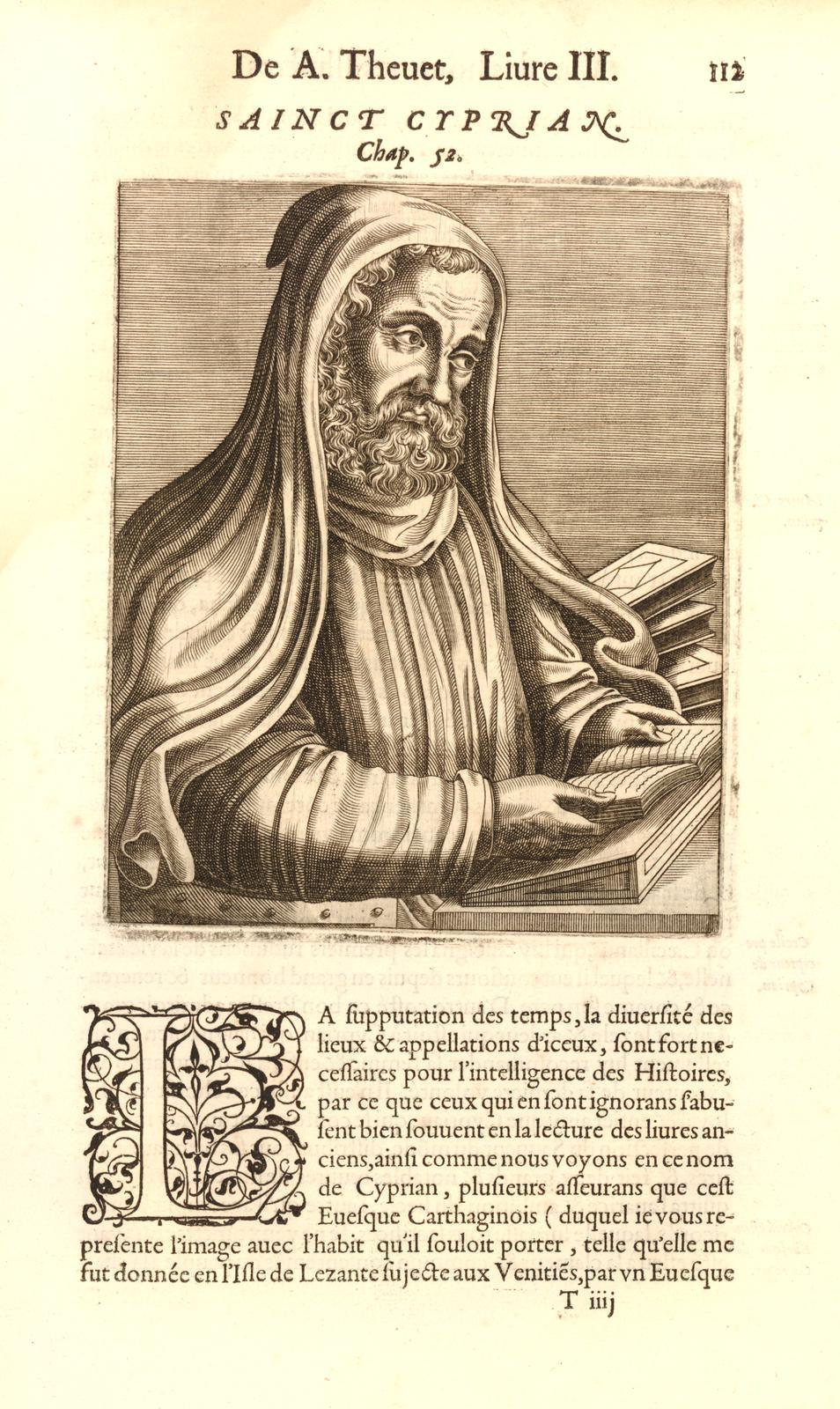
Valerian then turned on the clergy, and Cyprian learned from his messengers what the emperor's rescript to the Senate ordered. Valerian banished him to Curubis, and in 258 the proconsul sentenced him and he was beheaded with the sword, as his deacon Pontius tells it.
In Their Own Words
Perpetua of Carthage (182 to 203)
The Passion of Perpetua and Felicity, her own narrative, chapter 2, section 2
Perpetua told her father what she was.
“I am a Christian.”
Early church martyr
About this saying1 paragraph
Perpetua wrote this in prison at Carthage early in the third century, telling how her father begged her to give up her confession.
Cyprian (died 258)
On the Lapsed, 27
Cyprian called a certificate the testimony of a Christian against himself.
“That profession of one who denies, is the testimony of a Christian disowning what he had been.”
Early Church
About this saying1 paragraph
Cyprian wrote this in 251, after the persecution, to the fallen of his own church.
Cyprian
Epistle 81, to Successus, section 1
Cyprian sent word of Xistus's death to his fellow bishops.
“But know that Xistus was martyred in the cemetery on the eighth day of the Ides of August, and with him four deacons.”
Early Church
About this saying1 paragraph
Cyprian wrote this in 258 from Carthage, after the messengers he had sent to Rome came back.
Dionysius of Alexandria (died 264)
Letter to Fabius of Antioch, in Eusebius, Church History, 6.42.6
Dionysius asked whether the martyrs' mercy should stand.
“Shall we have the same judgment and rule as theirs, and observe their decision and charity, and show mercy to those whom they pitied?”
Early Church
About this saying1 paragraph
Dionysius, bishop of Alexandria, wrote to Fabius of Antioch after the persecution of 250 about the fallen whom the martyrs had received.
Novatian
The Roman clergy to Cyprian, Epistle 30 in the Ante-Nicene Fathers, 8
The clergy of Rome left the fallen to the judgment of God.
“to them, finally, such cautious and careful help should be ministered, God Himself knowing what He will do with such, and in what way He will examine the balance of His judgment”
Presbyter of Rome
About this saying1 paragraph
The clergy of Rome wrote this to Carthage in the third century, while their own church had no bishop.
Where the Churches Divided Over the Fallen
Cyprian received the fallen after penance, and Novatian refused them.
Cyprian held that the fallen could be received after penance, and that a Christian who took a certificate had fallen less far than one who sacrificed. Novatian held that the church could not receive those who had denied Christ, and his followers formed their own churches. A synod of sixty bishops at Rome held Novatian and his followers to be outside the church. The page on the certificates sets out both readings with their sources.
Books to Read Next
The Passion of Perpetua and Felicity
Vibia Perpetua and an unnamed editor, translated by R. E. Wallis · 1885
Wallis's English of 1885 is free to read and holds the whole Latin record in translation.
Free at the Christian Classics Ethereal LibraryThe Ante-Nicene Fathers, volume 5
Alexander Roberts and James Donaldson, editors · 1886
It holds Cyprian's letters and treatises and his deacon Pontius's Life of Cyprian.
Free at the Christian Classics Ethereal LibraryWhat the Third Century Left
The third century left the church a diary from a prison cell, a stack of certificates from Egypt and a hard question about the fallen. The last and longest persecution came at the start of the fourth.
Sources
Scripture is the Berean Standard Bible.
- The Holy Bible, Berean Standard Bible (read 2026)
- The Passion of Perpetua and Felicity, in R. E. Wallis's English, The Ante-Nicene Fathers, volume 3 (1885); J. P. Kirsch, The Catholic Encyclopedia, volume 6 (1909), for 7 March 203.
- Cyprian, On the Lapsed 27 and Epistle 81, translated by Ernest Wallis, and Pontius, Life of Cyprian 17 and 18, The Ante-Nicene Fathers, volume 5 (1886), with the editor's notice.
- Epistle 30 of Cyprian's correspondence, from the clergy of Rome.
- Dionysius of Alexandria, Letter to Fabius of Antioch, in Eusebius, Church History 6.42, translated by A. C. McGiffert (1890)
Keep Studying
Read it1
People and groups2
Subjects10
Church history2