
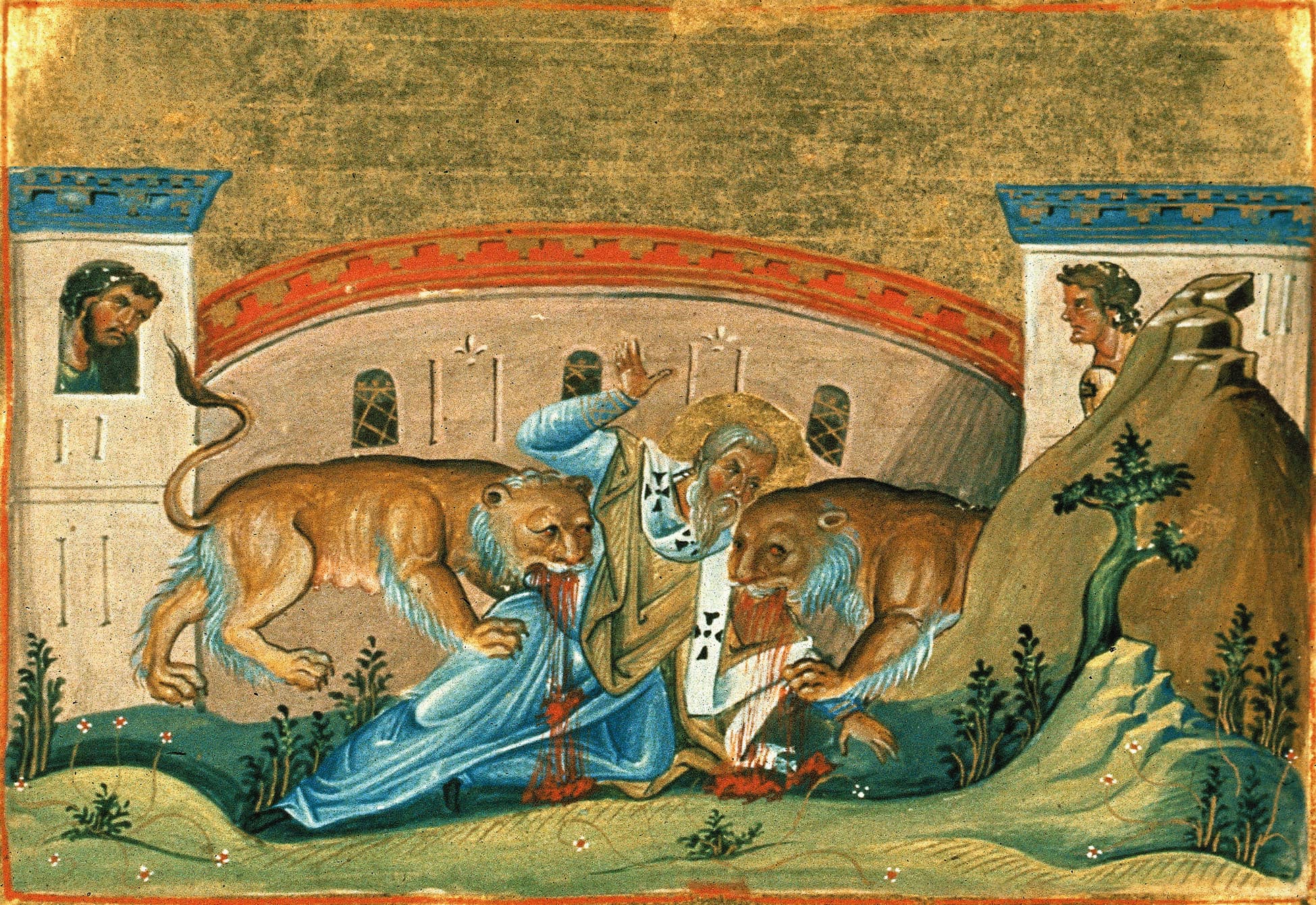
The martyrdom of Ignatius, a miniature of the Menologion of Basil II, about 985. Public domain.
Early in the second century · Story · Featured Study
Ignatius on the Road to Rome
What Eusebius, Polycarp and Irenaeus record of him, and what scholars hold of his letters.
- Where
- Antioch, Troas
- When
- Early in the second century (probable)
Ignatius begged the church at Rome not to save him from the beasts.
For to me, to live is Christ, and to die is gain.
Summary
Ignatius was the second bishop of Antioch in Syria. Early in the second century he was taken under guard to Rome to be given to the beasts, and on the way he wrote seven letters to the churches. Since Lightfoot's edition of 1885, most scholars have taken all seven letters as his own.
- He wrote four of the letters at Smyrna and three at Troas.
- Ussher dated his death to 107 and Pearson to 116.
- The year of his death is not known.
The Texts His Letters Echo
His words on the way to death echo John 12, 1 Corinthians 11 and 15, and Galatians 2.
Ignatius wrote to the churches as a man going to die, in words that echo Jesus and Paul.
Truly, truly, I tell you, unless a kernel of wheat falls to the ground and dies, it remains only a seed; but if it dies, it bears much fruit.Ignatius took the grain that dies in this verse for his own death, in his letter to the Romans, chapter 4.
If I fought wild beasts in Ephesus for human motives, what did I gain? If the dead are not raised, “Let us eat and drink, for tomorrow we die.”Ignatius took Paul's fight with beasts for his guard on the road, in his letter to the Romans, chapter 5.
You are to imitate me, just as I imitate Christ.Ignatius carried Paul's call to imitation as far as the cross, in his letter to the Romans, chapter 6.
I have been crucified with Christ, and I no longer live, but Christ lives in me. The life I live in the body, I live by faith in the Son of God, who loved me and gave Himself up for me.Ignatius wrote to Rome that his love had been crucified.
1 Corinthians 11:1, Galatians 2:20
Where He Wrote Each Letter
Eusebius names each letter and its city in Church History 3.36.
The seven letters by the city each was written in.
| Written at | The letter | Sent to |
|---|---|---|
| Smyrna | To the Ephesians | The church of Ephesus |
| Smyrna | To the Magnesians | The church of Magnesia |
| Smyrna | To the Trallians | The church of Tralles |
| Smyrna | To the Romans | The church of Rome |
| Troas | To the Philadelphians | The church of Philadelphia |
| Troas | To the Smyrnaeans | The church of Smyrna |
| Troas | To Polycarp | Polycarp at Smyrna |
The Road From Antioch to Rome
From his church at Antioch to the news Polycarp asked for.
Eusebius names Ignatius the second bishop of Antioch, after Evodius.
He reports that Ignatius was sent from Syria to Rome and became food for wild beasts for his witness to Christ. He went through Asia, Eusebius writes, "under the strictest military surveillance", and strengthened the churches in the cities where he stopped.
But I consider my life of no value to me, if only I may finish my course and complete the ministry I have received from the Lord Jesus—the ministry of testifying to the good news of God’s grace.Ignatius went to Rome as Paul went to Jerusalem, with his death in view.
Eusebius writes that he came to Smyrna, where Polycarp was.
Polycarp later wrote to the church at Philippi and named "the blessed Ignatius" among those who had suffered. He sent the Philippians the letters of Ignatius he had, and asked them for any sure news of Ignatius and those with him.
Lightfoot dated Polycarp's letter just after the martyrdom, "say A.D. 110, or A.D. 118 at the latest."
Do not fear what you are about to suffer. Look, the devil is about to throw some of you into prison to test you, and you will suffer tribulation for ten days. Be faithful even unto death, and I will give you the crown of life.The church at Smyrna, where Polycarp was, is told to be faithful even unto death.
Which Letters Are His
The editions from Ussher in 1644 to Cureton in 1845.
The editors of the Ante-Nicene Fathers count fifteen letters under the name of Ignatius, and they say all critics reject the first eight of them.
The seven Eusebius names survive in a shorter and a longer Greek form, and the Ante-Nicene editors write that scholars for the most part accept the shorter as the genuine letters.
James Ussher printed the Latin of the shorter seven in 1644, and Isaac Voss the Greek in 1646. The Greek of the letter to the Romans was printed by Ruinart in 1689.
In 1845 William Cureton published a Syriac version of three letters, to Polycarp, the Ephesians and the Romans.
Lightfoot placed the making of the longer form in the latter half of the fourth century.
How the Key Verse Was Taught
Three writers of three centuries on Philippians 1:21.
Ambrose of Milan (died 397)
On the Decease of His Brother Satyrus, Book 2
Ambrose of Milan read Paul's words as a call to die with Christ in order to live with Him.
“We see, then, that this death is a gain and life a penalty, so that Paul says: ‘To me to live is Christ and to die is gain.’ What is Christ but the death of the body, the breath of life? And so let us die with Him, that we may live with Him.”
on Philippians 1:21Patristic
Nicolaus Ludwig von Zinzendorf (1700 to 1760)
Spangenberg (1775), page 2164; Hutton (1909), page 180
Zinzendorf, in the eighteenth century, named Christ his one passion.
“I have … but one passion—’tis He, ’tis only He.”
Moravian
Albert Barnes (1798 to 1870)
Notes, Explanatory and Practical, on the Old and New Testaments (1832 to 1869)
Albert Barnes read the verse as Paul's one aim in living, the glory of Christ.
“His aim was not honor, learning, gold, pleasure; it was, to glorify the Lord Jesus. This was the single purpose of his soul - a purpose to which he devoted himself with as much singleness and ardor as ever did a miser to the pursuit of gold, or a devotee of pleasure to amusement, or an aspirant for fame to ambition.”
on Philippians 1:21Evangelical
In Their Own Words
Five sayings of Ignatius, in the shorter Greek as the Ante-Nicene Fathers give it.
Ignatius of Antioch (died 108)
The Epistle to the Romans, chapter 4
The wheat of God
“I am the wheat of God, and let me be ground by the teeth of the wild beasts, that I may be found the pure bread of Christ.”
Early Church
About this saying1 paragraph
He wrote this to the church at Rome, and Irenaeus, writing between 182 and 188, quotes it from "a certain man of ours".
Ignatius of Antioch
The Epistle to the Romans, chapter 5
Ten leopards
“From Syria even unto Rome I fight with beasts, both by land and sea, both by night and day, being bound to ten leopards, I mean a band of soldiers, who, even when they receive benefits, show themselves all the worse. But I am the more instructed by their injuries [to act as a disciple of Christ]; ‘yet am I not thereby justified.’ May I enjoy the wild beasts that are prepared for me; and I pray they may be found eager to rush upon me, which also I will entice to devour me speedily, and not deal with me as with some, whom, out of fear, they have not touched. But if they be unwilling to assail me, I will compel them to do so. Pardon me [in this]: I know what is for my benefit. Now I begin to be a disciple. And let no one, of things visible or invisible, envy me that I should attain to Jesus Christ. Let fire and the cross; let the crowds of wild beasts; let tearings, breakings, and dislocations of bones; let cutting off of members; let shatterings of the whole body; and let all the dreadful torments of the devil come upon me: only let me attain to Jesus Christ.”
on 1 Corinthians 15:32Early Church
About this saying1 paragraph
Writing to Rome in the second century's first years, he told how his guard treated him on the road.
Ignatius of Antioch
The Epistle to the Romans, chapter 6
An imitator of the passion
“Permit me to be an imitator of the passion of my God.”
Early Church
About this saying1 paragraph
In the same letter of about 110, he asked to share in the passion of his God.
Ignatius of Antioch
The Epistle to the Smyrnaeans, chapter 8
Where Jesus Christ is
“Wherever the bishop shall appear, there let the multitude [of the people] also be; even as, wherever Jesus Christ is, there is the Catholic Church.”
Early Church
About this saying1 paragraph
At Troas, in the years about 110, he told the church at Smyrna to hold to its bishop.
Ignatius of Antioch
The Epistle to Polycarp, chapter 3
Like an anvil
“Stand firm, as does an anvil which is beaten. It is the part of a noble athlete to be wounded, and yet to conquer.”
Early Church
About this saying1 paragraph
To Polycarp, also from Troas, he wrote in the second century to stand firm against those who teach strange doctrines.
Ignatius of Antioch, Ignatius of Antioch, Ignatius of Antioch
Where Historians Disagree
Three questions of the letters and his death, with the writers who answer them.
Are the seven letters his?3 paragraphs
Lightfoot, in his edition of 1885 and its second edition of 1889, held the seven letters of the shorter form genuine, as Theodor Zahn had in 1873. McGiffert wrote in 1890 that since Lightfoot's work the question was settled for almost all scholars.
McGiffert named the strongest case against them: the developed form of church government the letters show, and their attacks on heresy.
Timothy Barnes argued in 2008 that Ignatius knew the writings of the Gnostic Ptolemaeus, and that the letters were probably written in the 140s.
When did he die?2 paragraphs
The Chronicle of Eusebius gives the tenth year of Trajan, which McGiffert reckons as 107. Lightfoot called that date of no authority and placed the death within a few years of 110.
Harnack, McGiffert reports, put it in the reign of Hadrian.
Did he die at Rome?2 paragraphs
McGiffert writes that Origen is the first to say Ignatius suffered at Rome, and that the report might have come from the letters themselves.
The accounts of his martyrdom belong to the fourth century and later. The Ante-Nicene translators note that no reference to the Martyrdom of Ignatius is found in the first six centuries.
Books to Read Next
The seven letters are free to read online in two English editions.
The Apostolic Fathers
J. B. Lightfoot, completed by J. R. Harmer · 1891
It gives Lightfoot's English of the seven letters with Clement and Polycarp in one volume.
Free at the Internet ArchiveThe Ante-Nicene Fathers, volume 1
Edited by Alexander Roberts and James Donaldson · 1885
It gives Clement, Polycarp and Ignatius with the notes of its editors.
Free at the Christian Classics Ethereal LibraryWhat Ignatius Left
Ignatius left the church no account of his death, only the letters he wrote on the road. To the Ephesians he called the one bread of the church the medicine of immortality.
Sources
Scripture is the Berean Standard Bible.
- The Holy Bible, Berean Standard Bible (read 2026)
- Eusebius, Church History 3.22 and 3.36, translated by A. C. McGiffert, Nicene and Post-Nicene Fathers, second series, volume 1 (1890), with McGiffert's notes.
- The Ante-Nicene Fathers, volume 1 (1885): Ignatius, the shorter recension, with the editors' notes; Polycarp, To the Philippians 9 and 13; Irenaeus, Against Heresies 5.28.4.
- J. B. Lightfoot, The Apostolic Fathers, part 2, volume 1, second edition (London, 1889)
- Theodor Zahn, Ignatius von Antiochien (Gotha, 1873), contents, section V.
- Timothy D. Barnes, "The Date of Ignatius", The Expository Times 120.3 (2008), pages 119 to 130, the abstract.
- Ambrose of Milan, On the Decease of His Brother Satyrus, book 2.
- Nicolaus Ludwig von Zinzendorf, as Spangenberg (1775) and Hutton (1909) give his words.
- Albert Barnes, Notes, Explanatory and Practical, on Philippians 1:21.
Keep Studying
Read it1
People and groups6
Places2
Trials of life1
Symbols1
Church history2
Doctrines2