
Nicomedia, AD 303, to the edict of 311 · Story · Featured Study
The Great Persecution, 303
Lactantius at Nicomedia and Eusebius in the East wrote down what the emperors' orders did to the churches.
Diocletian and Galerius watched from the palace and argued over whether to set the church at Nicomedia on fire.
- Where
- Nicomedia, Cirta, Egypt, Palestine
- Who
- Diocletian, Galerius, Lactantius, Eusebius of Caesarea
- When
- AD 303 to 311
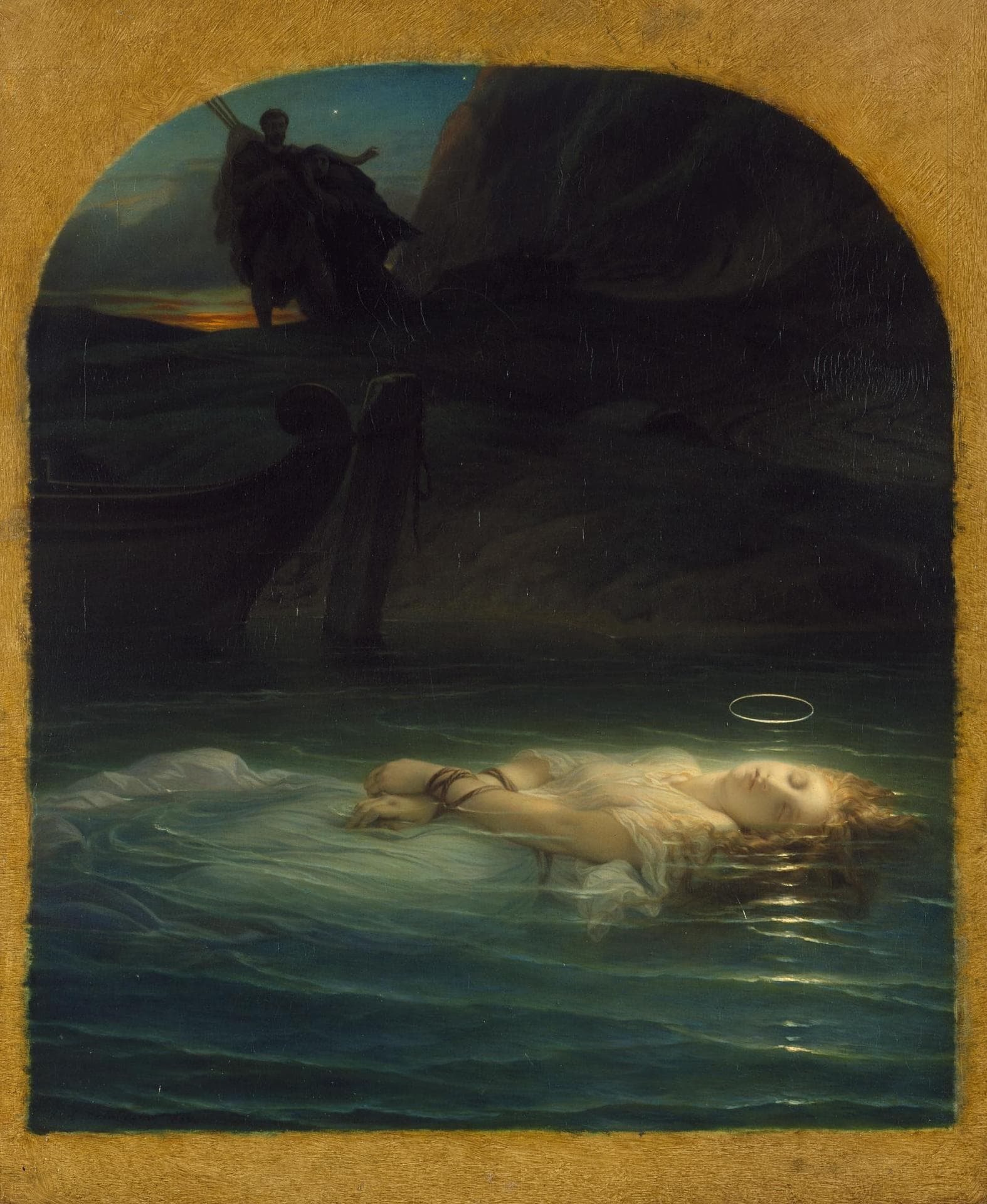
Paul Delaroche, A Christian Martyr Drowned in the Tiber During the Reign of Diocletian, 1853. Public domain.
And when the Lamb opened the fifth seal, I saw under the altar the souls of those who had been slain for the word of God and for the testimony they had upheld.
Summary
The last persecution of the Roman empire began at Nicomedia in February 303. It ran in the East until 311, under Diocletian and his junior emperor Galerius.
- Lactantius dates its first day to the feast of the god Terminus.
- Galerius ended it by his edict of 30 April 311.
- The churches of Africa divided afterwards over who had handed over the Scriptures.
The Texts of the Word That Was Burned
Eusebius read the persecution through a psalm, and Jesus had spoken of words that would outlast every edict.
McGiffert noted in 1890 that the first edict's order against the sacred books was entirely new.
He pours out contempt on the nobles and makes them wander in a trackless wasteland.
Eusebius applies the psalm to the shepherds of the churches mocked and scattered in 303.
Psalm 107:40BSB
Heaven and earth will pass away, but My words will never pass away.
The promise stands against an edict that ordered the Scriptures burned in the market-places.
The Four Edicts
Lactantius and Eusebius between them give four orders.
The orders moved from the church's property to its clergy and then to its people.
| Edict | When | What it commanded | The witness |
|---|---|---|---|
| The first | 24 February 303 at Nicomedia, the day after the church there was razed | Churches razed, the Scriptures burned, Christians stripped of rank and of their rights at law | Lactantius 13; Eusebius 8.2.4 |
| The second | Soon after, following risings in Melitene and in Syria | The rulers of the churches imprisoned | Eusebius 8.2.5 and 8.6.8 |
| The third | After the second | The imprisoned set free if they sacrificed, and tortured if they refused | Eusebius 8.6.10 |
| The fourth | In the second year of the persecution | All the people in every city to sacrifice at once | Eusebius, Martyrs of Palestine 3.1 |
From Nicomedia to Every Province
The persecution began in the emperor's own city, and in Palestine, Eusebius says, it ran for eight complete years.
Lactantius writes that while Diocletian sacrificed in the East, Christians among his attendants made the sign of the cross, and the soothsayers could read nothing in the victims. Diocletian ordered his household and his soldiers to sacrifice.
Through a winter at Nicomedia, Galerius, his junior emperor, pressed him to destroy the Christians, urged on, Lactantius says, by his mother, a worshipper of the mountain gods. Diocletian sent to ask Apollo at Miletus and then agreed, on condition that the work be done without bloodshed.
At dawn on the chosen day the prefect's men forced the church at Nicomedia, burned the books they found and plundered the furnishings. The guards levelled the building in a few hours.
The next day the edict was posted, and a man tore it down and was burned alive. A fire in the palace, which Lactantius says Galerius's agents set, was blamed on the Christians, and a second fire followed fifteen days later.
Then Diocletian made his wife and daughter sacrifice. Presbyters and other officers of the church were put to death with their families, and altars were set in the courts so that no one could bring a case without first offering incense.
The servants of the palace1 paragraph
A servant of the palace named Peter refused to sacrifice and was beaten, salted and roasted until he died. Dorotheus and Gorgonius, of the emperor's household, were strangled, and Anthimus, bishop of Nicomedia, was beheaded.
In the provinces the prisons filled with bishops, presbyters, deacons, readers and exorcists, Eusebius writes, until there was no room left in them for criminals.
A small town of Phrygia whose people, its officials among them, all confessed Christ was surrounded by soldiers and burned with its men, women and children.
In the Thebaid of Egypt Eusebius saw executions by the sword and by fire carried out on crowds in a single day. He writes that the condemned received the sentence with joy and sang hymns until they died.
The Search at Cirta, 19 May 303
The officers wrote down what they took from the church at Cirta.
The record survives because it was read aloud at a later trial, and Vassall-Phillips printed it in English in 1917. It is dated in the eighth consulship of Diocletian, on the nineteenth of May, from the acts of Munatius Felix, the city's perpetual flamen.
At the house where the Christians met, Felix ordered Bishop Paul to bring out "the Scriptures of the Law" and anything else they had.
The officers' inventory begins "Two golden chalices, also six silver chalices" and runs on through lamps and candlesticks to eighty-two women's garments, sixteen men's garments and forty-seven pairs of women's shoes.
The bookcases were found empty, and the subdeacon Silvanus brought out a silver casket and a candlestick. The officers then went to the readers' houses, and several of them gave up codices.
The Handers-Over and the Division in Africa
Optatus and the record of a later trial name men who gave up the books.
Optatus, writing against the Donatists, names bishops who "impiously betrayed the records of the law of God". Eusebius, by his own word, chose not to record those who were shaken by the persecution.
Bishops of Africa who charged Caecilian of Carthage with the handing over broke communion with him, and the quarrel reached the emperor Constantine. The editor of 1917 sets out that a trial of 320 proved the same charge against Silvanus. By then Silvanus had become a bishop of the party that broke away.
The churches honoured those who would not give up the books and argued over those who did.
How the Key Verse Was Taught
Three writers of three centuries on the souls under the altar.
Tertullian (died 220)
Scorpiace
Tertullian read the souls under the altar as the martyrs, resting in the hope of vindication.
“Who, pray, are these so blessed conquerors, but martyrs in the strict sense of the word? For indeed theirs are the victories whose also are the fights; theirs, however, are the fights whose also is the blood. But the souls of the martyrs both peacefully rest in the meantime under the altar, and support their patience by the assured hope of revenge; and, clothed in their robes, wear the dazzling halo of brightness, until others also may fully share in their glory.”
on Revelation 6:9Patristic
In Their Own Words
The historian, a bishop who gave up the goods, and two martyrs, in the English of their editors before 1930.
Phileas of Thmuis (died 306)
Letter on the martyrs of Alexandria, in Eusebius, Church History, 8.10.2
Christ became man on our account
“For they understood that our Lord Jesus Christ had become man on our account, that he might cut off all sin and furnish us with the means of entrance into eternal life.”
Early Church
About this saying1 paragraph
Phileas, bishop of Thmuis in Egypt, wrote this of the martyrs of Alexandria before his own death in the persecution, as Eusebius keeps his letter.
Eusebius of Caesarea (died 339)
Church History, 8.2.1
With our own eyes
“All these things were fulfilled in us, when we saw with our own eyes the houses of prayer thrown down to the very foundations, and the Divine and Sacred Scriptures committed to the flames in the midst of the market-places”
Patristic
About this saying1 paragraph
Eusebius wrote this in the fourth century of what he had seen.
Paul of Cirta
The record of the search at Cirta, in the Proceedings before Zenophilus, The Work of St. Optatus, appendix II, page 353
The lectors have the Scriptures
“The lectors have the Scriptures. But we surrender what we have here.”
Bishop
About this saying1 paragraph
Paul, bishop of Cirta, gave this answer on 19 May 303 as he gave up the church's goods, as the city's record has it.
Felix of Thibiuca
The Acts of Felix, in Arthur James Mason, The Persecution of Diocletian, page 173
Better to obey God
“for me to be burned myself than for the Divine Scriptures, for it is better to obey God than men.”
Martyr
About this saying1 paragraph
Felix, bishop of Thibiuca in Africa, gave this answer in 303, in Mason's retelling of 1876.
Paul of Cirta, Felix of Thibiuca
Who Drove It, and How Many Died
The two witnesses give different causes, and no ancient writer gives a total of the dead.
Lactantius lays the persecution on Galerius and his mother, with Diocletian yielding to them. Eusebius gives Constantine's own memory that Apollo said "the righteous men on earth" kept him from speaking the truth, and that a priest named them as the Christians.
Lactantius too has Diocletian consult Apollo at Miletus before he agreed, so the two accounts meet in the oracle. Both men wrote after the persecutors had fallen, and Lactantius wrote to show their deaths as God's judgment.
Gibbon took Eusebius's ninety-two martyrs of Palestine as a base and reckoned somewhat less than two thousand judicial executions in the whole persecution. Schaff answered that the Palestinian list was "a select list" and no fair basis for such a sum, and the number is not known.
An article of 1954 in the Harvard Theological Review numbered the edicts one to four, and its notes report doubt, from Bigg and from Jones, that the fourth was ever published in the West.
Books to Read Next
Of the Manner in Which the Persecutors Died
Lactantius, translated by William Fletcher · 1886
The witness at Nicomedia tells the first edict and the fall of the persecutors.
Read Lactantius free at CCELThe Persecution of Diocletian
Arthur James Mason · 1876
Mason tells the persecution edict by edict, and retells the Acts of Felix from a later form of them.
Read Mason free at the Internet ArchiveThe Work of St. Optatus against the Donatists
Optatus of Milevis, translated by O. R. Vassall-Phillips · 1917
Vassall-Phillips gives the Cirta search in English in his second appendix.
Read Vassall-Phillips free at the Internet ArchiveWhat the Great Persecution Left
Jesus said His words would not pass away, and the Scriptures the first edict ordered burned are the Scriptures the church still reads.
Sources
Scripture is the Berean Standard Bible.
- The Holy Bible, Berean Standard Bible (read 2026)
- Lactantius, Of the Manner in Which the Persecutors Died 10 to 15, 34, 35, 48 and 52, translated by William Fletcher, Ante-Nicene Fathers, volume 7 (1886)
- Eusebius, Church History 8.2 to 8.11 and the Martyrs of Palestine 3 and 13, translated by Arthur Cushman McGiffert, and the Life of Constantine 2.50 to 2.51, translated by Ernest Cushing Richardson, Nicene and Post-Nicene Fathers, second series, volume 1 (1890)
- O. R. Vassall-Phillips, The Work of St. Optatus, Bishop of Milevis, against the Donatists (London, 1917), appendix II, the Proceedings before Zenophilus, pages 346 to 381.
- Optatus, Against the Donatists 1.13, in the English of 1917.
- Arthur James Mason, The Persecution of Diocletian (Cambridge, 1876), pages 172 to 174.
- Edward Gibbon, The Decline and Fall of the Roman Empire, chapter 16 (1776), in Milman's edition.
- Philip Schaff, History of the Christian Church, volume 2 (third edition, 1883), sections 24 and 26.
- G. E. M. de Ste. Croix, "Aspects of the 'Great' Persecution", Harvard Theological Review 47 (1954), pages 75 to 113, the opening and the notes.
Keep Studying
Studies4
People and groups6