
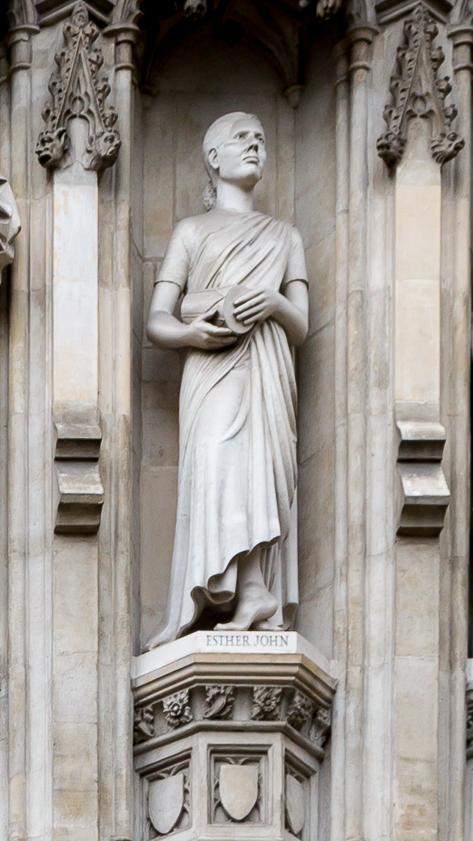
CEphoto, Uwe Aranas, 2013. CC BY-SA 3.0.
Pakistan, to 1960 · Person · Featured Study
Esther John
She left her family and her name for Christ, and she was found murdered in Pakistan in 1960.
A girl reading Isaiah 53 in secret came to faith, and she left her home and her name.
But He was pierced for our transgressions, He was crushed for our iniquities; the punishment that brought us peace was upon Him, and by His stripes we are healed.
But He was pierced for our transgressions, He was crushed for our iniquities; the punishment that brought us peace was upon Him, and by His stripes we are healed.
- Born
- 14 October 1929, as Qamar Zia; the place is not recorded (probable)
- Died
- 2 February 1960, found dead at Chichawatni
- Places
- Karachi, Sahiwal, Gujranwala, Chichawatni
Summary
Esther John was born Qamar Zia, one of seven children, and came to faith as a schoolgirl. She ran from her family's plans for her marriage, took a new name and trained to teach. She worked among the women of the villages around Chichawatni in the Punjab, and there someone killed her in her bed.
- Her life is told by Westminster Abbey, and her own words come through Barnabas Aid.
- The Abbey names no killer and gives no motive.
- Her statue has stood over the west door of the Abbey since 1998.
The Chapter She Read
Isaiah 53 brought her to faith, and Mark 10 speaks to those who leave their families for Christ.
The Abbey writes that she was reading the 53rd chapter of Isaiah when a sense of conversion came over her. The question of this life is what a young woman paid for a faith her family did not share, as far as two accounts can tell it.
“Truly I tell you,” Jesus replied, “no one who has left home or brothers or sisters or mother or father or children or fields for My sake and for the gospelChrist promised a return to all who give up their own for Him.
The Life in Order
The dates all come from the Abbey.
Less than five years passed from her flight to Sahiwal to her death.
- 14 October 1929Birth as Qamar ZiaThe Abbey
- After the age of seventeenA Christian school, and her conversionThe Abbey
- 30 June 1955Train north to SahiwalThe Abbey
- September 1956Entry to the United Bible Training Centre, GujranwalaThe Abbey
- April 1959End of her studies, and the move to ChichawatniThe Abbey
- 2 February 1960Her death at ChichawatniThe Abbey
- 1998Her statue unveiled at Westminster AbbeyThe Abbey
Each step of the life stands with its witness.
From Qamar Zia to Esther John
A schoolgirl's secret faith led her out of her family and into the villages of the Punjab.
She went first to a government school and later to a Christian one. There the faith of one of her teachers moved her deeply, and she began to read the Bible for herself.
When India was partitioned, her family moved to the new state of Pakistan. In Karachi she met a missionary, Marian Laugesen, who gave her a New Testament at her request. Her faith grew in private and even in secret. Seven years later, afraid that she would be married to a Muslim husband, she ran away from home.
She went back to Laugesen in Karachi and worked for a time in an orphanage, and there she took the name Esther John. Her family still pressed her to come home and marry. She went north to Sahiwal, worked at a mission hospital and stayed with Bishop Chandu Ray.
She trained as a teacher at Gujranwala and then went to live with American Presbyterian missionaries at Chichawatni, about thirty miles from Sahiwal. She rode by bicycle from village to village, taught women to read and worked beside them in the cotton fields. At times her family seemed calm toward her, and at other times the tension rose.
The Two Accounts
The Abbey tells her life and death, and Barnabas Aid carries her own account of her faith.
The Abbey calls her death "sudden and mysterious". It writes that she was found dead in her bed at the house where she lived, and that she "had been brutally murdered".
The Abbey cites no police or court record of her death and quotes no words of her own.
It sets one line apart beside the account of her burial, "Leave all other ties, Jesus is calling", and gives no name, date or source for it.
In Their Own Words
Two of her sayings and a word of the pastor who baptised her come from Barnabas Aid's account, archived in May 2023.
Esther John (1929 to 1960)
Barnabas Aid, "This girl was in love only with your Christ", archived May 2023, her account of Isaiah 53
Jesus is alive for ever
“God, by his grace, showed me that there was life and power in this book. Then I began to realise that Jesus is alive for ever.”
Protestant
About this saying1 paragraph
She later described a day before 1947 when her class was set to learn parts of Isaiah 53 by heart.
Esther John
Barnabas Aid, "This girl was in love only with your Christ", archived May 2023, her call to teach
What it has done for me
“This book has great power. I want to see it do for others what it has done for me.”
Protestant
About this saying1 paragraph
She told friends this after her baptism in 1955, when she felt that God wanted her to teach the Bible.
Padri Alexander David
Barnabas Aid, "This girl was in love only with your Christ", archived May 2023, her baptism
Only to Christ
“I told her that she did not belong to anyone in this world but only to Christ who had died on the Cross for her and betrothed her unto Himself forever and ever.”
Protestant
About this saying1 paragraph
Padri Alexander David baptised her at Sahiwal in 1955 and later wrote of what he told her that day.
What the police said
The saying1 paragraph
Attributed to the police by Barnabas Aid, which reports that in 1960 they searched her books and papers and afterwards said to Dale White, in whose home she lived: “Sir, we have found no clue. This girl was in love only with your Christ.”
The People Around Her
The Abbey names a teacher, a missionary, a bishop and the family she left.
The missionaries took her in when her family pressed her to marry.
| Person | Tie to Esther John | The witness |
|---|---|---|
| Her family | One of seven children; they pressed her to come home. | The Abbey |
| A teacher | The teacher at the Christian school whose faith moved her. | The Abbey |
| Marian Laugesen | A missionary at Karachi, to whom she turned twice. | The Abbey |
| Chandu Ray | The first Anglican bishop of Karachi. | The Abbey |
| The missionaries at Chichawatni | American Presbyterians with whom she lived from 1959. | The Abbey |
| The village women | Her pupils in the countryside around Chichawatni. | The Abbey |
The Places of Her Life
Her life ran from Karachi on the coast to the towns of the Punjab.
She died thirty miles from the town where she was buried.
| Place | What the witnesses say | The witness |
|---|---|---|
| Karachi | The city of her first Christian contacts. | The Abbey |
| Sahiwal | The town of her grave. | The Abbey |
| Gujranwala | She trained to teach at the United Bible Training Centre. | The Abbey |
| Chichawatni | She lived there from 1959, and she died there. | The Abbey |
| Westminster Abbey, London | The site of her statue since 1998. | The Abbey |
How She Is Remembered
Her grave and a chapel stand at Sahiwal, and her statue in London.
Her body was carried to the Christian cemetery at Sahiwal and buried there. A memorial chapel was later built in front of the nurses' home in the grounds of the hospital, and the Abbey writes that the Christians she lived among remember her with devotion.
The Abbey chose her for one of its ten niches. Her statue is the work of Corin Johnson of the Neil Simmons studio.
How the Key Verse Was Taught
Athanasius and Matthew Henry read the wounds of the Servant.
Athanasius of Alexandria (296 to 373)
Discourses Against the Arians 3.31
Athanasius read the verse of the Son who carried our sins in His own body.
“It did not say, ‘He remedied our infirmities,’ lest, as being external to the body and only healing it, as he has always done, he should leave people subject still to death. Rather, he carries our infirmities, and he himself bears our sins, that it might be shown that he has become human for us, and that the body that in him bore them was his own body.”
on Isaiah 53:5Patristic
Matthew Henry (1662 to 1714)
Commentary on the Whole Bible
Matthew Henry read the wounds as the wounds our sin deserved.
“Wounds and bruises were the consequences of sin, what we deserved and what we had brought upon ourselves, ch. i. That these wounds and bruises, though they are painful, may not be mortal, Christ was wounded for our transgressions, was tormented or pained (the word is used for the pains of a woman in travail) for our revolts and rebellions.”
on Isaiah 53:5Puritan
What the Witnesses Leave Open
The record leaves open who killed her, why, and where she was born.
Who killed her, and whyWestminster Abbey
The Abbey counts her among the martyrs, and its account of her death names no one and gives no reason. That account shows that she was murdered and that she had turned to Christ against her family's wishes. It ties the two together only by the Abbey's choice of her.
Where she was bornWestminster Abbey
The Abbey gives the day of her birth and names no town or province.
Books to Read Next
The Terrible Alternative: Christian Martyrdom in the Twentieth Century
Andrew Chandler, editor · 1998
It gathers studies of the martyrs of the twentieth century.
In print: find it wherever books are sold.
What Esther John Left
She left the women she taught to read and the name she chose. She was thirty years old.
Sources
Scripture is the Berean Standard Bible.
- The Holy Bible, Berean Standard Bible (read 2026)
- Westminster Abbey, "Esther John", the Abbey's commemoration page.
- Barnabas Aid, "This girl was in love only with your Christ", archived 18 May 2023, which points to a longer version of her story in Patrick Sookhdeo, "Mission and conversion in Pakistan: Esther John (Qamar Zia)", in Andrew Chandler, ed., The Terrible Alternative (Cassell, 1998), pages 102 to 116; the chapter was not opened.
- Athanasius, Discourses Against the Arians 3.31, on Isaiah 53.
- Matthew Henry, Commentary on the Whole Bible (1710), on Isaiah 53:5.
Keep Studying
Studies1
People and groups4
Subjects6
Trials of life1