
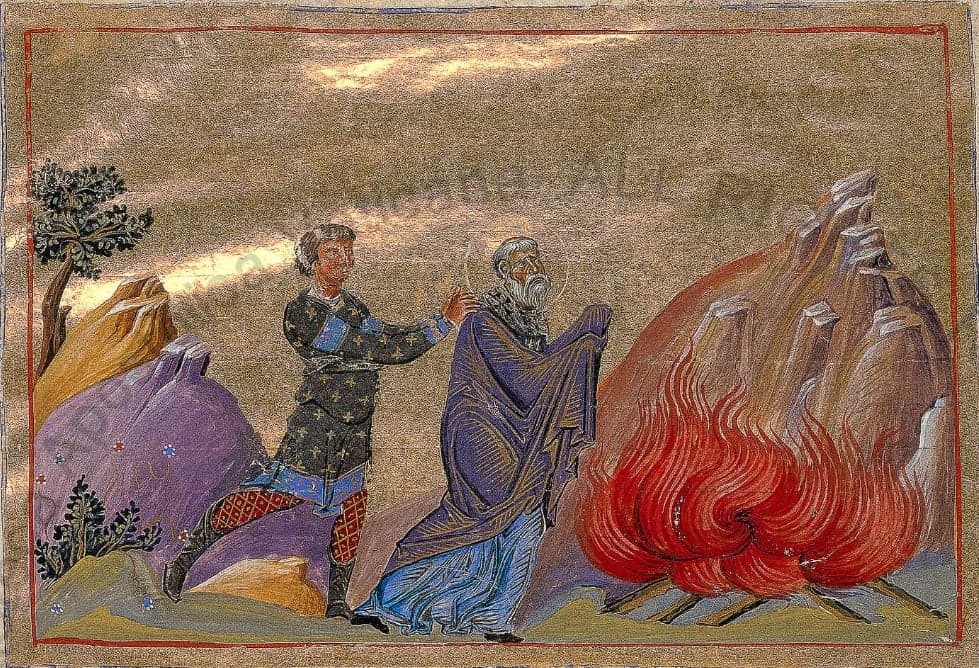
The Martyrdom of Polycarp, Menologion of Basil II, about 985. Public domain.
Smyrna, to about AD 155 · Person · Featured Study
Polycarp
He was bishop of Smyrna in the second century, and he died in its stadium about 155.
- Born
- about AD 69, if his eighty-six years count from his birth (proposed)
- Died
- about AD 155, by the proconsul's term; the letter of his church names no year (probable)
- Places
- Smyrna, Rome, Philippi
Ordered to curse Christ, an old bishop answered that he had served Him eighty-six years.
Do not fear what you are about to suffer. Look, the devil is about to throw some of you into prison to test you, and you will suffer tribulation for ten days. Be faithful even unto death, and I will give you the crown of life.
Summary
Irenaeus saw Polycarp as a boy. He says apostles taught him and that he spoke of John. One letter of his survives, to the Philippians. His church wrote down his arrest and his death in a letter to the church at Philomelium, the earliest of all the martyr accounts.
- Ignatius of Antioch wrote to him from Troas on the way to Rome.
- Michael Haykin and Candida Moss differ on how near the letter of his church stands to the events.
- The letter of his church names no year, and McGiffert in 1890 took about 155 as the date.
The Letter to His City
Smyrna received a letter in Revelation 2, and 1 Peter 4 speaks to those who suffer as Christians.
Revelation 2 addresses the church at Smyrna, where Polycarp served as bishop, and no verse of Scripture names him. The introductory note in Roberts and Donaldson's edition of 1885 sees "nothing improbable in the conjecture of Usher" that he was the angel of that church.
The question of this life is how much three witnesses can tell: Irenaeus, his own letter to the Philippians, and the letter his church wrote. They leave open the year he died, how the eighty-six years are counted, which John he knew and how near the letter stands to the events.
To the angel of the church in Smyrna write: These are the words of the First and the Last, who died and returned to life.This is the opening of the letter to the city where Polycarp would die.
But if you suffer as a Christian, do not be ashamed, but glorify God that you bear that name.Polycarp told the proconsul he was a Christian, and this verse speaks to that name.
The Life in Order
The earlier years stand on Irenaeus and Eusebius, and the last days on the letter of his church.
Almost every date in the life falls in its last days.
- About AD 69, if the years count from his birthHe was bornAn inference from Martyrdom 9, with Lightfoot (1889)
- No date givenApostles set him over the church in SmyrnaIrenaeus, Against Heresies 3.3.4
- When Ignatius passed on toward RomeIgnatius wrote to him from TroasIgnatius, To Polycarp
- After Ignatius had goneHe sent the letters of Ignatius to Philippi and asked for news of himPolycarp, Philippians 13
- The time of AnicetusHe stayed at Rome and kept fellowship with AnicetusIrenaeus to Victor, in Eusebius 5.24
- When the search beganHe left the city for a country house at the wish of manyMartyrdom 5
- Three days before he was takenHis pillow seemed to him on fire as he prayedMartyrdom 5
- The day of the preparation, at supper-timeHe was found and he fed his pursuersMartyrdom 7
- The great Sabbath, at the eighth hourHe was brought to the stadium and put to deathMartyrdom 8 to 16 and 21
- AfterwardsHis church looked ahead to keeping the dayMartyrdom 18
Each step of the life stands with its witness.
Three days before he was taken, The day of the preparation, at supper-time, The great Sabbath, at the eighth hour, Afterwards
From Smyrna to the Stadium
Irenaeus gives the early years, the one letter gives his teaching, and his church gives his death.
Smyrna was a port city on the Aegean coast of Asia Minor and one of the seven churches of Revelation.
Irenaeus of Lyons, as a boy, sat and listened to him. Irenaeus wrote that Polycarp was "instructed by apostles, and conversed with many who had seen Christ". He remembered the old man telling how he had talked with John and with others who had seen the Lord. Polycarp repeated what they said about his miracles and his teaching. Polycarp lived well into the second century and had heard eyewitnesses speak.
One letter of his survives, written to the Philippians, probably not long after Ignatius of Antioch passed through Smyrna on his way to die in Rome. It is short, humble, and stitched together out of Scripture; he quotes or echoes the New Testament dozens of times in a few pages. He tells them to hold to what was handed down, to care for widows, to keep the elders honest with money, and to pray for kings.
As an old man he stayed at Rome in the time of Bishop Anicetus. The churches of Asia kept the feast on Nisan 14, and Rome on the following Sunday, and neither bishop persuaded the other. Anicetus invited Polycarp to lead the Lord's Supper in his own church, and they parted in peace.
The church at Smyrna wrote the account of his death. A mob at the games demanded him. He was found at a little house and ordered a meal for the men sent to arrest him. He asked for an hour to pray and prayed for two. In the stadium the proconsul urged him to swear by the fortune of Caesar, curse Christ, and go free.
He refused, and they threatened him with beasts, then with fire. He told them the fire they lit would burn an hour and go out. They knew nothing, he said, of the fire of the judgment to come. He asked not to be nailed to the stake, saying the One who gave him strength to endure the fire would give him strength to stay in it. The account says the flames arched around him like a sail, and an executioner finally killed him with a dagger.
The Christians of Smyrna gathered his bones, "more precious than the most exquisite jewels," and meant to keep the anniversary. The letter is an early witness to the keeping of a martyr's day.
The Letter Behind the Life
The church at Smyrna sent it to Philomelium, and later hands copied it.
The letter opens from the church at Smyrna to the church at Philomelium. Its chapter 20 says that Marcus carried it and Evarestus wrote it.
Its closing lines name three later copyists, Caius, Socrates and Pionius. Roberts and Donaldson wrote in 1885, "We cannot tell how much it may owe to the writers" who copied it. Eusebius keeps a great part of it in his Church History 4.15, in a text that differs. In McGiffert's English the answer begins "Fourscore and six years".
The letter also claims a voice from heaven at the stadium and a dove at the dagger's stroke. Those are the letter's claims, and a note in Roberts and Donaldson's edition says, "Eusebius omits all mention of the dove".
It says too that the crowd gathered the wood with "the Jews especially, according to custom," helping. That is the charge of the church at Smyrna, in its own letter.
In Their Own Words
Three sayings as his church recorded them, a line of his letter, and a reply Irenaeus reports.
Polycarp of Smyrna (died 155)
The Martyrdom of Polycarp, chapter 9
He never did me any injury
“Eighty and six years have I served Him, and He never did me any injury: how then can I blaspheme my King and my Saviour?”
Early Church
About this saying1 paragraph
In the stadium at Smyrna, about 155, he answered the proconsul's last offer, as chapter 9 of his church's letter records.
Polycarp of Smyrna
Epistle to the Philippians 8
If we suffer for His name's sake
“Let us then continually persevere in our hope, and the earnest of our righteousness, which is Jesus Christ, ‘who bore our sins in His own body on the tree,’ ‘who did no sin, neither was guile found in His mouth,’ but endured all things for us, that we might live in Him. Let us then be imitators of His patience; and if we suffer for His name's sake, let us glorify Him. For He has set us this example in Himself, and we have believed that such is the case.”
on 1 Peter 4:16Early Church
About this saying1 paragraph
He wrote this to the church at Philippi in the second century, in chapter 8 of his letter, and the edition gives no year.
Irenaeus (died 202)
Against Heresies Book III
A reply to Marcion, as Irenaeus reports it
“There are also those who heard from him that John, the disciple of the Lord, going to bathe at Ephesus, and perceiving Cerinthus within, rushed out of the bath-house without bathing, exclaiming, ‘Let us fly, lest even the bath-house fall down, because Cerinthus, the enemy of the truth, is within.’ And Polycarp himself replied to Marcion, who met him on one occasion, and said, ‘Dost thou know me?’ ‘I do know thee, the first-born of Satan.’ Such was the horror which the apostles and their disciples had against holding even verbal communication with any corrupters of the truth; as Paul also says, ‘A man that is an heretic, after the first and second admonition, reject; knowing that he that is such is subverted, and sinneth, being condemned of himself.’”
on Titus 3:10Patristic
About this saying1 paragraph
Irenaeus, in the second century, sets this reply beside a story of John he has from "those who heard from him". McGiffert wrote of that story, "Irenæus did not himself hear it from Polycarp".
The fire of an hour1 quotation, 1 paragraph
He gave this reply about 155, when fire was named, as chapter 11 of the letter records.
His thanks at the pile1 quotation, 1 paragraph
Bound at the pile, about 155, he looked up to heaven and prayed, and chapter 14 of the letter gives the prayer.
The People Around Him
The witnesses name his teacher, his friends and one opponent.
His tie to John stands on the word of Irenaeus.
| Person | Tie to Polycarp | The witness |
|---|---|---|
| John | Polycarp gave accounts of talking with him, as Irenaeus remembered. | Irenaeus to Florinus, in Eusebius 5.20 |
| Ignatius of Antioch | He wrote to Polycarp from Troas, and Polycarp sent on his letters. | Ignatius, To Polycarp; Polycarp, Philippians 13 |
| Irenaeus | He saw Polycarp in his early youth and remembered where he sat to teach. | Against Heresies 3.3.4; Eusebius 5.20 |
| Florinus | He stood with Polycarp in lower Asia, by the letter Irenaeus later wrote to him. | Eusebius 5.20 |
| Anicetus | He received Polycarp at Rome, by the letter of Irenaeus. | Eusebius 5.24, quoting Irenaeus |
| Marcion | Polycarp answered him when they met, by the report of Irenaeus. | Against Heresies 3.3.4 |
Ignatius gave the bishop of Smyrna this counsel on the road to Rome.
“Stand firm, as does an anvil which is beaten. It is the part of a noble athlete to be wounded, and yet to conquer.”
Ignatius of Antioch · The Epistle to Polycarp, chapter 3Early Church
The Places of His Life
His life runs from Smyrna to Rome, and his death reached Philomelium by letter.
The record of his life centres on Smyrna.
| Place | What the witnesses say | The witness |
|---|---|---|
| Smyrna | It was his see, and his church sent its letter from there. | Irenaeus 3.3.4; Martyrdom 9 and 21 |
| Philippi | He wrote to its church and sent it the letters of Ignatius. | Polycarp, Philippians 13 |
| Troas | Ignatius wrote to him from there. | Ignatius, To Polycarp |
| Ephesus | Irenaeus names it as the city of the bath-house. | Irenaeus 3.3.4 |
| Rome | He came there in the time of Anicetus and turned many from the heretics, Irenaeus says. | Irenaeus 3.3.4 |
| Philomelium | Its church asked for the account of his death and received the letter. | Martyrdom, the opening and chapter 20 |
What the Letter Commends
It sets his conduct beside a man who failed, and it marks the honour due to a martyr.
A Phrygian named Quintus forced himself and others to come forward for trial, and when he saw the beasts he swore and sacrificed. The letter draws the lesson from him, "we do not commend those who give themselves up". Polycarp had meant to stay in the city, and he left at the wish of many, and when they found him he refused to escape.
The letter also keeps the honour of a martyr below the worship of Christ. Of Christ it says, "as being the Son of God, we adore", and of the martyrs, "we worthily love" them as disciples and followers of the Lord.
How the Key Verse Was Taught
Tertullian and Matthew Henry read the word to Smyrna.
Tertullian (died 220)
De Corona
Tertullian used the verse in The Chaplet, his treatise on the soldier's crown.
“Nay, then, He does even choose. He calls us to it. To him who conquers He says, ‘I will give a crown Of life.’ Be you, too, faithful unto death, and fight you, too, the good fight, whose crown the apostle feels so justly confident has been laid up for him.”
on Revelation 2:10Patristic
Matthew Henry (1662 to 1714)
Commentary on the Whole Bible
Matthew Henry drew from the verse a rule for all who follow Christ.
“Those who will be faithful to Christ must expect to go through many tribulations; but Jesus Christ takes particular notice of all their troubles. In all their afflictions, he is afflicted, and he will recompense tribulation to those who trouble them, but to those that are troubled rest with himself.”
on Revelation 2:10Puritan
What the Witnesses Leave Open
Readers differ on the year, the day, the count of his years, his John and the age of the letter.
The year of his deathWaddington, Lightfoot and McGiffert; Eusebius; Wieseler and Keim; Adam Clarke
The letter names the proconsul Statius Quadratus and gives no year. Waddington's reckoning of the proconsul's term gives 155, Lightfoot follows it, and McGiffert in 1890 wrote "between 154 and 156 (probably in 155)". Those three are one line of argument.
Eusebius puts the death under Marcus Aurelius, and his Chronicle seems to put it in 166 to 167. McGiffert opposes that date, and he reports that Wieseler and Keim defended it in 1878. Adam Clarke wrote in 1832, "about the year of our Lord 166".
McGiffert dates the start of Anicetus to 154 or 155, and Lightfoot says the visit to Rome came shortly before the death.
The day of his deathRoberts and Donaldson's edition of 1885; Lightfoot
Roberts and Donaldson's English of 1885 reads "the seventh day before the Kalends of May". Its note makes that the 25th of April and says "Great obscurity hangs over the chronology". Lightfoot takes the 23rd of February, which needs another reading of the line, and writes that it was a Saturday in 155.
The count of the eighty-six yearsLightfoot
Lightfoot wrote that the years may be "reckoned from his birth or from his conversion, though the former would be the more natural interpretation". The birth year of about 69 is an inference from that first reading.
Which John he knewIrenaeus; McGiffert
Irenaeus names John as the one Polycarp spoke of, and a boy's memory carries that link. McGiffert argues that Irenaeus took a John named by Papias for the apostle. In the same sentence he calls Polycarp "a disciple of the apostle John".
How near the letter stands to the eventsRoberts and Donaldson; Candida Moss; Michael Haykin
Roberts and Donaldson noted in 1885, "Not a few, however, deem it interpolated in several passages". Haykin reports that Candida Moss, in The Myth of Persecution (2013), argues the story "is probably a third-century invention". He answers that stylized features do not show that Polycarp did not die as a martyr.
Books to Read Next
The Apostolic Fathers with Justin Martyr and Irenaeus
Alexander Roberts and James Donaldson, editors, Ante-Nicene Fathers, volume 1 · 1885
This volume holds the three texts this life rests on.
Read the volume free at CCELThe Apostolic Fathers, part 2, volume 1
J. B. Lightfoot · 1889
Lightfoot weighs the date of his birth and the date of his death.
Read Lightfoot free at the Internet ArchiveChurch History
Eusebius, translated by Arthur Cushman McGiffert · 1890
Eusebius keeps the letter's account and the letters of Irenaeus, and McGiffert's notes argue the date.
Read Eusebius free at CCELWhat Polycarp Left
Polycarp left one letter and a student's memory of him. His church asked its readers to send the record on to the brethren at a greater distance.
Sources
Scripture is the Berean Standard Bible.
- The Holy Bible, Berean Standard Bible (read 2026)
- The Encyclical Epistle of the Church at Smyrna Concerning the Martyrdom of the Holy Polycarp, translated by Alexander Roberts and James Donaldson, with their introductory note, Ante-Nicene Fathers, volume 1 (1885)
- Polycarp, The Epistle to the Philippians, with the edition's notes, Ante-Nicene Fathers, volume 1 (1885)
- Ignatius, The Epistle to Polycarp, chapter 3, and The Martyrdom of Ignatius, Ante-Nicene Fathers, volume 1 (1885)
- Irenaeus, Against Heresies 3.3.4 and Fragment III, translated by Alexander Roberts and W. H. Rambaut, Ante-Nicene Fathers, volume 1 (1885)
- Eusebius, Church History 4.15, 5.20, 5.23 and 5.24, translated by Arthur Cushman McGiffert, with his notes, Nicene and Post-Nicene Fathers, second series, volume 1 (1890)
- J. B. Lightfoot, The Apostolic Fathers, part 2, volume 1 (1889), on the dates of Polycarp's birth and death.
- Tertullian, De Corona (The Chaplet), on Revelation 2:10.
- Matthew Henry, Commentary on the Whole Bible (1710), on Revelation 2:10.
- Adam Clarke, Commentary on the Bible (1832), on Revelation 2:10.
- Smith's Bible Dictionary and the International Standard Bible Encyclopedia, the articles on Smyrna.
- Michael Haykin, review of Candida Moss, The Myth of Persecution (HarperCollins, 2013)
Keep Studying
Studies1
People and groups9
Symbols1
Church history5
Trials of life1