
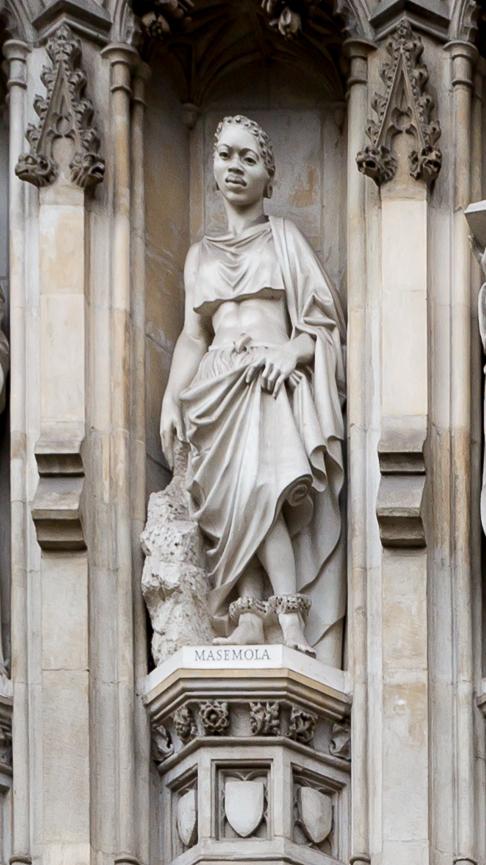
CEphoto, Uwe Aranas, 2013. CC BY-SA 3.0.
Sekhukhuneland, to 1928 · Person · Featured Study
Manche Masemola
She was a Pedi girl of South Africa who died at her parents' hands as a catechumen.
Told she must wait for baptism, she said she might be baptized with a better baptism.
Anyone who loves his father or mother more than Me is not worthy of Me; anyone who loves his son or daughter more than Me is not worthy of Me;
Anyone who loves his father or mother more than Me is not worthy of Me; anyone who loves his son or daughter more than Me is not worthy of Me;
- Born
- about 1913, at Marishane in Sekhukhuneland (proposed)
- Died
- on or near 4 February 1928, near Marishane (probable)
- Family
- sister: Mabule; cousin: Lucia
- Places
- Marishane, Sekhukhuneland, Jane Furse
Summary
Manche Masemola grew up among the Pedi people of Sekhukhuneland, in South Africa. In her early teens she went to the classes of an Anglican mission. Her parents forbade it. Early in 1928, while she still waited to be baptized, they killed her.
- She could not read or write, so what is known of her comes from records others kept.
- The historian Mandy Goedhals finds that the missionaries' aims shaped those records.
- The Anglican Church of Southern Africa keeps her name in its calendar.
The Baptism She Spoke Of
Jesus spoke of a baptism He must undergo, and of love for Him more than for father and mother.
Her words survive only in her teacher's notes. The question of this life is what can be known of a girl who left no writing, from the records of those who taught and buried her.
But I have a baptism to undergo, and how distressed I am until it is accomplished!Jesus called His coming death a baptism.
The Life in Order
Most dates stand on the Abbey, and the classes on Father Moeka's notes as Masenya reports them.
She was killed a few weeks before the baptism planned for her.
- About 1913Birth at MarishaneThe Abbey
- 1919Father Moeka opens his mission at MarishaneThe Abbey
- At thirteenFirst hearing of his preachingMasenya, after Lucia's report
- By the middle of 1927Enrolled as a catechumenMasenya, after Moeka's notes
- February 1928Killed by her parentsThe Abbey; Quinn; Goedhals
- Before Easter 1928The date planned for her baptismMasenya, after Moeka's notes
- 1937Her cousin's testimony taken downMasenya
- 1998Her statue unveiled at Westminster AbbeyThe Abbey
Each step of the life stands with its witness.
1937, 1998
From the Hearers' Class to the Hillside
A girl who worked her family's fields chose the church over her parents' will.
The Pedi lived on reserved land that was barren and hard to farm. German and then English missionaries had worked among them for some decades, and by the early twentieth century a tiny Christian community stood there. Those who kept the old faith and customs watched it with anxiety and suspicion.
Manche never went to school. She worked at home and on the land, and she went with her cousin to hear the mission's priest. She asked to learn more and began to attend his classes twice a week.
Her parents feared that she would leave them or refuse the marriage they would arrange. Her parents beat her, and her mother hid her clothes so that she could not go. She and Lucia were sent away to a distant place to look after the young herders. By Lucia's account, her mother once followed her with a whip and a spear. She still prayed outside, morning and evening.
She told Lucia and Moeka more than once that her parents would kill her. Her parents took her to a lonely place and killed her there, and they buried her beside a granite rock on a remote hillside.
The Records of Her Death
A priest's notes, a missionary wife's report and a cousin's memory are the sources.
Moeka was away from the village when the news of her death came. On his return he gathered what people remembered of his talks with her, and those notes are the first account.
His notes keep what she said to him as a catechumen. Asked shortly before her death if she was afraid to die for her faith, she answered, "Never".
The earliest written record is a report by a Mrs Moffat. Masenya writes that it says Manche laughed as she was beaten to death.
Lucia, an orphan who lived with the family, gave her account in 1937 through Moeka as translator. She remembered, "Manche's mother said she would force us to leave the church. She beat Manche every time she returned from church."
Goedhals writes that most of what is known comes from missionary records, which show "some of the crude and uncritical characteristics often associated with missionary writings".
In Their Own Words
Four of her sayings survive, each in the notes of her teacher Augustine Moeka.
Manche Masemola (1913 to 1928)
Madipoane Masenya, "Masemola, Manche (B)", Dictionary of African Christian Biography (2017), from Augustine Moeka's notes as Mandy Goedhals reports them, the paragraph on Moeka's notes, note 10, her first reply
She would stand by herself
“I am sorry, but from now on, I am going to stand by myself.”
Anglican
About this saying1 paragraph
Moeka told the girls beaten at home to respect their parents, and she gave this answer while she was a catechumen.
Manche Masemola
Madipoane Masenya, "Masemola, Manche (B)", Dictionary of African Christian Biography (2017), from Augustine Moeka's notes as Mandy Goedhals reports them, the paragraph on Moeka's notes, note 10, her second reply
She would keep her faith
“If they cut off my head, I will never leave my faith.”
Anglican
About this saying1 paragraph
Moeka's notes set this answer beside the last, from the months while she was a catechumen.
Manche Masemola
Madipoane Masenya, "Masemola, Manche (B)", Dictionary of African Christian Biography (2017), from Augustine Moeka's notes as Mandy Goedhals reports them, the paragraph on Moeka's notes, note 11
A better baptism
“I may be baptized with a better baptism.”
Anglican
About this saying1 paragraph
Warned that her baptism would take time, she answered Moeka so while she was a catechumen.
Manche Masemola
Madipoane Masenya, "Masemola, Manche (B)", Dictionary of African Christian Biography (2017), from Augustine Moeka's notes as Mandy Goedhals reports them, the paragraph on her planned baptism, note 12
Her own blood
“I shall be baptized with my own blood.”
Anglican
About this saying1 paragraph
Moeka reported that she spoke these words shortly before her death early in 1928.
The People Around Her
The witnesses name her household, her teacher, a bishop and a historian.
Her mother, who opposed her faith, was baptized forty-one years after her death.
| Person | Tie to Manche | The witness |
|---|---|---|
| Her mother | Baptized and confirmed in 1969, taking the name Magdalene. | The Abbey; Masenya |
| Her father | He planted euphorbia trees to mark the graves. | The Abbey |
| Mabule | Her younger sister, who fell ill and died days later and lies beside her. | The Abbey |
| Lucia | Her cousin and companion in the classes. | The Abbey; Masenya |
| Augustine Moeka | A priest of the Community of the Resurrection, who taught her. | Quinn; the Abbey |
| Wilfrid Parker | Bishop of Pretoria, who took Lucia's account and judged the case. | Masenya |
| Mandy Goedhals | The historian whose studies of 1998 and 2000 weigh the sources. | Masenya |
The Places of Her Life
Her whole life passed in one district of Sekhukhuneland.
Her home, her church and her grave lay close together.
| Place | What the witnesses say | The witness |
|---|---|---|
| Sekhukhuneland | The Pedi homeland, north-east of modern Johannesburg. | The Abbey |
| Marishane | Her home village, where St Peter's Church stood. | The Abbey; Masenya |
| Mabuke | The family's fields, where they lived. | Masenya |
| Jane Furse | The mission centre and hospital, sixteen kilometres away. | Masenya |
| Westminster Abbey, London | The site of her statue since 1998. | The Abbey |
How Her Church Remembered Her
Small pilgrimages grew into a yearly gathering, and her name entered the calendar.
A little group of Christians went on pilgrimage to the grave in 1935, and others followed in 1941 and 1949. A tablet with the Te Deum's line on the noble army of martyrs was set up in 1949, and Masenya notes that an earlier report put it at the grave by Easter 1929.
The South African bishops asked that she be remembered each year, and her day entered the calendar in 1975. The Abbey writes that hundreds now visit the grave every August.
How the Key Verse Was Taught
Benedict and J. C. Ryle read the call to love Christ above all.
Benedict of Nursia (died 548)
The Rule of Saint Benedict, chapter 4, instrument 21
Benedict made the love of Christ one of the rules of his monks.
“To prefer nothing to the love of Christ.”
Patristic
J.C. Ryle (1816 to 1900)
Expository Thoughts on the Gospels: Matthew
J. C. Ryle read the passage as a warning that the gospel divides.
“In these verses the great head of the church winds up his first charge to those whom he sends forth to make known his Gospel. He declares three great truths, which form a fitting conclusion to the whole discourse. In the first place, he bids us remember that his Gospel will not cause peace and agreement wherever it comes.”
on Matthew 10:34 to 42Reformed Evangelical
What the Witnesses Leave Open
Readers differ on how to read her death, how she died and on what day.
A martyr's death, or a clash of customsBishop Wilfrid Parker and the South African bishops; Mandy Goedhals and Madipoane Masenya
After Lucia's account, Masenya writes, Bishop Parker was satisfied that hers was a true case of Christian martyrdom. Goedhals writes that the missionaries presented her as "a stereotype of the faithful Christian", stripped of her own culture.
Masenya, herself a Pedi Anglican, finds that the pressures of the mission and the old customs bore down on a young girl and ended in her death, "perhaps not as a martyr, but by default".
How she diedWestminster Abbey; Mandy Goedhals; Mrs Moffat; the other tellings Masenya records
The Abbey writes only that her parents killed her. Goedhals says they beat her to death, and the Moffat report agrees. Against both stand two tellings Masenya records, one of illness in the rainy season and one of a healer's medicine smeared on her hoe.
The day of her deathWestminster Abbey; Frederick Quinn; Mandy Goedhals
The Abbey writes "on or near" 4 February 1928, Quinn gives that day plainly, and Goedhals writes "in about February 1928".
Books to Read Next
Masemola, Manche (B)
Madipoane Masenya, Dictionary of African Christian Biography · 2017
It traces each record of her life to its writer.
Read the entry free at the DACBImperialism, Mission and Conversion: Manche Masemola of Sekhukhuneland
Mandy Goedhals, in Andrew Chandler, editor, The Terrible Alternative · 1998
Masenya draws on this chapter.
In print: find it wherever books are sold.
What Manche Masemola Left
She left a grave on a hillside and a few sayings in her teacher's notes. She died a catechumen, before the baptism she had asked for.
Sources
Scripture is the Berean Standard Bible.
- The Holy Bible, Berean Standard Bible (read 2026)
- Westminster Abbey, "Manche Masemola", the Abbey's commemoration page.
- Madipoane Masenya, "Masemola, Manche (B)", Dictionary of African Christian Biography (2017), citing Mandy Goedhals (1998 and 2000), Bishop Wilfrid Parker's notes of 1937 and Dominic Whitnall (1983)
- Frederick Quinn, "Masemola, Manche", from African Saints (Crossroad, 2002), Dictionary of African Christian Biography.
- Benedict of Nursia, The Rule of Saint Benedict, chapter 4, instrument 21.
- J. C. Ryle, Expository Thoughts on the Gospels: Matthew (1856), on Matthew 10:34 to 42.
Keep Studying
Studies1
Church history2
Trials of life1