
1685 to 1886 · Subject · The Cloud of Witnesses
The Witnesses of the Eighteenth and Nineteenth Centuries
French Protestants went to the galleys, and new churches in Korea, Madagascar and Uganda lost their first members to the sword, the spear and the fire.
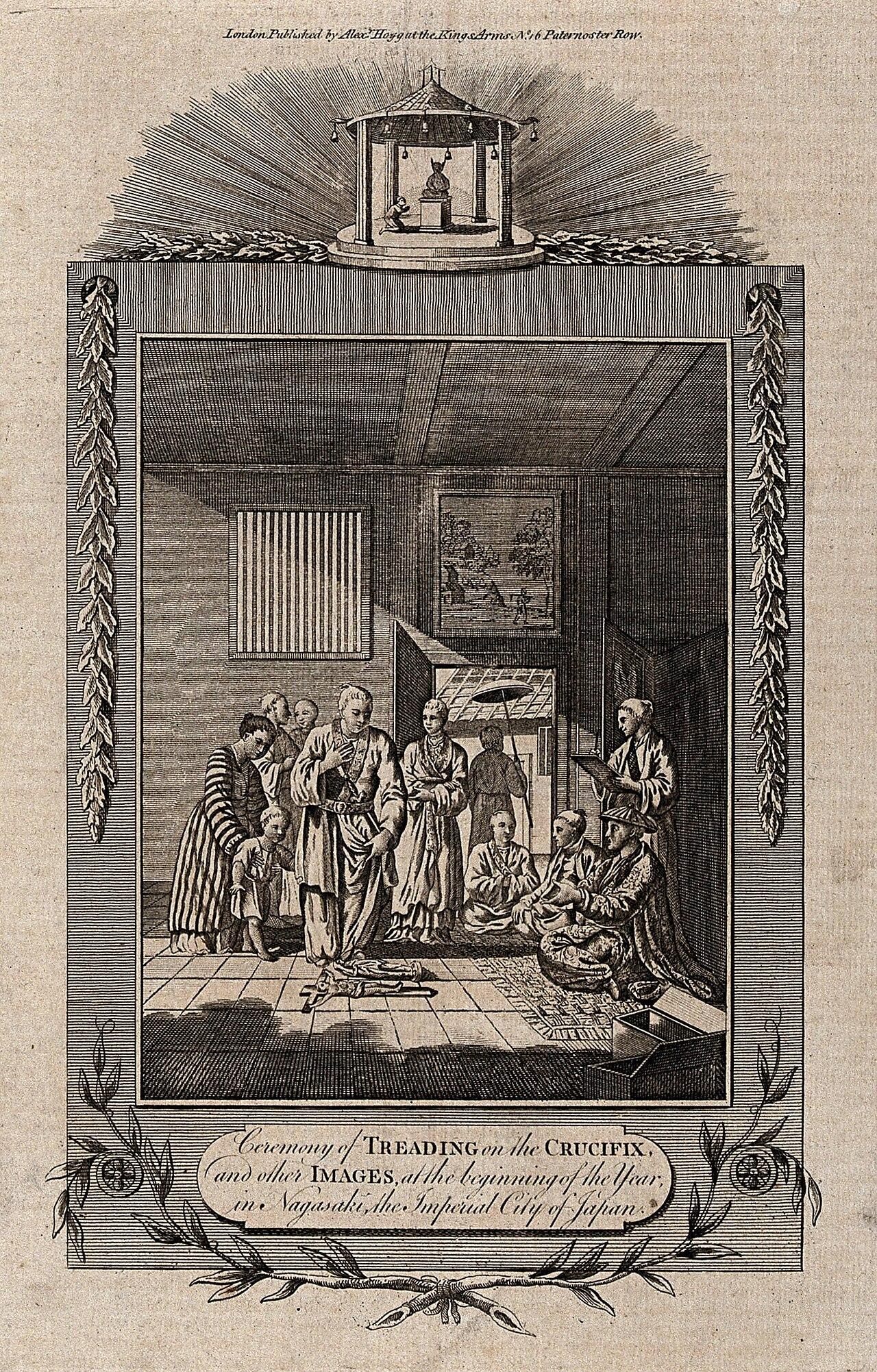
In 1865 fifteen Japanese Christians came into the new church at Nagasaki and made themselves known to the priest.
After this I looked and saw a multitude too large to count, from every nation and tribe and people and tongue, standing before the throne and before the Lamb. They were wearing white robes and holding palm branches in their hands.
- Books
- Revelation, Matthew, Hebrews
- Hold in memory
- Revelation 7:9, Hebrews 13:3
Summary
In these two centuries France sent its Protestants to the galleys and its prisons. In Asia and Africa the first believers of new churches were put to death by their own rulers. Many of them had been baptized only a few years before.
- Jean Marteilhe served in the French galleys from 1700 to 1713 for his Protestant faith.
- Korea's first Christians were killed from 1791, and two bishops and seven missionaries died there in 1866.
- In Madagascar believers were burned and thrown from a cliff in 1849.
- Anglican and Catholic converts in Uganda were burned together in 1886.
The Verses of the New Churches
Jesus said his followers would be hated by all nations, and John saw a multitude from every nation before the throne.
These witnesses came from France, Korea, Japan, Madagascar and Uganda. Their deaths stand between the warning of Matthew 24 and the vision of Revelation 7.
Hated by the nations, gathered from the nations
Then they will deliver you over to be persecuted and killed, and you will be hated by all nations because of My name.
Jesus warned that his disciples would be delivered up and killed and hated by all nations for his name.
Matthew 24:9BSB
Remember those in prison as if you were bound with them, and those who are mistreated as if you were suffering with them.
The writer to the Hebrews asks the church to remember those in prison, as the Huguenot women of Aigues-Mortes were for decades.
Hebrews 13:3BSB
Precious in the sight of the LORD is the death of His saints.
The psalm calls the death of the Lord's saints precious in his sight.
Psalm 116:15BSB
The Stations from Bergerac to Buganda
Each row names the record that fixes its date.
In two hundred years the record moves from the prisons of France to the new churches of Asia and Africa.
- The Edict of Nantes is revoked22 October 1685The preface to Marteilhe's memoir
- Marteilhe in the galleys1700 to 1713Marteilhe's own memoir
- The first Korean deaths1791The Catholic Encyclopedia, volume 4 (1908)
- Rasalama is speared14 August 1837William Ellis, The Martyr Church (1870)
- Three priests beheaded in Korea21 September 1839The Catholic Encyclopedia, volume 4 (1908)
- The persecution of 1849 in MadagascarFrom 19 February 1849Ellis (1870), page 162
- The hidden Christians of Nagasaki come forward17 March 1865The Catholic Encyclopedia, volume 8 (1910)
- Two bishops and seven priests die in KoreaMarch 1866The Catholic Encyclopedia, volume 4 (1908)
- Thirty converts burned in Buganda26 May 1886The Catholic Encyclopedia, volume 15 (1912)
A timeline of nine stations.
The hidden Christians of Nagasaki come forward, Two bishops and seven priests die in Korea, Thirty converts burned in Buganda
The era of the missionary century holds the wider story of the churches planted in these years.
The Galleys and the Tower of Constance
France forbade Protestant worship, sent its Protestant men to the galleys and held its Protestant women in a tower.
When Louis XIV revoked the Edict of Nantes, Protestant pastors were given fifteen days to leave France “under pain of the galleys,” and all Protestant worship, public and private, was forbidden.
Jean Marteilhe was born at Bergerac in 1684. As a young man he was taken with other Protestants. A court told them that, whether they abjured or not, the king's will was to send them to the galleys for life.
Samuel Smiles wrote of the Tour de Constance at Aigues-Mortes in 1874. He says it was for about a hundred years the chief prison of the Huguenot women. Sixteen women held there in 1686 died within five months.
When the last prisoners were set free, fourteen women were still in the tower. The youngest was over fifty, and she had been taken at eight for going with her mother to a service.
The Huguenots suffered under a Catholic king, and they were Christians imprisoned by Christians.
Madagascar and Uganda
The government of Madagascar and King Mwanga of Buganda put to death the first believers of their kingdoms.
In February 1835 the government of Madagascar forbade the missionaries to teach and threatened death to any Malagasy who read the Bible, prayed or was baptized. No life was taken then, and William Ellis gives the number punished in the table below.
Ellis calls Rasalama the first martyr of Madagascar. She knelt to pray and was speared at the southern end of the ridge of the city. Two hundred Christians were sold into slavery after her death.
Ellis counts more than ten thousand Malagasy Christians sentenced in the four great persecutions.
| Year | Ellis's count | Where he gives it |
|---|---|---|
| 1835 | 2,500 punished, none killed | Page 269 |
| 1849 | Four nobles burned and fourteen hurled from the cliff of Ampamarinana | Page 168 |
| 1849 | Four burned and thirteen hurled down, two or three thousand punished | Page 269, which differs from page 168 |
| 1857 | Thirteen stoned and more than fifty put in heavy fetters | Pages 268 to 269 |
| 1835 to 1861 | More than 10,000 sentenced in all | Pages 268 to 269 |
In Buganda, Robert Ashe of the Church Missionary Society names Seruwanga, Kakumba and Lugalama as the first martyrs, and records that Lugalama died on 31 January 1885.
On 5 November 1885 the Catholic priest Père Lourdel confirmed that Bishop James Hannington and all his porters had been killed.
Balikudembe, a young chief, told Mwanga that he did unwisely to kill the white men, and he was put to death. The Catholic Encyclopedia calls him Joseph Mkasa and names him the first martyr of his church there.
The same work dates the burning of thirty newly baptized Catholics to 26 May 1886 and says more than seventy others were martyred soon after. Ashe records Walukaga, a smith, and some thirty others burned on one pyre.
The dead were converts of both the Anglican and the Catholic missions, and each church honours them as its martyrs.
In Their Own Words
Jean Marteilhe (born 1684)
Autobiography of a French Protestant condemned to the galleys for the sake of his religion, page 2
Marteilhe gave thanks for his release from the galleys.
“I shall therefore only impart to the public, in these memoirs, that which befell myself, from the year 1700 to 1713, when I was happily delivered from the galleys of France by God's mercy, and by the intercession of Queen Anne of England of glorious memory.”
French Reformed
About this saying1 paragraph
He wrote this at the opening of his memoir, which was first printed in French in 1757.
Rasalama (died 1837)
Her words on the way to execution, in William Ellis, The Martyr Church, page 121
Rasalama passed the place where she had worshipped.
“There I heard the words of the Saviour.”
Protestant
About this saying1 paragraph
She said this as she was led out in 1837.
A. M. Mackay
A letter from Msalala, 1885, in A. M. Mackay, Pioneer Missionary of the Church Missionary Society to Uganda, by his sister, page 257
Mackay wrote of the three boys burned that January.
“Our first martyrs have won the martyr's crown.”
Anglican
About this saying1 paragraph
He sent this news after three Christian boys were burned in January 1885.
Where the Counts and Dates Differ
Ellis's two pages on that persecution give different counts.
Ellis writes fourteen on one page and thirteen on another for those hurled from the cliff in 1849. Page 168 gives the sentences as they were passed, and page 269 stands in his retrospect of all four persecutions.
Books to Read Next
The Martyr Church
William Ellis · 1870
Ellis tells the persecutions of Madagascar from the letters written at the time.
Free at the Internet ArchiveTwo Kings of Uganda
Robert P. Ashe · 1889
Ashe records these deaths in the journal he kept as a missionary in Buganda.
Free at the Internet ArchiveWhat These Witnesses Handed On
The churches of Korea, Madagascar and Uganda began with believers who died within a few years of their baptism. Ellis's book and the missionaries' journals name them one by one.
Sources
Scripture is the Berean Standard Bible.
- The Holy Bible, Berean Standard Bible (read 2026)
- Jean Marteilhe, Autobiography of a French Protestant condemned to the galleys for the sake of his religion (London: Religious Tract Society, about 1864), the translator's preface and pages 2 and 43 to 44.
- Samuel Smiles, The Huguenots in France after the Revocation of the Edict of Nantes (New York: Harper and Brothers, 1874), pages 193 to 194 and 273 to 274.
- Gustave Mutel, Corea, The Catholic Encyclopedia, volume 4 (New York: Robert Appleton Company, 1908)
- Justin Balette and François Ligneul, Japan, The Catholic Encyclopedia, volume 8 (New York: Robert Appleton Company, 1910)
- William Ellis, The Martyr Church (London: John Snow and Co., 1870), pages 121 to 122, 162, 168 to 169 and 268 to 269.
- Robert P. Ashe, Two Kings of Uganda (London, 1889), pages 144 to 145, 197 to 198, 205 and 225 to 226.
- A. M. Mackay, Pioneer Missionary of the Church Missionary Society to Uganda, by his sister (New York: A. C. Armstrong and Son, 1890), page 257.
- Andrew MacErlean, Upper Nile, The Catholic Encyclopedia, volume 15 (New York: Robert Appleton Company, 1912)
Keep Studying
Subjects10
Church history1