
The empire, AD 250 to 251 · Story · Featured Study
The Decian Certificates
Papyri from Egypt show what the emperor's order asked of everyone, and the bishops' letters show what it did to the churches.
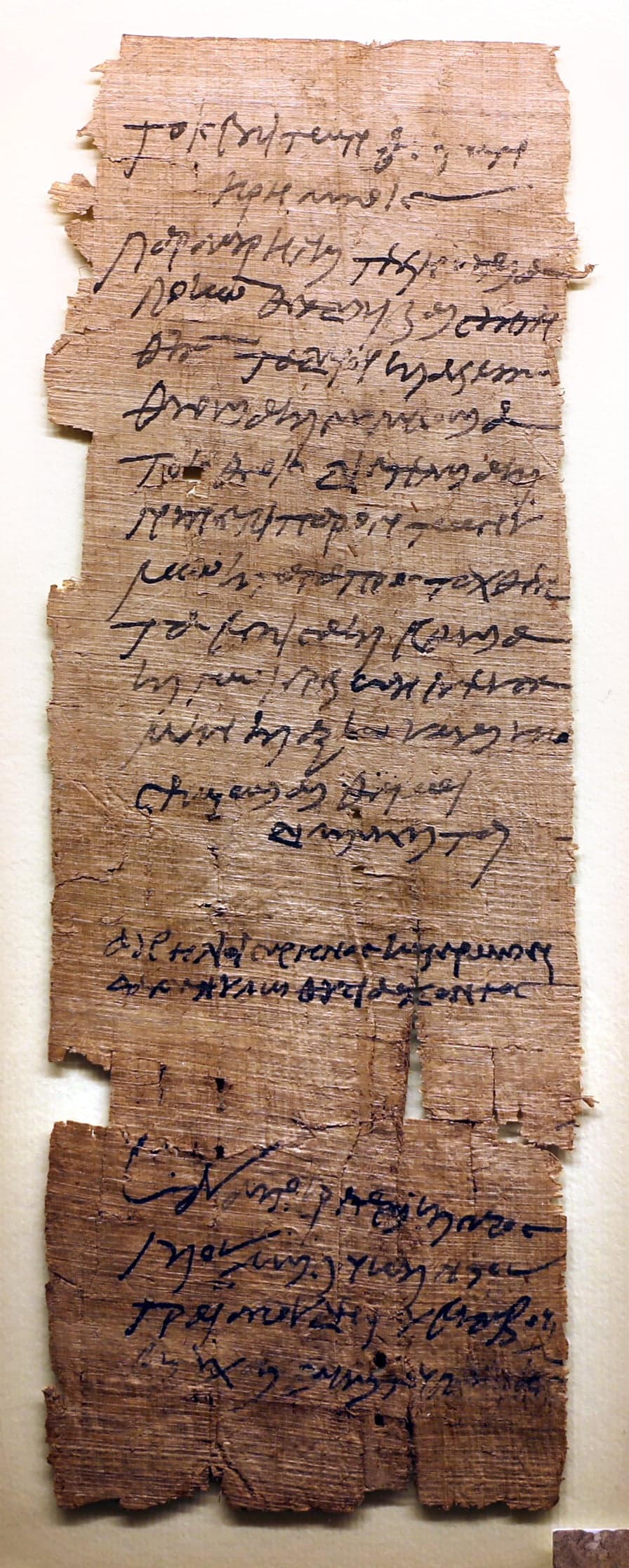
A certificate from an Egyptian village describes its holder, a man of seventy-two, by the scar on his right eyebrow.
- Where
- Egypt, Carthage, Alexandria, Rome
- Who
- Cyprian, Dionysius of Alexandria, Novatian, Fabian
- When
- AD 250 to 251
Certificate of sacrifice, 250. CC BY-SA 4.0.
Therefore everyone who confesses Me before men, I will also confess him before My Father in heaven.
Summary
In 250 an order of the emperor Decius commanded the inhabitants of the empire to sacrifice to the gods, and in Egypt those who obeyed took a paper signed by the officials who watched. Many Christians obeyed and some died, and when the persecution ended the churches argued over whether those who had denied could come back.
- Forty-one of the certificates were known in 1923, when John Knipfing edited them all.
- Fabian, bishop of Rome, was among those put to death.
- A synod of sixty bishops at Rome held Novatian and his followers strangers to the church and ordered the fallen healed with repentance.
The Texts of Confessing and Denying
Cyprian and Dionysius set the question of the lapsed under the words of Jesus, the law and the prophets.
Cyprian argued from the law against sacrifice and from the warnings of Jesus, and Dionysius from the mercy God shows the sinner who turns.
Scripture warns against denial
But whoever denies Me before men, I will also deny him before My Father in heaven.
The warning to those who deny was the charge the lapsed carried.
If anyone sacrifices to any god other than the LORD alone, he must be set apart for destruction.
Cyprian cites the law against sacrifice to other gods against those who ran to the altars.
Exodus 22:20BSB
No one can serve two masters: Either he will hate the one and love the other, or he will be devoted to the one and despise the other. You cannot serve both God and money.
Cyprian says the one who took a certificate served an earthly master.
Matthew 6:24BSB
God receives the sinner who turns
For false Christs and false prophets will appear and perform great signs and wonders that would deceive even the elect, if that were possible.
Dionysius says the decree came like the time the Lord foretold, when even the elect would be deceived.
Say to them: ‘As surely as I live, declares the Lord GOD, I take no pleasure in the death of the wicked, but rather that the wicked should turn from their ways and live. Turn! Turn from your evil ways! For why should you die, O house of Israel?’
Dionysius says the martyrs received the fallen because God desires the repentance of the sinner.
Jesus asked a third time, “Simon son of John, do you love Me?” Peter was deeply hurt that Jesus had asked him a third time, “Do you love Me?” “Lord, You know all things,” he replied. “You know I love You.” Jesus said to him, “Feed My sheep.
Peter, who had denied Jesus, is the apostle Jesus restored, and every lapsed Christian stood where Peter had stood.
John 21:17BSB
Matthew 24:24, Ezekiel 33:11, John 21:17
What a Certificate Says
A certificate from the village of Alexandru Nesus in Egypt, in Knipfing's English.
A certificate names the holder, swears to the sacrifice and carries the witness's own hand.
| Part | Its words | What it shows |
|---|---|---|
| The address | To the commission of the village of Alexandru Nesus, chosen to superintend the sacrifices | Each village had officials appointed to watch |
| The holder | Aurelius Diogenes, son of Satabous, of the village of Alexandru Nesus | The holder is named with his father and his village |
| The declaration | I have always and without interruption sacrificed to the gods, and now in your presence in accordance with the edict's decree I have made sacrifice | The holder swears to the past and to the present sacrifice, done in the officials' sight |
| The rite | and poured a libation, and partaken of the sacred victims | Sacrifice, libation and eating of the offering made the act |
| The request | I request you to certify this below | The holder asks for the signature that makes the paper proof |
| The witness | I, Aurelius Syrus, saw you and your son sacrificing | An official signs in a second hand |
| The date | The year one of the Emperor Caesar Gaius Messius Quintus Trajanus Decius Pius Felix Augustus, Epeiph 2 (June 26, 250) | The certificate is dated by the emperor's first year |
The Order Reached Every City
The order reached each church through the city's own officials, and the bishops wrote down what followed.
Eusebius writes that Origen suffered the iron collar, the dungeon and the stocks.
At Alexandria, Dionysius writes, the persecution had begun a year before the decree. When the decree came, "many of the more eminent in their fear came forward immediately", some led by their office and some by their friends.
Some went to the altars pale and trembling, and the crowd mocked them. Others declared boldly that they had never been Christians, and some held out in prison for days and then gave way.
At Carthage, Cyprian writes, "the greatest number of the brethren betrayed their faith" at the first threat. He says many did not wait to be arrested but "ran to the market-place of their own accord".
Cyprian also names a second way of standing. The one who withdrew from his home for a while, because he would not deny, made a private confession, he wrote, as the one arrested made a public one.
Serapion at Alexandria1 paragraph
Dionysius tells of Serapion, an old man who had sacrificed and could find no one to absolve him. Dionysius had ordered that the dying be received, and a presbyter who was sick sent the eucharist by Serapion's grandson, who gave it to the old man, and Serapion died.
The Certificates That Survive
Every certificate that survives comes from Egypt, and all of them come from the one year.
Jennifer Cromwell counted more than forty certificates in 2019.
Knipfing took the edict to be of December 249, and he found that it did not name the gods to whom the holders sacrificed.
An edition is a reading of the papyrus and can be corrected. Knipfing read one Michigan papyrus of 17 June 250, from Theadelphia, as the certificate of a woman named Inaris, and the later Michigan edition reads the holder as Aurelius Sakis.
Who Could Come Back
Cyprian at Carthage and Novatian at Rome gave two answers to those who had denied.
Cyprian taught that the lapsed must repent and be received after penance, each case weighed.
The Roman clergy wrote to Cyprian in 250, in a letter Novatian composed, that the lapsed should wait for a bishop to be chosen, and that only the dying penitent should be helped meanwhile.
When Cornelius was chosen bishop of Rome in 251, Novatian was set up against him. Socrates, writing long after, says Novatian taught that those who had sacrificed should not be admitted to the mysteries, and that their pardon should be left to God.
Dionysius of Alexandria told how the martyrs of his city had themselves received some who sacrificed.
How the Key Verse Was Taught
Three writers of three centuries on confessing Christ before men.
Tertullian (died 220)
On Flight in Persecution
Tertullian used the verse in his treatise against fleeing persecution.
“If to flee, how to suffer? If to suffer, how to flee? In fact, what utter inconsistency in the decrees of One who commands to flee, and yet urges to suffer, which is the very opposite! ‘Him who will confess Me, I also will confess before My Father.’ How will he confess, fleeing? How flee, confessing? ‘Of him who shall be ashamed of Me, will I also be ashamed before My Father.”
on Matthew 10:32Patristic
Hilary of Poitiers (died 367)
Catena Aurea by Aquinas
Hilary of Poitiers read the saying as the close of Christ's charge to the apostles.
“This He says in conclusion, because it behoves them after being confirmed by such teaching, to have a confident freedom in confessing God.”
on Matthew 10:32 to 33Patristic
The rest1 more paragraph
This teaches us, that in what measure we have borne witness to Him upon earth, in the same shall we have Him to bear witness to us in heaven before the face of God the Father.
Thomas Aquinas (died 1274)
Commentary on Matthew
Thomas Aquinas set the gain of confessing Christ against the loss of denying Him.
“So everyone who acknowledges me before men I will acknowledge before my Father. Here he touches on the advantage which accrues from acknowledging him; secondly, the loss which comes from denying him (v. 33). He says, therefore: Thus I will that you suffer and die. …”
on Matthew 10:32Patristic
In Their Own Words
The bishops and the presbyter who answered the question of the lapsed, in the English of the nineteenth century.
Cyprian (died 258)
On the Lapsed, 27
A Christian disowning
“That profession of one who denies, is the testimony of a Christian disowning what he had been.”
Early Church
About this saying1 paragraph
Cyprian wrote this in 251 of those who took a certificate without sacrificing.
Cyprian
Epistle 51, to Antonianus, 13
Certificates and sacrifices
“Neither must you think, dearest brother, as some do, that those who receive certificates are to be put on a par with those who have sacrificed; since even among those who have sacrificed, the condition and the case are frequently different.”
Early Church
About this saying1 paragraph
Cyprian wrote this in 252 to a bishop who had begun to lean toward Novatian's party.
Dionysius of Alexandria (died 264)
Letter to Fabius of Antioch, in Eusebius, Church History, 6.42.6
What should we do?
“Shall we have the same judgment and rule as theirs, and observe their decision and charity, and show mercy to those whom they pitied?”
Early Church
About this saying1 paragraph
Dionysius of Alexandria put this question to the bishop of Antioch in the third century.
Novatian
The Roman clergy to Cyprian, Epistle 30 in the Ante-Nicene Fathers, 8
God Himself knowing
“to them, finally, such cautious and careful help should be ministered, God Himself knowing what He will do with such, and in what way He will examine the balance of His judgment”
Presbyter of Rome
About this saying1 paragraph
These words of the third century close Rome's counsel to Carthage on the lapsed.
Dionysius of Alexandria, Novatian
What Decius Wanted
Eusebius gives the emperor a personal motive, and Rives reads a plan for the whole empire.
Eusebius writes that Decius persecuted from hatred of Philip, the emperor before him, and McGiffert called that motive "quite incorrect" in 1890.
J. B. Rives argued in the Journal of Roman Studies in 1999 that before Decius persecutions "had always been local affairs". He called the decree "a highly innovative and important step towards a radical restructuring of religious organization in the Roman world".
The strongest evidence against reading the order as aimed at Christians is the certificates themselves, which ask the same sacrifice of everyone. The strongest evidence for it is that the churches' own leaders wrote of the order as a persecution aimed at them.
Books to Read Next
The Libelli of the Decian Persecution
John R. Knipfing · 1923
Knipfing prints every certificate he knew in Greek and English.
Read Knipfing free at the Internet ArchiveThe Writings of Cyprian
Cyprian of Carthage, translated by Robert Ernest Wallis · 1886
Volume 5 of the Ante-Nicene Fathers holds On the Lapsed and the letters on the lapsed.
Read Cyprian free at CCELSources
Scripture is the Berean Standard Bible.
- The Holy Bible, Berean Standard Bible (read 2026)
- John R. Knipfing, "The Libelli of the Decian Persecution", Harvard Theological Review 16 (1923), pages 345 to 390.
- Eusebius, Church History 6.39 to 6.44, translated by Arthur Cushman McGiffert, Nicene and Post-Nicene Fathers, second series, volume 1 (1890), with McGiffert's notes.
- Cyprian, On the Lapsed 3, 7, 8 and 27, and Epistle 51, translated by Robert Ernest Wallis, Ante-Nicene Fathers, volume 5 (1886)
- The Roman clergy to Cyprian, Epistle 30, with the introduction to Novatian, Ante-Nicene Fathers, volume 5 (1886)
- Socrates Scholasticus, Church History 4.28, Nicene and Post-Nicene Fathers, second series, volume 2 (1890)
- Jennifer Cromwell, "Imperial Decrees, Animal Sacrifices, and Christian Persecution", Papyrus Stories (2019, updated 2021)
- P.Mich. III 157 (P.Mich. inv. 262), the Heidelberg Gesamtverzeichnis record 11977 and the APIS record michigan.apis.1607.
- J. B. Rives, "The Decree of Decius and the Religion of Empire", Journal of Roman Studies 89 (1999), pages 135 to 154, the abstract.
Keep Studying
People and groups9