
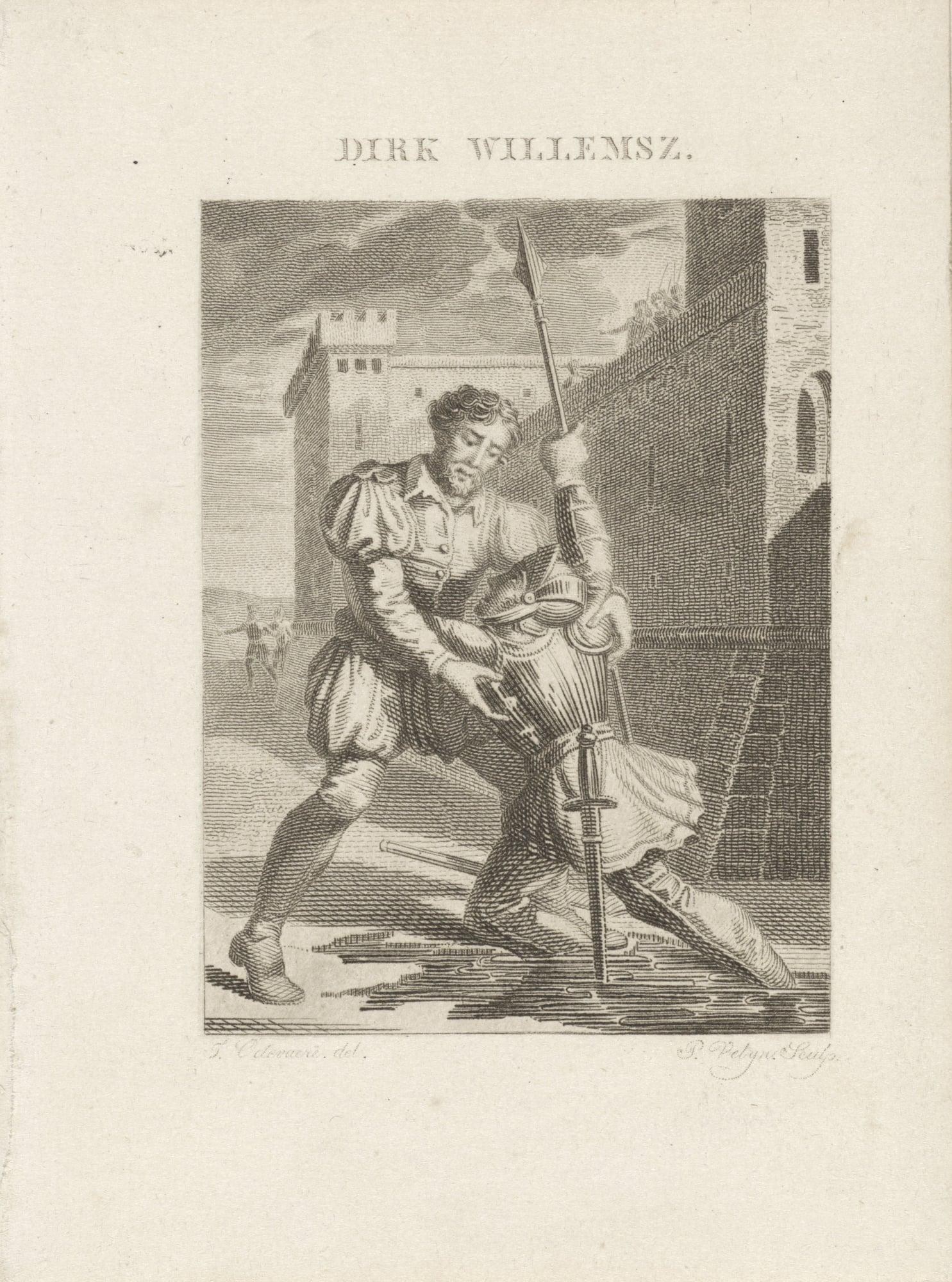
Philippus Velijn after Joseph-Denis Odevaere, Dirk Willemsz, 1819. Public domain.
Asperen, 1569 · Person · Featured Study
Dirk Willems
He was an Anabaptist of Asperen in Holland, and he was burned there for his rebaptism.
Fleeing arrest across the ice, he turned back to pull out the man who had fallen through behind him.
But I tell you, love your enemies and pray for those who persecute you,
But I tell you, love your enemies and pray for those who persecute you,
- Born
- at Asperen, by the sentence; the year is not recorded
- Died
- 1569, by fire outside Asperen, after the sentence of 16 May
- Places
- Asperen, Rotterdam, Leerdam
Summary
Dirk Willems was born at Asperen in Holland. As a young man he was baptized again at Rotterdam, and he held secret meetings in his house. In 1569 the court of Asperen sentenced him to die by fire. Thieleman van Braght printed the sentence in his book of martyrs in 1660. He also gave the report of the rescue on the ice.
- The court's sentence confirms his death and the charge, and van Braght printed a copy taken from the town records.
- The rescue on the ice rests on van Braght's word alone, from "trustworthy persons", about ninety years later.
- Jan Luyken etched the rescue for the Dutch edition of 1685.
Love Your Enemies
Matthew 5 commands love for enemies, and Romans 12 tells the believer to overcome evil with good.
No verse of Scripture names him, and the record of his life gives no verse of his own.
The question of this life is what two witnesses can show. The court's sentence shows why he died, and van Braght's report tells what he did on the ice.
Do not be overcome by evil, but overcome evil with good.His rescue of the man hunting him is the deed this verse asks of the believer.
The Life in Order
Most steps come from the court's judgment.
Only one date of his life is written in the record: the day of his sentence.
- Year not recordedBirth at AsperenThe sentence
- As a young manRebaptismThe sentence
- No date givenMeetings in his houseThe sentence
- 1569The flight over the iceThe Mirror, page 711
- 16 May 1569CondemnedThe copy of the judgment
- No day givenDeath by fireThe note on his death
- 15 October 1606The copyThe clerk of Asperen
- 1660The Mirror in DutchSohm's title page
- 1685Luyken's etchingThe Rijksmuseum
- 1886Sohm's translationThe title page
Each step stands with its witness.
15 October 1606, 1660, 1685, 1886
From Rotterdam to the Ice
The court record gives the charge, and the martyrs' book gives the chase and the burning.
Asperen lies in Holland, and van Braght's account puts the town of Leerdam within earshot of it. The sentence calls Willems a man "born at Asperen". It says he confessed that at fifteen, eighteen or twenty he was rebaptized at Rotterdam, in the house of one Pieter Willems.
The sentence says he held "secret conventicles" in his house at Asperen at divers hours, and let several persons be rebaptized there. It calls all of this contrary to the Christian faith and to the decrees of the king.
He fled from arrest. The compiler of the martyrs' book writes that a thief-catcher pursued him, and that there had been some frost. Willems ran over the ice and got across with considerable peril, and the thief-catcher broke through behind him.
Willems saw that the man was in danger of his life. He "quickly returned and aided him in getting out, and thus saved his life". The thief-catcher wanted to let him go, but the burgomaster sternly called on him to consider his oath, and he seized Willems again.
After a severe imprisonment, seven judges sentenced him on 16 May 1569 to be executed with fire until death ensued, and all his property was confiscated. The sentence was passed in the name of the king, as Count of Holland.
Those present at his death said he was burned outside Asperen, on the side of Leerdam. A strong east wind drove the fire away from the upper part of his body, and his death was slow. In the town of Leerdam, they said, he was heard to cry out more than seventy times.
The judge or bailiff sat on horseback at the fire. The compiler writes that he was filled with sorrow at the man's sufferings, turned his horse away, and told the executioner, "Dispatch the man with a quick death."
The Record Behind the Life
A town record and a martyrs' book compiled about ninety years later give everything that is known of him.
Van Braght gathered the Anabaptist martyrs into The Bloody Theatre, or Martyrs Mirror, and his title page carries the record to the year 1660. Joseph F. Sohm translated it from the Dutch edition of that year, and the Mennonite Publishing Company printed his English at Elkhart, Indiana, in 1886.
The compiler writes that he came into possession of the sentence and printed it so that readers "may be able to perceive the truth of this matter". The copy ends with a note that it was extracted from the records of Asperen and checked against the original in the autumn of 1606.
The rescue and the death come from van Braght's own report. He gives the rescue from "trustworthy persons" and the death from the memoirs of those who were present. He also writes that he could not learn how the executioner dealt with Willems at the end.
The book is the Anabaptists' own record, and van Braght writes as one of them. He calls the judges "rulers of darkness" and the men who burned Willems "bloodthirsty, ravening wolves".
In Their Own Words
The account of the ice, his cry at the stake and the judges' sentence.
The ice, in van Braght's entry1 quotation, 1 paragraph
The compiler set this account down in 1660, at second hand.
His cry at the stake1 quotation, 1 paragraph
The note on his death keeps the one cry heard from him at the stake in 1569.
With fire, until death ensues1 quotation, 1 paragraph
The judges wrote it in 1569, and the town clerk copied it in 1606.
The People Around Him
The record names the man in whose house he was rebaptized, the man he saved and the judges who sentenced him.
Most of the people at his death are named by office alone.
| Person | Tie to Willems | The witness |
|---|---|---|
| Pieter Willems | He kept the house where the young man joined the Anabaptists. | The sentence |
| The thief-catcher | He owed his life to the man he chased. | The Mirror, page 711 |
| The burgomaster | He would not let the arrest be undone. | The account of the ice |
| Cornelis Goverts and six other judges | Their names stand at the foot of the judgment. | The copy of 1606 |
| The judge or bailiff | He was present on horseback at the burning. | The note on his death |
| Thieleman J. van Braght | He compiled the Martyrs Mirror of 1660, in which the entry on Willems stands. | Sohm's title page |
The other judges were Jan van Stege Jans, Adriaen Gerritts, Adriaen Jans, Lucas Rutgers, Jan Jans and Jan Roelofs.
The Places of His Life
His life ran between Rotterdam and the towns of Asperen and Leerdam.
Asperen is the town of his birth, his meetings, his trial and his death.
| Place | What the record says | The witness |
|---|---|---|
| Asperen | Town of his birth, his trial and his burning. | The judgment and the note |
| Rotterdam | The city of his rebaptism. | The judgment |
| Leerdam | The town the east wind blew toward. | The note on his death |
What the Ice Shows
The Anabaptists' confession at Dordrecht refused revenge, and van Braght set Willems before his readers as an example.
The Dordrecht Confession, which van Braght prints, forbids opposing an enemy with the sword and cites Matthew 5:44. Willems died sixty-three years before the confession was made at Dordrecht on 21 April 1632.
The compiler set his death before the reader "as an instructive example to all pious Christians of this time". The Herald Press printing of the book says it is printed "to nurture loyalty to the historic peace principles of the faith".
How the Key Verse Was Taught
Jerome read the command to love an enemy, and John Wesley kept it in a day of trouble.
Jerome (died 420)
Catena Aurea by Aquinas
Jerome answered those who held the command impossible, and his words come down in the Catena Aurea of Thomas Aquinas.
“Many measuring the commandments of God by their own weakness, not by the strength of the saints, hold these commands for impossible, and say that it is virtue enough not to hate our enemies; but to love them is a command beyond human nature to obey. But it must be understood that Christ enjoins not impossibilities but perfection. Such was the temper of David towards Saul and Absalom; the Martyr Stephen also prayed for his enemies while they stoned him, and Paul wished himself anathema for the sake of his persecutors. (Rom. 9:3.)”
on Matthew 5:44Patristic
John Wesley (1703 to 1791)
Journal, 24 May 1738, section 15, Curnock, Standard Edition, volume I, page 476
John Wesley wrote in his Journal for 24 May 1738 that he prayed for those who had used him despitefully.
“I began to pray with all my might for those who had in a more especial manner despitefully used me and persecuted me.”
Evangelical
What the Record Leaves Open
The record leaves open the rescue, the day of his death and the voice of the compiler.
Whether he turned back on the iceThieleman van Braght; the sentence of 1569
The compiler gives the rescue as "stated by trustworthy persons" and names none of them. The sentence of 1569 says nothing of a flight or a rescue. So the rescue rests on one report, while the court record confirms the death and the charge.
The day he diedThe sentence of 1569; van Braght
The judgment carries its date in May 1569, and the copy names no day for the burning. The compiler gives the place and the wind and says he could not learn how the executioner ended it.
The voice of the compilerThieleman van Braght; the Herald Press preface
The compiler calls the court "rulers of darkness" and the papists "deceitful". His book is the Anabaptists' own record of their martyrs.
Books to Read Next
The Bloody Theatre, or Martyrs Mirror of the Defenseless Christians
Thieleman J. van Braght, translated by Joseph F. Sohm · 1886
Its entry on Willems holds the report of the rescue and the sentence of the court.
Read the Martyrs Mirror free at the Internet ArchiveWhat Dirk Willems Left
Willems left no writing, and his name lives in one court record and one martyrs' book.
Sources
Scripture is the Berean Standard Bible.
- The Holy Bible, Berean Standard Bible (read 2026)
- Thieleman J. van Braght, The Bloody Theatre, or Martyrs Mirror of the Defenseless Christians, translated from the Dutch edition of 1660 by Joseph F. Sohm (Elkhart, Indiana: Mennonite Publishing Company, 1886), the title page and the entry Dirk Willems, A. D. 1569, pages 710 and 711, with the copy of the sentence.
- Jerome, on Matthew 5:44, in Thomas Aquinas, Catena Aurea.
- John Wesley, Journal, 24 May 1738, section 15, in Curnock's Standard Edition.
Keep Studying
Go further1
Church history2
People and groups4
Values1