
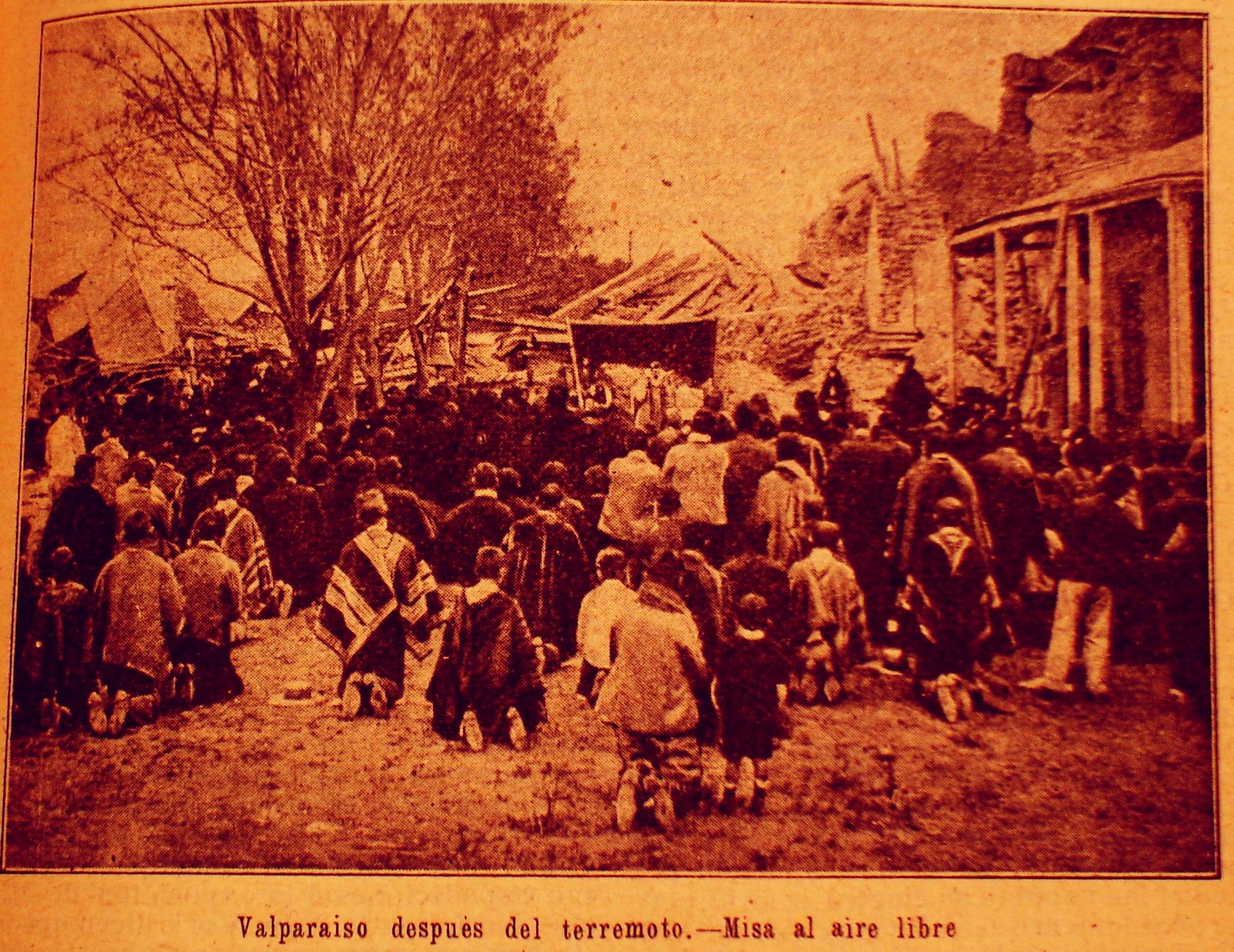
Unknown photographer, Catholic mass after the earthquake that also destroyed Hoover's church, 1906. Public domain.
Valparaíso, from the booklet to the new church · Story · Featured Study
Chile, 1909
Willis Hoover's own reports and the Methodist Board's reports tell this revival from two sides.
- Where
- Valparaíso, Santiago, Mukti, India, Chicago
- Who
- Willis Hoover, Mary Hoover, Minnie Abrams, Nellie Laidlaw, William F. Rice
- When
- 1906 to May 1910
Two housebreakers heard the noise of the Sunday service at Valparaíso, took it for an auction and went in.
“Yet even now,” declares the LORD, “return to Me with all your heart, with fasting, weeping, and mourning.”
Summary
A revival broke out on Sunday 4 July 1909 in Willis Hoover's Methodist church at Valparaíso. By May of the next year it was a new body, the Methodist Pentecostal Church.
- On Hoover's word a booklet from India reached him first, and word from Chicago next.
- The Methodist conference framed charges and dropped them when he promised to go home.
- He resigned in April, and the counts of those who left run from about 400 to 600.
- Kessler writes that his church's court put him out of office in January 1933.
The Texts of the Night Watch
A lay preacher read the prophet Joel to the church's officers on the night the all-night prayer began.
And afterward, I will pour out My Spirit on all people. Your sons and daughters will prophesy, your old men will dream dreams, your young men will see visions.
Hoover calls Joel 2 the church's favourite topic, and this promise stands later in the chapter.
Joel 2:28BSB
And they were all filled with the Holy Spirit and began to speak in other tongues as the Spirit enabled them.
Hoover wrote in 1932 that the experiences of that summer were well described in Acts 2.
Acts 2:4BSB
The Line to Valparaíso
Hoover's own reports name the steps by which word of tongues reached his church.
The reports of Hoover's that were found never name Azusa as his source.
- 1906Mukti, IndiaMinnie Abrams made her newspaper articles a book, The Baptism of the Holy Ghost and Fire, revising it after word of Azusa reached IndiaBoston University's History of Missiology
- 1907ValparaísoHoover opened the booklet that came by post, and Mary Hoover wrote to the author, her schoolmateHoover, 1911 and 1932
- January 1908ValparaísoPastor Franson of a Chicago Swedish church told of tongues at their table, and a letter from Oak Park came as he spokeHoover, 1911
- From 1908India and Oak ParkFriends sent Pentecostal papersHoover, 1911
- By 1909Chicago to ChileTwo copies of The Latter Rain Evangel went from India to ChileThe Latter Rain Evangel, September 1909
- February 1909ValparaísoThe first all-night prayer, on Joel 2Hoover, 1922
- 4 July 1909ValparaísoThe Sunday the revival broke outHoover, 1911
Hoover's own reports carry most of this line, with the Boston University history for Mukti and the Stone Church's paper for Chicago.
Alfred Cooper writes in 2024 that the Hoovers may well have read The Apostolic Faith, the paper of Azusa Street, and he does not prove it. Juan Sepúlveda holds that Valparaíso had taken its first steps before Azusa.
From the Earthquake to the Resignation
The story runs four years, from the fall of one church to the founding of another.
Hoover had bought a plot on Olivar in 1903. The earthquake of 16 August 1906 destroyed the old church and the buildings on the new plot. The congregation was divided into groups, each under an exhorter. J. B. A. Kessler makes those groups the base of the lay ministry that followed.
They began a new building in February 1908 to seat about twelve hundred, by Hoover's figure, and their congregation was between three and four hundred. They entered it unfinished at the watch night service of the next New Year's Eve, and Bishop Bristol dedicated it on 7 March.
A night watchman brought Hoover a message that led him to form a group of five, who met daily at five o'clock to pray. While Hoover was at conference in February 1909, one of the five kept the officers all night at the altar. Kessler writes that the initiative came from the Chileans and that Hoover followed it.
The vigils grew from thirty people to over two hundred, by Hoover's report to his Board. People gave back what they had taken, jewels among it from the days of the earthquake. Hoover says he prayed two hours for God to destroy him, the pastor, if he hindered the work.
On the night of 3 July four young women fell in an all-night service, and they rose to testify. The next day was Sunday, and fifteen children were converted, by Hoover's memory of 1921.
He reported more than one hundred fallen in about three months, nearly half of them speaking in tongues. His Sunday school averages went from 363 in July to 425 in August and 527 in September, and he reported 107 new probationers.
A sensational paper ran “The Great Impostor” for two weeks and called him a hypnotist who gave people a drink called the blood of the Lord. He says El Mercurio treated the matter seriously, and a criminal charge against him was dismissed. Missionaries and the American consul told the Board the meetings were discreditable.
Nellie Laidlaw, an Englishwoman whom Hoover calls saved that August, went through the congregation telling people what was in their hearts. On 12 September at Santiago, W. T. Robinson refused to let her speak and fell from the platform in the disorder, and William Rice brought in a waiting policeman, who arrested her.
Two congregations walked out that day. Kessler says the records of it conflict, and Chilean Pentecostals still keep 12 September. Hoover held to her until late in 1910, and Kessler counts that against him.
The conference at Valparaíso3 paragraphs
The conference sat at Valparaíso from 4 to 11 February 1910, in Hoover's own church, with Bishop Bristol presiding. A commission under Robert Elphick examined him, and the first charge read “Teaching and disseminating false and anti-Methodist doctrines, publicly and privately.”
The sixth specification named The Latter Rain Evangel and tracts from the United States and India. Rice moved, and the conference approved, that it was false, anti-Methodist and irrational to affirm that the baptism of the Spirit came with tongues, visions and healing.
The Board's report says the revival “developed fanatical teachings and practices,” and that the charges were withdrawn on his promise of furlough. Hoover called that promise a moment of weakness. Only his copy of the charges survives, and Kessler found that the conference's own minutes do not mention the difficulties.
Rice was made superintendent and met the Valparaíso officers on 4 April, and thirty of the thirty-five resolved to withdraw, by Hoover's count of 1911. Goodsil Arms then wrote to Hoover with the bishop's terms: renounce his errors, keep his promise to leave Chile, or leave the church.
Kessler writes that on Saturday 9 April Mary Hoover told her husband to go with them. Hoover read his resignation on 17 April, Kessler writes, while Cooper has the letter sent on 15 April and the Board says 1 April. On 1 May they formed an independent, self-supporting body. On 25 May the two Santiago groups joined, and the church took the name Iglesia Metodista Pentecostal.
Who Counted Those Who Left
Every count comes from a party, and the figure of 440 is one of several that Hoover gave.
Hoover's own figure fell from 450 in 1911 to about 400 in 1932.
| The count | Who gave it | When |
|---|---|---|
| More than one half of the membership | The Methodist Board | 1910 |
| 500 to 600 | Campbell, for the Methodists at Valparaíso | 1910 |
| 450 of 700 | Hoover | 1911 |
| Eighty per cent of the congregation | The Stone Church of Chicago, from Mary Hoover | 1914 |
| About 450 | Hoover | 1921 |
| 440 | Hoover | 1922 |
| About 400, with eighteen officers | Hoover | 1932 |
The Failure and What Followed
The record against the movement and against Hoover himself stands in his own reports and in a critical history of 1967.
Hoover himself printed broken homes and an attempted murder and suicide among his people. He also printed an error of bringing seekers through by making them repeat a word rapidly. Kessler writes, from a letter of Campbell, a party, that young men and women lay on the ground together, and that Hoover did not intervene in September and October, the first months of the revival.
Kessler writes that in Holy Week of 1932 young people whom Hoover had forbidden the cinema accused him of immorality, and that Ramón Yáñez, his assistant, supported them. He writes that the charge was behaviour that gave cause for offence, and that it stopped short of immoral relations. By his account a tribunal under Manuel Umaña, Hoover's rival for the leadership, met at Valparaíso from 17 to 20 November.
Kessler writes that Hoover confessed to the charge, and that the tribunal found extenuating circumstances and let him stay as pastor if a majority of the congregation wished. Kessler writes that a young friend of Hoover had a church official call for three shouts of “Glory to God,” that the congregation gave them, and that Umaña later complained that this had swayed it. He has Umaña leave for Santiago before that sentence was signed. He writes that at the annual conference the next January the tribunal sat again and Hoover was made to repeat his confession. By four votes to two it excluded him from the superintendency and the pastorate. He adds that the conference voted him a pension and the title of Counsellor, against Umaña and Yáñez, and that its minutes never became valid.
Kessler also reports a letter of 1933 in which Hoover admitted his guilt in the matter of immoral relations. He writes that Hoover hid the truth for years to save the church and not himself. Kessler knew the letter from another man's letter of 1966 and did not print it. Alfred Cooper wrote in 2024 that the accusations “to this day have never been proved,” and Hoover's grandson Mario vouches for him. Kessler rests on church papers of those years and the recollections of Yáñez and Gatica, and Cooper rests on Mario Hoover's book.
The church divided that year, and about one hundred churches and groups stayed with the Methodist Pentecostal Church, by Kessler's count. Hoover died on 27 May 1936. Pew reports that a later bishop of that church helped organize a gathering of 2,500 Protestants in December 1974 to support the military junta. It adds that other Pentecostals demonstrated against the regime and were sent into exile or killed.
The census counts Protestants, and Sepúlveda writes of the 1992 figure that the large majority are Pentecostal. It gives 1.5 percent of Chile in 1930, 5.6 percent in 1960, and, among those over fourteen, 13.2 percent in 1992.
How the Key Verse Was Taught
Three teachers on the call to turn with all the heart.
Matthew Henry (1662 to 1714)
Commentary on the Whole Bible, on Joel 2:12
Matthew Henry read a promise in the call, that God would repair what the judgment broke.
“A promise that, upon their repentance, God would remove the judgment, would repair the breaches made upon them by it, and restore unto them plenty of all good things”
Puritan
Adam Clarke (1762 to 1832)
Commentary on the Bible, on Joel 2:12
Adam Clarke read three means of turning in the verse.
“Three means of turning are recommended: Fasting, weeping, mourning, i.e., continued sorrow.”
Methodist
Albert Barnes (1798 to 1870)
Notes, Explanatory and Practical, on the Old and New Testaments, on Joel 2:12
Albert Barnes read the verse as the one way of escape left open.
“All this being so, one way of escape there is, true repentance.”
Presbyterian
In Their Own Words
These words come from the pastor, his wife, his successor and the Board that reported his going.
Mary Hilton Hoover (1864 to 1921)
Letter in Confidence (1910), May, from Valparaíso
Still waiting
“As yet my husband and myself have not received the Baptism, but we are still waiting.”
Methodist Pentecostal
About this saying1 paragraph
In 1921 Hoover said he himself was not baptized in the Holy Spirit until two years after the conference year.
Willis Collins Hoover (1858 to 1936)
"The Wonderful Works of God in Chili", The Latter Rain Evangel (1911), April, part one
A little roll in the mail
“One day in 1907 I opened a little roll that came in the mail and read with wonder and a little questioning, Miss Minnie F. Abrams' little story, ‘The Baptism of the Holy Ghost and Fire.’”
Methodist Pentecostal
About this saying1 paragraph
In 1907 the booklet raised for him the question whether the Christian life had three steps where he had been taught two.
Willis Collins Hoover
"The Wonderful Works of God in Chili", The Latter Rain Evangel (1911), April, part one
Thou must fill it
“Lord, do not let this building mock us. We are building it to save sinners. Thou must fill it.”
Methodist Pentecostal
About this saying1 paragraph
Hoover prayed this in 1908 as he went about superintending the building, struck with its enormous size.
Willis Collins Hoover
"How God Exonerated His Servant Under Trial", The Latter Rain Evangel (1921), February, the conference of 1910
When my brethren show me fruits
“Brother, when my brethren show me fruits using the methods that they recommend that will compare with the fruits the Lord has given us here in the past year, then it will be time for me to yield to them.”
Methodist Pentecostal
About this saying1 paragraph
Hoover recalled in 1921 what he told a Chilean preacher who asked why he would not yield.
Buell O. Campbell
Letter to Homer Stuntz (1910), in Alfred Cooper, "A Gem in the Water" (2024), appendix A, as quoted
The step he was planning
“He prepared his people to follow him in the step he was planning to take”
Methodist missionary
About this saying1 paragraph
Hoover's successor wrote this to the Board's secretary in 1910, as Cooper quotes the letter.
Board of Foreign Missions of the Methodist Episcopal Church
Annual Report (1910), the Chile Conference
With deep regret
“With deep regret we record that Dr. Hoover withdrew from the ministry and membership of our church on April 1st, and organized an independent church”
Methodist mission board
About this saying1 paragraph
The accounts of 1909, this same Board had said, read very much like early Methodist revivals.
Chilean or Received, and What the Break Was Over
Scholars and witnesses read the same four years in different ways.
Kessler writes that Hoover gave the Chileans real freedom to build the only truly indigenous Protestant movement in Chile or Peru, and the Chileans led the first vigil and the officers chose the exit. David Bundy adds that those who make all Pentecostalism an American export must learn from Hoover. Hoover's own line answers them, since he names a booklet and papers from India and a letter from Oak Park, and the sixth specification names The Latter Rain Evangel.
Sepúlveda holds that the crux was more cultural than doctrinal. Kessler holds that doctrine itself was at stake, and the Board's report says the charges stood on doctrinal and administrative grounds.
Hoover says the exit was unplanned. Buell Campbell, his successor, wrote at the time that he had prepared his people for it. Kessler writes that the Chileans saw the break first.
Kessler judged both sides at the last: the Methodists forecast collapse, and he wrote that “Hoover was right in erring on the side of giving too much liberty.”
Books to Read Next
The Wonderful Works of God in Chili
W. C. Hoover · 1911
Hoover tells the story two years on, in the paper his accusers named.
Read Hoover free at the Flower Pentecostal Heritage CenterA Study of the Older Protestant Missions and Churches in Peru and Chile
J. B. A. Kessler · 1967
Kessler read the conference's minutes and the mission's letters, and his is the critical account.
Read Kessler free at the Internet ArchiveAnnual Report of the Board of Foreign Missions
Methodist Episcopal Church · 1910
The Board's report gives the case against Hoover in its own words.
Read the Board's report free at the Internet ArchiveWhat Valparaíso Left
Joel called his people to turn with all the heart. The body that came out of Valparaíso counted 615 churches by 1954 and 862 by 1964, by Kessler's count.
Sources
Scripture is the Berean Standard Bible.
- The Holy Bible, Berean Standard Bible (read 2026)
- W. C. Hoover, "The Wonderful Works of God in Chili", The Latter Rain Evangel (Chicago), April 1911, and part two, July 1911.
- W. C. Hoover, Stone Church address, The Latter Rain Evangel, January 1921, and "How God Exonerated His Servant Under Trial", February 1921.
- W. C. Hoover, first printed in The Pentecostal Evangel, 22 July and 5 August 1922, read as reprinted from S. H. Frodsham, With Signs Following; that printing and Frodsham's edition were not opened.
- W. C. Hoover, "Pentecostes en Chile", Fuego de Pentecostés, number 54, June 1932.
- Annual Report of the Board of Foreign Missions of the Methodist Episcopal Church, for the years 1909 and 1910.
- The Latter Rain Evangel, September 1909, editorial; February 1910, a letter of Mrs. Hoover; June 1914, an interview with Mrs. Hoover.
- Confidence (Sunderland, edited by A. A. Boddy), May 1910.
- J. B. A. Kessler Jr., A Study of the Older Protestant Missions and Churches in Peru and Chile (Goes: Oosterbaan and Le Cointre, 1967)
- Alfred Cooper, "A Gem in the Water", PhD thesis, Middlesex University and the Oxford Centre for Mission Studies, January 2024.
- Juan Sepúlveda, "Theological Characteristics of an Indigenous Pentecostalism: Chile", in In the Power of the Spirit (1996), chapter 2.
- David Bundy, review of Hoover and M. G. Hoover (2000), Cyberjournal for Pentecostal-Charismatic Research 8.
- Boston University, History of Missiology, "Abrams, Minnie F. (1859-1912)".
- Pew Forum, "Historical Overview of Pentecostalism in Chile" (2006)
Keep Studying
Studies1
People and groups6