
The women of the Welsh revival · Story · Featured Study
The Women of the Welsh Revival
The revival's witnesses name its women at the coast, in the valleys and in Merioneth.
Stead wrote that the Singing Sisters were “as conspicuous figures in the movement as Evan Roberts himself.”
- When
- early 1904 to June 1905
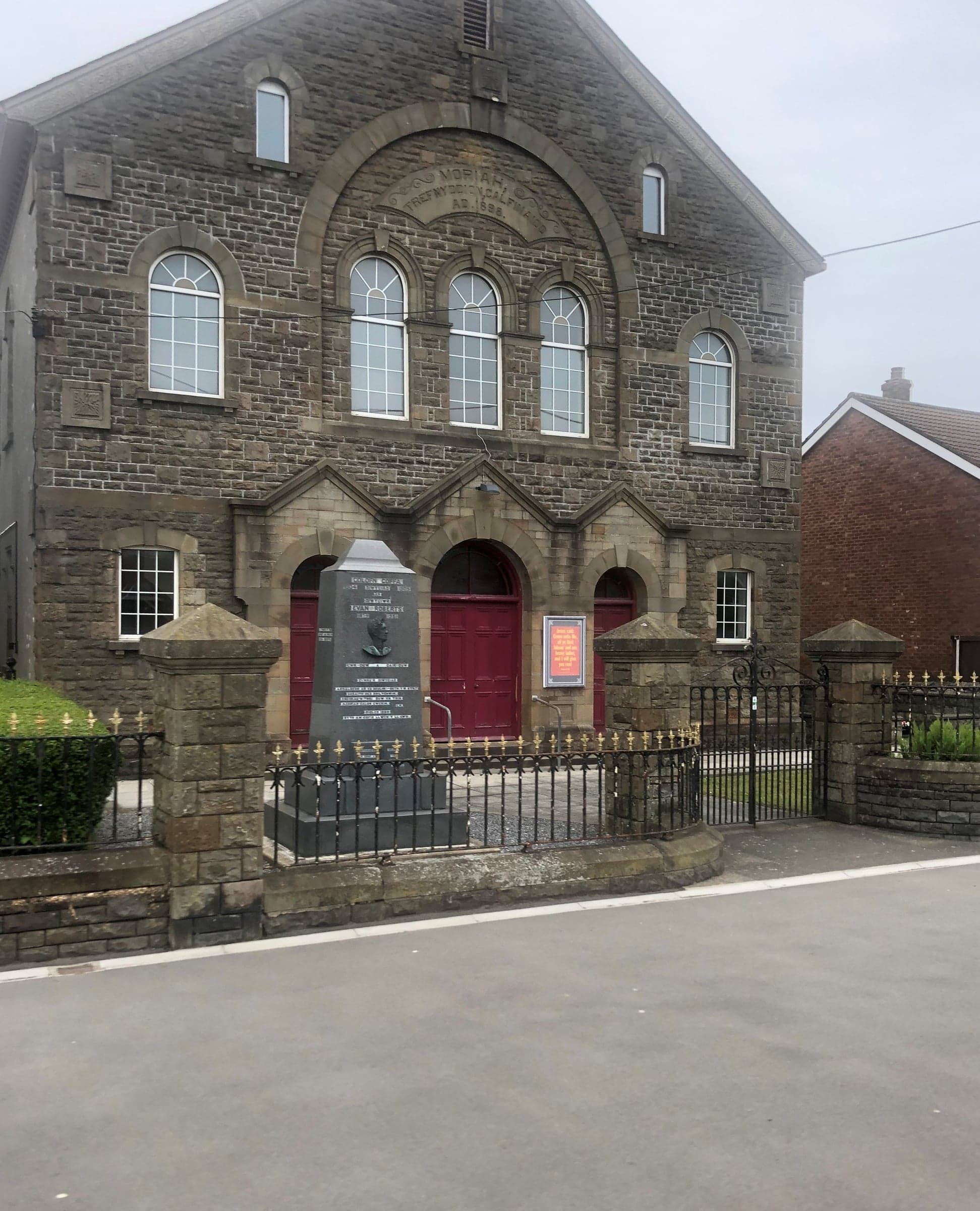
Moriah Calvinistic Methodist Church, Loughor, Eirian Evans, 2022. CC BY-SA 2.0.
And afterward, I will pour out My Spirit on all people. Your sons and daughters will prophesy, your old men will dream dreams, your young men will see visions.
Summary
Young women stood beside Evan Roberts from the first weeks of the revival. Their names come down in the books and papers of the time.
- Florrie Evans, the girl who spoke at Joseph Jenkins's meeting, is named in print two years later.
- The young singer of Pontycymmer was eighteen by one account and fifteen by another.
- Roberts's sister Mary later served as a missionary in Africa.
- Sarah Prendergast's thesis of 2018 studies the women's part.
The Prophecy of Joel
Peter's sermon at Pentecost gave the revival's preachers a second text beside Joel's.
Even on My menservants and maidservants I will pour out My Spirit in those days, and they will prophesy.Campbell Morgan compared the meetings in Wales with Peter's sermon at Pentecost, which names the women servants on whom the Spirit falls.
The Women in the Record
Five places of the revival had women whose names the record keeps.
The women stood in the meetings from New Quay to Egryn.
| Name | Place | Time, in 1904 unless named |
|---|---|---|
| Florrie Evans | New Quay | February |
| Maud Davies and Magdalen Phillips | Blaenannerch | Before November |
| Five women of Gorseinon, Annie May Rees among them | Trecynon | 13 November |
| Annie Davies, her sister Maggie and S. A. Jones | Pontycymmer, and on the road with Roberts | From 17 November |
| Mary Jones | Egryn, Merioneth | January 1905 |
From New Quay to Trecynon
Girls from the coast and from Gorseinon went with Roberts, and some hearers objected.
Young women from New Quay had spoken in the young people's service at Seth Joshua's mission, and Roberts went, he wrote, to pray for the girls there.
At Blaenannerch, by his own account, Magdalen Phillips stood on his right and Maud Davies on his left.
His plan for a team of ten names nine people, seven of them women.
Of the girls from the coast at prayer he wrote that they were “so earnest, so simple, and not in the least nervous.”
At home in Loughor he began a women's prayer meeting after the Sunday school, the first of its kind at Moriah, and about twenty-five girls came to it.
Five women of Gorseinon went with him on his first mission away from Loughor, and their appearance with him displeased the people of Trecynon.
At his meetings, D. M. Phillips writes, young ladies gave out hymns to sing and others testified.
Mary Jones of Egryn
Elvet Lewis heard her story in her own home near Barmouth.
She asked her brother, who ran the branch chapel, to announce meetings of prayer, and she became, Lewis writes, “the leading worker in these meetings.”
She visited and invited by day, and when the fortnight was over, Lewis writes, fifty-one had been brought to Christ in that thinly peopled district.
The Singers
Three young women joined Roberts after a meeting at Pontycymmer and sang at his meetings.
Annie Davies, a young singer from Maesteg, wrote that she had come to the meeting at Pontycymmer indifferent and full of curiosity.
After the meeting S. A. Jones of Nantymoel, whom she had never met, spoke to her and her sister Maggie.
The three felt “a great desire to consecrate our voices to the Master,” and Roberts told them to pray about it.
D. M. Phillips calls the three “the immediate and chief helpers” of Roberts's meetings, and names Miss Mary Roberts with them.
Elvet Lewis wrote that her voice “won for her a path through the surging crowd.”
How the Key Verse Was Taught
Matthew Henry, John Wesley, Jamieson, Fausset & Brown, and Evan Roberts each read Joel 2:28.
Matthew Henry (1662 to 1714)
Commentary on the Whole Bible
Matthew Henry tied the promise to the gift the apostles received at Pentecost.
“The blessing itself here promised is the pouring out of the Spirit of God, his gifts, graces, and comforts, which the blessed Spirit is the author of.”
Puritan
John Wesley (1703 to 1791)
Explanatory Notes upon the Old Testament, on Joel 2:28
John Wesley looked past Pentecost for the promise's wider meaning.
“This was in part fulfilled according to the letter in the first days of the gospel; but the promise means farther, by pouring out of the spirit on your sons and your daughters, they shall have as full a knowledge of the mysteries of God's law, as prophets before time had.”
Evangelical
Jamieson, Fausset & Brown (1802 to 1910)
Commentary Critical and Explanatory on the Whole Bible
Jamieson, Fausset & Brown gave the word a wider sense.
“‘Prophesying’ in the New Testament is applied to all speaking under the enlightenment of the Holy Spirit, and not merely to foretelling events.”
Evangelical
Evan Roberts (1878 to 1951)
Interview in the South Wales Daily News, reprinted in W. T. Stead, The Welsh Revival (Boston: Pilgrim Press), the four conditions
Evan Roberts gave this answer to a reporter in November 1904.
“This is the message. Of course I had to pray for it. To ask for guidance how the prophecy of Joel is being fulfilled. There the Lord says, 'I will pour out my Spirit upon all flesh.' If that be so all flesh must be prepared to receive it. Note the four conditions: First. The past must be clear: every sin confessed to God. Any wrong put upon any man must be made right. Second. Everything doubtful must be removed once and for all out of our lives. Third. Obedience prompt and implicit to the Holy Spirit. Fourth. Public confession must be made of Christ.”
Welsh revival
Jamieson, Fausset & Brown, Evan Roberts
In Their Own Words
A girl, a singer, a leader of meetings and the woman of Egryn left these words in letters and reports.
Florrie Evans (born 1884)
Words to Joseph Jenkins at New Quay, in D. M. Phillips, Evan Roberts, the Great Welsh Revivalist and His Work, the chapter on New Quay
Under its feet
“I am in a fearful state concerning my soul. I saw the world in tonight's sermon, and I am under its feet; I cannot live like this.”
young woman of New Quay
About this saying1 paragraph
Florrie Evans came to her minister's door after the evening sermon in February 1904.
Annie Davies of Maesteg
Letter of 10 January 1906, in D. M. Phillips, Evan Roberts, the Great Welsh Revivalist and His Work, the chapter on the singers
Sing something, Annie
“With an irresistible force I leapt from my seat, and sang ‘Here is love vast as the ocean’ to the tune ‘Britain's Lament.’ I could not finish it, as I was sobbing too much.”
singer of the Welsh
About this saying1 paragraph
Annie Davies was asked to sing at a meeting at Pontycymmer in November 1904.
Annie May Rees
At a revival meeting, reported in the Evening Express, 16 December 1904, as quoted in Sarah Louise Prendergast, The Welsh Revival (1904-1905): Recovering the Role of Welsh Women, page 216
Bring them in
“Where are the sinners? Bring them in; my heart is bleeding for the sinners.”
woman of Gorseinon in
About this saying1 paragraph
Annie May Rees led the meeting herself, in the revival's first winter at the start of the twentieth century.
Mary Jones of Egryn
As told to H. Elvet Lewis, in With Christ among the Miners, page 238
There must be four
“But there must be four”
leader of revival
About this saying1 paragraph
Mary Jones of Egryn told of an evening when only three converts stood up, in January 1905.
Annie May Rees, Mary Jones of Egryn
Where Historians Disagree
Writers then and now differ on the women's place in the revival and on the lights at Egryn.
Were the women forgotten?2 paragraphs
Prendergast argues that the women have been remembered as singers and as Roberts's helpers, and that Florrie Evans “has all but been written out of the historical record.”
Her own thesis grants that the claim of more women than men among the revivalists is “a point which is difficult to prove,” since so many of the women went unnamed.
Did the women belong at the front?2 paragraphs
Peter Price, a Congregational minister of Dowlais, wrote to the Western Mail that Roberts and his girl-companions should withdraw to their homes, in a letter J. Vyrnwy Morgan printed in 1909.
Roberts told Stead that the Singing Sisters were “Most useful. They go with me wherever I go.”
What were the lights at Egryn?2 paragraphs
Elvet Lewis judged that too many accredited witnesses had seen the lights to doubt them, though he wrote that they later became “a sort of foolish cult.”
Vyrnwy Morgan set her among those who claimed visions, writing that she “professed to have seen lights.”
Books to Read Next
Evan Roberts, the Great Welsh Revivalist and His Work
D. M. Phillips · 1906
Phillips prints Roberts's letters and Annie Davies's own account of joining him.
Free at the Internet ArchiveWith Christ among the Miners
H. Elvet Lewis · 1906
Lewis tells what the woman of Egryn and the singers told him.
Free at the Internet ArchiveThe Welsh Revival (1904-1905): Recovering the Role of Welsh Women
Sarah Louise Prendergast · 2018
Prendergast reads the newspapers of the revival for the women they name.
Free from Oxford Brookes UniversityWhat the Revival Carried to India
In January of the revival's second year, the news from Wales reached Pandita Ramabai's mission at Mukti in India, where seventy volunteers began to meet for prayer.
Thirty young women of her Bible school later volunteered to preach in the villages, after word came that the revival had reached the Khassia Hills.
Sources
Scripture is the Berean Standard Bible.
- The Holy Bible, Berean Standard Bible (read 2026)
- D. M. Phillips, Evan Roberts, the Great Welsh Revivalist and His Work (London: Marshall Brothers, 1906)
- W. T. Stead and G. Campbell Morgan, The Welsh Revival (Boston: Pilgrim Press, 1905)
- H. Elvet Lewis, With Christ among the Miners (London: Hodder and Stoughton, 1906)
- J. Vyrnwy Morgan, The Welsh Religious Revival 1904-5: A Retrospect and a Criticism (London, 1909)
- The Story of the Welsh Revival as Told by Eyewitnesses (New York: Revell, 1905), G. Campbell Morgan's address.
- Sarah Louise Prendergast, The Welsh Revival (1904-1905): Recovering the Role of Welsh Women (PhD thesis, Oxford Brookes University, 2018)
- Helen S. Dyer, Revival in India (London: Morgan and Scott, about 1907)
- Matthew Henry, Commentary on the Whole Bible (1710)
- John Wesley, Explanatory Notes upon the Old Testament, on Joel 2:28 (1765)
- Jamieson, Fausset & Brown, Commentary Critical and Explanatory on the Whole Bible (1871)
- Evan Roberts, interview in the South Wales Daily News (November 1904), reprinted in W. T. Stead and G. Campbell Morgan, The Welsh Revival (Boston: Pilgrim Press, 1905)