
1 Samuel 21:1
in 1 Samuel 21Then David came to Nob, to Ahimelech the priest. And when Ahimelech met David, he trembled and asked him, “Why are you alone? Why is no one with you?”
BSB
The same verse in ASV and KJV ▾
ASV
Then came David to Nob to Ahimelech the priest: and Ahimelech came to meet David trembling, and said unto him, Why art thou alone, and no man with thee?
KJV
Then came David to Nob to Ahimelech the priest: and Ahimelech was afraid at the meeting of David, and said unto him, Why art thou alone, and no man with thee?
⋯
This verse in 1 Samuel 21
Commentary
10 notes on this verseA commentator
Albert Barnes1798–1870
Notes, Explanatory and Practical, on the Old and New Testaments (1832-1869)
Nob was a city of the priests, the high priest resided there, and the tabernacle was pitched there 1Sa 21:4, 1Sa 21:6,1Sa 21:9; 1Sa 22:10. It was situated on the road from the north to Jerusalem, near Anathoth, and within sight of the holy city Isa 10:32; Neh 11:32. But the site has not been identified with certainty.
This site's exposition
Why are you alone? Why is no one with you
on 1 Samuel 21:1-2
David reaches Nob alone, and Ahimelech trembles and asks why no one is with him, exposing the change before David explains anything. Ahimelech later tells Saul at 22:10 that he inquired of the LORD for David at this visit, though it is not narrated here. The mission David invents for the king is the first outright lie of his exile, and the older writers read it as fear overtaking faith.
The record, by era
The Church Fathers1 voice
In similar fashion, whenever we have God on our side, even if we are utterly alone, we will live more securely than those who dwell in the cities. After all, the grace of God is the greatest security and the most impregnable fortification. To prove to you how the person who, in fact, lives utterly alone turns out to be more secure and efficacious than a person living in the middle of cities and enjoying plenty of human assistance, let us see how David, though shifting from place to place and living like a nomad, was protected by the hand from above, whereas Saul, who in fact was in the middle of cities and had armies at his command, bodyguards and shieldbearers as well, still spent each day in fear and dread of enemy assaults. Whereas the one man, although alone and with no one else in his company, had no need of assistance from human beings, the other, by contrast, needed his help, despite wearing a diadem and being clad in purple. The king stood in need of the shepherd; the wearer of the crown had need of the peasant.
The Medieval Church1 voice
And Achimelech was astonished, etc. The ancient chosen ones were astonished, and the modern ones are astonished too, whenever they receive the coming of the Lord's visitation with a simple mind. They are not only stunned by the majesty of His vision, but also disturbed …
The Puritans and the Awakening3 voices
To enquire of the Lord there, and to beg direction from him in the way both of duty and safety, his case being difficult and dangerous. That this was his business appears ch. xxii. 10 , where it is said that Ahimelech enquired of the Lord for him, as he had done formerly,
Ahimelech the priest is surprised to see him in so poor an equipage; having heard that he had fallen into disgrace at court, he looked shy upon him, as most are apt to do upon their friends when the world frowns upon them. He was afraid of incurring Saul's displeasure by entertaining him, and took notice how mean a figure he now made to what he used to make: Why art thou alone?
Was afraid - Suspecting some extraordinary cause of his coming in such a manner. Alone - For though David had some servants as is manifest from ver. 4, 5, whom Jonathan probably had sent to a place appointed, yet they were left at another place: as David himself affirmeth, ver. 2. And David was now alone, as also he was when he fled to Achish.
quarantine:anchor (2026-07-29) — cites-ver-4-anchored-1-1
3 more voices on this verse
The Puritans and the Awakening1 voice
Then came David to Nob, to Ahimelech the priest,....
The Nineteenth Century2 voices
A commentator
Jamieson, Fausset & Brown1802–1910
Commentary Critical and Explanatory on the Whole Bible (1871)
proposed
It is computed to have been about five miles distant from Gibeah. Ahimelech, the same as Ahiah, or perhaps his brother, both being sons of Ahitub (compare 1Sa 14:3, with 1Sa 22:4-11, 20). His object in fleeing to this place was partly for the supply of his necessities, and partly for comfort and counsel, in the prospect of leaving the kingdom.
Then came David to Nob - There were two places of this name, one on this side, the second on the other side of Jordan; but it is generally supposed that Nob, near Gibeah of Benjamin, is the place here intended; it was about twelve miles from Jerusalem. Why art thou alone - Ahimelech probably knew nothing of the difference between Saul and David; and as he knew him to be the king’s son-in-law, he wondered to see him come without any attendants.
How the passage was read
What the Jewish commentators add
And [David] arose and went. And Jonathan went into the city.
This section is reception history: how the passage was read and kept in the Jewish tradition. Where a reading parts from an essential of the Christian faith, the section says so at that point.
Texts and citation data: Sefaria; each excerpt follows its version’s licence. 6 further sources are cited on this chapter that carry no English text this site may quote or only restate the verse.
The words behind it
18 Hebrew wordsEvery Hebrew word of this verse in the order it stands, with what it means and the door to its own study. The last column counts the times a word stands in the whole Bible: the rarer the word, the more the places it appears belong together.
| Hebrew | Sound | Meaning | Word study | In the Bible |
|---|---|---|---|---|
| וַיָּבֹ֤א | vaiyavo' | and he went | H935 → | 2568 times |
| דָוִד֙ | david | David | H1732 → | 999 times |
| נֹ֔בֶה | noeh | Nob towards | H5011 → | 6 times |
| אֶל־ | ʾel- | to | H413 → | 5510 times |
| אֲחִימֶ֖לֶךְ | ʾachimelekh | Ahimelech | H288 → | 16 times |
| הַכֹּהֵ֑ן | hakohen | the priest | H3548 → | 750 times |
| וַיֶּחֱרַ֨ד | vaiyecherad | and he trembled | H2729 → | 39 times |
| אֲחִימֶ֜לֶךְ | ʾachimelekh | Ahimelech | H288 → | 16 times |
| לִקְרַ֣את | likrat | to meet | H7122 → | 139 times |
| דָּוִ֗ד | david | David | H1732 → | 999 times |
| וַיֹּ֤אמֶר | vaiyomer | and he said | H559 → | 5305 times |
| לוֹ֙ | lo | to <the> him | ||
| מַדּ֤וּעַ | madua' | why? | H4069 → | 72 times |
| אַתָּה֙ | ʾatah | [are] you | H859 → | 1094 times |
| לְבַדֶּ֔ךָ | levadekha | to alone you | H905 → | 200 times |
| וְאִ֖ישׁ | veish | and [is] anyone | H376 → | 1663 times |
| אֵ֥ין | ʾein | there not | H369 → | 789 times |
| אִתָּֽךְ׃ | ʾitakh | with you | H854 → | 929 times |
וַיָּבֹ֤אand he went
vaiyavo'H935 →2568 times
דָוִד֙David
davidH1732 →999 times
נֹ֔בֶהNob towards
noehH5011 →6 times
אֶל־to
ʾel-H413 →5510 times
אֲחִימֶ֖לֶךְAhimelech
ʾachimelekhH288 →16 times
הַכֹּהֵ֑ןthe priest
hakohenH3548 →750 times
וַיֶּחֱרַ֨דand he trembled
vaiyecheradH2729 →39 times
אֲחִימֶ֜לֶךְAhimelech
ʾachimelekhH288 →16 times
לִקְרַ֣אתto meet
likratH7122 →139 times
דָּוִ֗דDavid
davidH1732 →999 times
וַיֹּ֤אמֶרand he said
vaiyomerH559 →5305 times
לוֹ֙to <the> him
lo
מַדּ֤וּעַwhy?
madua'H4069 →72 times
אַתָּה֙[are] you
ʾatahH859 →1094 times
לְבַדֶּ֔ךָto alone you
levadekhaH905 →200 times
וְאִ֖ישׁand [is] anyone
veishH376 →1663 times
אֵ֥יןthere not
ʾeinH369 →789 times
אִתָּֽךְ׃with you
ʾitakhH854 →929 times
A shaded row is a word that stands 400 times or fewer in the Bible.
The walk
8 stopsEach card is a verse this one points to, and under it the verses that one points to in turn. Where several paths arrive at the same place, that place is listed first: the text keeps returning to it.
Through
Mark 2:26During the high priesthood of Abiathar, he entered the house of God and ate the consecrated bread, which was lawful only for the priests. And he gave some to his companions as well.”
it leads to
- 2 Samuel 8:17
Zadok son of Ahitub and Ahimelech son of Abiathar were priests; Seraiah was the scribe;
- Leviticus 24:5–9
You are also to take fine flour and bake twelve loaves, using two-tenths of an ephah for each loaf,
- 2 Samuel 8:17
Through
1 Samuel 14:3including Ahijah, who was wearing an ephod. He was the son of Ichabod’s brother Ahitub son of Phinehas, the son of Eli the priest of the LORD in Shiloh. But the troops did not…
it leads to
- 1 Samuel 4:21
And she named the boy Ichabod, saying, “The glory has departed from Israel,” because the ark of God had been captured and her father-in-law and her husband had been killed.
- 1 Samuel 2:28
And out of all the tribes of Israel I selected your father to be My priest, to offer sacrifices on My altar, to burn incense, and to wear an ephod in My presence. I…
- 1 Samuel 22:20
But one of the sons of Ahimelech son of Ahitub escaped. His name was Abiathar, and he fled to David.
- 1 Samuel 4:21
Through
1 Samuel 16:4So Samuel did what the LORD had said and went to Bethlehem. When the elders of the town met him, they trembled and asked, “Do you come in peace?”
it leads to
- 1 Kings 2:13
Now Adonijah son of Haggith went to Bathsheba the mother of Solomon, and she asked, “Do you come in peace?” “Yes, in peace,” he replied.
- 1 Chronicles 12:17–18
And David went out to meet them, saying, “If you have come to me in peace to help me, my heart will be united with you; but if you have come to betray me…
- Luke 5:8
When Simon Peter saw this, he fell at Jesus’ knees. “Go away from me, Lord,” he said, “for I am a sinful man.”
- 1 Kings 2:13
Where this verse is studied
On this page
About 1 Samuel
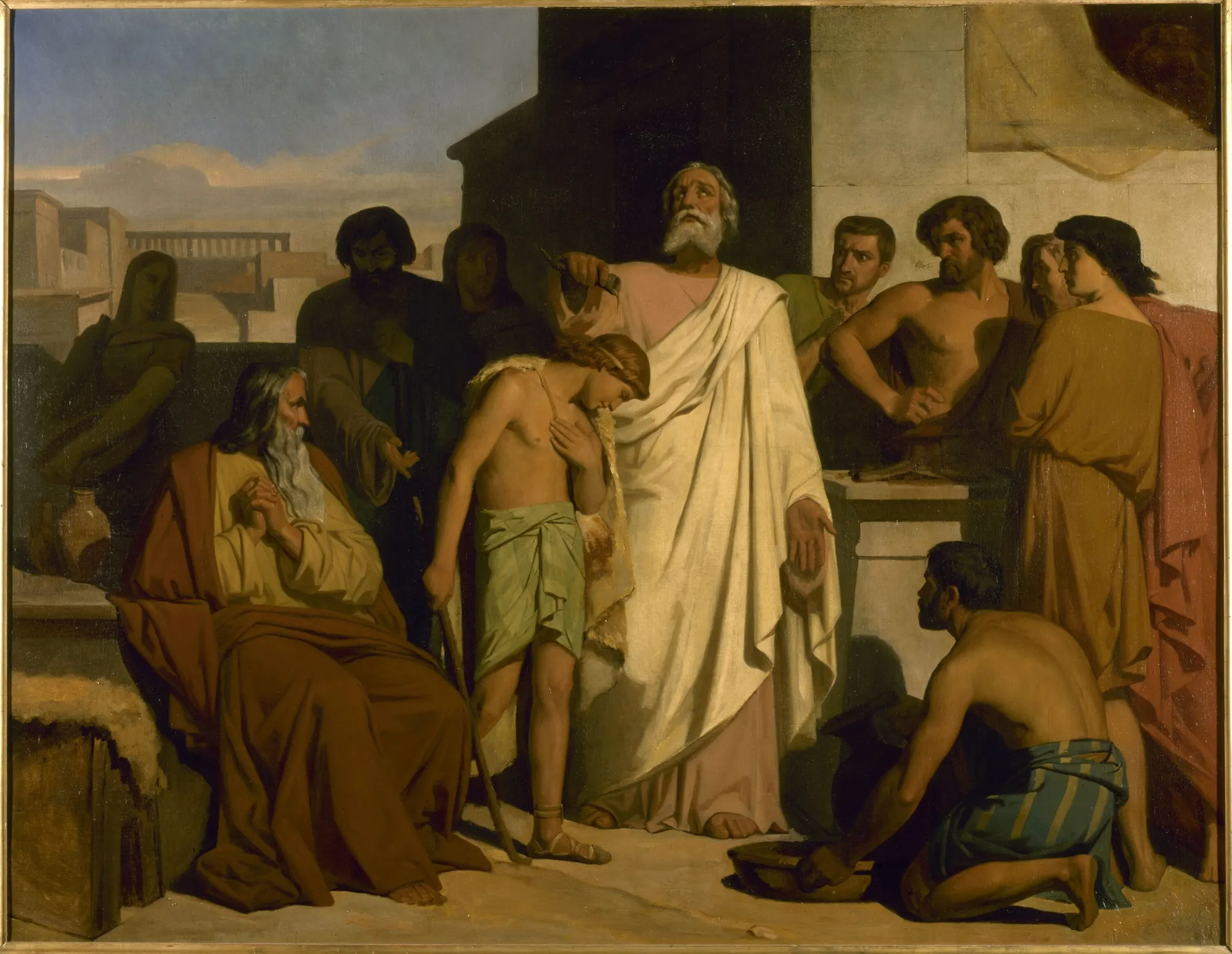
Who and where
3 names in this verse with a page on the site.
- PersonUnited MonarchyDavidSecond king of united Israel, shepherd-turned-monarch, ancestor of the Messiah, and traditional author of many Psalms.
- PersonEarly monarchyAhimelechPriest of Nob who gave the fugitive David the showbread and Goliath's sword, not knowing the king's quarrel; slain with eighty-fiv…
- PlaceBenjaminNobThe town of the priests near Jerusalem where David ate the showbread, the precedent Jesus cited, and which Saul put to the sword.
This page draws on 9 works. Open the list of works
This page draws on Adam Clarke, Commentary on the Bible; Albert Barnes, Notes, Explanatory and Practical, on the Old and New Testaments (1832-1869); Albert Barnes, Notes on the Old Testament; Bede, Commentary on Samuel; Jamieson, Fausset & Brown, Commentary Critical and Explanatory on the Whole Bible; John Chrysostom, HOMILIES ON GENESIS 46.8; John Gill, Exposition of the Old Testament (1748-1763); John Wesley, Explanatory Notes upon the Old Testament and Matthew Henry, Commentary on the Whole Bible.