
Revelation 5:8
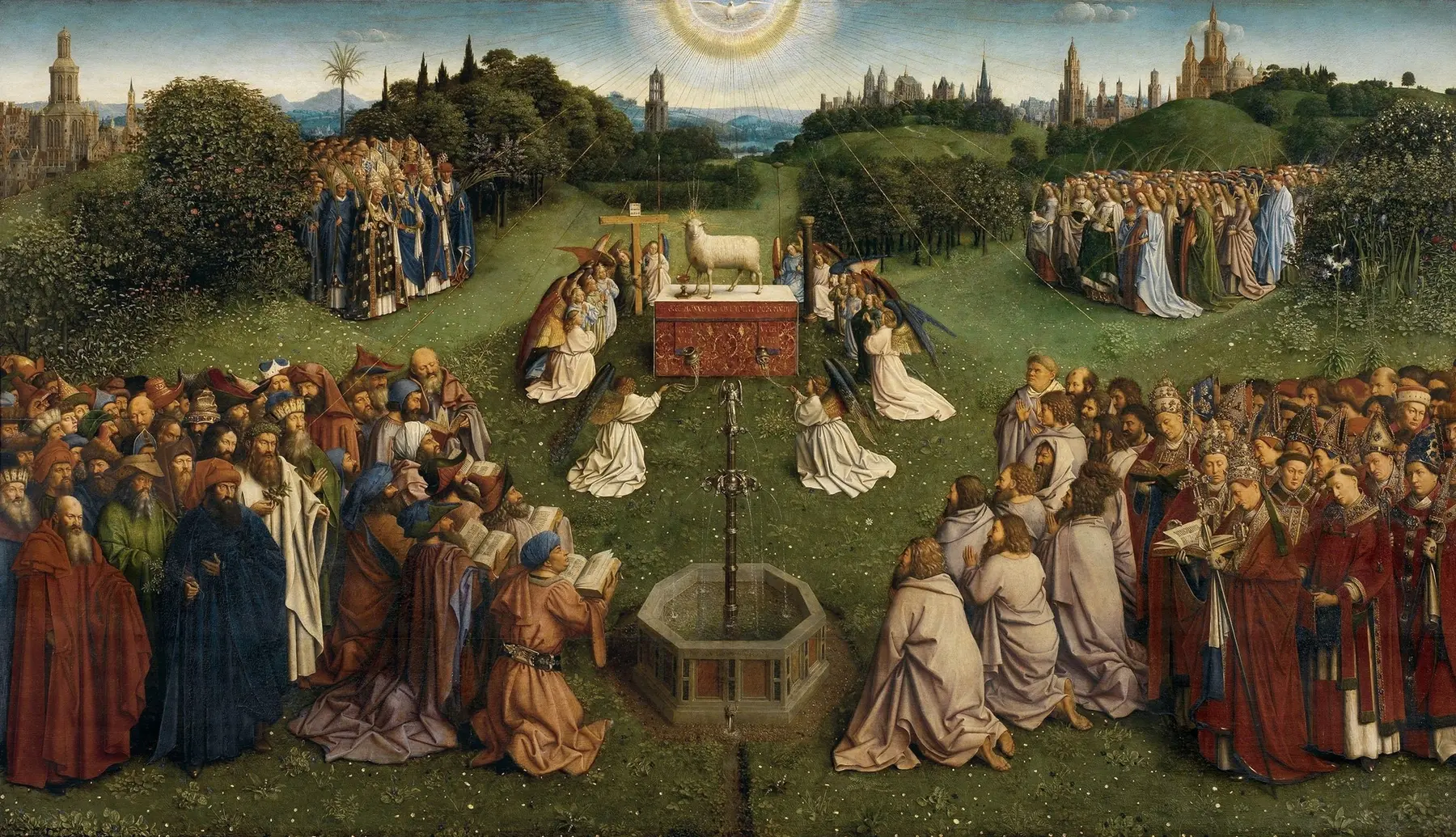
in Revelation 5When He had taken the scroll, the four living creatures and the twenty-four elders fell down before the Lamb. Each one had a harp, and they were holding golden bowls full of incense, which are the prayers of the saints.
BSB
The same verse in ASV and KJV ▾
ASV
And when he had taken the book, the four living creatures and the four and twenty elders fell down before the Lamb, having each one a harp, and golden bowls full of incense, which are the prayers of the saints.
KJV
And when he had taken the book, the four beasts and four and twenty elders fell down before the Lamb, having every one of them harps, and golden vials full of odours, which are the prayers of saints.
⋯
This verse in Revelation 5
Commentary
20 notes on this verseThe four beasts - fell down before the Lamb - The whole Church of God, and all his children in heaven and earth, acknowledge that Jesus Christ is alone worthy and able to unfold and execute all the mysteries and counsels of God. See on Rev 5:9 (note). Having every one of them harps - There were harps and vials; and each of the elders and living creatures had one. Odours, which are the prayers of saints - The frankincense and odours offered at the tabernacle were emblems of the prayers and praises of the Lord.
This site's exposition
golden bowls full of incense
The creatures and elders fell down before the Lamb, holding golden bowls full of incense, which are the prayers of the saints, Psalm 141:2. Here for the first time in the book the Lamb receives the worship given to the One on the throne.
The record, by era
The Church Fathers5 voices
A commentator
Victorinus of PettauCommentary on the Apocalypse of the Blessed John · Written before 304.
proposed
"Twenty-four elders and four living creatures, having harps and phials, and singing a new song." The proclamation of the Old Testament associated with the New, points out the Christian people singing a new song, that is, bearing their confession publicly. It is a new thing that the Son of God should become man. It is a new thing to ascend into the heavens with a body. It is a new thing to give remission of sins to men. It is a new thing for men to be sealed with the Holy Spirit. It is a new thing to receive the priesthood of sacred observance, and to look for a kingdom of unbounded promise. The harp, and the chord stretched on its wooden frame, signifies the flesh of Christ linked with the wood of the passion. The phial signifies the Confession, and the race of the new Priesthood. But it is the praise of many angels, yea, of all, the salvation of all, and the testimony of the universal creation, bringing to our Lord thanksgiving for the deliverance of men from the destruction of death. The unsealing of the seals, as we have said, is the opening of the Old Testament, and the foretelling of the preachers of things to come in the last times, which, although the prophetic Scripture speaks by single seals, yet by all the seals opened at once, prophecy takes its rank.
But what other name is there which is glorified among the Gentiles than that of our Lord, by whom the Father is glorified, and man also? And because it is [the name] of His own Son, who was made man by Him, He calls it His own.
A commentator
IrenaeusFragments from the Lost Writings of Irenaeus, Fragment XXXVII · Written before 202.
proposed
Those who have become acquainted with the secondary (i.e., under Christ) constitutions of the apostles, are aware that the Lord instituted a new oblation in the new covenant, according to [the declaration of] Malachi the prophet. For, "from the rising of the sun even to the setting my name has been glorified among the Gentiles, and in every place incense is offered to my name, and a pure sacrifice;" as John also declares in the Apocalypse: "The incense is the prayers of the saints." Then again, Paul exhorts us "to present our bodies a living sacrifice, holy, acceptable unto God, which is your reasonable service." And again, "Let us offer the sacrifice of praise, that is, the fruit of the lips." Now those oblations are not according to the law, the handwriting of which the Lord took away from the midst by cancelling it; but they are according to the Spirit, for we must worship God "in spirit and in truth." And therefore the oblation of the Eucharist is not a carnal one, but a spiritual; and in this respect it is pure. For we make an oblation to God of the bread and the cup of blessing, giving Him thanks in that He has commanded the earth to bring forth these fruits for our nourishment. And then, when we have perfected the oblation, we invoke the Holy Spirit, that He may exhibit this sacrifice, both the bread the body of Christ, and the cup the blood of Christ, in order that the receivers of these antitypes may obtain remission of sins and life eternal. Those persons, then, who perform these oblations in remembrance of the Lord, do not fall in with Jewish views, but, performing the service after a spiritual manner, they shall be called sons of wisdom.
We regard the spirit of every good person as an altar from which arises an incense that is truly and spiritually sweet-smelling, namely, the prayers ascending from a pure conscience. Therefore it is said by John in the Revelation, "The odors are the prayers of the saints"; and by the psalmist, "Let my prayer come before you as incense." And the statues and gifts that are fit offerings to God are the work of no common mechanics but are wrought and fashioned in us by the Word of God, to wit, the virtues in which we imitate "the firstborn of all creation," who has set us an example of justice, of temperance, of courage, of wisdom, of piety, and of the other virtues.
The bowls that are accepted by God are the pious confession in which no one is hidden with a duplicitous heart but is rather sincere with an open affection. They are also the golden vessels that are in the great house, burning with the sweetness …
13 more voices on this verse
The Church Fathers1 voice
Having received the little scroll from the Lord, all worshiped it, fully aware of the salvation it is destined to bring to humanity, and the punishment it holds for the impure demons. The elders holding harps signify the harmonious and melodious nature of their confession …
The Medieval Church4 voices
The harps indicate the harmonious and melodious divine doxology, while the incense indicates the sweet-smelling sacrifice of the faithful that is offered through a most pure life, as the apostle says: "We are the aroma of Christ." The bowls are symbolic of the thoughts from …
And when he had opened the book, the four living creatures, and the four and twenty ancients fell down before the Lamb, having every one of them harps, and golden vials full of odours, which are the prayers of saints. The Lamb opened the book …
Just as it is proper for us to seek the Lord shining with the light of good works, so also is it proper for us to seek him abundantly provided with the gift of spiritual prayers. Hence it is good that the women who came …
And when He had opened the book, etc. When by His passion the Lord proved that the proclamations of both Testaments were fulfilled in Him, the Church, giving thanks, also offers itself to sufferings, so that, according to the Apostle, it may complete in its …
The Puritans and the Awakening2 voices
), the four living creatures, and the four-and-twenty elders, the Christian people, under their minister, lead up the chorus. Here observe, (1.) The object of their worship-- the Lamb, the Lord Jesus Christ; it is the declared will of God that all men should honour the Son as they honour the Father; for he has the same nature.
quarantine:debris (2026-07-29) — leading-punctuation+unbalanced-parens
And when he had taken the book,....
The Nineteenth Century6 voices
A commentator
Jamieson, Fausset & Brown1802–1910
Commentary Critical and Explanatory on the Whole Bible (1871)
proposed
had taken--Greek, "took." fell down before the Lamb--who shares worship and the throne with the Father. harps--Two oldest manuscripts, A, B, Syriac and Coptic read, "a harp": a kind of guitar, played with the hand or a quill. vials--"bowls" [TREGELLES]; censers. odours--Greek, "incense." prayers of saints--as the angel offers their prayers (Re 8:3) with incense (compare Ps 141:2).
quarantine:debris (2026-07-29) — starts-lowercase
I SHOULD not have addressed you upon the subject of intercession today if this week had not been set apart for general prayer, for it was only two Sabbaths ago that I endeavored to set before you the duty and privilege of intercession [Sermon #1049, Intercessory Prayer.] However, as our mind is now directed to it again, it may be that the line upon line, the precept upon precept, the here a little and there a little, may not be without benefit to us. The vision before us is a very remarkable one.
I SHOULD not have addressed you upon the subject of intercession today if this week had not been set apart for general prayer, for it was only two Sabbaths ago that I endeavored to set before you the duty and privilege of intercession [Sermon #1049, Intercessory Prayer.] However, as our mind is now directed to it again, it may be that the line upon line, the precept upon precept, the here a little and there a little, may not be without benefit to us. The vision before us is a very remarkable one. We do not intend, for we have not the time, to go into all the details of it. No doubt it is a vision referring to some special occasion, but at the same time we may regard it as descriptive of the usual worship which is offered before the Throne of God and the Lamb. We have sometimes in continental galleries seen a mediaeval painting representing the assembly of the great council of the ancient German Empire. There is the emperor surrounded by the various kings, princes, electors, dukes, and counts. Yonder are the knights of the Golden Fleece. There are the bishops and the cardinals, the barons, knights, and burghers of various degrees making up a marvelous spectacle of pomp and pageantry. If we made minute enquiries we should, perhaps, discover the one particular Diet which the picture represented—but even without such investigation the painting is instructive—we know that if it represents the Diet on one occasion, the one might stand for all. And so in the great assembly of Heaven, the outline which the seer of Patmos gives us here may, if we wish to be very accurate, be referred to some one particular event. But it will suffice for us to believe that it represents in general the homage which is rendered at the Throne of the Eternal.
A commentator
Charles Spurgeon1834–1892
The Metropolitan Tabernacle Pulpit, Sermon No. 2321: “The Heavenly Singers and Their Song” (lightly modernized text, CCEL edition) · Written before 1892.
proposed
THIS morning [Sermon #2095, Volume 35—The Lamb in Glory.] we had a picture of our Lord Jesus Christ appearing in Heaven in His Sacrificial Character, being adored in that Character, looking like a Lamb that had been slain, and being worshipped under that aspect in the very center of Heaven.
A commentator
Charles Spurgeon1834–1892
The Metropolitan Tabernacle Pulpit, Sermon No. 2321: “The Heavenly Singers and Their Song” (lightly modernized text, CCEL edition) · Written before 1892.
proposed
THIS morning [Sermon #2095, Volume 35—The Lamb in Glory.] we had a picture of our Lord Jesus Christ appearing in Heaven in His Sacrificial Character, being adored in that Character, looking like a Lamb that had been slain, and being worshipped under that aspect in the very center of Heaven. I tried, as far as ever I could, to insist upon it that we must never hide the Atoning Sacrifice—that Christ, as the Lamb of God which takes away the sin of the world—is always to be brought to the front, to be put foremost in our preaching and in our practice, too. In this verse we go a step further. This blessed Lamb appears in Heaven as the Mediator between God and men. At God's right hand was the Book of His Eternal Purposes. None dared even to look upon it—it was hopeless that any creature should be able to loose its seven seals. But there came forward this glorious Lamb who had the marks of His slaughter upon Him and He took the Book out of the right hand of Him that sat upon the Throne of God! Thus He acted as Mediator, Interpreter—taking the will of God and translating it—letting us know the meaning of that writing of the right hand of God which we could never have deciphered, but which, when Christ looses the seals, is made clear to us! Jesus Christ, then, is seen as our Sacrifice in the capacity of Mediator and, in that capacity, He becomes the object of the adoration, first, of the Church, then of all the thousands and ten thousands of angels, and then of every creature that God has made! It would be too large a subject to take in all those hallelujahs and, therefore, in speaking, tonight, I select only these three verses to set forth the song of the Church, the adoration of the Church of God, rendered to the bleeding Lamb as the Mediator between God and men. I shall have only two divisions. First, behold the worshippers. And, secondly, listen to their song. I.
A commentator
Albert Barnes1798–1870
Notes, Explanatory and Practical, on the Old and New Testaments (1832-1869)
proposed
And when he had taken the book, the four beasts ... - The acts of adoration here described as rendered by the four living creatures and the elders are, according to the explanation given in Rev 4:4-7, emblematic of the honor done to the Redeemer by the church, and by the course of providential events in the government of the world. Fell down before the Lamb - The usual posture of profound worship. Usually in such worship there was entire prostration on the earth. See the Mat 2:2 note; 1Co 14:25 note. Having every one of them harps - That is, as the construction, and the propriety of the case would seem to demand, the elders had each of them harps. The whole prostrated themselves with profound reverence; the elders had harps and censers, and broke out into a song of praise for redemption. This construction is demanded, because: (a) The Greek word - ἔχοντες echontes - more properly agrees with the word “elders” - πρεσβύτεροι presbuteroi - and not with the word “beasts” - ζῶα zōa; (b) There is an incongruity in the representation that the living creatures, in the form of a lion, a calf, an eagle, should have harps and censers; and, (c) The song of praise that is sung Rev 5:9 is one that properly applies to the elders as the representatives of the church, and not to the living creatures - “Thou hast redeemed us to God by thy blood.” The harp was a well-known instrument used in the service of God. Josephus describes it as having ten strings, and as struck with a key (Ant. Rev 7:12, Rev 7:3). See the notes on Isa 5:12. And golden vials - The word “vial” with us, denoting a small slender bottle with a narrow neck, evidently does not express the idea here. The article here referred to was used for offering incense, and must have been a vessel with a large open mouth. The word “bowl” or “goblet” would better express the idea, and it is so explained by Prof. […]
The words behind it
31 Greek wordsEvery Greek word of this verse in the order it stands, with what it means and the door to its own study. The last column counts the times a word stands in the whole Bible: the rarer the word, the more the places it appears belong together.
| Greek | Sound | Meaning | Word study | In the Bible |
|---|---|---|---|---|
| καὶ | kai | And | G2532 → | 9120 times |
| ὅτε | hote | when | G3753 → | 103 times |
| ἔλαβεν | elaben | He had taken | G2983 → | 257 times |
| τὸ | to | the | G3588 → | 19766 times |
| βιβλίον, | biblion | scroll, | G975 → | 34 times |
| τὰ | ta | the | G3588 → | 19766 times |
| τέσσαρα | tessara | four | G5064 → | 41 times |
| ζῷα | zoa | living creatures | G2226 → | 23 times |
| καὶ | kai | and | G2532 → | 9120 times |
| οἱ | hoi | the | G3588 → | 19766 times |
| εἴκοσι | eikosi | twenty | G1501 → | 11 times |
| τέσσαρες | tessares | four | G5064 → | 41 times |
| πρεσβύτεροι | presbuteroi | elders | G4245 → | 65 times |
| ἔπεσαν | epesan | fell down | G4098 → | 90 times |
| ἐνώπιον | enopion | before | G1799 → | 94 times |
| τοῦ | tou | the | G3588 → | 19766 times |
| ἀρνίου | arniou | Lamb | G721 → | 30 times |
| ἔχοντες | echontes | having | G2192 → | 707 times |
| ἕκαστος | hekastos | each | G1538 → | 81 times |
| κιθάραν | kitharan | a harp | G2788 → | 4 times |
| καὶ | kai | and | G2532 → | 9120 times |
| φιάλας | phialas | bowls | G5357 → | 12 times |
| χρυσᾶς | chrusas | golden | G5552 → | 18 times |
| γεμούσας | gemousas | being full | G1073 → | 11 times |
| θυμιαμάτων | thumiamaton | of incenses | G2368 → | 6 times |
| αἵ | ai | which | G3739 → | 1405 times |
| εἰσιν | eisin | are | G1510 → | 2333 times |
| αἱ | hai | the | G3588 → | 19766 times |
| προσευχαὶ | proseuchai | prayers | G4335 → | 35 times |
| τῶν | ton | of the | G3588 → | 19766 times |
| ἁγίων. | hagion | saints. | G40 → | 220 times |
καὶAnd
kaiG2532 →9120 times
ὅτεwhen
hoteG3753 →103 times
ἔλαβενHe had taken
elabenG2983 →257 times
τὸthe
toG3588 →19766 times
βιβλίον,scroll,
biblionG975 →34 times
τὰthe
taG3588 →19766 times
τέσσαραfour
tessaraG5064 →41 times
ζῷαliving creatures
zoaG2226 →23 times
καὶand
kaiG2532 →9120 times
οἱthe
hoiG3588 →19766 times
εἴκοσιtwenty
eikosiG1501 →11 times
τέσσαρεςfour
tessaresG5064 →41 times
πρεσβύτεροιelders
presbuteroiG4245 →65 times
ἔπεσανfell down
epesanG4098 →90 times
ἐνώπιονbefore
enopionG1799 →94 times
τοῦthe
touG3588 →19766 times
ἀρνίουLamb
arniouG721 →30 times
ἔχοντεςhaving
echontesG2192 →707 times
ἕκαστοςeach
hekastosG1538 →81 times
κιθάρανa harp
kitharanG2788 →4 times
καὶand
kaiG2532 →9120 times
φιάλαςbowls
phialasG5357 →12 times
χρυσᾶςgolden
chrusasG5552 →18 times
γεμούσαςbeing full
gemousasG1073 →11 times
θυμιαμάτωνof incenses
thumiamatonG2368 →6 times
αἵwhich
aiG3739 →1405 times
εἰσινare
eisinG1510 →2333 times
αἱthe
haiG3588 →19766 times
προσευχαὶprayers
proseuchaiG4335 →35 times
τῶνof the
tonG3588 →19766 times
ἁγίων.saints.
hagionG40 →220 times
A shaded row is a word that stands 400 times or fewer in the Bible.
The walk
8 stopsEach card is a verse this one points to, and under it the verses that one points to in turn. Where several paths arrive at the same place, that place is listed first: the text keeps returning to it.
Through
Revelation 4:10the twenty-four elders fall down before the One seated on the throne, and they worship Him who lives forever and ever. They cast their crowns before the throne, saying:
it leads to
- Revelation 19:4
And the twenty-four elders and the four living creatures fell down and worshiped God who sits on the throne, saying: “Amen, Hallelujah!”
Reached by 2 separate paths from here.
- Psalms 95:6
O come, let us worship and bow down; let us kneel before the LORD our Maker.
- Revelation 11:16
And the twenty-four elders who sit on their thrones before God fell on their faces and worshiped God,
- 1 Chronicles 29:11–16
Yours, O LORD, is the greatness and the power and the glory and the splendor and the majesty, for everything in heaven and on earth belongs to You. Yours, O LORD, is the kingdom,…
- Revelation 5:14
And the four living creatures said, “Amen,” and the elders fell down and worshiped.
- Revelation 19:4
Through
Psalms 141:2May my prayer be set before You like incense, my uplifted hands like the evening offering.
it leads to
- Revelation 8:3–4
Then another angel, who had a golden censer, came and stood at the altar. He was given much incense to offer, along with the prayers of all the saints, on the golden altar before…
- 1 Timothy 2:8
Therefore I want the men everywhere to pray, lifting up holy hands, without anger or dissension.
- Malachi 1:11
For My name will be great among the nations, from where the sun rises to where it sets. In every place, incense and pure offerings will be presented in My name, because My name…
- Revelation 8:3–4
Where this verse is studied
On this page
Studies18
On this verse
On this chapter
About Revelation
This page draws on 18 works. Open the list of works
This page draws on Adam Clarke, Commentary on the Bible; Albert Barnes, Notes, Explanatory and Practical, on the Old and New Testaments (1832-1869); Alcuin of York, COMMENTARY ON REVELATION; Andreas of Caesarea, COMMENTARY ON THE APOCALYPSE 5:7-8; Bede, Homilies on the Gospels 2.10; Bede, Commentary on Revelation; Charles Spurgeon, The Metropolitan Tabernacle Pulpit, Sermon No. 1051: “Golden Bowls Full Of Incense” (lightly modernized text, CCEL edition); Charles Spurgeon, The Metropolitan Tabernacle Pulpit, Sermon No. 2321: “The Heavenly Singers and Their Song” (lightly modernized text, CCEL edition); Irenaeus, Against Heresies Book IV; Irenaeus, Fragments from the Lost Writings of Irenaeus, Fragment XXXVII; Jamieson, Fausset & Brown, Commentary Critical and Explanatory on the Whole Bible; John Gill, Exposition of the New Testament; John Gill, Exposition of the New Testament (1746-1748); Matthew Henry, Commentary on the Whole Bible; Oecumenius, Commentary on Revelation; Origen of Alexandria, AGAINST CELSUS 8.17; Primasius of Hadrumetum, COMMENTARY ON THE APOCALYPSE 5:8 and Victorinus of Pettau, Commentary on the Apocalypse of the Blessed John.