
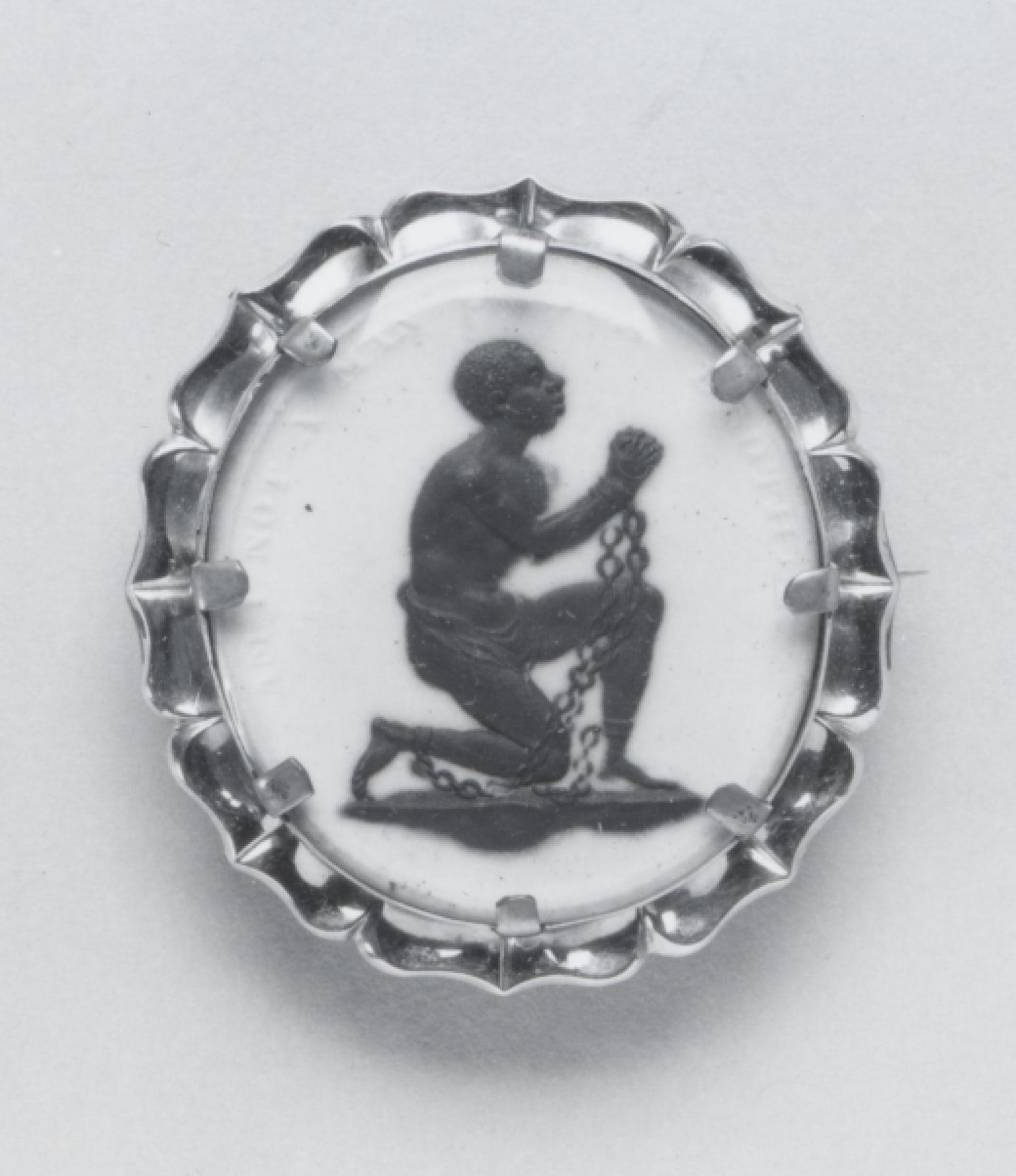
William Hackwood for Josiah Wedgwood, Anti-Slavery Medallion, 1787. Public domain.
1740 to 1835 · Subject · Featured Study
Equality Before God
Wheatley's elegy, Wesley's Thoughts upon Slavery and the Methodist rule of 1784 set the revival's word on slavery beside Whitefield's practice.
Whitefield charged the southern colonies with cruelty to their slaves, and eight years later he asked that slaves be allowed in Georgia.
There is neither Jew nor Greek, slave nor free, male nor female, for you are all one in Christ Jesus.
- Books
- Galatians, Revelation
- Hold in memory
- Galatians 3:28, Revelation 5:9
Summary
The revival preachers offered the new birth to every hearer, slave and free. Some of them wrote against the cruelty of slavery. The Methodists told their members to free their slaves. Yet Whitefield left the slaves of his orphan house to the Countess of Huntingdon in his will. The Methodists dropped their rule within six months.
- Whitefield's first letter blamed the planters' cruelty but not slaveholding itself.
- Phillis Wheatley, an enslaved poet in Boston, wrote Whitefield's elegy.
- Wesley wrote a book against slavery.
- Finney kept slaveholders from the Lord's table.
The Verses Both Halves Read
A poet, a revivalist and the song of heaven named the verses on which the equality of believers rests.
The three verses below stand under the words of Wheatley and Finney quoted further down.
Every nation
And they sang a new song: “Worthy are You to take the scroll and open its seals, because You were slain, and by Your blood You purchased for God those from every tribe and tongue and people and nation.
The song of the redeemed names people from every tribe and tongue, the hope of Wheatley's poem on her own coming to Christ.
Freedom
It is for freedom that Christ has set us free. Stand firm, then, and do not be encumbered once more by a yoke of slavery.
Wheatley's poem to the Earl of Dartmouth speaks of her love of freedom.
Galatians 5:1
What Was Said and What Was Done
Five voices of the revival, from Whitefield to Finney.
The same movement that preached one salvation for slave and free kept slaves and suspended its own rule against slavery.
| Voice | Said | Did |
|---|---|---|
| George Whitefield | Slaves are born in sin as their masters are and are capable of the same grace | Asked the Georgia Trustees to allow slaves (1748); fifty enslaved people at Bethesda at his death (1770) |
| Phillis Wheatley | Christ is offered to Africans as to all (1770) | Published her poems in London as the servant of John Wheatley of Boston (1773) |
| John Wesley | Liberty belongs to every human creature (1774) | Wrote the book ten years before the American rule |
| The Methodist conference | Emancipation required of its members (December 1784) | Dropped the rule the next summer |
| Charles G. Finney | Slavery seemed to shut the revival out of the South (his Memoirs) | Kept slaveholders from the communion where he had authority (1835) |
Two Halves of One Movement
The record supports both the revival's word against cruelty and its failure to end slavery among its own.
The Wesleyan tradition holds that every human being bears God's image and that the new birth is offered to all on the same terms. The revival's own record shows its failures as plainly as its witness.
Whitefield's first letter left open whether Christians might lawfully buy slaves, and said he would not take upon himself to determine it.
Whitefield's Letter to the Southern Colonies
Whitefield charged the planters with cruelty and with keeping their slaves from the gospel.
Whitefield addressed a letter from Savannah, dated 23 January 1740, to the inhabitants of Maryland, Virginia, North and South Carolina. It stands in his Works, printed in 1771.
He accused his readers of keeping their slaves from the faith, writing that most of them “on purpose keep your negroes ignorant of christianity.”
He set both races under the same fall. “Blacks are just as much, and no more, conceived and born in sin, as white men are,” he wrote.
Wheatley, Wesley and the Rule of 1784
An enslaved poet, a preacher in England and a new church each spoke against slavery in their own way.
Phillis Wheatley wrote her elegy on Whitefield in Boston after his death and printed it again in her Poems of 1773. In it she gives his voice an invitation to Africans to take Christ, whom it calls the impartial Saviour.
John Wesley published his Thoughts upon Slavery and closed it with an appeal for the liberty of every child of man.
The American Methodists made a rule at their conference of December 1784. Every member holding slaves, where the law allowed, was to “legally execute and record an instrument” setting each of them free.
In Their Own Words
George Whitefield (1714 to 1770)
A Letter to the Inhabitants of Maryland, Virginia, North and South Carolina, dated Savannah, 23 January 1740
Whitefield wrote that God had a quarrel with the masters.
“I think God has a quarrel with you, for your abuse of and cruelty to the poor negroes.”
Calvinistic Methodist
About this saying1 paragraph
The charge stands on the first page of the letter as his Works printed it in 1771.
Phillis Wheatley (1753 to 1784)
On being brought from Africa to America, Poems on Various Subjects, Religious and Moral
Wheatley asked Christians to remember her people.
“'Twas mercy brought me from my Pagan land, Taught my benighted soul to understand That there's a God, that there's a Saviour too: Once I redemption neither sought nor knew, Some view our sable race with scornful eye, ‘Their colour is a diabolic die.’ Remember, Christians, Negroes, black as Cain, May be refin'd, and join th' angelic train.”
Congregational
About this saying1 paragraph
The poem stands on page 18 of the London volume of 1773.
John Wesley (1703 to 1791)
Thoughts upon Slavery, section V, page 51
Wesley wrote that liberty is the right of every human creature.
“Liberty is the right of every human creature, as soon as he breathes the vital air.”
Evangelical
About this saying1 paragraph
Wesley set this sentence near the end of his Thoughts upon Slavery in 1774.
Charles G. Finney (1792 to 1875)
Lectures on Revivals of Religion, Lecture XV, pp. 277 to 278
Finney wrote that he refused the communion to slaveholders.
“My duty is to belong to the church, even if the devil belong to it. Where I have authority, I exclude slaveholders from the communion, and I always will as long as I live.”
Presbyterian and Congregational revivalist
About this saying1 paragraph
Finney gave his own rule for the Lord's table in 1835.
Where the Revival Fell Short
Whitefield's later letters and his will, and the fate of the Methodist rule, are the other half of the record.
Writing to the Trustees of Georgia on 6 December, Whitefield said that “Georgia never can or will be a flourishing province without negroes are allowed.”
His biographer Luke Tyerman prints the list of the Bethesda orphan house at Whitefield's death. It names twenty-four men, eleven women and fifteen children held as slaves.
Tyerman adds that Whitefield's will left the orphan house and all its slaves to the Countess of Huntingdon.
Jesse Lee records that the rule was suspended at the conference of June 1785, about six months after it was formed. It was never afterwards carried into full force.
Books to Read Next
Poems on Various Subjects, Religious and Moral
Phillis Wheatley · 1773
Wheatley printed her elegy on Whitefield and her poem on her own coming to America in this book.
Free at Project GutenbergThe Life of the Rev. George Whitefield, volume 2
Luke Tyerman · 1877
Tyerman tells Whitefield's whole life in two volumes.
Free at the Internet ArchiveA Short History of the Methodists in the United States
Jesse Lee · 1810
Lee tells the early history of the Methodists in the United States.
Free at the Internet ArchiveWhat the Record Teaches
The revival preached one fall and one Saviour for slave and master, and its own leaders did not live out all that their preaching meant. The poet who wrote Whitefield's elegy took his invitation to her own people.
Sources
Scripture is the Berean Standard Bible.
- The Holy Bible, Berean Standard Bible (read 2026)
- George Whitefield, The Works of the Reverend George Whitefield (London: Edward and Charles Dilly, 1771), volume 4, pages 37 to 40, the letter of 23 January 1740, and volume 2, pages 208 to 209, the letter of 6 December 1748.
- Luke Tyerman, The Life of the Rev. George Whitefield, volume 2, second edition (London: Hodder and Stoughton), pages 582 to 583.
- Phillis Wheatley, Poems on Various Subjects, Religious and Moral (London: A. Bell, 1773), pages 18 and 22 to 23.
- John Wesley, Thoughts upon Slavery (1774), pages 51 to 52.
- Jesse Lee, A Short History of the Methodists in the United States of America (Baltimore: Magill and Clime, 1810), pages 101 to 102.
- Phillis Wheatley, On being brought from Africa to America, in Poems on Various Subjects (1773)
- Charles G. Finney, Lectures on Revivals of Religion (1835), Lecture XV, pages 277 to 278.
Keep Studying
People and groups2
Go further1