
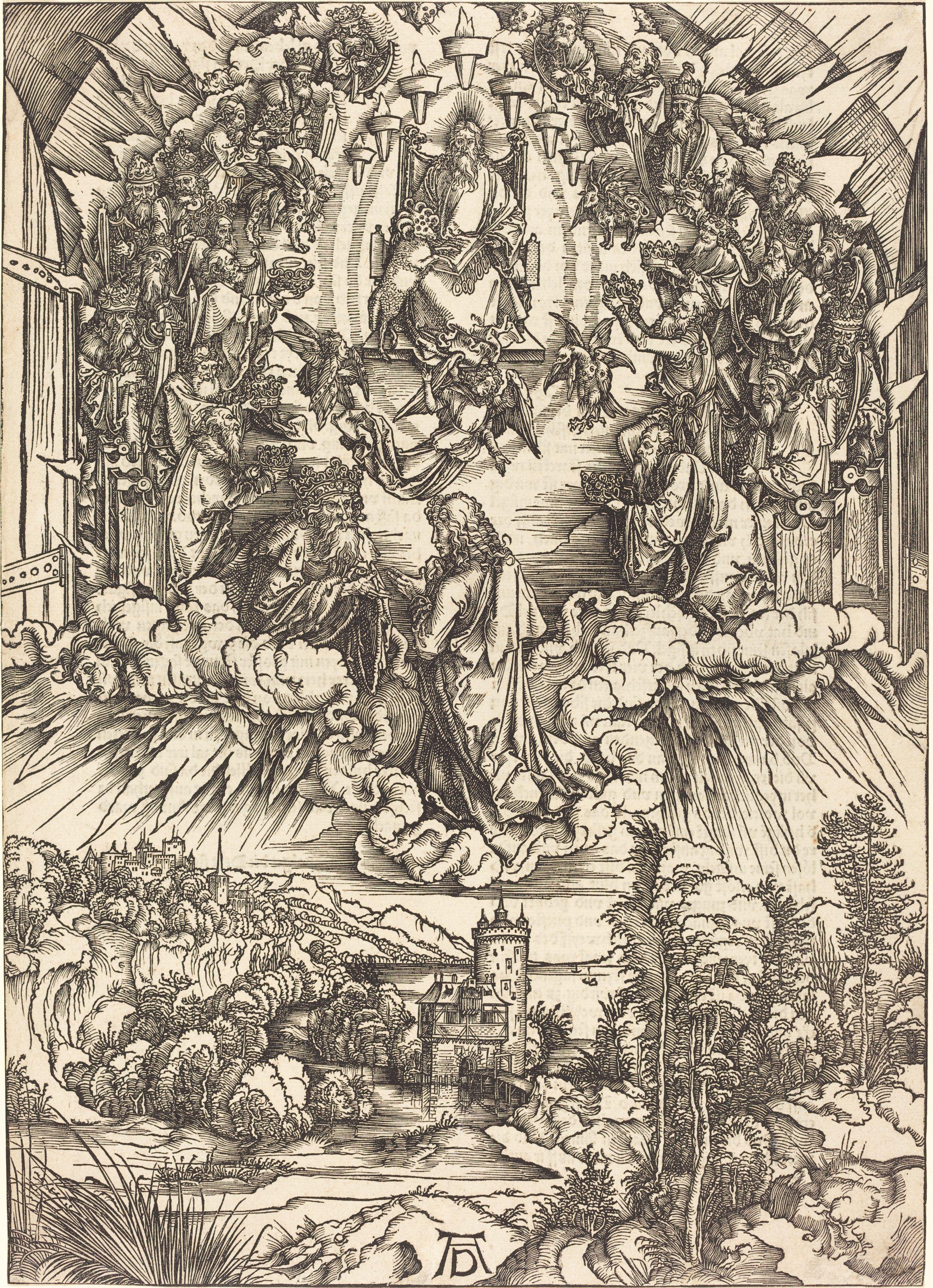
Albrecht Dürer, Saint John before God and the Elders, 1496 to 1498. Public domain.
Revelation 5 to 19 · Passage · Featured Study
The Hymns of Revelation
The songs of Revelation reuse words from the Psalter.
Heaven's newest songs are made of the oldest words.
And they sang a new song before the throne and before the four living creatures and the elders. And no one could learn the song except the 144,000 who had been redeemed from the earth.
And they sang a new song before the throne and before the four living creatures and the elders. And no one could learn the song except the 144,000 who had been redeemed from the earth.
- The passage
- Revelation 5:9 to 14, Revelation 11:15 to 18, Revelation 15:2 to 4, Revelation 19:1 to 8, Psalm 2:1 to 5, Psalm 96:1, Psalm 146:10
- Books
- Revelation, Psalms
- Hold in memory
- Revelation 5:9, Revelation 15:3, Revelation 19:6
Summary
In Revelation the elders, the angels, the martyrs and a great multitude break into song at each turn of the vision.
- The new song of the Lamb has roots in Israel's praise.
- The raging nations of Psalm 2 meet their answer at the seventh trumpet.
- The song of Moses and of the Lamb is read two ways.
The New Song
The elders and the living creatures sing a new song to the Lamb.
And they sang a new song: “Worthy are You to take the scroll and open its seals, because You were slain, and by Your blood You purchased for God those from every tribe and tongue and people and nation. You have made them to be a kingdom and priests to serve our God, and they will reign upon the earth.”This is the first song the book calls new.
Swete finds the phrase a new song in six psalms and in Isaiah 42:10. He writes that it first meant a fresh song of praise and came to be used for songs made for great occasions.
Sing to the LORD a new song; sing to the LORD, all the earth.Psalm 96 is one of the six that Swete lists.
In Revelation, Swete writes, the new song is the praise of redemption.
The Songs and Their Psalms
The songs run from the elders' new song to the multitude's last Hallelujah.
Each song stands beside the psalms Swete names behind it.
| Song | Who sings | The psalms behind it |
|---|---|---|
| Revelation 5:9 to 10 | The four living creatures and the twenty-four elders | Psalms 33, 40, 96, 98, 144 and 149 |
| Revelation 11:15 | Loud voices called out in heaven | Psalm 2 |
| Revelation 11:17 to 18 | The twenty-four elders on their thrones | Psalm 93:1 and Psalm 2 |
| Revelation 15:3 to 4 | Those who had conquered the beast | Psalms 111, 139 and 145, with Deuteronomy 32:4, Jeremiah 10:7 and Amos 4:13 |
| Revelation 19:1 to 3 | A vast crowd whose voice John hears | Psalms 106, 135, 146 and 150 |
| Revelation 19:5 to 8 | A voice from the throne calls, and a great multitude answers | Psalm 115:13, perhaps, and Psalm 97:1 |
Psalm 2 at the Seventh Trumpet
The voices and the elders of Revelation 11 sing the outcome of Psalm 2.
Why do the nations rage and the peoples plot in vain? The kings of the earth take their stand and the rulers gather together, against the LORD and against His Anointed One:Swete reads the seventh trumpet as the end of the struggle this psalm describes.
Then the seventh angel sounded his trumpet, and loud voices called out in heaven: “The kingdom of the world has become the kingdom of our Lord and of His Christ, and He will reign forever and ever.”Swete traces two words of this verse to Psalm 2:2.
saying: “We give thanks to You, O Lord God Almighty, the One who is and who was, because You have taken Your great power and have begun to reign. The nations were enraged, and Your wrath has come. The time has come to judge the dead and to reward Your servants the prophets, as well as the saints and those who fear Your name, both small and great—and to destroy those who destroy the earth.”Swete hears Psalm 93:1 in this thanksgiving.
Swete reads the futile anger of the nations in Revelation 11:18 as answered by the judgments of God. He and John Gill both hear Psalm 99:1 there in its Greek form, the Lord reigns, let the nations be angry.
The Song of Moses and of the Lamb
Two readings explain what the name of Moses means in this song.
and they sang the song of God’s servant Moses and of the Lamb: “Great and wonderful are Your works, O Lord God Almighty! Just and true are Your ways, O King of the nations! Who will not fear You, O Lord, and glorify Your name? For You alone are holy. All nations will come and worship before You, for Your righteous acts have been revealed.”Swete counts this song's words as almost wholly from the Old Testament.
Two songs for two covenantsAndreas of Caesarea; Primasius, as Swete quotes him
Andreas hears in the song of Moses the praise of those justified by the law before grace. In the song of the Lamb he hears the thanks of those who lived after it.
Primasius reads Moses as the old covenant and the Lamb as the new. Swete grants that Primasius is right if his words are taken in a wider sense than he meant.
Against this reading, Gill prefers to hear a song like that of Moses, sung on a like occasion.
The song of victory by the seaJohn Gill; H. B. Swete
Gill takes the song of Moses to be the song of Exodus 15 and sets it apart from the song of Deuteronomy 32. Swete agrees that the song of victory is in view, and he hears the notes of Moses and of the Lamb as distinct but in harmony.
Against this reading, the song itself borrows a line of Deuteronomy 32:4, as Swete's own list shows.
Hallelujah in Heaven
The multitude of Revelation 19 takes up the cry of the Hallelujah Psalms.
After this I heard a sound like the roar of a great multitude in heaven, shouting: “Hallelujah! Salvation and glory and power belong to our God! For His judgments are true and just. He has judged the great prostitute who corrupted the earth with her immorality. He has avenged the blood of His servants that was poured out by her hand.” And a second time they called out: “Hallelujah! Her smoke rises forever and ever.”Swete gives this passage the name of a psalm.
Swete notes that Hallelujah occurs in the New Testament only in this passage. He finds the shout ending as it began, as certain of the Hallelujah Psalms do.
The LORD reigns forever, your God, O Zion, for all generations. Hallelujah!Psalm 146 is one of the four Swete names.
Then a voice came from the throne, saying: “Praise our God, all you who serve Him, and those who fear Him, small and great alike!” And I heard a sound like the roar of a great multitude, like the rushing of many waters, and like a mighty rumbling of thunder, crying out: “Hallelujah! For the Lord our God the Almighty reigns.Swete reads this reign as the setting up of the kingdom of God.
Voices on the Songs
Victorinus wrote on the song of Revelation 5, and Matthew Henry on the song of Revelation 14.
Victorinus of Pettau (died 304)
Commentary on the Apocalypse of the Blessed John
Victorinus lists three new things in the gospel.
“It is a new thing that the Son of God should become man. It is a new thing to ascend into the heavens with a body. It is a new thing to give remission of sins to men.”
Early Church
Matthew Henry (1662 to 1714)
Commentary on the Whole Bible
Henry adds that strangers could repeat the words without their sense.
“The song was new, suited to the new covenant, and unto that new and gracious dispensation of Providence under which they now were; and their song was a secret to others, strangers intermeddled not with their joy; others might repeat the words of the song, but they were strangers to the true sense and spirit of it.”
on Revelation 14:3Puritan
Books to Read Next
Swete's commentary is in the public domain, with a free copy to read.
The Apocalypse of St John: the Greek Text, with Introduction, Notes and Indices
Henry Barclay Swete · 1906
His notes on Revelation 5, 11, 15 and 19 name the psalms behind each song.
Read at the Internet ArchiveEvery Creature Sings
The song of Revelation 5 widens circle by circle, from the elders to the angels to all that lives.
And I heard every creature in heaven and on earth and under the earth and in the sea, and all that is in them, saying: “To Him who sits on the throne and to the Lamb be praise and honor and glory and power forever and ever!”The first scene of song in the book ends here.
Sources
Scripture is the Berean Standard Bible.
- Henry Barclay Swete, The Apocalypse of St John: the Greek Text, with Introduction, Notes and Indices, Macmillan, London, 1906, pp. 79, 139 to 140, 192 to 193, 238 to 242.
- Andreas of Caesarea, Commentary on the Apocalypse, about 614, on Revelation 15:3 to 4.
- John Gill, Exposition of the New Testament, 1746 to 1748, on Revelation 11:18 and Revelation 15:3.
- Victorinus of Pettau, Commentary on the Apocalypse, on Revelation 5:9 to 10.
- Matthew Henry, Commentary on the Whole Bible, 1710, on Revelation 14:3.
Keep Studying
Read it4
Studies5
People and groups2
Go further3
Places1
Doctrines2