
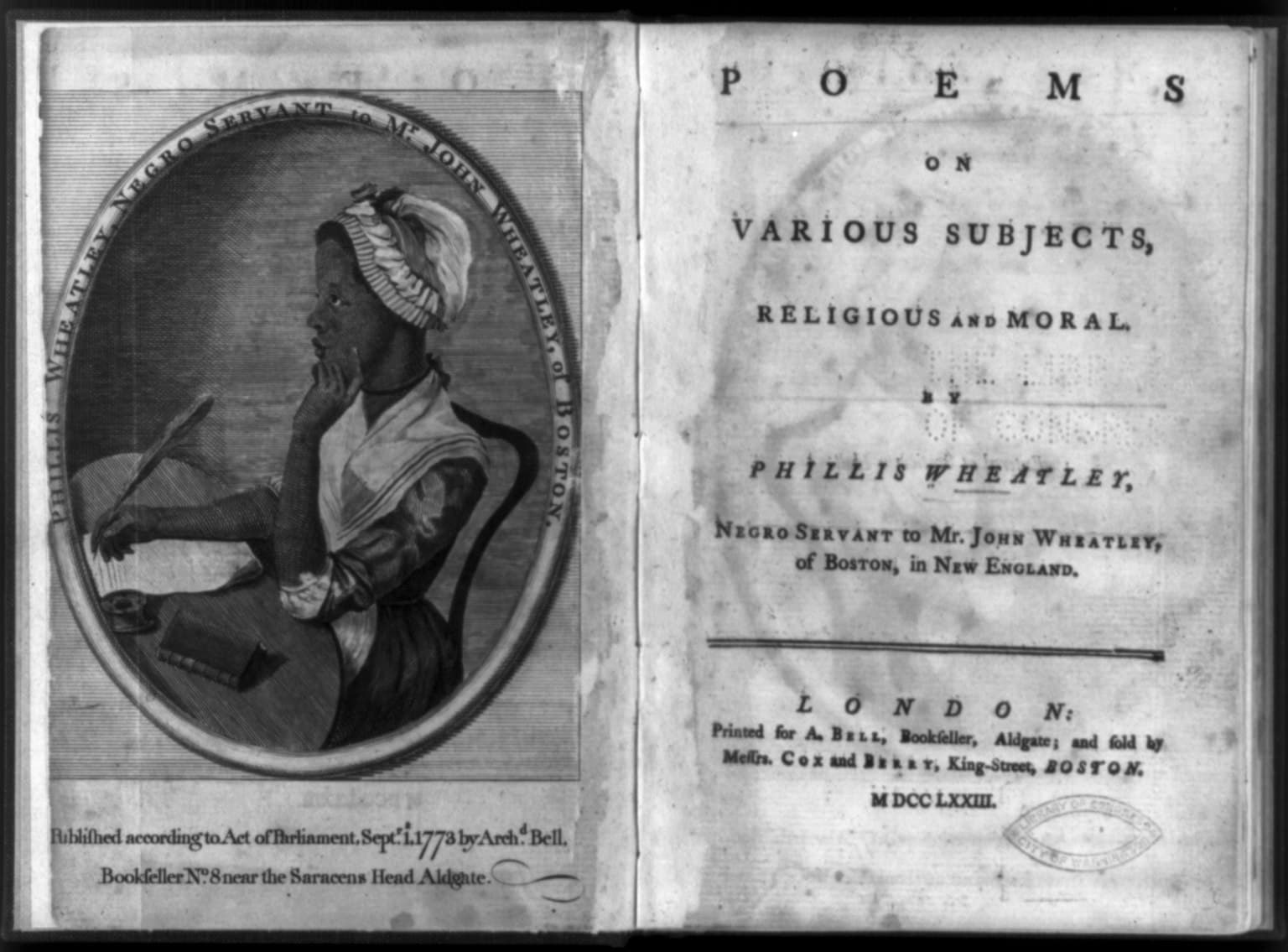
The frontispiece and title page of Phillis Wheatley, Poems on Various Subjects, 1773. Public domain.
An elegy from Boston and a book from London · Story · Featured Study
Phillis Wheatley and Whitefield
Her patron was the Countess of Huntingdon, whom the preacher she mourned had served as chaplain.
- When
- October 1770 to September 1773
The first printing named its author “Phillis, A Servant Girl, of 17 Years of Age,” nine years in the country from Africa.
And they sang a new song: “Worthy are You to take the scroll and open its seals, because You were slain, and by Your blood You purchased for God those from every tribe and tongue and people and nation. You have made them to be a kingdom and priests to serve our God, and they will reign upon the earth.”
Summary
Phillis Wheatley, a slave in a Boston home, wrote a poem on George Whitefield's death that was sold within weeks, and a book of her poems came out in London three years later.
- John Wheatley wrote that she was brought from Africa in 1761, between seven and eight years of age, and could read the hardest parts of Scripture sixteen months later.
- Her letters to Obour Tanner of Newport stand in the Proceedings of the Massachusetts Historical Society.
- She died in Boston on 5 December 1784, named in the newspaper notice as Mrs. Phillis Peters.
The Scripture in the Elegy
The poem names no chapter and verse, and two of its lines take up the words of the prophets.
The closing call of the poem, to the wretched, the thirsty, the preachers, the Americans and the Africans, borrows the invitations of Scripture.
“Come, all you who are thirsty, come to the waters; and you without money, come, buy, and eat! Come, buy wine and milk without money and without cost!The elegy's line “Ye thirsty, come to this life-giving stream” takes up the prophet's call to all who thirst.
“On that day a fountain will be opened to the house of David and the people of Jerusalem, to cleanse them from sin and impurity.In the London book Wheatley rewrote the couplet to the Africans around the fountain this verse opens.
The Elegy in Two Printings
The Boston pamphlet and the London book differ in three places.
The two printings differ in who speaks, in one line and in the place of the Countess.
| Question | Boston, 1770 | London, 1773 |
|---|---|---|
| Who speaks the call to the Africans? | The poet, after Whitefield's words to the Americans | Whitefield himself, inside the quotation marks |
| How is the couplet's third line worded? | “If you will chuse to walk in grace's road” | “Wash'd in the fountain of redeeming blood” |
| Where does the Countess stand? | Named Lady Huntingdon in the title, and addressed as “Great Countess” in the poem | She stands in the poem, in a footnote and in the dedication of the whole book |
From Newburyport to London
The story runs from Whitefield's death to her visit to England.
George Whitefield died at Newburyport, near Boston, on Sunday 30 September 1770, after what the elegy's title calls “a Fit of the Asthma.”
Wheatley's poem was printed as an eight-page pamphlet by Ezekiel Russell and John Boyles of Boston. Charles F. Heartman, her bibliographer of 1915, found it advertised as “This Day was published” in the Massachusetts Spy of 11 October.
Its title promised “a Condolatory Address” to Whitefield's “truly noble Benefactress,” the Countess of Huntingdon, and to the orphan children in Georgia.
S. Southwick reprinted it at Newport, and a London reprint followed in 1771 at the end of Ebenezer Pemberton's sermon on Whitefield.
In 1773, N. B. Shurtleff wrote in a notice of 1863, she left Boston to visit England in company with Nathaniel Wheatley and his family.
The Preacher She Praised and the Enslaved
Whitefield's own letters and his will show where he stood on slavery.
From Savannah on 23 January 1740 Whitefield told the planters of Maryland, Virginia and the Carolinas, “I think God has a quarrel with you, for your cruelty to the poor negroes.”
On 22 March 1751 he wrote, “As to the lawfulness of keeping slaves, I have no doubt,” and that he “should think myself highly favoured if I could purchase a good number of them.”
His will left the orphan house in Georgia, with its buildings, furniture, slaves and lands, to the Countess of Huntingdon, the “Great Countess” of Wheatley's elegy.
The Attestation
The book carried a page of signatures from Boston's governor, its ministers and her master.
The publisher wrote that people who had seen the manuscript warned him that many “would be ready to suspect they were not really the Writings of PHILLIS.”
The signers declared the poems were written by “a young Negro Girl, who was but a few Years since, brought an uncultivated Barbarian from Africa.”
They added that she served “as a Slave in a Family in this Town.”
The names under it run from Governor Thomas Hutchinson and Lieutenant-Governor Andrew Oliver to John Hancock, seven ministers among them Charles Chauncy and Mather Byles, and “Mr. John Wheatley, her Master.”
What the Record Leaves Unsaid
Neither the memoir of 1838 nor Shurtleff names a deed of her freedom.
The memoir of 1838 says, “We cannot ascertain that she ever received any formal manumission.” Shurtleff found her styled “a free negro” at her marriage.
The Impartial Saviour
The revised couplet names Christ the Saviour of Africans on the same terms as of Americans.
The couplet to the Africans calls Christ the “Impartial Saviour” who longs for them.
Its last line promises the Africans, “You shall be sons, and kings, and priests to God.”
How the Key Verse Was Taught
Writers from the early church to the nineteenth century take up Revelation 5:9 to 10.
Victorinus of Pettau (died 304)
Commentary on the Apocalypse of the Blessed John
A commentary of the early church explains what the elders' song praises.
“It is a new thing that the Son of God should become man. It is a new thing to ascend into the heavens with a body. It is a new thing to give remission of sins to men.”
Early Church
Matthew Henry (1662 to 1714)
Commentary on the Whole Bible
An exposition of the eighteenth century sets out the price paid and the purpose of the purchase.
“Christ has redeemed his people from the bondage of sin, guilt, and Satan, redeemed them to God, set them at liberty to serve him and to enjoy him.”
Puritan
John Wesley (1703 to 1791)
Explanatory Notes upon the New Testament
Wesley answers in his note when the promise of the verse will be kept.
“The reign of the saints in general follows, under the trumpet of the seventh angel; particularly after the first resurrection, as also in eternity”
Evangelical
Albert Barnes (1798 to 1870)
Notes, Explanatory and Practical, on the Book of Revelation
A commentary of the nineteenth century reads the promise of the verse for the world.
“The idea clearly is, in accordance with what is so frequently said in the Scriptures, that the dominion on the earth will be given to the saints”
Presbyterian
John Wesley, Albert Barnes
In Their Own Words
Wheatley wrote of Africa in two poems of her book, and of England and of her mistress in two letters to Obour Tanner.
Phillis Wheatley (1753 to 1784)
On being brought from Africa to America, Poems on Various Subjects, Religious and Moral
On being brought from Africa to America
“'Twas mercy brought me from my Pagan land, Taught my benighted soul to understand That there's a God, that there's a Saviour too: Once I redemption neither sought nor knew, Some view our sable race with scornful eye, ‘Their colour is a diabolic die.’ Remember, Christians, Negroes, black as Cain, May be refin'd, and join th' angelic train.”
Congregational
About this saying1 paragraph
These eight lines of 1773 set the faith she found beside the scorn she met.
Phillis Wheatley
To the Right Honourable William, Earl of Dartmouth, Poems on Various Subjects, Religious and Moral
To the Earl of Dartmouth
“Should you, my lord, while you peruse my song, Wonder from whence my love of Freedom sprung”
Congregational
About this saying1 paragraph
In 1773 she opened the passage on her own seizure from Africa with these lines.
Phillis Wheatley
Letter to Obour Tanner, Boston, 30 October 1773, Proceedings of the Massachusetts Historical Society, volume 7
The welcome in England
“The friends I found there among the nobility and gentry, their benevolent conduct towards me, the unexpected and unmerited civility and complaisance with which I was treated by all, fills me with astonishment.”
Congregational
About this saying1 paragraph
She wrote this in 1773, home again, of the friends she had met abroad.
Phillis Wheatley
Letter to Obour Tanner, Boston, 21 March 1774, Proceedings of the Massachusetts Historical Society, volume 7
A letter of March 1774
“I have lately met with a great trial in the death of my mistress; let us imagine the loss of a parent, sister, or brother, the tenderness of all these were united in her. I was a poor little outcast & a stranger when she took me in”
Congregational
About this saying1 paragraph
She wrote this in 1774 of the woman of the Wheatley house who had died.
Phillis Wheatley, Phillis Wheatley
Where Historians Disagree
Writers on Wheatley differ on what made her name and on what the attestation's examination was.
Did the elegy make her name on both sides of the Atlantic?2 paragraphs
Charles Deane wrote in 1863 that she had been “the object of so much attraction both here and in England,” and the elegy's printings at Boston, Newport and London by 1771 bear him out.
Heartman's list of 1915 shows the New York and Philadelphia printings of 1770 only from notices, for he located no copy of either.
Was she examined by the men who signed?2 paragraphs
The attestation says, “She has been examined by some of the best Judges, and is thought qualified to write them,” and gives no day, place or examiner.
Heartman read the master's letter and the attestation in 1915 as answers to doubt “as to the belief of the public in the genuinity of these poems,” and named no meeting.
Books to Read Next
Poems on Various Subjects, Religious and Moral
Phillis Wheatley · 1773
The London book itself, with the attestation, the dedication and the revised elegy.
Free at the Internet ArchivePhillis Wheatley (Phillis Peters): A Critical Attempt and a Bibliography of Her Writings
Charles F. Heartman · 1915
Heartman lists every printing of the elegy he could trace.
Free at the Internet ArchiveMemoir and Poems of Phillis Wheatley
Phillis Wheatley, with an unsigned memoir · 1838
The memoir says she was well received in England and was presented to the Countess of Huntingdon.
Free at the Internet ArchiveWhat the Elegy Left
The elegy left a record in which the enslaved poet and the slaveholding preacher stand on the same page.
Sources
Scripture is the Berean Standard Bible.
- The Holy Bible, Berean Standard Bible (read 2026)
- Phillis Wheatley, An Elegiac Poem, on the Death of that Celebrated Divine ... George Whitefield (Boston: Ezekiel Russell and John Boyles, 1770), and the Newport reprint by S. Southwick.
- Phillis Wheatley, Poems on Various Subjects, Religious and Moral (London: A. Bell; Boston: Cox and Berry, 1773), the dedication, John Wheatley's letter, the attestation and the poems.
- Luke Tyerman, The Life of the Rev. George Whitefield, two volumes (London: Hodder and Stoughton, 1876), the letters of 23 January 1740 and 22 March 1751, his death and his will.
- Proceedings of the Massachusetts Historical Society, volume 7 (Boston, 1863), Charles Deane's communication of her letters and N. B. Shurtleff's notice.
- Memoir and Poems of Phillis Wheatley, the memoir unsigned (Boston: Isaac Knapp, 1838)
- Charles F. Heartman, Phillis Wheatley (Phillis Peters): A Critical Attempt and a Bibliography of Her Writings (New York: for the author, 1915)
- Victorinus of Pettau, Commentary on the Apocalypse of the Blessed John, in Ante-Nicene Fathers, volume 7, ed. Philip Schaff (a preface dated June 1886)
- Matthew Henry, Commentary on the Whole Bible, on Revelation 5:9.
- John Wesley, Explanatory Notes upon the New Testament (1755), on Revelation 5:10.
- Albert Barnes, Notes, Explanatory and Practical, on the Book of Revelation, on Revelation 5:10.
Keep Studying
People and groups8
Doctrines1
Church history2