
Numbers 13:17
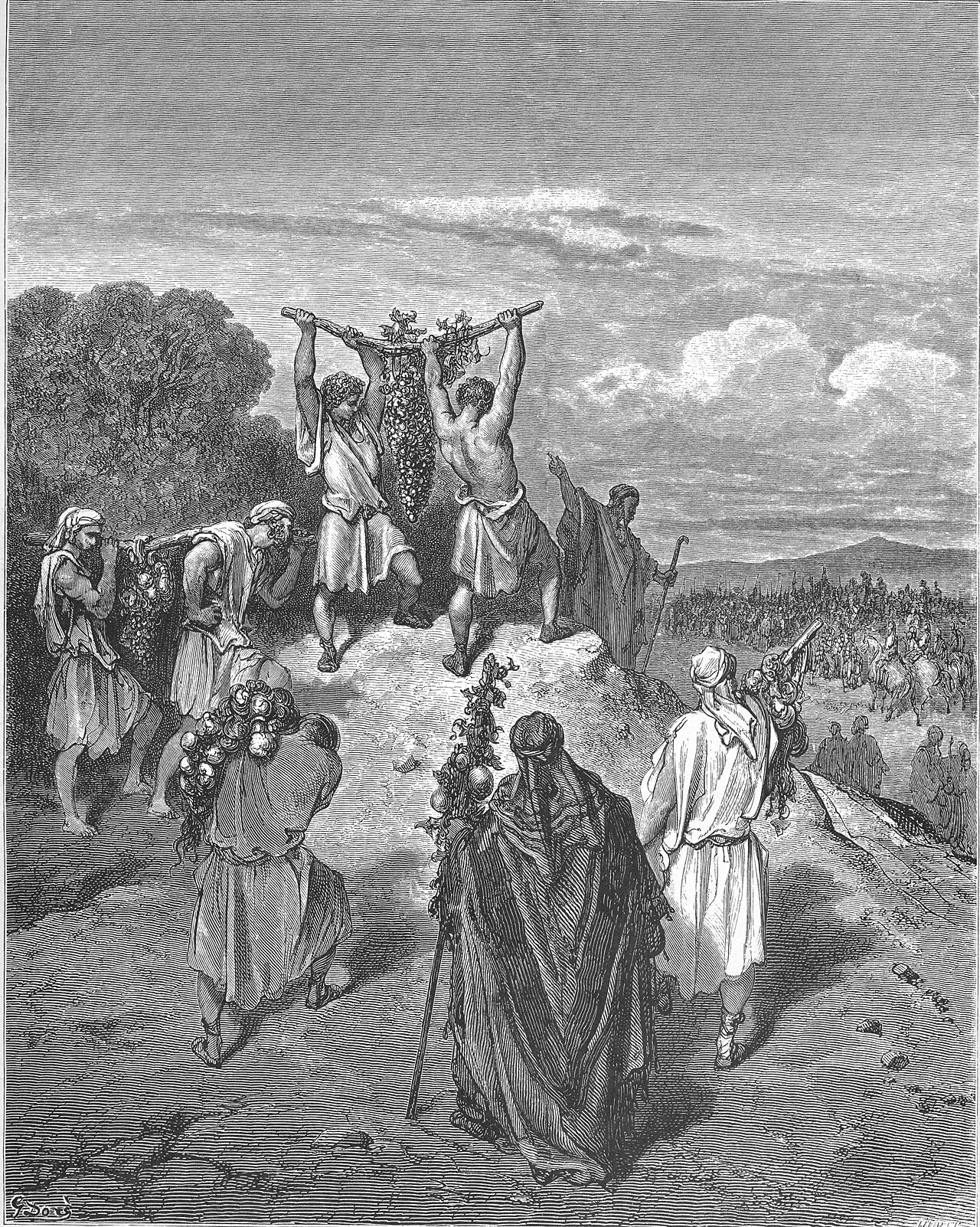
in Numbers 13When Moses sent them to spy out the land of Canaan, he told them, “Go up through the Negev and into the hill country.
BSB
The same verse in ASV and KJV ▾
ASV
And Moses sent them to spy out the land of Canaan, and said unto them, Get you up this way by the South, and go up into the hill-country:
KJV
And Moses sent them to spy out the land of Canaan, and said unto them, Get you up this way southward, and go up into the mountain:
⋯
This verse in Numbers 13
Commentary
4 notes on this verseA commentator
Albert Barnes1798–1870
Notes, Explanatory and Practical, on the Old and New Testaments (1832-1869)
Southward - Rather, “by the Negeb,” or south-country; a well-defined tract of territory forming the southernmost and least fertile portion of the land of Canaan and of the subsequent inheritance of Judah. It extended northward from Kadesh to within a few miles of Hebron, and from the Dead Sea westward to the Mediterranean (see especially Jos 15:21-32). Into the mountain - The hill-country of southern and central Canaan, mostly within the borders of Judah and Ephraim.
This site's exposition
Go up through the Negev and into the hill country
on Numbers 13:17-20
The brief is a set of questions about the land and its people, strong or weak, few or many, good or bad. Every one is answered accurately at verses 27 to 29, and the quarrel at verse 31 is over what the answers mean.
The record, by era
The Puritans and the Awakening1 voice
And Moses sent them to spy out the land of Canaan,....
The Nineteenth Century1 voice
A commentator
Jamieson, Fausset & Brown1802–1910
Commentary Critical and Explanatory on the Whole Bible (1871)
Get you up this way . . . , and go up into the mountain--Mount Seir (De 1:2), which lay directly from Sinai across the wilderness of Paran, in a northeasterly direction into the southern parts of the promised land.
The words behind it
15 Hebrew wordsEvery Hebrew word of this verse in the order it stands, with what it means and the door to its own study. The last column counts the times a word stands in the whole Bible: the rarer the word, the more the places it appears belong together.
| Hebrew | Sound | Meaning | Word study | In the Bible |
|---|---|---|---|---|
| וַיִּשְׁלַ֤ח | vaiyishlach | and he sent | H7971 → | 845 times |
| אֹתָם֙ | ʾotam | <obj.> them | H853 → | 10935 times |
| מֹשֶׁ֔ה | mosheh | Moses | H4872 → | 765 times |
| לָת֖וּר | latur | to spy out | H8446 → | 24 times |
| אֶת־ | ʾet- | <obj.> | H853 → | 10935 times |
| אֶ֣רֶץ | ʾeretz | [the] land of | H776 → | 2504 times |
| כְּנָ֑עַן | kenaan | Canaan | H3667 → | 94 times |
| וַיֹּ֣אמֶר | vaiyomer | and he said | H559 → | 5305 times |
| אֲלֵהֶ֗ם | ʾalehem | to them | H413 → | 5510 times |
| עֲל֥וּ | ʾalu | go up | H5927 → | 890 times |
| זֶה֙ | zeh | this | H2088 → | 1180 times |
| בַּנֶּ֔גֶב | banegev | in the Negev | H5045 → | 112 times |
| וַעֲלִיתֶ֖ם | vaalitem | and you will go up | H5927 → | 890 times |
| אֶת־ | ʾet- | <obj.> | H853 → | 10935 times |
| הָהָֽר׃ | hahar | the hill country | H2022 → | 546 times |
וַיִּשְׁלַ֤חand he sent
vaiyishlachH7971 →845 times
אֹתָם֙<obj.> them
ʾotamH853 →10935 times
מֹשֶׁ֔הMoses
moshehH4872 →765 times
לָת֖וּרto spy out
laturH8446 →24 times
אֶת־<obj.>
ʾet-H853 →10935 times
אֶ֣רֶץ[the] land of
ʾeretzH776 →2504 times
כְּנָ֑עַןCanaan
kenaanH3667 →94 times
וַיֹּ֣אמֶרand he said
vaiyomerH559 →5305 times
אֲלֵהֶ֗םto them
ʾalehemH413 →5510 times
עֲל֥וּgo up
ʾaluH5927 →890 times
זֶה֙this
zehH2088 →1180 times
בַּנֶּ֔גֶבin the Negev
banegevH5045 →112 times
וַעֲלִיתֶ֖םand you will go up
vaalitemH5927 →890 times
אֶת־<obj.>
ʾet-H853 →10935 times
הָהָֽר׃the hill country
haharH2022 →546 times
A shaded row is a word that stands 400 times or fewer in the Bible.
The walk
8 stopsEach card is a verse this one points to, and under it the verses that one points to in turn. Where several paths arrive at the same place, that place is listed first: the text keeps returning to it.
Through
Joshua 15:3proceeded south of the Ascent of Akrabbim, continued on to Zin, went over to the south of Kadesh-barnea, ran past Hezron up to Addar, and curved toward Karka.
it leads to
- Numbers 34:4
cross south of the Ascent of Akrabbim, continue to Zin, and go south of Kadesh-barnea. Then it will go on to Hazar-addar and proceed to Azmon,
- Numbers 34:4
Through
Genesis 12:9And Abram journeyed on toward the Negev.
it leads to
- Genesis 13:3
From the Negev he journeyed from place to place toward Bethel, until he came to the place between Bethel and Ai where his tent had formerly been pitched,
- Genesis 24:62
Now Isaac had just returned from Beer-lahai-roi, for he was living in the Negev.
- Genesis 13:3
Through
Judges 1:15“Give me a blessing,” she answered. “Since you have given me land in the Negev, give me springs of water as well.” So Caleb gave her both the upper and lower springs.
it leads to
- Hebrews 6:7
For land that drinks in the rain often falling on it and that produces a crop useful to those for whom it is tended receives the blessing of God.
- 1 Peter 3:9
Do not repay evil with evil or insult with insult, but with blessing, because to this you were called so that you may inherit a blessing.
- Hebrews 6:7
Through
Genesis 13:1So Abram went up out of Egypt into the Negev—he and his wife and all his possessions—and Lot was with him.
it leads to
- Genesis 12:9–20
And Abram journeyed on toward the Negev.
- 2 Samuel 24:7
They went toward the fortress of Tyre and all the cities of the Hivites and Canaanites. Finally, they went on to the Negev of Judah, to Beersheba.
- Joshua 10:40
So Joshua conquered the whole region—the hill country, the Negev, the foothills, and the slopes, together with all their kings—leaving no survivors. He devoted to destruction everything that breathed, just as the LORD, the…
- Genesis 12:9–20
Where this verse is studied
On this page
About Numbers
Who and where
2 names in this verse with a page on the site.
This page draws on Adam Clarke, Commentary on the Bible; Albert Barnes, Notes, Explanatory and Practical, on the Old and New Testaments (1832-1869); Jamieson, Fausset & Brown, Commentary Critical and Explanatory on the Whole Bible and John Gill, Exposition of the Old Testament (1748-1763).