
2 Samuel 6:22
in 2 Samuel 6and I will humiliate and humble myself even more than this. Yet I will be honored by the maidservants of whom you have spoken.”
BSB
The same verse in ASV and KJV ▾
ASV
And I will be yet more vile than this, and will be base in mine own sight: but of the handmaids of whom thou hast spoken, of them shall I be had in honor.
KJV
And I will yet be more vile than thus, and will be base in mine own sight: and of the maidservants which thou hast spoken of, of them shall I be had in honour.
⋯
This verse in 2 Samuel 6
Commentary
4 notes on this verseOn the contrary, when David despised the power of his kingdom by dancing before the ark of the Lord's covenant, he said: "I will play and become more vile than I have become, and I will be humble in my own eyes."
This site's exposition
uncovered himself to day
on 2 Samuel 6:20-22
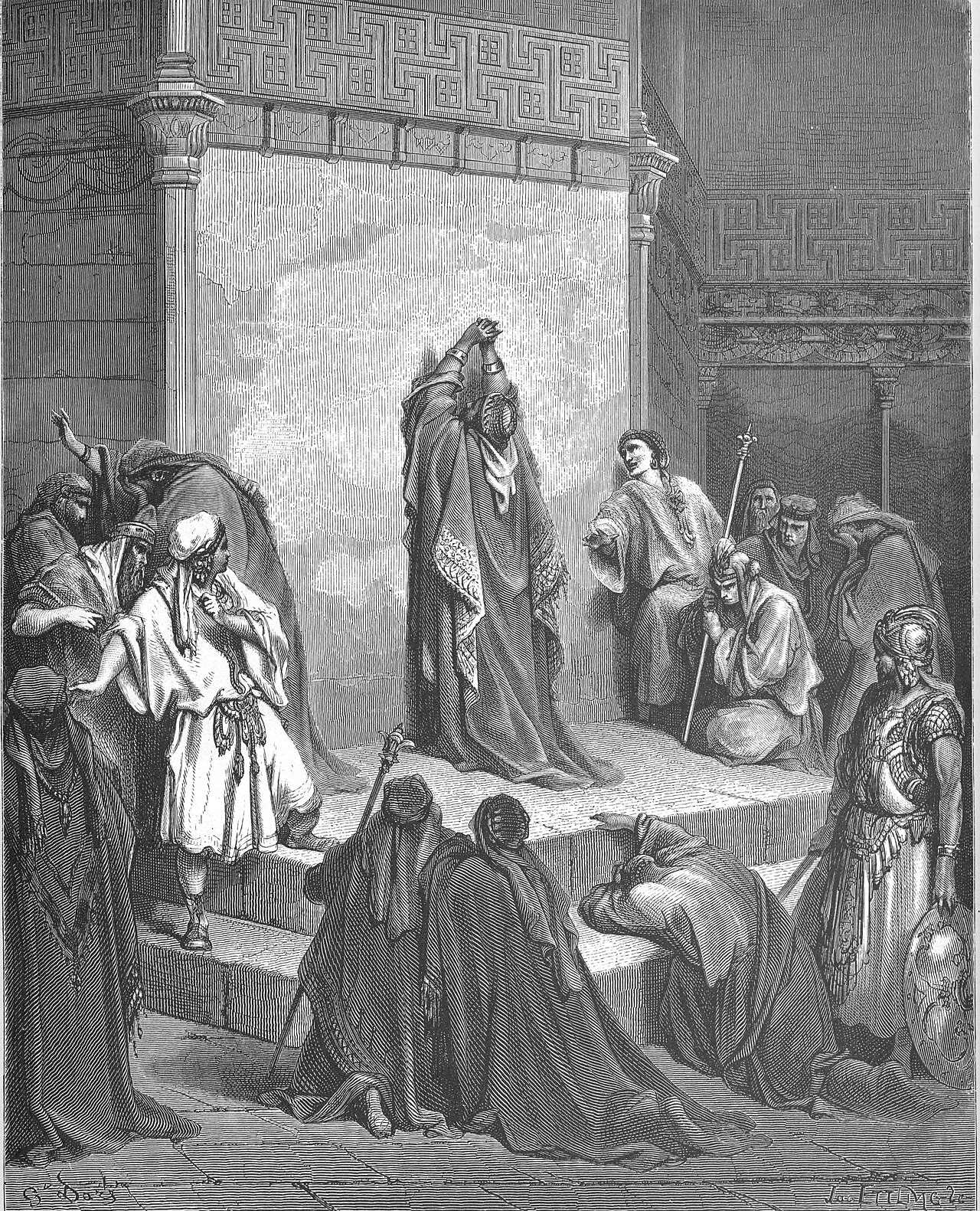
Michal's word glorious is sarcasm, and her charge that David uncovered himself plays against the very ephod verse 14 already described; a linen ephod covered the body, and the commentators read her complaint as wounded royal dignity rather than a report of actual exposure. David's answer sets God's choice against her father's house in one breath, it was before the Lord, which chose me before thy father, and before all his house, turning her rebuke back on the reason he dances at all. His last word to her, I will yet be more vile than thus, and will be base in mine own sight, answers contempt with a deliberate choice: honour from the very maidservants she named in scorn.
The record, by era
The Church Fathers1 voice
on 2 Samuel 6:20-22
But the things which viewed corporeally are unseemly, when viewed in regard to holy religion become venerable, so that they who blame such things will involve their own souls in the net of blame. Thus Michal reproves David for his dancing and says to him, How glorious was the king of Israel to day, who uncovered himself to day in the eyes of his handmaids!
The Puritans and the Awakening1 voice
The greatest of men is less than the least of the ordinances of Jesus Christ. (3.) He doubted not but even this would turn to his reputation among those whose reproach Michal pretended to fear: Of the maid-servants shall I be had in honour.
The words behind it
12 Hebrew wordsEvery Hebrew word of this verse in the order it stands, with what it means and the door to its own study. The last column counts the times a word stands in the whole Bible: the rarer the word, the more the places it appears belong together.
| Hebrew | Sound | Meaning | Word study | In the Bible |
|---|---|---|---|---|
| וּנְקַלֹּ֤תִי | unekaloti | and I will demean myself | H7043 → | 82 times |
| עוֹד֙ | ʾod | still | H5750 → | 490 times |
| מִזֹּ֔את | mizot | more than this | H2063 → | 603 times |
| וְהָיִ֥יתִי | vehayiti | and I will be | H1961 → | 3559 times |
| שָׁפָ֖ל | shafal | lowly | H8217 → | |
| בְּעֵינָ֑י | beeinai | in own eyes my | H5869 → | 887 times |
| וְעִם־ | veim- | and with | H5973 → | 1050 times |
| הָֽאֲמָהוֹת֙ | haamahot | the maidservants | H519 → | 56 times |
| אֲשֶׁ֣ר | ʾasher | whom | H834 → | 5497 times |
| אָמַ֔רְתְּ | ʾamart | you have said | H559 → | 5305 times |
| עִמָּ֖ם | ʾimam | with them | H5973 → | 1050 times |
| אִכָּבֵֽדָה׃ | ʾikavedah | I will be honored | H3513 → | 113 times |
וּנְקַלֹּ֤תִיand I will demean myself
unekalotiH7043 →82 times
עוֹד֙still
ʾodH5750 →490 times
מִזֹּ֔אתmore than this
mizotH2063 →603 times
וְהָיִ֥יתִיand I will be
vehayitiH1961 →3559 times
שָׁפָ֖לlowly
shafalH8217 →
בְּעֵינָ֑יin own eyes my
beeinaiH5869 →887 times
וְעִם־and with
veim-H5973 →1050 times
הָֽאֲמָהוֹת֙the maidservants
haamahotH519 →56 times
אֲשֶׁ֣רwhom
ʾasherH834 →5497 times
אָמַ֔רְתְּyou have said
ʾamartH559 →5305 times
עִמָּ֖םwith them
ʾimamH5973 →1050 times
אִכָּבֵֽדָה׃I will be honored
ʾikavedahH3513 →113 times
A shaded row is a word that stands 400 times or fewer in the Bible.
The walk
8 stopsEach card is a verse this one points to, and under it the verses that one points to in turn. Where several paths arrive at the same place, that place is listed first: the text keeps returning to it.
Through
Hebrews 12:2Let us fix our eyes on Jesus, the author and perfecter of our faith, who for the joy set before Him endured the cross, scorning its shame, and sat down at the right hand…
it leads to
- Micah 7:7
But as for me, I will look to the LORD; I will wait for the God of my salvation. My God will hear me.
- 1 Peter 3:18
For Christ also suffered for sins once for all, the righteous for the unrighteous, to bring you to God. He was put to death in the body but made alive in the Spirit,
- 1 Peter 2:23–24
When they heaped abuse on Him, He did not retaliate; when He suffered, He made no threats, but entrusted Himself to Him who judges justly.
- Hebrews 1:3
The Son is the radiance of God’s glory and the exact representation of His nature, upholding all things by His powerful word. After He had provided purification for sins, He sat down at the…
- Philippians 1:6
being confident of this, that He who began a good work in you will carry it on to completion until the day of Christ Jesus.
- Micah 7:7
Through
Isaiah 51:7Listen to Me, you who know what is right, you people with My law in your hearts: Do not fear the scorn of men; do not be broken by their insults.
it leads to
- Matthew 5:11
Blessed are you when people insult you, persecute you, and falsely say all kinds of evil against you because of Me.
- Ezekiel 2:6
But you, son of man, do not be afraid of them or their words. Do not be afraid, though briers and thorns surround you, and you dwell among scorpions. Do not be afraid of…
- Matthew 5:11
Through
1 Peter 4:14If you are insulted for the name of Christ, you are blessed, because the Spirit of glory and of God rests on you.
it leads to
- 1 Peter 3:14
But even if you should suffer for what is right, you are blessed. “Do not fear what they fear; do not be shaken.”
- 1 Peter 3:14
Where this verse is studied
On this page
Studies1
About 2 Samuel
This page draws on Ambrose of Milan, Letter 58.6; Calvin, Sermons on 2 Samuel; Gregory the Dialogist, Forty Gospel Homilies, Homily 7; John Gill, Exposition of the Old Testament and Matthew Henry, Commentary on the Whole Bible.