
1 Samuel 2:12
in 1 Samuel 2Now the sons of Eli were wicked men; they had no regard for the LORD
BSB
The same verse in ASV and KJV ▾
ASV
Now the sons of Eli were base men; they knew not Jehovah.
KJV
Now the sons of Eli were sons of Belial; they knew not the Lord.
⋯
This verse in 1 Samuel 2
Commentary
10 notes on this verseThe sons of Eli were sons of Belial - They were perverse, wicked, profligate men; devil’s children. They knew not the Lord. “They know! nor would an angel show Him; They would not know, nor choose to know Him.” These men were the principal cause of all the ungodliness of Israel. Their most execrable conduct, described 1Sa 2:13-17, caused the people to abhor the Lord’s offering. An impious priesthood is the grand cause of the transgressions and ruin of any nation; witness France, Germany, Spain, Ac., from 1792 to 1814.
This site's exposition
the sons of Eli were wicked men
on 1 Samuel 2:12-14
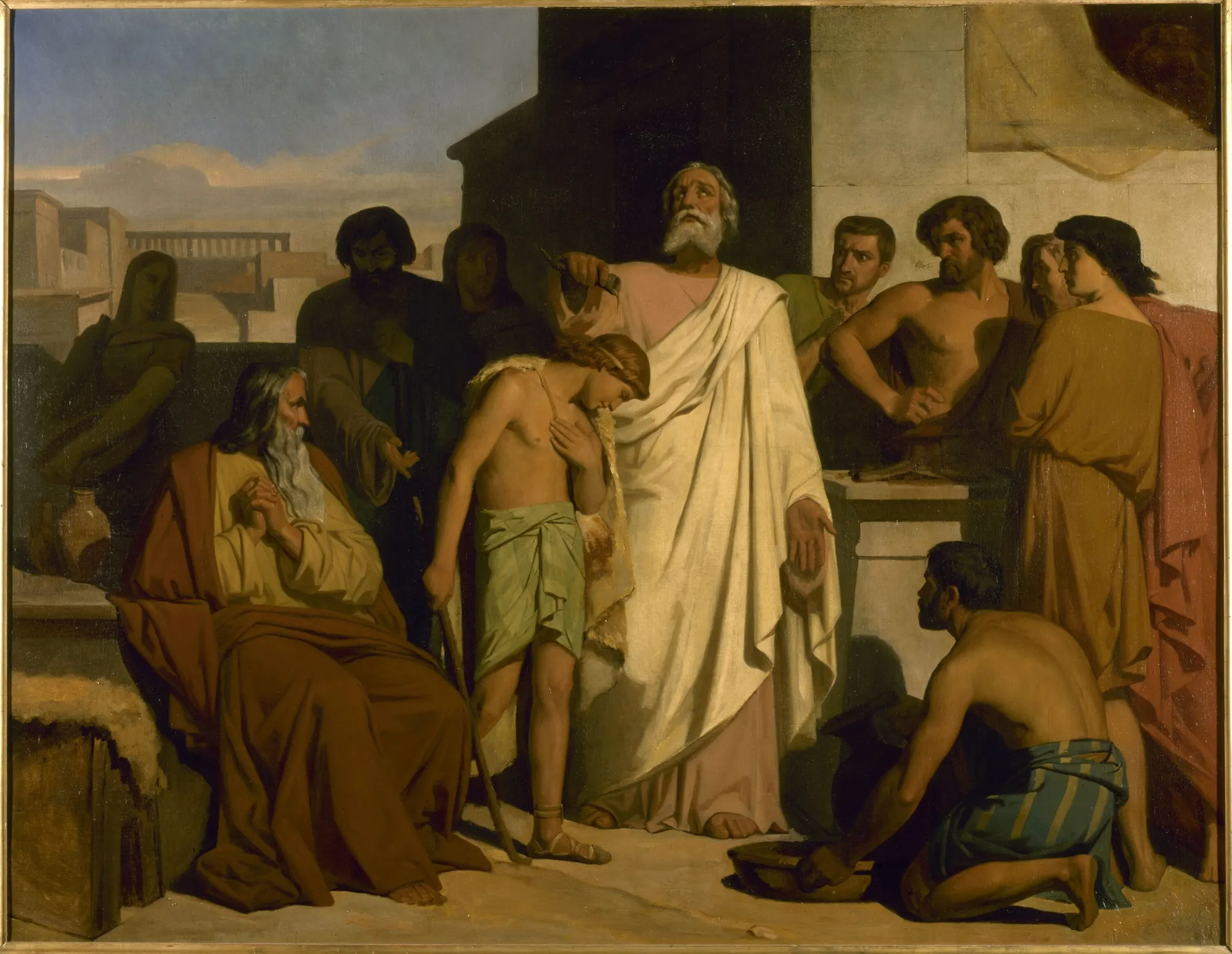
Eli's sons are named sons of Belial, worthless men, and the phrase they knew not the Lord is damning precisely because their father is the Lord's own priest. Their corruption is not doctrine but appetite: a servant thrusts a three toothed hook into the boiling pot and claims by force whatever it lifts, a theft dressed as custom and practiced on every worshiper who came to Shiloh.
The record, by era
The Church Fathers1 voice
Samuel bore with the wicked sons of Eli, his debased sons whom the people would not bear and who were thereupon accused by divine truth or disciplined by divine wrath; finally he bore with the people themselves in their pride and rejection of God.… Let them read who wish, and who can, the heavenly language. They will find that all the saints have had to tolerate among their own people those who were recognized as servants and friends of God.
The Medieval Church2 voices
Furthermore, the sons of Eli, sons of Belial, etc. The sons of the Jewish priesthood, sons of blind light, or without a yoke (for both Belial and Beliar mean this), were those who did not know the doctrine of Christ; not following the commands of …
A commentator
Gregory the DialogistCommentary on 1 Kings, Book 2, Chapter 2 · Written before 604.
proposed
3. Supply "were." For who else are the sons of Eli, if not the Israelites according to the flesh, who knew the Sacred Scripture published by the fathers, and yet did not know the one whom Scripture had promised? Whom indeed Truth itself rebukes in the Gospel, saying: "Abraham rejoiced to see my day; he saw it, and was glad" (John 8:56). And again: "If you believed Moses, you would certainly believe me also, for he wrote about me" (John 5:46). Therefore they did not know the Lord, who spurned the Redeemer coming in our flesh.
The Puritans and the Awakening2 voices
) according as his capacity was. He learned his catechism and was constant to his devotions, soon learned to read, and took a pleasure in the book of the law, and thus he ministered to the Lord. He ministered before Eli, that is, under his inspection, and as he ordered him, not before Eli's sons; all parties were agreed that they were unfit to be his tutors.
quarantine:debris (2026-07-29) — leading-punctuation+unbalanced-parens
Now the sons of Eli were sons of Belial,....
3 more voices on this verse
The Puritans and the Awakening1 voice
Note, Parents cannot give grace to their children, nor does it run in the blood. Many that are sincerely pious themselves live to see those that come from them notoriously impious and profane; for the race is not to the swift. Eli was high priest and judge in Israel.
The Nineteenth Century2 voices
A commentator
Jamieson, Fausset & Brown1802–1910
Commentary Critical and Explanatory on the Whole Bible (1871)
Though professionally engaged in sacred duties, they were not only strangers to the power of religion in the heart, but they had thrown off its restraints, and even ran, as is sometimes done in similar cases by the sons of eminent ministers, to the opposite extreme of reckless and open profligacy.
A commentator
Albert Barnes1798–1870
Notes, Explanatory and Practical, on the Old and New Testaments (1832-1869)
proposed
Sons of Belial - See the marginal reference note. The phrase is very frequent in the books of Samuel. In the New Testament, Paul contrasts Christ and Belial, as if Belial were the name of an idol or the personification of evil 2Co 6:15. This probably led to the use of the term “Belial” in the the King James Version, instead of expressing its meaning, which is “mischief, wickedness.”
How the passage was read
What the Jewish commentators add
On the verses either side of this one
Served Adonoy in the presence of Eili the kohein. From here [our Sages conclude] that "whoever serves before a Torah scholar is considered as though he had served before the Divine Presence." 8 Talmud Yerushalmi Eruvin:1.
1 more on this passage, in their own words ▾
The custom of the kohanim. They established this law for themselves, since they rightfully inherited only the breast and the thigh of the peace offering.
This section is reception history: how the passage was read and kept in the Jewish tradition. Where a reading parts from an essential of the Christian faith, the section says so at that point.
Texts and citation data: Sefaria; each excerpt follows its version’s licence. 3 further sources are cited on this chapter that carry no English text this site may quote or only restate the verse.
The words behind it
8 Hebrew wordsEvery Hebrew word of this verse in the order it stands, with what it means and the door to its own study. The last column counts the times a word stands in the whole Bible: the rarer the word, the more the places it appears belong together.
| Hebrew | Sound | Meaning | Word study | In the Bible |
|---|---|---|---|---|
| וּבְנֵ֥י | uvenei | and [the] sons of | H1121 → | 4930 times |
| עֵלִ֖י | ʾeli | Eli | H5941 → | 33 times |
| בְּנֵ֣י | benei | [were] sons of | H1121 → | 4930 times |
| בְלִיָּ֑עַל | veliyaal | worthlessness | H1100 → | 27 times |
| לֹ֥א | lo' | not | H3808 → | 5168 times |
| יָדְע֖וּ | yadeu | they knew | H3045 → | 945 times |
| אֶת־ | ʾet- | <obj.> | H853 → | 10935 times |
| יְהוָֽה׃ | yahweh | Yahweh | H3068 → | 6520 times |
וּבְנֵ֥יand [the] sons of
uveneiH1121 →4930 times
עֵלִ֖יEli
ʾeliH5941 →33 times
בְּנֵ֣י[were] sons of
beneiH1121 →4930 times
בְלִיָּ֑עַלworthlessness
veliyaalH1100 →27 times
לֹ֥אnot
lo'H3808 →5168 times
יָדְע֖וּthey knew
yadeuH3045 →945 times
אֶת־<obj.>
ʾet-H853 →10935 times
יְהוָֽה׃Yahweh
yahwehH3068 →6520 times
A shaded row is a word that stands 400 times or fewer in the Bible.
The walk
8 stopsEach card is a verse this one points to, and under it the verses that one points to in turn. Where several paths arrive at the same place, that place is listed first: the text keeps returning to it.
Through
Romans 1:21For although they knew God, they neither glorified Him as God nor gave thanks to Him, but they became futile in their thinking and darkened in their foolish hearts.
it leads to
- Ephesians 4:17–18
So I tell you this, and insist on it in the Lord, that you must no longer walk as the Gentiles do, in the futility of their thinking.
- 2 Kings 17:15
They rejected His statutes and the covenant He had made with their fathers, as well as the decrees He had given them. They pursued worthless idols and themselves became worthless, going after the surrounding…
- Jeremiah 2:5
This is what the LORD says: “What fault did your fathers find in Me that they strayed so far from Me, and followed worthless idols, and became worthless themselves?
- 2 Timothy 3:2
For men will be lovers of themselves, lovers of money, boastful, arrogant, abusive, disobedient to their parents, ungrateful, unholy,
- Psalms 50:23
He who sacrifices a thank offering honors Me, and to him who rights his way, I will show the salvation of God.”
- Ephesians 4:17–18
Through
Judges 2:10After that whole generation had also been gathered to their fathers, another generation rose up who did not know the LORD or the works that He had done for Israel.
it leads to
- Titus 1:16
They profess to know God, but by their actions they deny Him. They are detestable, disobedient, and unfit for any good deed.
- Exodus 5:2
But Pharaoh replied, “Who is the LORD that I should obey His voice and let Israel go? I do not know the LORD, and I will not let Israel go.”
- Titus 1:16
Through
2 Corinthians 6:15What harmony is there between Christ and Belial? Or what does a believer have in common with an unbeliever?
it leads to
- 1 Corinthians 10:20–21
No, but the sacrifices of pagans are offered to demons, not to God. And I do not want you to be participants with demons.
- 1 Corinthians 10:20–21
Where this verse is studied
On this page
Studies5
About 1 Samuel
Who and where
1 name in this verse with a page on the site.
This page draws on 9 works. Open the list of works
This page draws on Adam Clarke, Commentary on the Bible; Albert Barnes, Notes on the Old Testament; Albert Barnes, Notes, Explanatory and Practical, on the Old and New Testaments (1832-1869); Augustine of Hippo, LETTER 43; Bede, Commentary on Samuel; Gregory the Dialogist, Commentary on 1 Kings, Book 2, Chapter 2; Jamieson, Fausset & Brown, Commentary Critical and Explanatory on the Whole Bible; John Gill, Exposition of the Old Testament (1748-1763) and Matthew Henry, Commentary on the Whole Bible.