
Romanschapter 5
21 verses · Paul · AD 56 or 57 · Paul's letters
Therefore, since we have been justified through faith, we have peace with God through our Lord Jesus Christ,
Introduction
Paul, Paul's letters, Romans Overview.
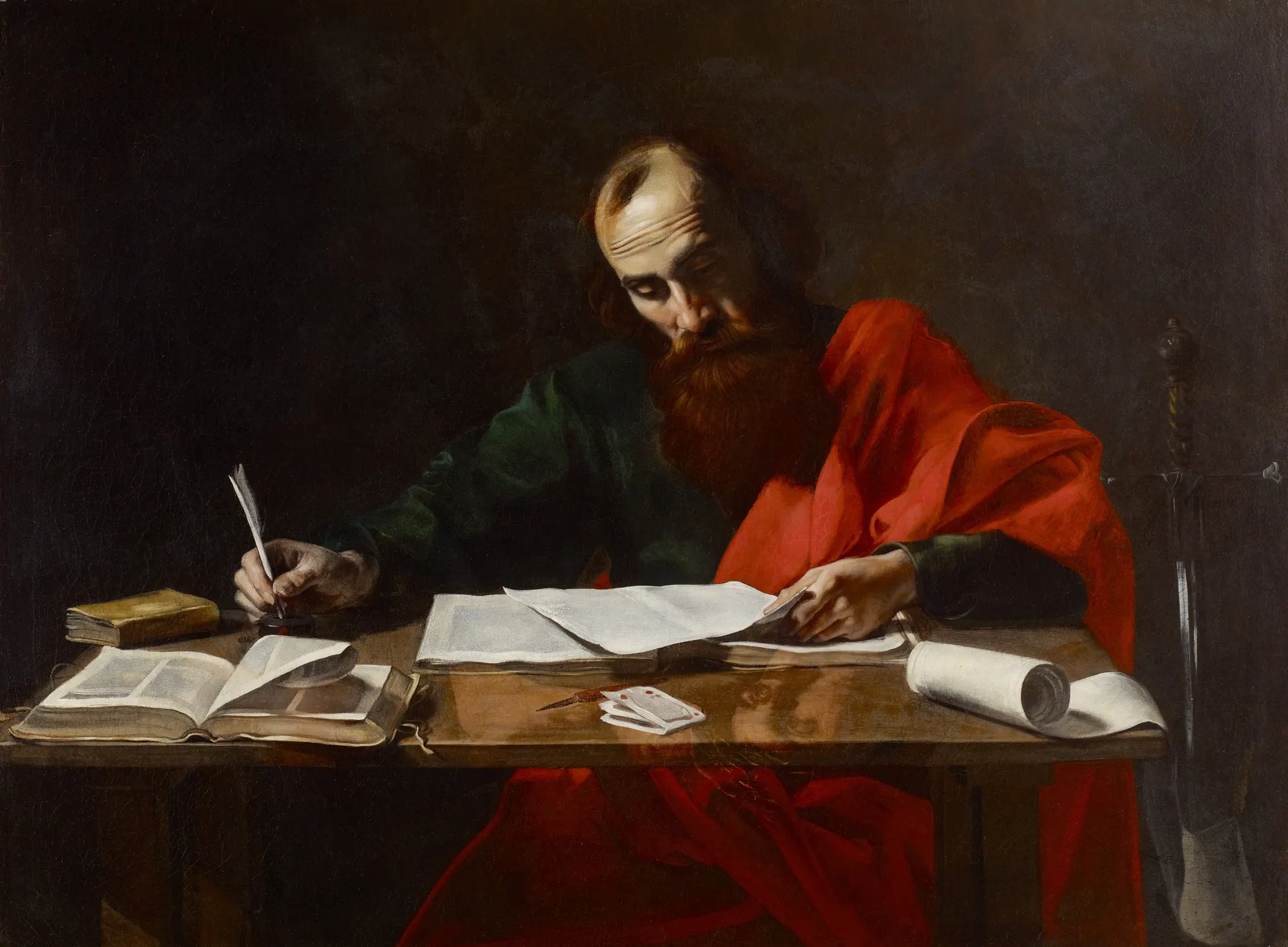
Paul wrote this letter from Corinth about AD 57 to house churches in Rome he had never visited. Some of those believers had already suffered for the name of Christ and expected to suffer again. He had spent four chapters on how a guilty person is made right with God, and here he turns to what that person now has. The chapter then widens to the whole human race and its first father. Listen for the words how much more, which carry the argument forward. Listen also for the two men set side by side, and for which of them you stand under.
Context
- Who
- House churches in Rome, some of whose members had already suffered for the name and expected to again.
- What
- The fruits of justification, peace, hope and joy in God, followed by the comparison of Adam and Christ as the two heads of the human race.
- Where
- Written from Corinth to the house churches of Rome.
- When
- About AD 57, early in the reign of Nero.
- Why
- To assure believers under pressure that their standing with God holds, and to show that grace reaches further than sin.
Historical context
"Peace with God" and "reconciliation" were words from diplomacy and war. Rome's proudest boast was the peace it enforced across the world, celebrated on altars and coins, and it was made by conquest and treaty. Paul uses that vocabulary for a peace made at the enemy's cost by the offended party.
Show the rest of the historical context, 2 more paragraphs
The comparison he draws, dying for a righteous man is rare, for a good man perhaps someone would dare, reflects a real ancient ideal. Stories of a friend dying for a friend were celebrated in Greek and Roman literature as the height of virtue. Paul's point is that Christ died for people who were still enemies, which had no parallel in those stories.
The chapter's second half sets Adam against Christ as two heads of humanity. Ancient thinking about family and nation assumed that what the head did bound those under him, so a single man's act shaping the destiny of many was not a strange idea to Paul's hearers, it was how they understood ancestry, tribe, and kingship.
Significance
To believers under pressure, the chain running from suffering to endurance to proven character to hope reframed hardship as something being formed rather than something merely endured, backed by love poured into their hearts through the Spirit.
Show the rest of the significance, 1 more paragraph
And the Adam comparison told them where they now stood. They had been transferred out of one line and into another, and the gift was not merely equal to the damage but far greater than it.
The heads below are this chapter's scenes. The numbered points under each are its verses.
Peace With God and Rejoicing in Tribulation
Romans 5:1-2
we have peace with God: Justification is God's verdict that the sinner is righteous in His sight, received through faith. The first result is peace with God through Jesus Christ. Hodge and Haldane read the believer's standing as a fixed place on which the hope of the glory of God rests.
Romans 5:1
"Being justified therefore by faith, let us have peace with God through our Lord Jesus Christ, through whom also we have access by faith into this grace in which we stand, and we glory in the hope of the glory of God." By this he most plainly invites the one who has understood what it is to be justified by faith and not by works to that peace of God which surpasses every mind, in which also the summit of perfection consists.
Origen of Alexandria · written before 253 · Commentary on the Epistle to the Romanspatristic
3 more voices on this verseWhat preachers and commentators have said about this verse, in their own words.
Romans 5:1
“Therefore - οὖν oun Since we are thus justified, or as a consequence of being justified, we have peace. Being justified by faith - See the notes at Rom 1:17; Rom 3:24; Rom 4:5. We - That is, all who are justified. The apostle is evidently speaking of true Christians. Have peace with God - see the note at Joh 14:27. True religion is often represented as peace with God; see Act 10:36; Rom 8:6; Rom 10:15; Rom 14:17; Gal 5:22; see also Isa 32:17. “And the work of righteousness shall be peace, And the effect of righteousness.”
Romans 5:1
“But this is through our Lord Jesus Christ --through him as the great peace-maker, the Mediator between God and man, that blessed Day's-man that has laid his hand upon us both. Adam, in innocency, had peace with God immediately; there needed no such mediator. But to guilty sinful man it is a very dreadful thing to think of God out of Christ; for he is our peace, Eph. ii.”
Matthew Henry · Commentary on the Whole Bible (1707-1721)puritan
Romans 5:1
“He had said before, that faith is abolished, if righteousness is sought by works; and in this case perpetual inquietude would disturb miserable souls, as they can find nothing substantial in themselves: but he teaches us now, that they are rendered quiet and tranquil, when we have obtained righteousness by faith, we have peace with God; and this is the peculiar fruit of the righteousness of faith.”
John Calvin · Commentaries (1554)reformed
access by faith into this grace: Paul glories in the hope of the glory of God, and Origen asks why he stops short of the glory itself. The answer lies in time. Matthew Henry puts it in a line: grace is glory begun.
Romans 5:2
“Those, and those only, that have access by faith into the grace of God now may hope for the glory of God hereafter. There is no good hope of glory but what is founded in grace; grace is glory begun, the earnest and assurance of glory.”
Matthew Henry · Commentary on the Whole Bible (1707-1721)puritan
3 more voices on this verse
Romans 5:2
"Let us" therefore "have peace with God through our Lord Jesus Christ." And he added: "Through whom also we have access into this grace in which we stand." How we have access to grace through our Lord Jesus Christ, the Savior himself says: "I am the door"; and, "No one comes to the Father except through me." Through him, then, who is the door, we have access to grace. But let us see what kind of door it is, that we may know what kind of persons they ought to be who enter through it and have access to grace.
Origen of Alexandria · written before 253 · Commentary on the Epistle to the Romanspatristic
Romans 5:2
“By whom also - We are not only indebted to our Lord Jesus Christ for the free and full pardon which we have received, but our continuance in a justified state depends upon his gracious influence in our hearts, and his intercession before the throne of God. We have access - προσαγωγην εσχηκαμεν, We have received this access. It was only through Christ that we could at first approach God; and it is only through him that the privilege is continued to us.”
Adam Clarke · Commentary on the Bible (1810-1826)evangelical
Romans 5:2
“Through whom we have access, etc. Our reconciliation with God depends only on Christ; for he only is the beloved Son, and we are all by nature the children of wrath. But this favor is communicated to us by the gospel; for the gospel is the ministry of reconciliation, by the means of which we are in a manner brought into the kingdom of God.”
John Calvin · Commentaries (1554)reformed
Romans 5:3-5
suffering produces perseverance: , perseverance produces character, and character produces hope. Hope holds at the end of it, God having poured out His love into the heart through the Holy Spirit whom He gave. Wesley and Henry rest the whole chain on that gift of the Spirit.
Romans 5:3
“And not only so - We not only rejoice in times of prosperity, and of health. Paul proceeds to show that this plan is not less adapted to produce support in trials. But we glory - The word used here is the same that is in Rom 5:2, translated, “we rejoice” καυχώμεθα kauchōmetha. It should have been so rendered here. The meaning is, that we rejoice not only in hope; not only in the direct results of justification, in the immediate effect which religion itself produces; but we carry our joy and triumph even into the midst of trials.”
2 more voices on this verse
Romans 5:3
“For those who are well prepared, tribulations are like certain foods and exercises for athletes which lead the contestant on to the inheritance of glory. When we are reviled, we bless; maligned, we entreat; ill-treated, we give thanks; afflicted, we glory in our afflictions.”
Basil of Caesarea · written before 379 · HOMILY 16patristic
Romans 5:3
“We glory in tribulations also - Which we are so far from esteeming a mark of God's displeasure, that we receive them as tokens of his fatherly love, whereby we are prepared for a more exalted happiness. The Jews objected to the persecuted state of the Christians as inconsistent with the people of the Messiah.”
John Wesley · Explanatory Notes upon the New Testament (1755)evangelical
perseverance, character: Barnes explains character as dokime, the proof of tested metal. Suffering met with perseverance produces a proven character, and a proven character has grounds to hope. Chrysostom holds that suffering confirms the hope of glory it seemed to threaten.
Romans 5:4
“Divinely, therefore, Paul writes expressly, "Tribulation worketh, patience, and patience experience, and experience hope; and hope maketh not ashamed." For the patience is on account of the hope in the future. Now hope is synonymous with the recompense and restitution of hope; which maketh not ashamed, not being any more vilified.”
Clement of Alexandria · written before 215 · The Stromata Book 4patristic
1 more voice on this verse
Romans 5:4
“And patience, experience - Δὀκιμεν, Full proof, by trial, of the truth of our religion, the solidity of our Christian state, and the faithfulness of our God. In such cases we have the opportunity of putting our religion to the test; and, by every such test, it receives the deeper sterling stamp. The apostle uses here also a metaphor taken from the purifying, refining, and testing of silver and gold.”
Adam Clarke · Commentary on the Bible (1810-1826)evangelical
hope does not disappoint us: God's love here is read two ways. Augustine takes it as love for God, poured into the heart by the Holy Spirit. Jamieson, Fausset and Brown read it as God's love for the believer, which verses 6 to 8 prove at the cross.
Romans 5:5
“THE Apostle sets before us a ladder like that which Jacob saw—the foot rests upon the earth, but the top ascends to Heaven. Tribulation is the foot, but we mount as we see that it works patience. And we climb again, for patience works experience. And we ascend yet once again, for experience sustains hope, and hope that makes not ashamed climbs up to the very heart of God—and the love of God is shed abroad in our hearts by the Holy Spirit which is given unto us.”
2 more voices on this verse
Romans 5:5
“Hope shameth us not - That is, gives us the highest glorying. We glory in this our hope, because the love of God is shed abroad in our hearts - The divine conviction of God's love to us, and that love to God which is both the earnest and the beginning of heaven.”
John Wesley · Explanatory Notes upon the New Testament (1755)evangelical
Romans 5:5
“And hope maketh not ashamed - That is, this hope will not disappoint, or deceive. When we hope for an object which we do not obtain, we are conscious of disappointment; perhaps sometimes of a feeling of shame. But the apostle says that the Christian hope is such that it will be fulfilled; it will not disappoint; what we hope for we shall certainly obtain; see Php 1:20. The expression used here is probably taken from Psa 22:4-5; Our fathers trusted in thee; They trusted; and thou didst deliver them.”
While We Were Yet Sinners, Christ Died for Us
Romans 5:6-8
Christ died for the ungodly: at the set time, while they had no strength. Verse 7 measures human love at its height, one man barely willing to die for a good man. Verse 8 puts God's love beside that, Christ dying for sinners.
Romans 5:6
“But again, showing that Christ did suffer, and was Himself the Son of God, who died for us, and redeemed us with His blood at the time appointed beforehand, he says: "For how is it, that Christ, when we were yet without strength, in due time died for the ungodly? But God commendeth His love towards us, in that, while we were yet sinners, Christ died for us. Much more, then, being now justified by His blood, we shall be saved from wrath through Him.”
Irenaeus · written before 202 · Against Heresies Book IIIpatristic
3 more voices on this verse
Romans 5:6
“For when we were without strength - Either to think, will, or do anything good. In due time - Neither too soon nor too late; but in that very point of time which the wisdom of God knew to be more proper than any other. Christ died for the ungodly - Not only to set them a pattern, or to procure them power to follow it.”
John Wesley · Explanatory Notes upon the New Testament (1755)evangelical
Romans 5:6
“For when we were yet without strength - The apostle, having pointed out the glorious state of the believing Gentiles, takes occasion to contrast this with their former state; and the means by which they were redeemed from it. Their former state he points out in four particulars; which may be applied to men in general. I. They were ασθενεις, without strength; in a weak, dying state: neither able to resist sin, nor do any good: utterly devoid of power to extricate themselves from the misery of their situation. II.”
Adam Clarke · Commentary on the Bible (1810-1826)evangelical
Romans 5:6
“God's time to help and save is when those that are to be saved are without strength, that his own power and grace may be the more magnified, Deut. xxxii.”
Matthew Henry · Commentary on the Whole Bible (1707-1721)puritan
ConnectionsIsaiah 53:5
for a righteous man: Wesley separates the righteous man from the good man. The righteous man gives each his due, and the good man is full of love and kindness, someone a friend might dare to die for.
Romans 5:7
“In what sense should we take what we read in the Epistle to the Romans: for scarcely for a righteous man will one die; for peradventure for the good man some would even dare to die. (Rom. 5:7) For two heretics, because they do not understand this testimony, being in different errors indeed, but with equal impiety, blaspheme.”
Jerome · written before 420 · Letter 121, Chapter 7patristic
1 more voice on this verse
Romans 5:7
“A just man - One who gives to all what is strictly their due The good man - One who is eminently holy; full of love, of compassion, kindness, mildness, of every heavenly and amiable temper.”
John Wesley · Explanatory Notes upon the New Testament (1755)evangelical
God proves His love for us in this: God proves His love renders synistemi, to set a thing in plain view, and Clarke hears God setting His mercy in the clearest light. Verse 7 measured the most human love can dare. Here Christ died for sinners.
Romans 5:8
“But God commendeth his love, etc. - συνιστησι· God hath set this act of infinite mercy in the most conspicuous light, so as to recommend it to the notice and admiration of all. While we were yet sinners - We were neither righteous nor good; but impious and wicked. See the preceding verse, and see the note on Rom 5:6.”
Adam Clarke · Commentary on the Bible (1810-1826)evangelical
2 more voices on this verse
Romans 5:8
“But God recommendeth - A most elegant expression. Those are wont to be recommended to us, who were before either unknown to, or alienated from, us. While we were sinners - So far from being good, that we were not even just.”
John Wesley · Explanatory Notes upon the New Testament (1755)evangelical
Romans 5:8
“But God commendeth--"setteth off," "displayeth"--in glorious contrast with all that men will do for each other. his love toward us, in that, while we were yet sinners--that is, in a state not of positive "goodness," nor even of negative "righteousness," but on the contrary, "sinners," a state which His soul hateth.”
Jamieson, Fausset & Brown · Commentary Critical and Explanatory on the Whole Bible (1871)reformed
Romans 5:9-11
justified by His blood: Justification by His blood is already done, and verse 9 argues from it to a salvation still ahead, deliverance from wrath. Verse 10 takes the same step from reconciliation made while men were enemies to life through the Son. Hodge and Godet mark the repeated how much more.
Romans 5:9
"Much more therefore," he says, "being now justified in his blood, shall we be saved from wrath through him." Above indeed he had said: "Being justified therefore by faith, let us have peace with God"; and now he says: "Much more now, being justified in his blood, shall we be saved from wrath through him." From which he shows that neither does our faith justify us without the blood of Christ, nor does the blood of Christ justify us without our faith; yet of the two, the blood of Christ justifies us much more than our faith does.
Origen of Alexandria · written before 253 · Commentary on the Epistle to the Romanspatristic
1 more voice on this verse
Romans 5:9
“Much more then being now justified by his blood,.... The apostle here argues from justification by Christ to salvation by him, there being a certain and inseparable connection between these two; whoever is justified shall be saved; and speaks of justification "as being now by his blood".”
when we were enemies of God: Reconciled through the Son's death while still enemies, believers will much more be saved through His life, the risen Christ who intercedes. Ambrosiaster states the logic: God who acted for His enemies will do no less for His friends.
Romans 5:10
If - As sure as; so the word frequently signifies; particularly in this and the eighth chapter. We shalt be saved - Sanctified and glorified. Through his life - "Whoever liveth to make intercession for us."
John Wesley · Explanatory Notes upon the New Testament (1755)evangelical
1 more voice on this verse
Romans 5:10
“Sin is pardoned, the sinner accepted as righteous, the quarrel taken up, the enmity slain, an end made of iniquity, and an everlasting righteousness brought in. This is done, that is, Christ has done all that was requisite on his part to be done in order hereunto, and, immediately upon our believing, we are actually put into a state of justification and reconciliation.”
Matthew Henry · Commentary on the Whole Bible (1707-1721)puritan
we also rejoice in God: Barnes marks the climb of the chapter. The believer rejoiced in hope at verse 2 and in sufferings at verse 3, and now rejoices in God Himself through the Lord Jesus Christ. The reconciliation received is the one verse 10 described, made through the death of His Son.
Romans 5:11
“And not only so, but we also glory - The whole sentence, from the third to the eleventh verse, may be taken together thus: We not only "rejoice in hope of the glory of God," but also in the midst of tribulations we glory in God himself through our Lord Jesus Christ, by whom we have now received the reconciliation.”
John Wesley · Explanatory Notes upon the New Testament (1755)evangelical
3 more voices on this verse
Romans 5:11
“And not only so, but we also joy--rather, "glory." in God through our Lord Jesus Christ, by--"through" whom we have now received the atonement--rather, "the reconciliation" (Margin), as the same word is rendered in Ro 5:10 and in 2Co 5:18, 19. (In fact, the earlier meaning of the English word "atonement" was "the reconciliation of two estranged parties") [TRENCH].”
Jamieson, Fausset & Brown · Commentary Critical and Explanatory on the Whole Bible (1871)reformed
Romans 5:11
“True believers do by Jesus Christ receive the atonement. Receiving the atonement is our actual reconciliation to God in justification, grounded upon Christ's satisfaction.”
Matthew Henry · Commentary on the Whole Bible (1707-1721)puritan
Romans 5:11
“And not only so - The apostle states another effect of justification. We also joy in God - In Rom 5:2, he had said that we rejoice in tribulations, and in hope of the glory of God. But he here adds that we rejoice in God himself; in his existence; his attributes; his justice, holiness, mercy, truth, love. The Christian rejoices that God is such a being as he is; and glories that the universe is under his administration.”
Two Men, Two Races: Adam and Christ
sin entered the world through one man: , death came in with sin, and death reached every man. Paul opens the comparison of Adam and Christ here and breaks off the sentence. He finishes it at verse 18.
Romans 5:12
“He does not therefore properly make a digression, but returns to speak again of sin and of righteousness. As by one man - Adam; who is mentioned, and not Eve, as being the representative of mankind. Sin entered into the world - Actual sin, and its consequence, a sinful nature.”
John Wesley · Explanatory Notes upon the New Testament (1755)evangelical
2 more voices on this verse
Romans 5:12
“For death is alike to all, without difference for the poor, without exception for the rich. And so although through the sin of one alone, yet it passed upon all; that we may not refuse to acknowledge Him to be also the Author of death, Whom we do not refuse to acknowledge as the Author of our race; and that, as through one death is ours, so should be also the resurrection; and that we should not refuse the misery, that we may attain to the gift.”
Ambrose of Milan · written before 397 · On the Decease of His Brother Satyrus, Book 2patristic
Romans 5:12
“Wherefore, as by one man sin entered into the world - From this verse, to the conclusion of the chapter, the apostle produces a strong argument to prove that, as all mankind stood in need of the grace of God in Christ to redeem them from their sins, so this grace has been afforded equally to all, both Jews and Gentiles. Dr. Taylor has given the following analysis of the apostle’s mode of argumentation. The argument stands thus: - “The consequences of Christ’s obedience extend as far as the consequences of Adam’s disobedience.”
Adam Clarke · Commentary on the Bible (1810-1826)evangelical
Romans 5:13-14
sin was in the world before the law: Sin was already in the world before the law came, and death reigned from Adam until Moses. Those who died in that stretch lived before any written command stood over them, and death took them from Adam's one act. Verse 14 calls Adam a pattern of the One to come.
Romans 5:13
“For until the law sin was in the world - As death reigned from Adam to Moses, so also did sin. Now, as there was no written law from Adam to that given to Moses, the death that prevailed could not be the breach of that law; for sin, so as to be punished with temporal death, is not imputed where there is no law, which shows the penalty of sin to be death.”
Adam Clarke · Commentary on the Bible (1810-1826)evangelical
3 more voices on this verse
Romans 5:13
“The law of Moses was the power constraining the weakness of sinners. It proved to be not the answer to sin but rather a provocation to wrath. For it was necessary for transgressors to undergo the punishments prescribed by the law, and wherever there was transgression, there was also sin. So if sin brought death in its wake, it may undoubtedly be said that death, having been born of sin, was strengthened by this very thing. But when sin was taken away death was also weakened, and it disappeared along with its parent.”
Cyril of Alexandria · written before 444 · Explanation of the Letter to the Romanspatristic
Romans 5:13
“For until the law sin was in the world - All, I say, had sinned, for sin was in the world long before the written law; but, I grant, sin is not so much imputed, nor so severely punished by God, where there is no express law to convince men of it.”
John Wesley · Explanatory Notes upon the New Testament (1755)evangelical
Romans 5:13
“For until the law sin was in the world--that is during all the period from Adam "until the law" of Moses was given, God continued to treat men as sinners. but sin is not imputed where there is no law--"There must therefore have been a law during that period, because sin was then imputed"; as is now to be shown.”
Jamieson, Fausset & Brown · Commentary Critical and Explanatory on the Whole Bible (1871)reformed
a pattern of the One to come: Verse 14 calls Adam a pattern of the one to come, and Augustine reads it as a pattern in reverse. Diodorus of Tarsus places the likeness in the reach of each man's act, one spreading sin to all and the other spreading life.
Romans 5:14
“Nevertheless death reigned from Adam to Moses,.... Though the law of Moses was not yet given, death exerted itself, and extended its dominion over all the sons and daughters of Adam, during the interval between Adam and Moses; which clearly shows that sin was in the world, and that there must be a law in being, which that was a transgression of: death is represented as a king, as sin and Satan sometimes are; and indeed, death reigns by sin, and Satan both by sin and death; their empires rise, stand, and fall together.”
4 more voices on this verse
Romans 5:14
“Nevertheless, death reigned from Adam to Moses - This supposes, as Dr. Taylor very properly observes: - 1. That sin was in the world from Adam to Moses. 2. That law was not in the world from Adam to Moses during the space of about 2500 years; for, after Adam’s transgression, that law was abrogated; and, from that time, men were either under the general covenant of grace given to Adam or Noah, or under that which was specially made with Abraham.”
Adam Clarke · Commentary on the Bible (1810-1826)evangelical
Romans 5:14
“For it was incumbent upon the Mediator between God and men, by His relationship to both, to bring both to friendship and concord, and present man to God, while He revealed God to man. For, in what way could we be partaken of the adoption of sons, unless we had received from Him through the Son that fellowship which refers to Himself, unless His Word, having been made flesh, had entered into communion with us? Wherefore also He passed through every stage of life, restoring to all communion with God.”
Irenaeus · written before 202 · Against Heresies Book IIIpatristic
Romans 5:14
“Death reigned - And how vast is his kingdom! Scarce can we find any king who has as many subjects, as are the kings whom he hath conquered. Even over them that had not sinned after the likeness of Adam's transgression - Even over infants who had never sinned, as Adam did, in their own persons; and over others who had not, like him, sinned against an express law.”
John Wesley · Explanatory Notes upon the New Testament (1755)evangelical
Romans 5:14
"This clause is inserted on the first mention of the name "Adam," the one man of whom he is speaking, to recall the purpose for which he is treating of him, as the figure of Christ" [ALFORD].
Jamieson, Fausset & Brown · Commentary Critical and Explanatory on the Whole Bible (1871)reformed
the trespass of the one man: brought death to the many. Verse 15 measures God's grace against that loss and finds it greater, grace and the gift abounding to the many. Paul's how much more runs five times through this passage.
Romans 5:15
“By "the free gift" is meant (as in Ro 5:17) the glorious gift of justifying righteousness; this is expressly distinguished from "the grace of God," as the effect from the cause; and both are said to "abound" towards us in Christ--in what sense will appear in Ro 5:16, 17.”
Jamieson, Fausset & Brown · Commentary Critical and Explanatory on the Whole Bible (1871)reformed
2 more voices on this verse
Romans 5:15
“Yet not - St. Paul now describes the difference between Adam and Christ; and that much more directly and expressly than the agreement between them. Now the fall and the free gift differ, 1. He from whom sin came, and He from whom the free gift came, termed also "the gift of righteousness," differ in power, ver. 16.”
John Wesley · Explanatory Notes upon the New Testament (1755)evangelical
Romans 5:15
“But not as the offence - This is the first point of contrast between the effect of the sin of Adam and of the work of Christ. The word “offence” means properly a fall, where we stumble over anything lying in our way It then means sin in general, or crime Mat 6:14-15; Mat 18:35. Here it means the fall, or first sin of Adam.”
The judgment that followed one sin: One sin brought the judgment of condemnation on the whole race. The gift answers many trespasses at once and brings justification. Paul repeats at verse 16 the disproportion he set out at verse 15, and the weight falls on the side of the gift.
Romans 5:16
“And not as it was by one that sinned, so is the gift--"Another point of contrast may be mentioned." for the judgment--"sentence." was by one--rather, "was of one," meaning not "one man," but, as appears from the next clause, "one offense." to condemnation, but the free gift--"gift of grace." is of many offences unto justification--a glorious point of contrast.”
Jamieson, Fausset & Brown · Commentary Critical and Explanatory on the Whole Bible (1871)reformed
2 more voices on this verse
Romans 5:16
“And not as it was by one that sinned - That is, the judicial act that followed Adam’s sin (the sentence of death pronounced upon him, and his expulsion from paradise) took its rise from his one offense alone, and terminated in condemnation; but the free gift of God in Christ takes its rise also from the many offenses which men, in a long course of life, have personally committed; and the object of this grace is to justify them freely, and bring them to eternal life.”
Adam Clarke · Commentary on the Bible (1810-1826)evangelical
Romans 5:16
“I am not going to speak at length about the Doctrine of the Federal Headship of the first Adam and of the second Adam, which is, to my mind, indisputably taught in this chapter. I have heard a great many objections to that Truth of God which appear to me to be plainly revealed in Scripture, namely, that we were all represented by Adam in the Garden of Eden and that when he sinned, he so sinned as to sin representatively—and we fellby virtue of his disobedience.”
Charles Spurgeon · written before 1892 · The Metropolitan Tabernacle Pulpit, Sermon No. 2544: “The One and the Many” (lightly modernized text, CCEL edition)Particular Baptist
death reigned through that one man: Death reigned through the one man's trespass, and those under it were its subjects. Verse 17 gives the other side, those who receive the abundance of grace and the gift of righteousness reigning in life through Jesus Christ. Godet and Haldane mark the change from being ruled to ruling.
Romans 5:17
“Concurring with these statements, Paul, speaking to the Romans, declares: "Much more they who receive abundance of grace and righteousness for [eternal] life, shall reign by one, Christ Jesus." It follows from this, that he knew nothing of that Christ who flew away from Jesus; nor did he of the Saviour above, whom they hold to be impassible. For if, in truth, the one suffered, and the other remained incapable of suffering, and the one was born, but the other descended upon him who was born, and left him gain, it is not one, but two, that are shown forth.”
Irenaeus · written before 202 · Against Heresies Book IIIpatristic
3 more voices on this verse
Romans 5:17
“There is a difference between grace and the gift. Grace is opposed to the offense; the gift, to death, being the gift of life.”
John Wesley · Explanatory Notes upon the New Testament (1755)evangelical
Romans 5:17
“Nor does he say Life reigns in us, which would have been a scriptural enough idea; but, which is much more pregnant, "We shall reign in life." While freedom and might are implied in the figure of "reigning," "life" is represented as the glorious territory or atmosphere of that reign.”
Jamieson, Fausset & Brown · Commentary Critical and Explanatory on the Whole Bible (1871)reformed
Romans 5:17
“In and by the righteousness of Christ we have not only a charter of pardon, but a patent of honour, are not only freed from our chains, but, like Joseph, advanced to the second chariot, and made unto our God kings and priests--not only pardoned, but preferred.”
Matthew Henry · Commentary on the Whole Bible (1707-1721)puritan
Romans 5:18-19
one act of righteousness: One trespass brought condemnation on all men, and the obedience of Christ brought justification and life. Each all names the whole company joined to its own head. Verse 19 states the parallel as standing, the many made sinners through one disobedience and made righteous through one obedience.
Romans 5:18
“Therefore, as by the offense of one, etc. - The Greek text of this verse is as follows: - Αρα ουν, ὡς δι’ ἑνος παραπτωματος, εις παντας ανθρωπους εις κατακριμα· αυτω και ἑνος δικαιωματος, εις παντας ανθρωπους, εις δικαιωσιν ζωης; which literally rendered stands thus: - Therefore, as by one offense unto all men, unto condemnation; so likewise, by one righteousness unto all men, to justification of life. This is evidently an elliptical sentence, and its full meaning can be gathered only from the context.”
Adam Clarke · Commentary on the Bible (1810-1826)evangelical
3 more voices on this verse
Romans 5:18
“Justification of life - Is that sentence of God, by which a sinner under sentence of death is adjudged to life.”
John Wesley · Explanatory Notes upon the New Testament (1755)evangelical
Romans 5:18
“But this is to limit the apostle's idea too much; for as the same word is properly rendered "righteousness" in Ro 8:4, where it means "the righteousness of the law as fulfilled by us who walk not after the flesh, but after the Spirit," so here it denotes Christ's whole "obedience unto death," considered as the one meritorious ground of the reversal of the condemnation which came by Adam.”
Jamieson, Fausset & Brown · Commentary Critical and Explanatory on the Whole Bible (1871)reformed
Romans 5:18
“First, By the offence and disobedience of one many were made sinners, and judgment came upon all men to condemnation. That Adam's sin was disobedience, disobedience to a plain and express command: and it was a command of trial. The thing he did was therefore evil because it was forbidden, and not otherwise; but this opened the door to other sins, though itself seemingly small.”
Matthew Henry · Commentary on the Whole Bible (1707-1721)puritan
the many were made sinners: Made renders kathistemi, to set in a standing, so the many were placed among sinners through Adam and made righteous through Christ. Wesley takes the many as all men, and Theodoret and Ambrosiaster as fewer than all.
Romans 5:19
“For as by the disobedience of the one man who was originally moulded from virgin soil, the many were made sinners, and forfeited life; so was it necessary that, by the obedience of one man, who was originally born from a virgin, many should be justified and receive salvation. Thus, then, was the Word of God made man, as also Moses says: "God, true are His works." But if, not having been made flesh, He did appear as if flesh, His work was not a true one.”
Irenaeus · written before 202 · Against Heresies Book IIIpatristic
2 more voices on this verse
Romans 5:19
“As by the disobedience of one man many (that is, all men) were constituted sinners - Being then in the loins of their first parent, the common head and representative of them all. So by the obedience of one - By his obedience unto death; by his dying for us. Shall be constituted righteous - Justified, pardoned.”
John Wesley · Explanatory Notes upon the New Testament (1755)evangelical
Romans 5:19
“Thus too the forced interpretation by which the "justification of all" is made to mean a justification merely in possibility and offer to all, and the "justification of the many" to mean the actual justification of as many as believe [ALFORD, &c.], is completely avoided. And thus the harshness of comparing a whole fallen family with a recovered part is got rid of.”
Jamieson, Fausset & Brown · Commentary Critical and Explanatory on the Whole Bible (1871)reformed
Romans 5:20-21
where sin increased, grace increased: The law came in and the trespass grew under it, counted now as open lawbreaking. Grace grew faster still. Verse 21 closes the chapter with two reigns, sin reigning in death and grace reigning through righteousness to eternal life through Jesus Christ.
Romans 5:20
"But the law entered in secretly, that the offence might abound. But where sin abounded, grace did more abound: that as sin hath reigned unto death, so also grace might reign through justice unto life eternal, through Jesus Christ our Lord." If indeed no one had sinned before the law was given through Moses, Marcion and the other heretics, wishing to accuse the law, would seem to seize an occasion from these words of the Apostle, as though this had been the reason for the law's being given, namely that sin, which had not existed before the law, might abound.
Origen of Alexandria · written before 253 · Commentary on the Epistle to the Romanspatristic
2 more voices on this verse
Romans 5:20
“Yet where sin abounded, grace did much more abound - Not only in the remission of that sin which Adam brought on us, but of all our own; not only in remission of sins, but infusion of holiness; not only in deliverance from death, but admission to everlasting life, a far more noble and excellent life than that which we lost by Adam's fall.”
John Wesley · Explanatory Notes upon the New Testament (1755)evangelical
Romans 5:20
“Sin abounded by the Law because by the Law is the knowledge of sin, and thus it began to be injurious to me to know that which through infirmity I could not avoid; it is good to foreknow in order to avoid, but if I cannot avoid, to have known was injurious. Thus the effect of the Law was changed to me into its opposite, yet by the very increase of sin it became useful to me, because I was humbled. Wherefore David also said, It is good for me that I have been humbled.”
Ambrose of Milan · written before 397 · Letter 73, To Irenaeuspatristic
grace might reign through righteousness: Chrysostom sees two ranks in the first reign, sin as the king and death as the soldier sin arms. Matthew Henry reads the cruel reign as the foil that sets off the gentle one. Grace rules through righteousness, so its reign ends in life.
Romans 5:21
“I shall not pretend to enter into the fullness of this text, but merely select that topic, "Grace reigns through righteousness unto eternal life by Jesus Christ our Lord." Our Apostle represents man as being subject to two great kings. Sin is the grim tyrant, to whom, in the first place, man has bowed his willing neck. The reign of sin is a reign of terror and delusion; it promises pleasure, but being full of all manner of deceivableness, of unrighteousness, it gives pain even in this world—and in the world to come—eternal death!”
2 more voices on this verse
Romans 5:21
“That as sin had reigned - so grace also might reign - Which could not reign before the fall; before man had sinned. Through righteousness to eternal life by Jesus Christ our Lord - Here is pointed out the source of all our blessings, the rich and free grace of God.”
John Wesley · Explanatory Notes upon the New Testament (1755)evangelical
Romans 5:21
“That as sin hath reigned - Note, Rom 5:14. Unto death - Producing or causing death. Even so - In like manner, also. The provisions of redemption are in themselves ample to meet all the ruins of the fall. Might grace reign - Might mercy be triumphant; see Joh 1:17, “Grace and truth came by Jesus Christ.” Through righteousness - Through, or by means of, God’s plan of justification; Note, Rom 1:17. Unto eternal life - This stands opposed to “death” in the former part of the verse, and shows that there the apostle had reference to eternal death.”
How this psalm is built
The form: Two heads of the human race set side by side, with Adam the pattern of the One to come, as Chrysostom classes it.
The patterns in this chapter
| Device | What it does | Where to see it |
|---|---|---|
| How much more | The phrase how much more stands four times in the Berean text, at verses 9, 10, 15 and 17. Each time a fact already true carries a greater one still to come. Ambrosiaster states the pattern at verse 10, that the God who acted for His enemies will love His friends no less.Ambrosiaster, COMMENTARY ON PAUL'S EPISTLES, 384, on Romans 5:10. | Romans 5:9, Romans 5:10, Romans 5:15, Romans 5:17 |
| The one man | The phrase one man stands nine times in the Berean text, in verses 12, 15, 16, 17 and 19, naming Adam and naming Jesus Christ. Diodorus of Tarsus holds that Adam is a type of Christ in the effects of what he did, sin spreading to all from one and life from the other.Diodorus of Tarsus, PAULINE COMMENTARY FROM THE GREEK CHURCH, 390, on Romans 5:14. | Romans 5:12, Romans 5:15, Romans 5:17, Romans 5:19 |
| The chain from suffering to hope | Verses 3 to 5 run a chain in which each link produces the next, suffering, perseverance, character and hope. Barnes reads character as proof by testing, the way metal is tried in the fire, and the chain ends on the love of God poured out through the Holy Spirit.Albert Barnes, Notes, Explanatory and Practical, on the Old and New Testaments (1832-1869), on Romans 5:4. | Romans 5:3, Romans 5:4, Romans 5:5 |
How this chapter is built
6 more paragraphs on the patterns
Verses 1 to 11 name what the justified hold, peace with God, access into grace, a hope that holds through suffering, and joy in God Himself. Verses 12 to 21 set Adam beside Christ. The phrase one man stands nine times in the Berean text of the chapter, and how much more four times, at verses 9, 10, 15 and 17. The sentence begun at verse 12 breaks off, and verse 18 takes it up again. The chapter closes on two reigns, sin in death and grace through righteousness.
Where it stands in the letter
Chapter 4 ended on Jesus raised to life for justification, and chapter 5 opens with the peace that justification brings. The comparison of Adam and Christ runs to verse 21 and leaves a question open, which chapter 6 asks at once: if grace increased where sin increased, should a believer go on sinning?
Where to go deeper
The comparison of verses 12 to 21 has its own page at /featured/the-two-adams, and the peace of verses 1 to 11 at /featured/reconciliation. The doctrine behind verse 1 stands at /featured/justification-by-faith.
Sources: John Chrysostom, Homily on Romans X, 407, on Romans 5:14. Diodorus of Tarsus, PAULINE COMMENTARY FROM THE GREEK CHURCH, 390, on Romans 5:14. Ambrosiaster, COMMENTARY ON PAUL'S EPISTLES, 384, on Romans 5:10. Matthew Henry, Commentary on the Whole Bible, 1710, on Romans 5:12.
Keep studying
Studies24
People and groups1
Words12
Sources for this chapter
The summary
Jamieson, Fausset & Brown, Commentary Critical and Explanatory; John Calvin, Commentaries; John Wesley, Explanatory Notes Upon the New Testament and Matthew Henry, Complete Commentary.
The form and classifications
Augustine of Hippo, LETTER 157, 430, on Romans 5:14; John Chrysostom, Homily on Romans X, 407, on Romans 5:14 and Matthew Henry, Commentary on the Whole Bible, 1710, on Romans 5:14.
The exposition
Adam Clarke, Commentary on the Bible; Albert Barnes, Notes, Explanatory and Practical, on the Old and New Testaments (1832-1869); Ambrosiaster, COMMENTARY ON PAUL'S EPISTLES; Augustine of Hippo; Charles Hodge, Commentary on the Epistle to the Romans; Diodorus of Tarsus, PAULINE COMMENTARY FROM THE GREEK CHURCH; Frederic Godet, Commentary on St. Paul’s Epistle to the Romans; Jamieson, Fausset & Brown, Commentary Critical and Explanatory on the Whole Bible; John Calvin, Commentary on the Epistle to the Romans; John Chrysostom; John Gill, Exposition of the New Testament; John Wesley, Explanatory Notes upon the New Testament; Matthew Henry, Commentary on the Whole Bible; Origen of Alexandria, COMMENTARY ON THE EPISTLE TO THE ROMANS; Robert Haldane, Exposition of the Epistle to the Romans and Theodoret of Cyrus, INTERPRETATION OF THE LETTER TO THE ROMANS.