
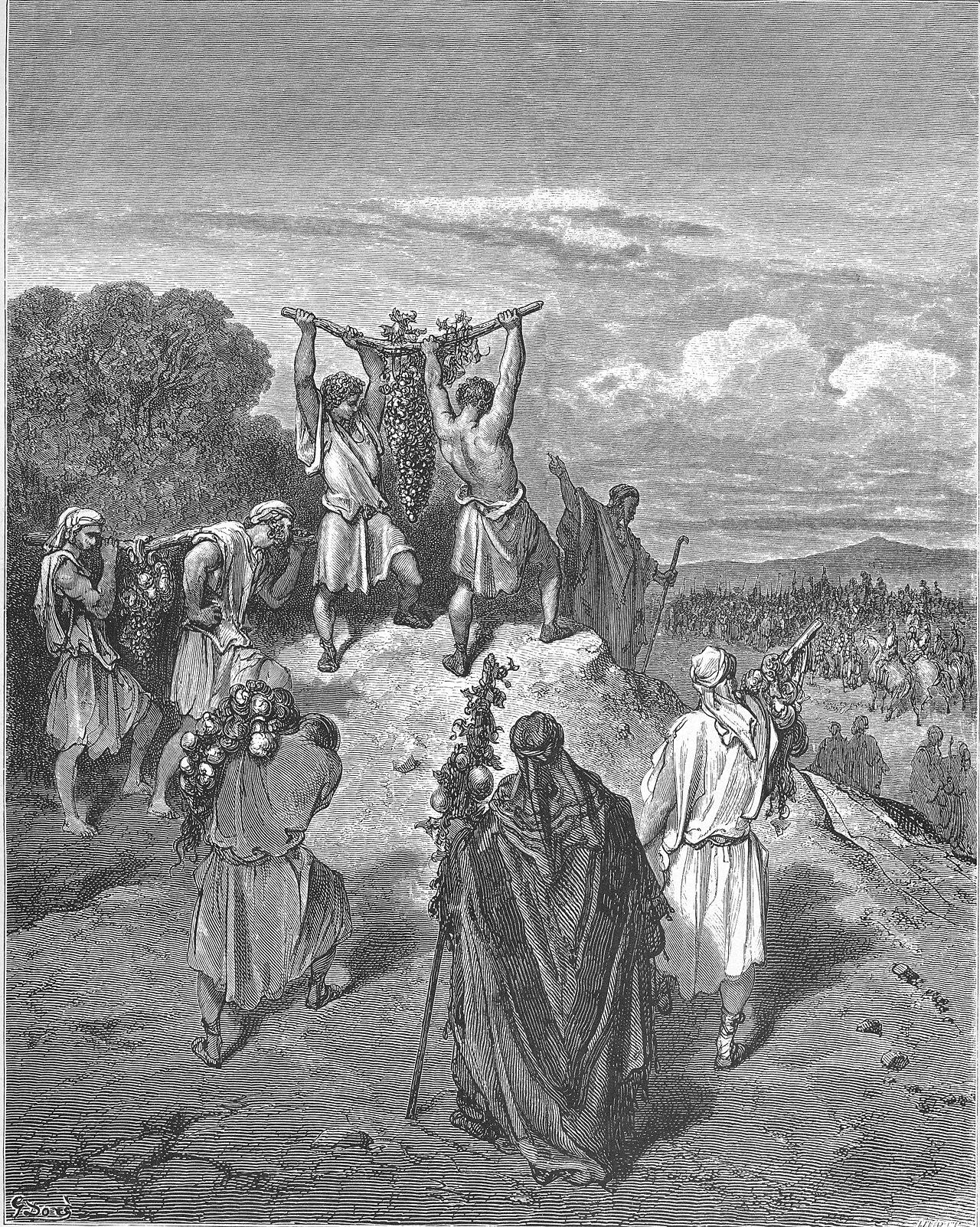
Numberschapter 13
33 verses · Moses, by tradition · 15th to 13th century BC · The Law
Original Language
Numbers 13— Hebrew word study · with the Hebrew tradition
In Jewish life
Jewish practice and Jewish teaching both have something to say about Numbers 13. Three things follow: where it is read, what is done because of it, and how the rabbis have taught it. The purpose is to inform a Christian reader what Jews believe and how Judaism was and is practised.
The reading
Weekly portion 37 of 54
שְׁלַח־לְךָ Sh'lach, Numbers 13:1 to 15:41
Read with it: Joshua 2:1 to 2:24.
The verse numbers here are the ones a Hebrew Bible carries, which differ from an English Bible by a verse or two in several places. The Sephardi reading is named only where this site records a difference; communities vary beyond what is listed. What these books are, and how a Christian reader meets them →
Where the rabbis cite this chapter
3 rows sit beside their verses in the text, on 3 verses of this chapter. No row that speaks to the chapter as a whole is recorded. Every quote links to its full source.
Texts and citation data: Sefaria (sefaria.org); excerpts follow each version’s license, and every passage opens at its source.
How to read a word below: the Hebrewword, then how it sounds, then what it means, then its number in Strong’s concordance, a widely used lookup this site follows (H for Hebrew and Aramaic, G for Greek). Square brackets hold a word the English supplies that the Hebrew does not, angle brackets mark the Hebrew’s own grammatical elements that English renders as separate words, and the mark ס or פ is where the Hebrew manuscripts end a paragraph.
Twelve men, one ruler from each tribe1
Numbers 13:1· Hebrew and glosses: STEP Bible
Numbers 13:2· Hebrew and glosses: STEP Bible
Ramban on Numbers 13:2
SEND ‘LECHA’ (THEE) 1 Literally: “for thyself,” as explained by Rashi. MEN. “As you see fit. I do not command you [to send them], but if you wish [to do so], send them.
Read it in full at Sefaria · Commentary on the Torah by Ramban (Nachmanides). Translated and annotated by Charles B. Chavel. New York, Shilo Pub. House, 1971-1976
Numbers 13:3· Hebrew and glosses: STEP Bible
Numbers 13:4· Hebrew and glosses: STEP Bible
Numbers 13:5· Hebrew and glosses: STEP Bible
Numbers 13:6· Hebrew and glosses: STEP Bible
Numbers 13:7· Hebrew and glosses: STEP Bible
Numbers 13:8· Hebrew and glosses: STEP Bible
Numbers 13:9· Hebrew and glosses: STEP Bible
Numbers 13:10· Hebrew and glosses: STEP Bible
Numbers 13:11· Hebrew and glosses: STEP Bible
Numbers 13:12· Hebrew and glosses: STEP Bible
Numbers 13:13· Hebrew and glosses: STEP Bible
Numbers 13:14· Hebrew and glosses: STEP Bible
Numbers 13:15· Hebrew and glosses: STEP Bible
Numbers 13:16· Hebrew and glosses: STEP Bible
Go see whether the land is fat or lean17
Numbers 13:17· Hebrew and glosses: STEP Bible
Numbers 13:18· Hebrew and glosses: STEP Bible
Numbers 13:19· Hebrew and glosses: STEP Bible
Ramban on Numbers 13:19
Rabbi Abraham ibn Ezra commented [that the meaning thereof is that they are to see] “if the Land is good, namely that its air is good, and its waters are good.” Then Moses continued, whether it is fat, 24 Further, Verse. meaning “capable of producing wheat” and many fruits.
Read it in full at Sefaria · Commentary on the Torah by Ramban (Nachmanides). Translated and annotated by Charles B. Chavel. New York, Shilo Pub. House, 1971-1976
Numbers 13:20· Hebrew and glosses: STEP Bible
Rashi on Numbers 13:20
היש בה עץ WHETHER THERE ARE TREES IN IT [OR NOT] — i.e. whether there is a righteous man amongst them who will protect them by his merits (cf. Bava Batra 15a).
Read it in full at Sefaria · Pentateuch with Rashi's commentary by M. Rosenbaum and A.M. Silbermann, 1929-1934
Forty days, and a cluster carried on a pole21
Numbers 13:21· Hebrew and glosses: STEP Bible
Numbers 13:22· Hebrew and glosses: STEP Bible
Numbers 13:23· Hebrew and glosses: STEP Bible
Numbers 13:24· Hebrew and glosses: STEP Bible
Numbers 13:25· Hebrew and glosses: STEP Bible
A good land — but we were as grasshoppers26
Numbers 13:26· Hebrew and glosses: STEP Bible
Numbers 13:27· Hebrew and glosses: STEP Bible
Numbers 13:28· Hebrew and glosses: STEP Bible
Numbers 13:29· Hebrew and glosses: STEP Bible
Numbers 13:30· Hebrew and glosses: STEP Bible
Numbers 13:31· Hebrew and glosses: STEP Bible
Numbers 13:32· Hebrew and glosses: STEP Bible
Numbers 13:33· Hebrew and glosses: STEP Bible