
Judgeschapter 2
23 verses · Samuel, by tradition · 11th century BC · History
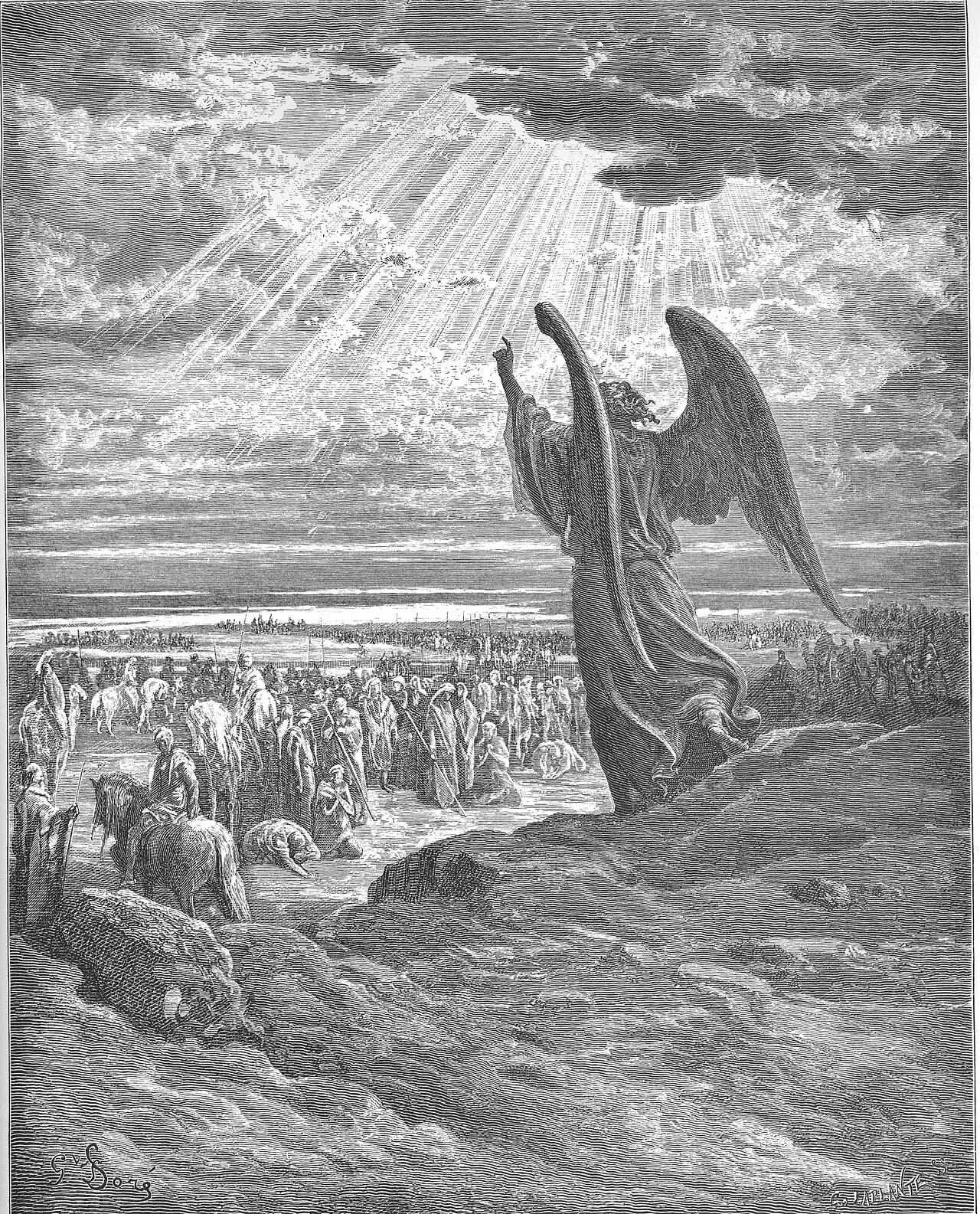
And an angel of the Lord came up from Gilgal to Bochim, and said, I made you to go up out of Egypt, and have brought you unto the land which I sware unto your fathers; and I said, I will never break my covenant with you.
Introduction
Samuel, by tradition, History, Judges Overview.
Samuel, by tradition · Narrative and editorial frame · Judges, the Former Prophets · [The book of Judges](/book/judges) The writer is unnamed, and in this chapter he stops telling single episodes and explains the book. A messenger speaks first, and then the writer speaks in his own voice about a whole era. It was written for Israelites who wanted to know why a nation given a land kept losing its grip on it. Listen for the pattern laid out here, because the accounts in chapters 3 to 16 follow it. Notice the line about a generation that grew up without knowing what its parents had seen. That line is addressed to every household that reads it.
Context
- Who
- Israelites who could see the whole cycle from the far end of it
- What
- A rebuke from the angel of the LORD at Bochim, followed by the writer's summary of the pattern that governs the whole book.
- Where
- Bochim, where the messenger came up from Gilgal, and then the whole land across the era of the judges.
- When
- From Joshua's burial, in the 14th century BC on the traditional reckoning, across the whole period of the judges.
- Why
- To explain why a people given the land kept being overrun inside it.
Historical context
The speaker of the first five verses is the angel of the LORD, who speaks in the first person and charges the nation with a broken covenant, and the rest of the chapter belongs to the writer, who stops telling episodes and states the pattern of the whole book. The time runs from Joshua's burial at the age of a hundred and ten to the death of everyone who had seen the conquest, and verse 10 carries that whole distance in one sentence.
Show the rest of the historical context, 3 more paragraphs
The rebuke is delivered at Bochim by a messenger who comes up from Gilgal, the camp where Israel first stood in the land after crossing the Jordan, where the men were circumcised and where the first Passover in Canaan was eaten. The occasion is the charge that Israel made a covenant with the people of the land instead of tearing down their altars, which is the failure chapter 1 has just listed town by town.
A first hearer knew that the gods named here were practical, since Baal was the storm god believed to bring the rain that made barley grow and the Ashtaroth were goddesses of fertility in field, flock and womb. Farmers in a land with no Nile, living on rain that either came in October or did not, had a standing temptation to hedge, and excavated Canaanite shrines from these centuries are full of small figurines and standing stones.
He also knew that the word translated judge covered more than a courtroom, since these men and women were deliverers raised for a crisis first and arbitrators second. None of them ruled the whole nation, and none founded a dynasty except by force. Most acted in one region while the rest of Israel farmed on undisturbed.
Significance
For the first hearers this chapter answered the hardest question of their national life. If God gave us this land, why are we constantly overrun inside it? The answer given is that the covenant had terms and the terms were broken.
Show the rest of the significance, 1 more paragraph
The line about a generation that did not know the LORD or the work He had done for Israel is aimed straight at parents. One generation failed to hand the story on, and the whole record of disasters follows from it.
This chapter in Jewish lifeWhat this chapter is in Jewish life and reading.
How it is read
This is the chapter in which the book states its own pattern, and the classical commentators spend their notes on who the speakers are and on the order of the telling. Rashi is quoted here from the Metsudah Tanach series of Lakewood, New Jersey, under a CC-BY licence. He opens by naming the messenger of the first verse. "We learn in Seder Olam that this was Pinchos", the son of Eleazar and grandson of Aaron (Rashi on Judges 2:1:1). The reason he gives for the title is that the man was lit with radiance when the holy spirit came on him. Bochim Rashi takes as the name of a place rather than as the weeping itself (Rashi on Judges 2:1:2). At the third verse he holds that the sentence left standing there was new, declared "in My fury" because they had sinned (Rashi on Judges 2:3:1).
Rashi then explains why the account doubles back to Joshua's death. Scripture means to relate that Israel acted wickedly, so it begins again at the dismissal, with the people serving God through Joshua's days and the days of the elders (Rashi on Judges 2:6:1). The note on those elders is the sharpest in the chapter. Their days were long but their years were short, he says, because they were remiss in mourning Joshua. The mountain by his grave is read by its sound, so that Gaash is heard as storm and "the mountain stormed at them" (Rashi on Judges 2:7:1). At the ninth verse he adds the custom that gave the burial place its name. A likeness of the sun was set over the grave of the man who once halted the sun (Rashi on Judges 2:9:1).
One note ties this book to another. At the fifteenth verse Rashi reads the hand of God that went out against Israel as a reference to Elimelech, Mahlon and Chilion. His authority again is Seder Olam (Rashi on Judges 2:15:1). The famine that opens the book of Ruth is placed inside the cycle this chapter describes. On the cycle itself his notes are brief and exact. The judges were raised up continuously, "judge succeeding judge" (Rashi on Judges 2:16:1). The eighteenth verse describes an ongoing process rather than one occasion (Rashi on Judges 2:18:1). Of the relapse he says only that they omitted nothing that deserved the reproach they were given (Rashi on Judges 2:19:1). At the twenty-second verse he settles a vowel, which turns the clause into a question because the verse is about a test (Rashi on Judges 2:22:1).
Metzudat David is kept in two places, in the Sefaria Community Translation under CC0. He reads the sentence of the twenty-first verse as measure for measure, "Just as they acted, so too I will repay them" (Metzudat David on Judges 2:21:1). At the last verse he draws the conclusion the chapter leaves hanging. The nations were left where they stood because this was the punishment God chose (Metzudat David on Judges 2:23:1). Eleven further notes stand on this chapter with no English text in the corpus and are cited here unquoted. They are Malbim on Judges 2:2:1, 2:4:1, 2:12:1 and 2:20:1, Metzudat David on Judges 2:2:1, 2:5:1, 2:10:1 and 2:17:1, and Radak on Judges 2:11:1, 2:13:1 and 2:14:1.
What the rabbis say
The corpus carries thirty-seven rabbinic locators on this chapter, twenty-nine Midrash and eight Talmud, and the text of none, so each is cited and linked here rather than quoted. The messenger who went up from Gilgal draws the heaviest run, six locators at the first verse. They are Bamidbar Rabbah 16:1, Midrash Lekach Tov, Leviticus 1:1:1, Midrash Tanchuma, Sh'lach 1:1, Midrash Tehillim 103:13, Vayikra Rabbah 1:1 and Yalkut Shimoni on Torah 427:2. The covenant charge of the second verse is taken up at Introductions to Tanaitic Literature, Introduction to Halakhic Midrashim, Sifrei Numbers 354, and the weeping and the sacrifice at Bochim at Megillah 14a:16.
The generation of Joshua carries the next run. The elders who outlived him carry eight locators. Four are Avot DeRabbi Natan 1:3, Avot DeRabbi Natan, Recension B 22:3, Bereshit Rabbati, Parashat Bereshit 12 and Midrash Sekhel Tov, Shemot 12:42:11. The other four are Ein Yaakov (Glick Edition), Shabbat 13:2, Ein Yaakov, Shabbat 13:2, Otzar Midrashim, Midrashim on Missing and Extra Letters 2:9 and Shabbat 105b:11. His burial at Timnath-heres draws Bava Batra 122b:1, Bereshit Rabbati, Parashat Chayei Sarah 16, Megillah 14b:11, Pesikta Rabbati 3:1 and Ruth Rabbah (Lerner) 1:2:1.
The generation that did not know the LORD is taken up at Midrash Lekach Tov, Deuteronomy 31:14:1 and Otzar Midrashim, Midrashim on Missing and Extra Letters 1:12. The turning to the Baals draws Midrash Tanchuma Buber, Vaera 11:1. Ashtaroth draws Midrash Aggadah, Numbers 33:1:5. The hand of the LORD against them draws Ruth Rabbah (Lerner) 2:16:9, Ruth Rabbah 2:19 and Seder Olam Rabbah 12:2. The refusal to listen to the judges draws five more. They are Otzar Midrashim, Hashkem, Midrash Hashkem ('Arise Early') 12, Ruth Rabbah (Lerner) 1:8:1, Ruth Rabbah 1:1, Yalkut Shimoni on Torah 22:7 and Yalkut Shimoni on Torah 945:1. Three of those five stand in the Midrash on Ruth, which is where the rabbinic tradition reads the famine of that book into these years.
The raising up of a judge and the pity that moved it are taken up at Avot DeRabbi Natan, Recension B 1:5, Midrash Tanchuma, Mishpatim 4:2 and Shemot Rabbah 30:24. The nations left to test Israel draw Midrash Tanchuma, Re'eh 9:1. What each of them teaches is a saying of the rabbis, and is reported as theirs wherever this site quotes one. The quotations wait on a fetch that carries the text.
Sources: Rashi, Rashi on Judges 2:1:1 to 2:22:1, eleven notes, the Metsudah Tanach series, Lakewood, N.J, CC-BY; Metzudat David, Metzudat David on Judges 2:21:1 and 2:23:1, the Sefaria Community Translation, CC0; and on 2:2:1, 2:5:1, 2:10:1 and 2:17:1 by ref alone; Radak, Radak on Judges 2:11:1, 2:13:1 and 2:14:1, cited by ref because the corpus carries no English text; Malbim, Malbim on Judges 2:2:1, 2:4:1, 2:12:1 and 2:20:1, cited by ref because the corpus carries no English text; The Sefaria corpus, scripts/data/sources/sefaria/judges/2.json, the 37 rabbinic locators of this chapter, 29 Midrash and 8 Talmud.
The heads below are this chapter's scenes. The numbered points under each are its verses.
The angel at Bochim, the place of weeping
Judges 2:1-3
The angel comes from Gilgal, where Joshua 5 placed the circumcision and the Passover, so the rebuke starts where the obedience started. He speaks in the first person, "I brought you up out of Egypt", and asks a question nobody answers, "What is this you have done". Verse 3 repeats the warning of Numbers 33:55 and Joshua 23:13, "thorns in your sides", so Israel meets what it was told.
Judges 2:1
“The learned bishop Patrick is clearly of opinion that this was not a created angel, but the Angel of the covenant, the same that appeared to Joshua as captain of the hosts of the Lord, who was God himself. Christ himself, says Dr. Lightfoot; who but God and Christ could say, I made you to go up out of Egypt?”
Matthew Henry · Commentary on the Whole Bible (1707-1721)puritan
2 more voices on this verseWhat preachers and commentators have said about this verse, in their own words.
Judges 2:1
“The angel of the Lord (not an angel). - The phrase is used nearly 60 times to designate the Angel of God’s presence. See Gen 12:7 note. In all cases where “the angel of the Lord” delivers a message, he does it as if God Himself were speaking, without the intervening words “Thus saith the Lord,” which are used in the case of prophets. (Compare Jdg 6:8; Jos 24:2.)”
Judges 2:1
“Bochim - A place so called by anticipation; it seems to be no other than Shiloh, where it is probable, the people were met together upon some solemn festival. I said - That is, I promised upon condition of your keeping covenant with me.”
John Wesley · Explanatory Notes upon the Old Testament (1765)evangelical
Albert Barnes notes that the angel names two commands, no covenant with the people and their altars torn down, because these were the two Israel had broken. The ban on intermarriage in Deuteronomy 7:3 goes unmentioned. Barnes takes that silence as a sign this rebuke came early, before the marriages of 3:6.
Judges 2:2
“The two articles of the covenant here specified (compare margin references) are those which the Israelites had at this time broken. The other important prohibition Deu 7:3 is not specified by the Angel, and this is an indication that at the time the Angel spoke, intermarriages with the pagan spoken of Jdg 3:6 had not taken place; and this again is another evidence of the early date of this occurrence.”
Albert Barnes takes So now I tell you as a declaration made on the spot, and he says this announcement is what made the people weep. He also notes that the word thorns is supplied, borrowed from the parallel warning in Joshua. Verse 4 records the weeping.
Judges 2:3
“Wherefore I also said” - Rather because ye have done the things mentioned in Jdg 2:2, “I have now said (i. e. I now protest and declare) that I will not drive them out from before you” (compare Jdg 19:29). And it was the annonncement of this resolution by the Angel that caused the people to weep. The word thorns in this verse is supplied by the King James Version from the similar passage in Joshua (see the marginal reference).
Judges 2:4-5
They weep and they sacrifice, and the place is named Bochim, which means weepers. Nothing is said about throwing down an altar or breaking a league, which is what verse 2 charged them with failing to do. The book's first recorded response to God is grief without amendment, and chapter 3 begins the cycle anyway.
Judges 2:4
“Let us consider where he has set his ascent: "In the valley of tears, in the place that he has appointed." We have read in the book of Judges that when the angel came and preached repentance to the people, saying, "You have abandoned the Lord, and the Lord shall abandon you," the Israelites wept aloud when they heard the threat; and that place was called the valley of tears. We have called attention to ancient history in order to avoid heresy.”
Jerome · written before 420 · HOMILIES ON THE PSALMS, ALTERNATE SERIES 63 (Ps 83)patristic
Verse 1 already calls the place Bochim, so the narrator uses the name before this verse explains it. The people name the place for their own weeping. Their sacrifices are offered to the LORD, whose voice verse 2 said they had disobeyed.
A generation arises that knew not Jehovah
Judges 2:6-7
The narrative reaches back before chapter 1 and repeats Joshua 24:28 to 31 almost word for word, showing the same events from a different angle. It adds how long the obedience lasted: "throughout the days of Joshua and of the elders who outlived him". What held them was men "who had seen all the great works that the LORD had done for Israel".
Judges 2:6
“When Joshua had let the people go - The author of this book is giving here a history of the people, from the division of the land by Joshua to the time in which the angel speaks. Joshua divided the land to them by lot; recommended obedience to God, which they solemnly promised: and they continued faithful during his life, and during the lives of those who had been his contemporaries, but who had survived him.”
Adam Clarke · Commentary on the Bible (1810-1826)evangelical
Albert Barnes estimates the span as about fifty years from the entry into Canaan, reaching some twenty years past Joshua's death. John Gill lists the great works as those in Egypt, at the Red Sea, in the wilderness, at the Jordan, and in Canaan. He records a Jewish fast day kept for their deaths.
Judges 2:7
“And the people served the Lord all the days of Joshua, and all the days of the elders that outlived Joshua, who had seen all the great works of the Lord that he did for Israel. In Egypt, at the Red sea, in the wilderness, at the river Jordan, and in the land of Canaan; See Gill on Jos 24:31. The Jews (a) say, the elders died on the fifth of Shebet, which answers to part of January and part of February, on which account a fast was kept on that day. (a) Schulchan Aruch, par. 1. c. 580. sect.”
2 more voices on this verse
Judges 2:7
“If Joshua was about 80 at the entrance into Canaan, 30 years would bring us to the close of his life. The “elders” would be all that were old enough to take part in the wars of Canaan Jdg 3:1-2; and therefore, reckoning from the age of 20 to 70, a period of about 50 years may be assigned from the entrance into Canaan to the death of the elders, or 20 years after the death of Joshua. The great works of the Lord - The overthrow of the Canaanite nations.”
Judges 2:7
“It mentions "the days of the elders who knew all the works of the Lord." Who is the person who "knows all the works of the Lord," except the one who does them himself?”
Origen of Alexandria · written before 253 · HOMILIES ON JUDGES 1.4patristic
Judges 2:8-9
Joshua dies "at the age of 110", the age Genesis 50:26 gives for Joseph and for no other man in Scripture. Both men are buried in the same country, and Joshua 24:32 records Joseph's bones going into the ground at Shechem. The title "the servant of the LORD" is one the book of Joshua gave only to Moses until its last chapter.
Judges 2:8
“Joshua's death is also recounted for us. But it is nothing unusual that he who was the "son of Nun" died, for everything that is owed to nature gets paid. Yet, because we have established that what is read here about the son of Nun must be seen as referring to our Lord Jesus Christ, we need to ask how is it befitting to say that "Jesus died." It is my opinion, though speaking according to the authority of Scripture, that Jesus lives in certain persons and is dead in other persons.”
Origen of Alexandria · written before 253 · HOMILIES ON JUDGES 2.1patristic
1 more voice on this verse
Judges 2:8
“The servant of the Lord - This is a title especially given to Moses Deu 34:5; Jos 1:1. In later books, the phrase “the servant of God” is used 1Ch 6:49; Neh 10:29; Dan 9:11; Rev 15:3. It is applied to Joshua only here and in Jos 24:29. It is spoken of David (Ps. 18, title), and generally of the prophets; and, like the analogous phrase, “man of God,” is transferred by Paul to the ministers of Christ under the New Testament 2Ti 2:24; Jas 1:1.”
Matthew Henry notes that Joshua's burial place is called Timnath-heres here and Timnath-serah in the book of Joshua. Heres means the sun. Henry reports a view that an image of the sun marked the tomb, in memory of the sun standing still at Joshua's word.
Judges 2:9
“Yet so much sense they had of their obligations to him that they did him honour at his death, and buried him in Timnath-heres; so it is called here, not, as in Joshua, Timnath-serah. Heres signifies the sun, a representation of which, some think, was set upon his sepulchre, and gave name to it, in remembrance of the sun's standing still at his word.”
Matthew Henry · Commentary on the Whole Bible (1707-1721)puritan
One sentence carries the whole distance between Joshua 24 and the rest of this book: "another generation rose up who did not know the LORD or the works that He had done for Israel". The failure it names is ignorance. Deuteronomy 6:7 and Joshua 4:21 to 24 had both laid the remedy on the parents, and this verse reports what happened where it was not done.
Judges 2:10
“And so he comes to give us a general idea of the series of things in Israel during the time of the judges, the same repeated in the same order. The people of Israel forsook the God of Israel, and gave that worship and honour to the dunghill deities of the Canaanites which was due to him alone.”
Matthew Henry · Commentary on the Whole Bible (1707-1721)puritan
The cycle named: sin, oppression, cry, deliverer
Judges 2:11-13
did evil in the sight of the Lord: This is the first of seven times the book says it, at 2:11, 3:7, 3:12, 4:1, 6:1, 10:6 and 13:1, and three of those read did evil again, so a reader counting the shorter phrase finds only four. The gods named are Baalim and Ashtaroth, the storm god and the goddess of the surrounding towns, so what draws them is the religion of the neighbours rather than an argument. The verb forsook falls twice in three verses.
Judges 2:11
“And the children of Israel - Here begins the narrative of what really did happen “after the death of Joshua,” but of which Judg. 1 conveys no hint. Israel served the Lord all the days of Joshua Jdg 2:7. But when Joshua was dead ... “the children of Israel did evil in the sight of the Lord, and served Baalim, and forsook the God of their fathers.” And then follows from Jdg 2:14 to the end of the chapter, a summary of the whole contents of the book.”
1 more voice on this verse
Judges 2:11
“An attentive consideration of them, therefore, is of the greatest importance to a right understanding of the strange and varying phases of Israelitish history, from the death of Joshua till the establishment of the monarchy. served Baalim--The plural is used to include all the gods of the country.”
Jamieson, Fausset & Brown · Commentary Critical and Explanatory on the Whole Bible (1871)reformed
they forsook the Lord: Origen of Alexandria links the forsaking here to the plunderers of verse 14. He teaches that a people who serve God are kept from plunderers, and that those who abandon the Lord to serve their own passions are given over to those passions. The gods they chose belonged to the peoples around them.
Judges 2:12
“As long as a people serves God, they are not "delivered into the hands of plunderers." But when they "abandon the Lord" and begin to serve their own passions, then it is said of them that "God gave them over to shameful passions" and, again, "He gave them over to a reprobate mind, that they would do unsuitable things." Why? Because, he says, "they were filled with every iniquity, wickedness, fornication, greed" and all other evils.”
Origen of Alexandria · written before 253 · HOMILIES ON JUDGES 2.5patristic
John Wesley takes Baal and the Ashtoreths as the sun and moon, the worship Deuteronomy 4:19 warned against. Adam Clarke agrees in general, yet he often finds Ashtoreth matching the Venus of the Greeks and Romans, worshipped with obscene rites. Wesley gives the plurals as lords and blessed ones.
Judges 2:13
“Served Baal and Ashtaroth - In a general way, probably, Baal and Ashtaroth mean the sun and moon; but in many cases Ashtaroth seems to have been the same among the Canaanites as Venus was among the Greeks and Romans, and to have been worshipped with the same obscene rites.”
Adam Clarke · Commentary on the Bible (1810-1826)evangelical
1 more voice on this verse
Judges 2:13
“Baal and Ashtaroth - That is, the sun and moon, whom many Heathens worshipped, tho' under divers names; and so they ran into that error which God had so expressly warned them against, Deut. iv, 19. Baalim signifies lords, and Ashtaroth, blessed ones, he-gods and she-gods.”
John Wesley · Explanatory Notes upon the Old Testament (1765)evangelical
Judges 2:14-15
"He sold them into the hands of their enemies", and the word sold treats the nation as property changing owner. Verse 15 says "the hand of the LORD was against them to bring calamity, just as He had sworn to them", which points back to the curses of Deuteronomy 28. Their defeats are read as the covenant working exactly as written.
Judges 2:14
“The hands of spoilers - Probably marauding parties of the Canaanites, making frequent incursions in their lands, carrying away cattle, spoiling their crops, etc.”
Adam Clarke · Commentary on the Bible (1810-1826)evangelical
the hand of the Lord was against them: Adam Clarke observes that the power which protected Israel when it obeyed now turned against it. Israel lost God's help and also found God opposing them. The distress reached every campaign, wherever Israel marched out.
Judges 2:15
“The hand of the Lord was against them - The power which before protected them when obedient, was now turned against them because of their disobedience. They not only had not God with them, but they had God against them.”
Adam Clarke · Commentary on the Bible (1810-1826)evangelical
Judges 2:16-17
The LORD raises up judges before anyone has repented, and that turn runs through the whole book. These judges are deliverers who "saved them from the hands of those who plundered them", raised up by God. Verse 17 makes the pattern worse than a simple cycle, since "Israel, however, did not listen to their judges", so the rescue is refused while it is happening.
Judges 2:16
“Judges - Supreme magistrates, whose office it was, under God, and by his particular direction, to govern the commonwealth of Israel by God's laws, and to protect and save them from their enemies, to preserve and purge religion, and to maintain the liberties of the people against all oppressors.”
John Wesley · Explanatory Notes upon the Old Testament (1765)evangelical
Adam Clarke notes that Scripture often calls idolatry adultery. Since many idol rites were themselves impure, he holds that the term here is literal as well as figurative. The verse adds that the turning came quickly, in the generation after fathers who obeyed the LORD.
Judges 2:17
“Went a whoring after other gods - Idolatry, or the worship of strange gods, is frequently termed adultery, fornication, and whoredom, in the sacred writings. As many of their idolatrous practices were accompanied with impure rites, the term was not only metaphorically but literally proper.”
Adam Clarke · Commentary on the Bible (1810-1826)evangelical
Judges 2:18-19
The reason given for the rescue is their groaning, with no word of repentance, since "the LORD was moved to pity by their groaning", and deliverance lasts exactly as long as the judge lives. Verse 19 turns the cycle into a descent, for "the Israelites became even more corrupt than their fathers". Each round starts lower than the last, and the book is built on that slope.
Judges 2:18
“The Lord was with the judge - God himself was king, and the judge was his representative. It repented the Lord - He changed his purpose towards them: he purposed to destroy them because of their sin; they repented and turned to him, and he changed this purpose. The purpose was to destroy them if they did not repent; when they did repent, his not destroying them was quite consistent with his purpose.”
Adam Clarke · Commentary on the Bible (1810-1826)evangelical
Adam Clarke infers that a judge held office for life. He reads stubborn ways as hard ways, since many sinners suffer more on the road to ruin than they would on the road to heaven. John Wesley calls the practices their own because they suited a nature corrupted in all people.
Judges 2:19
“When the judge was dead - It appears that in general the office of the judge was for life. Their stubborn way - Their hard or difficult way. Most sinners go through great tribulation, in order to get to eternal perdition; they would have had less pain in their way to heaven.”
Adam Clarke · Commentary on the Bible (1810-1826)evangelical
1 more voice on this verse
Judges 2:19
“Returned - To their former, and usual course. Their fathers - In Egypt, or in the wilderness. Their own doings - That is, from their evil practices, which he calls their own, because they were agreeable to their own natures, which in all mankind are deeply and universally corrupted, and because they were familiar and customary to them.”
John Wesley · Explanatory Notes upon the Old Testament (1765)evangelical
Judges 2:20-23
The nations Joshua left are now left on purpose, as a sentence at verse 21 and a test at verse 22. Joshua 21:45 says none of the LORD's promises failed, yet verse 23 says He did not deliver those nations "into the hand of Joshua". Two old readings hold both: God gave what He promised and Israel failed to take it, or Joshua means the land granted.
Judges 2:20
“And the anger of the Lord was hot against Israel,.... As at first, so whenever they fell into idolatry; see Jdg 2:14, and he said, because this people have transgressed my covenant which I commanded their fathers; made at Sinai, in which they were enjoined to have no other gods before him: and have not hearkened to my voice; in his commands, and particularly what related to his worship and against idolatry.”
3 more voices on this verse
Judges 2:20
“The anger of the Lord was hot - They were as fuel by their transgressions; and the displeasure of the Lord was as a fire about to kindle and consume that fuel.”
Adam Clarke · Commentary on the Bible (1810-1826)evangelical
Judges 2:20
“This verse is connected with Jdg 2:13. The intermediate verses refer to much later times; they have the appearance of being the reflections of the compiler interspersed with the original narrative. But Jdg 2:20 catches up the thread only to let it fall immediately. All that follows, down to the end of Jdg 3:7, seems to be another digression, closing with words like those of Jdg 2:13. It does not appear how this message was given to Israel, whether by Angel, or prophet, or Urim, nor indeed is it certain whether any message was given.”
Judges 2:20
“It was the privilege of Israel that they had not only a law in general sent them from heaven, once for all, to direct them into and keep them in the way of happiness, but that they had particular messages sent them from heaven, as there was occasion, for reproof, for correction, and for instruction in righteousness, when at any time they turned aside out of that way.”
Matthew Henry · Commentary on the Whole Bible (1707-1721)puritan
John Cassian reads the nations left in the land as a picture of the struggle grace leaves to the human will. God stirs the will and helps it, yet it must still fight its own enemies. The victor credits grace; the loser learns his own weakness.
Judges 2:21
“Divine grace ever stirs up the will of human beings, not so as to protect and defend it in all things in such a way as to cause it not to fight by its own efforts against its spiritual adversaries, the victor over whom may set it down to God's grace, and the vanquished to his own weakness, and thus learn that his hope is always not in his own courage but in the divine assistance and that he must ever fly to his Protector.”
John Cassian · written before 435 · CONFERENCE 13.14patristic
Adam Clarke holds that trouble was the only means left to bring this people to acknowledge the true God. The nations would press Israel into straits from which only God could deliver them. Judges 3:4 repeats this test in almost the same words.
Judges 2:22
“That through them I may prove Israel - There appeared to be no other way to induce this people to acknowledge the true God, but by permitting them to fall into straits from which they could not be delivered but by his especial providence.”
Adam Clarke · Commentary on the Bible (1810-1826)evangelical
Adam Clarke explains the delay by Israel's own conduct, since a people given the whole land at once would have forgotten God in prosperity. God cleared room enough for the tribes, who were to expand as they grew. Matthew Henry reads Christ's unfinished conquest in the same way.
Judges 2:23
“Without driving them out hastily - Had God expelled all the ancient inhabitants at once, we plainly see, from the subsequent conduct of the people, that they would soon have abandoned his worship, and in their prosperity forgotten their deliverer. He drove out at first as many as were necessary in order to afford the people, as they were then, a sufficiency of room to settle in; as the tribes increased in population, they were to extend themselves to the uttermost of their assigned borders, and expel all the remaining inhabitants.”
Adam Clarke · Commentary on the Bible (1810-1826)evangelical
1 more voice on this verse
Judges 2:23
“Our Lord Jesus, though he spoiled principalities and powers, yet did not complete his victory at first. We see not yet all things put under him; there are remains of Satan's interest in the church, as there were of the Canaanites in the land; but our Joshua lives for ever, and will in the great day perfect his conquest.”
Matthew Henry · Commentary on the Whole Bible (1707-1721)puritan
How this psalm is built
The form: A prophetic rebuke followed by the narrator's own preface to the book, in which the recurring pattern is stated in advance, as Barnes classes it.
The patterns in this chapter
| Device | What it does | Where to see it |
|---|---|---|
| The speech made straight to the people | Verses 1 to 3 are spoken in the first person throughout: I brought you up out of Egypt, I said I will never break My covenant with you, you have not obeyed My voice. The speech ends in a question nobody answers, what is this you have done. Matthew Henry records that Bishop Patrick held the speaker to be the Angel of the covenant rather than a created angel, and Albert Barnes reads the title as the Angel of God's presence, used nearly sixty times in Scripture.Albert Barnes, Notes, Explanatory and Practical, on the Old and New Testaments, 1832 to 1869, on Judges 2:1. | Judges 2:1, Judges 2:2, Judges 2:3 |
| The formula that opens every cycle | The sentence that Israel did evil in the sight of the LORD stands here for the first of seven times, at 2:11, 3:7, 3:12, 4:1, 6:1, 10:6 and 13:1. Three of the seven read did evil again, so a reader counting the shorter phrase alone finds four. John Wesley reads in the sight of the LORD as the mark of the offence, since God's presence was with this people in a way it was not with others.John Wesley, Explanatory Notes upon the Old Testament, 1765, on Judges 2:11. | Judges 2:11, Judges 3:7, Judges 6:1, Judges 13:1 |
| The rescue and the relapse, stated as a rule | Verses 16 to 19 give the cycle as a standing rule rather than as an event: the LORD raised up judges, the LORD was with the judge, the people were saved while the judge lived, and when the judge died they turned back and were worse than their fathers. Adam Clarke reads from verse 19 that the office of a judge was generally for life. The rule is then filled six times over from 3:7 to 16:31.Adam Clarke, Commentary on the Bible, 1810 to 1826, on Judges 2:19. | Judges 2:16, Judges 2:18, Judges 2:19 |
| The chapter that goes back before chapter 1 | Verses 6 to 9 repeat Joshua 24:28 to 31 almost word for word, so the reader is taken to the start again and shown the same events from a second angle. What the repetition adds is the measure of how long the obedience lasted, all the days of Joshua and all the days of the elders who outlived him. Jamieson, Fausset and Brown read the insertion as supplying the reasons for the rebuke that stands before it.Jamieson, Fausset and Brown, Commentary Critical and Explanatory on the Whole Bible, 1871, on Judges 2:6. | Judges 2:6, Judges 2:7, Judges 2:8, Judges 2:9 |
| The place named for what was done there | Bochim means weepers, as Adam Clarke and John Wesley both render it, and the people give the place that name after weeping at the angel's words. Albert Barnes sets the naming beside Allon-bacuth at Genesis 35:8 and Abel-mizraim at Genesis 50:11, where a place is named for the mourning held at it. Matthew Henry notes the same habit at verse 9, where Joshua's burial place is written Timnath-heres here and Timnath-serah in Joshua.Adam Clarke, Commentary on the Bible, 1810 to 1826, on Judges 2:5. | Judges 2:5, Judges 2:9 |
The structure the whole book runs on
13 more paragraphs on the patterns
The pattern is given in verses 11 to 19 in four beats. Israel does evil and serves the Baals at verse 11. The LORD hands them to plunderers and sells them into the hands of their enemies at verse 14. They groan under the oppression at verse 18. The LORD raises up judges who save them at verse 16. Each of the six cycles from 3:7 to 16:31 then fills the frame in turn.
Two things in the statement make the pattern worse than a circle. Verse 17 says Israel did not listen to their judges either, so the rescue is refused while it is happening. Verse 19 says that when the judge died they became more corrupt than their fathers, so each round begins lower than the last. The site's published theology for this book calls the shape a spiral rather than a circle and anchors it on verse 19.
The word nevertheless at verse 16 is the turn the book runs on, and it arrives before anyone has repented. The reason given for the rescue in verse 18 is their groaning. Albert Barnes notes that verse 16 is the first appearance of the word judge, which gives the book its name, and Adam Clarke reads the judges as leaders and governors raised up by an especial appointment of God.
The historical value
The gods named at verses 11 and 13 are known from their own literature. The site's published dossier for Judges carries the Ugaritic tablets from Ras Shamra, about 1400 to 1200 BC, which give the Canaanite pantheon in its own words, El the father, Asherah, Baal the storm god and the warrior goddess Anath. The dossier states that these tablets supply the actual content of the worship this chapter names, and that Baal, Asherah and Anath were living cults with a developed mythology in the right centuries.
The dossier also carries the Iron Age I hill-country villages of the central highlands, about 1200 to 1000 BC. Surveys found hundreds of small unwalled villages with four-room houses, collar-rim storage jars, terracing and an absence of pig bones. The dossier calls this the material world of a decentralized tribal Israel, which is the society this chapter describes, with no capital, no standing army and no king.
Adam Clarke reads the spoilers of verse 14 as marauding parties making frequent incursions, carrying off cattle and spoiling crops. That is the scale of warfare the archaeology of unwalled highland villages fits.
The New Testament's use
Paul's sermon at Antioch in Pisidia takes up the period this chapter prefaces. Acts 13:20 says that God gave them judges until the time of Samuel the prophet. The site's published dossier records that the placement of the four hundred and fifty years differs between text traditions, since the Berean Standard Bible, with the American Standard Version, attaches the figure to the period before the judges at Acts 13:19 to 20, while the Received Text behind the King James Version attaches it to the judges themselves. A reader who meets the two wordings should know that the difference is in the text traditions rather than in the arithmetic.
Hebrews 11:32 names Gideon, Barak, Samson and Jephthah among those who through faith conquered kingdoms, so four of the deliverers this chapter announces are read by the New Testament as men of faith without the record of their failures being erased.
Where the chapter reaches
The sentence at verse 15 that the hand of the LORD was against them for calamity, just as He had sworn, points back to the covenant curses of Deuteronomy 28 rather than to bad fortune. Adam Clarke states the reversal directly: the power that had protected them while they obeyed was now turned against them.
The pattern stated here is the pattern the site's own feature page on the judges cycle sets out in full, and the theology entry on the mercy that outlasts the pattern carries its turning point at 10:16, where the LORD could no longer bear the misery of Israel.
Keep studying
Sources for this chapter
The summary
Jamieson, Fausset & Brown, Commentary Critical and Explanatory; John Wesley, Notes on the Old Testament and Matthew Henry, Complete Commentary.
The form and classifications
Adam Clarke, Commentary on the Bible, 1810 to 1826, on Judges 2:6; Albert Barnes, Notes, Explanatory and Practical, on the Old and New Testaments, 1832 to 1869, on Judges 2:11; Jamieson, Fausset and Brown, Commentary Critical and Explanatory on the Whole Bible, 1871, on Judges 2:6 and Matthew Henry, Commentary on the Whole Bible, 1708 to 1710, on Judges 2:10.
The exposition
Adam Clarke, Commentary on the Bible; Albert Barnes; John Cassian, CONFERENCE 13.14; John Gill, Exposition of the Old Testament; John Wesley, Explanatory Notes upon the Old Testament; Keil and Delitzsch, Biblical Commentary on the Old Testament: Joshua, Judges, Ruth; Matthew Henry, Commentary on the Whole Bible and Origen of Alexandria, HOMILIES ON JUDGES 2.5.