
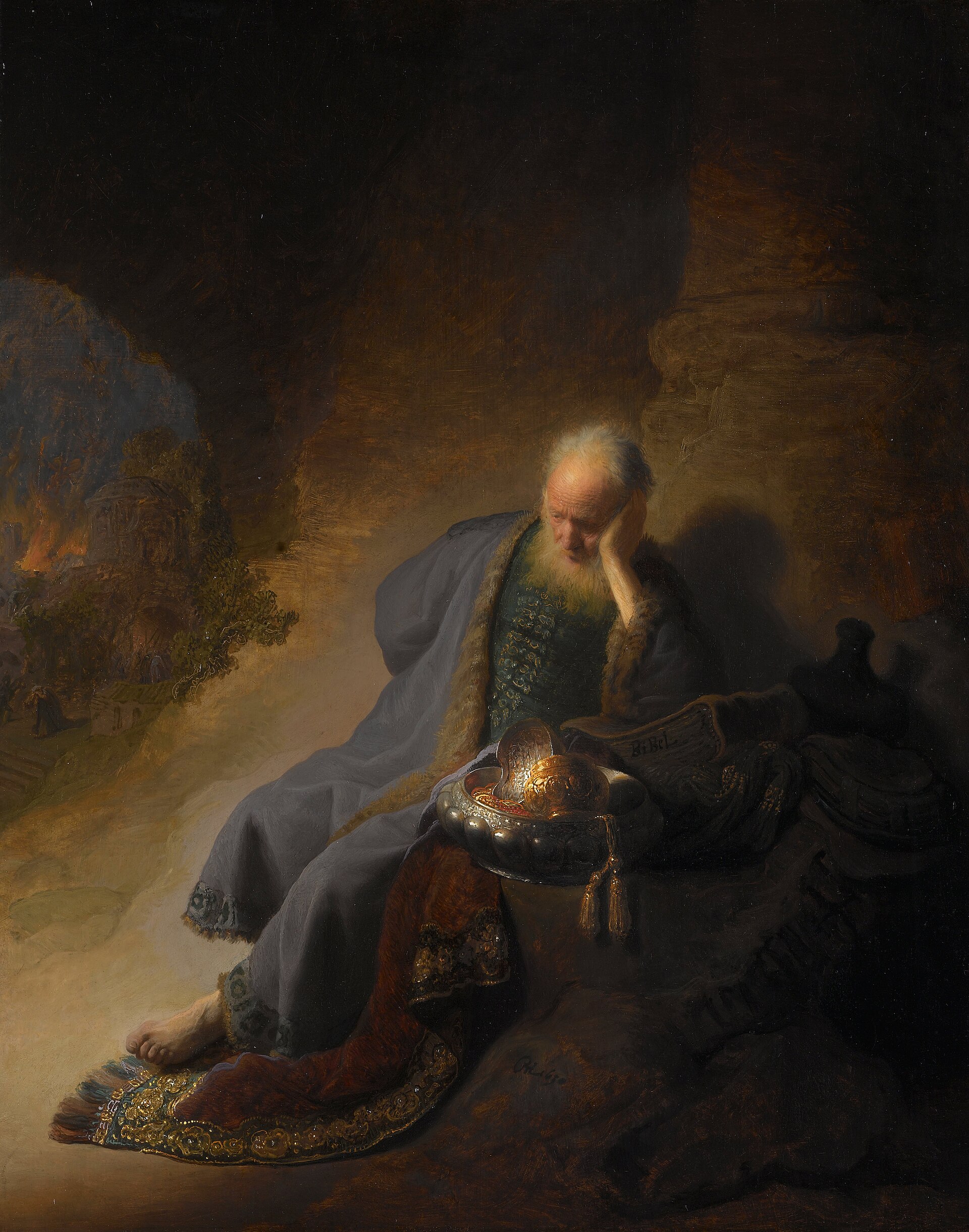
Jeremiahchapter 50
46 verses · Jeremiah, written by Baruch · 7th to 6th century BC · The Prophets
“In those days and at that time, declares the LORD, the children of Israel and the children of Judah will come together, weeping as they come, and will seek the LORD their God.
Introduction
Jeremiah, written by Baruch, The Prophets, Jeremiah Overview.
This chapter begins the longest oracle in the book, and it is aimed at Babylon, the empire that destroyed Jerusalem. For twenty years Jeremiah had told Judah to submit to Babylon, and he was called a traitor for it. Here the same prophet announces Babylon's own end. The chapter was first heard by exiles who lived under Babylon's rule and saw no sign of its weakness. Listen for how often the poem turns from the fall of the city to the return of the people, and for the family word the LORD takes for Himself.
Context
- Who
- Exiles living in the shadow of the greatest city on earth
- What
- The first half of a long poem announcing Babylon's fall to a nation from the north, woven with promises that Israel and Judah would return and be forgiven.
- Where
- Babylon and the land of the Chaldeans in southern Mesopotamia, with the road back to Zion in view.
- When
- The fourth year of Zedekiah, about 594 BC, by the note at Jeremiah 51:59 to 64 that closes this oracle, with the fall it foresees coming in 539 BC.
- Why
- To assure the exiles that the empire which punished Judah would itself be judged for its pride and cruelty, and that God would bring His people home.
Historical context
Babylon in this era was the largest city in the world, massive double walls, the Euphrates running through the middle of it, the processional way and the Ishtar Gate faced in glazed blue brick, the great stepped tower, and a calendar of festivals in which the images of the gods were carried through the streets.
Show the rest of the historical context, 3 more paragraphs
The two gods named are the ones a resident would name. Bel, meaning lord, and Marduk, here written Merodach, are titles of Babylon's chief deity, whose statue was central to the New Year festival. The chapter says Bel is put to shame and her images are dismayed.
The military picture is accurate to how the fall would come. A nation out of the north, an assembly of great nations, comes against her; the archers are told to draw the bow and spare no arrows. Babylon herself is called the hammer of the whole earth, now to be broken, and the golden cup that made the earth drunk.
Running through the chapter is the counter-theme: my people have been lost sheep, their shepherds led them astray, and now they are told to flee out of Babylon, to go home weeping and seeking the LORD, and to join themselves in an everlasting covenant that will not be forgotten.
Significance
For exiles the practical value of this chapter was that Babylon had an expiry date. They had been told to build houses and settle down; they were also told the empire was not permanent.
Show the rest of the significance, 1 more paragraph
The moral logic is stated plainly. Babylon was God's instrument, and Babylon is still held accountable for how it behaved, because it rejoiced and grew fat while plundering God's heritage. Being used by God is not the same as being approved by him.
This chapter in Jewish lifeWhat this chapter is in Jewish life and reading.
What is done
The site's own table in src/lib/hebraic/readings.ts, probed for this lane, printed no weekly portion and no Haftarah from this chapter, and no festival reading for the book. That table carries the Haftarah of each of the fifty-four weekly portions and the books read whole at the feasts, and it carries nothing for the special Sabbaths or the fast days. This card therefore names no public reading of the chapter and leaves that question to a source that holds those readings.
The corpus joins the chapter to the weeks of the Torah portions through the works arranged by portion. Under the fourth verse it carries Midrash Tanchuma Buber, Nitzavim 4:1. Under the fifth verse it carries Midrash Tanchuma Buber, Mishpatim 10:1.
How it is read
Rashi is the one commentator on this chapter whose English the corpus carries, quoted here from The Judaica Press complete Tanach with Rashi, translated by A. J. Rosenberg, which Sefaria reports as CC-BY. Every quotation of it is held to fifty words or fewer because the translation is modern, and his headwords, which carry the verse in that translation's wording, are never quoted.
Rashi names the nation from the north as "Persia and Media" (Rashi on Jeremiah 50:3:1). The faces turned toward Zion in the fifth verse turn to Jerusalem "when Babylon will be destroyed and they will leave it with the sanction of Cyrus, king of Persia" (Rashi on Jeremiah 50:5:1). The shepherds who led the flock astray are "Their kings" (Rashi on Jeremiah 50:6:1), and the mother put to shame in the twelfth verse is "Your nation" (Rashi on Jeremiah 50:12:1).
Babylon's surrender in the fifteenth verse he pictures as a beggar's gesture (Rashi on Jeremiah 50:15:1). She is "like a person who has no strength and stretches forth his hand to whomever he sees, to beg mercy and aid" (Rashi on Jeremiah 50:15:1). The first to devour Israel is the king of Assyria, "For he exiled the Ten Tribes" (Rashi on Jeremiah 50:17:1). The hammer of the whole earth is the one "which would shatter and crush everyone" (Rashi on Jeremiah 50:23:1). The corpus's notes on this chapter run to the twenty-fourth verse.
The corpus carries seven further notes on this chapter without an English text. Each is marked linked because Sefaria holds no English version of the ref, so each is cited here and none is quoted. The notes of Radak are cited at Radak on Jeremiah 50:1:1, 50:4:1, 50:10:1, 50:13:1, 50:18:1, 50:20:1 and 50:22:1.
What the rabbis say
The corpus carries forty rabbinic locators on this chapter and the text of none, so each is cited and linked here rather than quoted. On the second verse it holds Mekhilta DeRabbi Shimon Ben Yochai 12:12. On the third verse it holds Yalkut Shimoni on Torah 57:2. On the fourth verse it holds Midrash Tanchuma Buber, Nitzavim 4:1 and Midrash Tanchuma, Nitzavim 1:1. On the fifth verse it holds Midrash Tanchuma Buber, Mishpatim 10:1. On the sixth verse it holds Midrash Lekach Tov, Exodus 12:2:19 and Yalkut Shimoni on Nach 443:2.
On the seventh verse it holds Midrash Tehillim 72:2 and Midrash Tehillim 79:3. On the twelfth verse it holds Berakhot 58a:2, Berakhot 58b:5 and Bereshit Rabbati, Parashat Lech Lecha 20. On the fifteenth verse it holds Shemot Rabbah 20:2. On the seventeenth verse it holds Aggadat Bereshit 79:6, Bamidbar Rabbah 4:5 and Bamidbar Rabbah 9:47. On the twentieth verse it holds Midrash Tanchuma, Noach 13:6, Midrash Tannaim on Deuteronomy 32:1:2 and Pesikta Rabbati 44:1.
On the twenty-fifth verse it holds Bereshit Rabbah 11:10, Ein Yaakov, Khagigah 2:3 and Jerusalem Talmud Taanit 2:1:14. On the twenty-sixth verse it holds Midrash Sekhel Tov, Shemot 9:17:6, Sifrei Aggadah on Esther, Midrash Panim Acherim, Version I 1:21 and Sifrei Aggadah on Esther, Midrash Panim Acherim, Version II 3:8. On the twenty-eighth verse it holds Midrash Lekach Tov, Deuteronomy 32:35:1. On the twenty-ninth verse it holds Esther Rabbah 5:3 and Mekhilta DeRabbi Yishmael, Tractate Vayehi Beshalach 7:2. On the thirty-third verse it holds Midrash Tanchuma Buber, Behar 6:1 and Midrash Tanchuma Buber, Ki Teitzei 3:1.
On the thirty-fourth verse it holds Kohelet Rabbah 4:1:1 and Midrash Tanchuma Buber, Behar 9:2. On the thirty-fifth verse it holds Makkot 10a:20. On the thirty-sixth verse it holds Berakhot 63b:12 and Ein Yaakov (Glick Edition), Berakhot 9:19. On the forty-fourth verse it holds Tractate Soferim 7:4. On the forty-fifth verse it holds Yalkut Shimoni on Nach 51:1 and Yalkut Shimoni on Torah 130:4.
On the forty-sixth verse it holds Aggadat Bereshit 14:4 and Eikhah Rabbah 2:11. What each of them teaches is a saying of the rabbis, and is reported as theirs wherever this site quotes one. The quotations wait on a fetch that carries the text.
Sources: Rashi, Rashi on Jeremiah 50:3:1 to 50:23:1, The Judaica Press complete Tanach with Rashi, translated by A. J. Rosenberg, reported CC-BY; Radak, Radak on Jeremiah 50:1:1, 50:4:1, 50:10:1, 50:13:1, 50:18:1, 50:20:1 and 50:22:1, cited by ref because the corpus carries no English text; The Sefaria corpus, scripts/data/sources/sefaria/jeremiah/50.json, the 40 Talmud and Midrash locators of this chapter; The site's own files, src/lib/hebraic/readings.ts, printing no portion and no Haftarah for this chapter and no festival reading for this book.
The heads below are this chapter's scenes. The numbered points under each are its verses.
Babylon Taken: Bel Confounded, Merodach Dismayed
concerning Babylon and the land of the Chaldeans: “Bel is put to shame; Marduk is shattered,” as Isaiah 46:1 also names Bel and Nebo. Verse 3 names “a nation from the north,” the direction from which Babylon came against Judah in 1:14 and 4:6. The land is left so empty that “both man and beast will flee.”
Jeremiah 50:1
“The Word that the Lord Spake Against Babylon - This is also a new head of discourse. The prophecy contained in this and the following chapter was sent to the captives in Babylon in the fourth year of the reign of Zedekiah. They are very important; they predict the total destruction of the Babylonish empire, and the return of the Jews from their captivity. These chapters were probably composed, with several additions, out of the book that was then sent by Jeremiah to the captives by the hand of Seraiah. See Jer 51:59-64.”
Adam Clarke · Commentary on the Bible (1810-1826)evangelical
Jeremiah 50:2
“Declare ye among the nations - God’s determination relative to this empire. Set up a standard - Show the people where they are to assemble. Say, Babylon is taken - It is a thing so firmly determined, that it is as good as already done. Bel - The tutelar deity of Babylon is confounded, because it cannot save its own city. Merodach - Another of their idols, is broken to pieces; it was not able to save itself, much less the whole empire. Her idols are confounded - It is a reproach to have acknowledged them.”
Adam Clarke · Commentary on the Bible (1810-1826)evangelical
Jeremiah 50:3
Out of the north - Media lay to the northwest of Babylon. This constant use of the north, the quarter where the sun never shines, and therefore the region of darkness, is symbolic of the region from where danger ever comes. They shall remove ... - Translate it (as in Jer 9:10): “from man even to cattle they are fled, they are gone.”
the children of Israel and the children of Judah will come together: Israel and Judah “will come together, weeping as they come,” and join the LORD “in an everlasting covenant that will never be forgotten.” The cause of the exile is named: “their shepherds have led them astray,” the charge in 23:1-2. The exiles are told, “Flee from the midst of Babylon.”
Jeremiah 50:4
“In those days, and in that time - In the times in which Babylon shall be opposed by the Medes and Persians, both Israel and Judah, seeing the commencement of the fulfilling of the prophecies, shall begin to seek the Lord with much prayer, and broken and contrite hearts. When the decree of Cyrus comes, they shall be ready to set off for their own country, deploring their offenses, yet rejoicing in the mercy of God which has given them this reviving in their bondage.”
Adam Clarke · Commentary on the Bible (1810-1826)evangelical
1 more voice on this verse
Jeremiah 50:4
THE previous part of this chapter declares the overthrow of Israel's cruel oppressor—"Babylon is taken, Bel is ashamed, Merodach is broken in pieces." The Assyrian and Babylonian power had been the great tyrant of the ages and the Lord had employed it for the chastening of His people, until, at last, Israel and Judah had been carried away captive to the banks of the Euphrates and the land of their fathers knew them no more. This was the mournful song of the exiles, "By the rivers of Babylon, there we sat down, yes, we wept, when we remembered Zion."
Jeremiah 50:5
“Let us join ourselves to the Lord in a perpetual covenant - All our former covenants have been broken; let us now make one that shall last for ever. He shall be the Lord Our God, and We will no more worship idols. This covenant they have kept to the present day; whatever their present moral and spiritual state may be, they are no idolaters, in the gross sense of the term.”
Adam Clarke · Commentary on the Bible (1810-1826)evangelical
Jeremiah 50:6
“He said the sheep is like one who has gone astray. And also in the Gospel he said, "The Son of man came to search for and save the lost." And also in the parable only one is lost out of the hundred that the shepherd who dwelled with them came to find, who also, after laying it on his shoulders, returned it to the ninety-nine.”
Origen of Alexandria · written before 253 · Fragments on Jeremiah 28patristic
2 more voices on this verse
Jeremiah 50:6
“Jehovah is the resting-place of His sheep (Mt 11:28). They rest in His "bosom" (Isa 40:11). Also His temple at Zion, their "rest," because it is His (Ps 132:8, 14).”
Jamieson, Fausset & Brown · Commentary Critical and Explanatory on the Whole Bible (1871)reformed
Jeremiah 50:6
“Their shepherds - Their civil and ecclesiastical governors have been a cause of it. The former by their wicked commands and example; the latter by example as well as doctrine. Turned them - To offer sacrifices unto idols.”
John Wesley · Explanatory Notes upon the Old Testament (1765)evangelical
Jeremiah 50:7
“Offend not - i. e., “are not guilty.” Israel having left the fold, has no owner, and may therefore be maltreated with impunity. Habitation of justice - In Jer 31:23 applied to Jerusalem: here, Yahweh alone is the true pasturage, in whom His people will find safety, rest, and plenty.”
2 more voices on this verse
Jeremiah 50:7
“Habitation - Some think this is a name here given to God, who indeed is the habitation of justice, but whether the Chaldeans would call him so, may be a question. Others therefore think the preposition in is understood, making this the aggravation of the Jews sins, that they were committed in a land which ought to have been an habitation of justice.”
John Wesley · Explanatory Notes upon the Old Testament (1765)evangelical
Jeremiah 50:7
“At the same time these "adversaries" unconsciously use language which corrects their own notions. The covenant with the Jews' "fathers" is not utterly set aside by their sin, as their adversaries thought; there is still "a habitation" or refuge for them with the God of their fathers.”
Jamieson, Fausset & Brown · Commentary Critical and Explanatory on the Whole Bible (1871)reformed
Jeremiah 50:8
“Remove out of the midst of Babylon - The sentence of destruction is gone out against it; prepare for your flight, that ye be not overwhelmed in its ruin. Be as the he-goats before the flocks - Who always run to the head of the flock, giving the example for others to follow. This may be addressed to the elders and persons of authority among the people.”
Adam Clarke · Commentary on the Bible (1810-1826)evangelical
Jeremiah 50:9
“I will raise - Or, stir up. An assembly of great nations - The Medo-Persian empire was as much an aggregate of discordant nations as that of Babylon. From thence - From the north, i. e., by the great nations coming thence. Return in vain - A proverbial expression for ill success (compare Isa 55:11). Here the skillful warrior returns not empty.”
Jeremiah 50:10-20
Chaldea will be plundered: Verse 17 sums up: “The first to devour him was the king of Assyria; the last to crush his bones was Nebuchadnezzar king of Babylon.” Verse 20 turns to pardon, “for I will forgive the remnant I preserve,” the forgiveness promised in the new covenant of 31:34.
Jeremiah 50:10
“And Chaldea shall be a spoil,.... The land of the Chaldeans, as the Targum, should become a spoil to the enemy, and be plundered of all its riches and treasures; not only Babylon principally, but the whole country it was the metropolis of: all that spoil her shall be satisfied, saith the Lord; for though spoilers are generally insatiable, yet so great should be the riches found in Babylon and in Chaldea, that they should have enough, and desire no more; see Rev 18:17.”
Lost Sheep and the Shepherds Who Led Them Astrayvv. 11-20
Jeremiah 50:11
“But there is a disagreement of gender in Hebrew reading thus. The Keri is better: "a heifer threshing"; the strongest were used for threshing, and as the law did not allow their mouth to be muzzled in threshing (De 25:4), they waxed wanton with eating. bellow as bulls--rather, "neigh as steeds," literally, "strong ones," a poetical expression for steeds (see on Jer 8:16) [MAURER].”
Jamieson, Fausset & Brown · Commentary Critical and Explanatory on the Whole Bible (1871)reformed
1 more voice on this verse
Jeremiah 50:11
“Because ye were glad, because ye rejoiced, O ye destroyers of mine heritage,.... This is addressed to the Chaldeans who destroyed Jerusalem and the land of Judea, once the heritage of the Lord; when they rejoiced at the destruction of God's people, and insulted them in their miseries; and which is the cause and reason assigned of their ruin; for though they had a commission to destroy, yet they exceeded that, and especially by exulting at the ruin of that people, which showed great inhumanity.”
Jeremiah 50:12
“Your mother - Speaking to the Chaldeans: Babylon, the metropolis, or mother city, shall be a wilderness, a dry land, a desert, neither fit for man nor beast.”
Adam Clarke · Commentary on the Bible (1810-1826)evangelical
Jeremiah 50:13
“Because of the wrath of the Lord, it shall not be inhabited,.... That is, Babylon; which the Targum expresses, "because thou, Babylon, hast provoked the Lord;'' by their idolatry, luxury, ill usage of his people, and profanation of the vessels of the sanctuary; therefore it should be destroyed, and left without an inhabitant in it: but it shall be wholly desolate; as it now is.”
Jeremiah 50:14
“Summons to the Median army to attack Babylon. against the Lord--By oppressing His people, their cause is His cause. Also by profaning His sacred vessels (Da 5:2).”
Jamieson, Fausset & Brown · Commentary Critical and Explanatory on the Whole Bible (1871)reformed
1 more voice on this verse
Jeremiah 50:14
“Note, It is sin that makes men a mark for the arrows of God's judgments. An abundance of idolatry and immorality was to be found in Babylon, yet those are not mentioned as the reason of God's displeasure against them, but the injuries they had done to the people of God, from a principle of enmity to them as his people.”
Matthew Henry · Commentary on the Whole Bible (1707-1721)puritan
Jeremiah 50:15
“The country that was populous shall be dispeopled, that was enriched with a fertile soil shall become barren. The great city, the head of it, shall be quite ruined. Her foundations have fallen, and therefore her walls are thrown down; for how can the walls stand when divine vengeance is at the door and shakes the very foundations?”
Matthew Henry · Commentary on the Whole Bible (1707-1721)puritan
1 more voice on this verse
Jeremiah 50:15
“Shout against her round about,.... As soldiers do when they make an assault upon a place, to encourage one another, and dismay the besieged; just as the Israelites did when they surrounded Jericho: she hath given her hand; submitted to the conqueror, and sued for mercy.”
Jeremiah 50:16
“Cut off the sower from in Babylon, and him that handleth the sickle in the time of harvest,.... Both sower and reaper: the walls of Babylon took in a large compass of land, where there were corn fields; and which, as Curtius (s) observes, would yield a sufficiency to hold out a siege against an enemy; but being taken, the husbandman would not be spared, as used to be, but should be cut off, and so none to till the ground, or to reap what was upon it; and thus, in course, would be, desolate, as before threatened.”
1 more voice on this verse
Jeremiah 50:16
“The population is to be destroyed so utterly that the rich fields of Babylonia are to remain untilled. They shall turn - The full force of the words will be seen if it be remembered that it had been the policy of Nebuchadnezzar to compel citizens selected from the vanquished nations to settle in Babylonia.”
Jeremiah 50:17
“Israel is a scattered sheep - i. e., is like a flock which has been scared and driven in all directions, for lions have chased him. First the king ... - Rather, the first lion “ate him, even the king of Assyria; and this one, the last, heath picked his bones, even Nebuchadrezzar etc.” The constant wasting of the land by the Assyrians had so lessened the number of Israel, that Nebuchadnezzar had but the bones to pick.”
Jeremiah 50:18
“As I have punished the king of Assyria - The Assyrians were overthrown by the Medes and the Chaldeans. The king is here taken for all their kings, generals, etc., Tiglath-pileser, Shalmaneser, Sennacherib, Esar-haddon, etc. To them succeeded the Chaldean or Babylonish kings. Nebuchadnezzar came against Judea several times; and at last took the city and burnt it, profaned and demolished the temple, wasted the land, and carried the princes and people into captivity.”
Adam Clarke · Commentary on the Bible (1810-1826)evangelical
Jeremiah 50:19
“And I will bring Israel again to his habitation,.... Or "fold" (u), or place of pasturage; for the metaphor of sheep is still continued. Israel designs not the tribes of Judah and Benjamin, and the Levites, and a few of the other tribes mixed with them only, but all Israel, together with Judah, as appears from Jer 50:20; and so this prophecy had not its full accomplishment at the Jews' return from the Babylonish captivity; but respects their future conversion, when all Israel shall be saved, and they will return to their own land.”
2 more voices on this verse
Jeremiah 50:19
“Or, “I will bring Israel (the scared sheep) back to his pasturage (see Jer 50:7) and he shall graze etc.” The places named are the districts of Palestine most famous for their rich herbage.”
Jeremiah 50:19
“They still retained a title to the land of Canaan; it is their habitation still. The discontinuance of their possession was not the destruction of their right.”
Matthew Henry · Commentary on the Whole Bible (1707-1721)puritan
Jeremiah 50:20
“This denotes how fully God forgives sin; he remembers it no more. Note, Deliverances out of trouble are then comforts indeed when they are the fruits of the forgiveness of sin, Isa. xxxviii. Judah and Israel were so fully forgiven when they were brought back out of Babylon that they are said to have received of the Lord's hand double for all their sins, Isa. xl.”
Matthew Henry · Commentary on the Whole Bible (1707-1721)puritan
2 more voices on this verse
Jeremiah 50:20
“In those days and in that time - This phrase appears to take in the whole of an epoch, from its commencement to its end. See Jer 50:4. I will pardon them - So as to deliver them from their captivity, and exact no more punishment from them whom I reserve, namely, the remnant left in the Babylonish captivity.”
Adam Clarke · Commentary on the Bible (1810-1826)evangelical
Jeremiah 50:20
“The specification of "Israel," as well as Judah, shows the reference is to times yet to come. iniquity . . . none--not merely idolatry, which ceased among the Jews ever since the Babylonian captivity, but chiefly their rejection of Messiah. As in a cancelled debt, it shall be as if it had never been; God, for Christ's sake, shall treat them as innocent (Jer 31:34).”
Jamieson, Fausset & Brown · Commentary Critical and Explanatory on the Whole Bible (1871)reformed
Go Up Against Merathaim and Pekod: the Proud One Stumbles
against the land of Merathaim: Merathaim and Pekod are regions of Babylonia, and Keil and Barnes note in Hebrew the names sound like the words for double rebellion and punishment. Babylon, “the hammer of the whole earth,” “lies broken and shattered.” Babylon’s soldiers are pictured as young bulls that “go down to the slaughter.”
Jeremiah 50:21
“Go up against the land of Merathaim,.... Thought to be the country of the Mardi, which lay part of it in Assyria, and part of it in Armenia; expressed in the dual number, because one part of it lay on one side the Tigris, and the other on the other side. Cyrus, with his army of Medes and Persians, is here called upon; who, according to Herodotus, passed through Assyria to Babylon: and so it may be agreeably rendered, "go by the land of Merathaim"; or the country of the Mardi.”
3 more voices on this verse
Jeremiah 50:21
“The land of Merathaim - of double rebellion. Like Mitsraim, i. e., the two Egypts, Aram-Naharaim, i. e., Syria of the two rivers, or Mesopotamia, it is a dual. It may have been a real name; or - the dual ending being intensive - it may mean the land of very great rebelliousness. Pekod - Possibly a Babylonian town. Waste - Rather, slay, Jer 50:27.”
Jeremiah 50:21
“Pekod-- (Eze 23:23); a chief province of Assyria, in which Nineveh, now overthrown, once lay. But, as in Merathaim, the allusion is to the meaning of Pekod, namely, "visitation"; the inhabitants whose time of deserved visitation in punishment is come; not, however, without reference to the now Babylonian province, Pekod.”
Jamieson, Fausset & Brown · Commentary Critical and Explanatory on the Whole Bible (1871)reformed
Jeremiah 50:21
“It was said of Cyrus ( Isa. xliv. 28 ), He shall perform all my pleasure, in his expedition against Babylon. They must waste and utterly destroy after them; when they have destroyed once they must go over them again, or destroy their posterity that should come after them.”
Matthew Henry · Commentary on the Whole Bible (1707-1721)puritan
Jeremiah 50:22
“A sound of battle is in the land,.... In the land of the Chaldeans, as it is expressed in the Septuagint and Arabic versions; the noise of warriors, the clashing of arms, and sound of trumpets, both of the enemy entered into the land, and of the Chaldeans arming themselves in their own defence: and of great destruction; in the same land; or in Babylon, as Abarbinel supplies it; this is the consequent of the former.”
Jeremiah 50:23
“How is the hammer of the whole earth cut asunder and broken!.... The Targum is, "how is the king cut down and broken that moved the whole earth!'' The king of Babylon, or the kingdom of Babylon, which was like a hammer for its hardness and strength; and being an instrument, in the hand of God, of beating to pieces and destroying the kingdoms and nations around it; but is now destroyed itself.”
1 more voice on this verse
Jeremiah 50:23
“The hammer - Babylon, by whose instrumentality Yahweh had crushed the nations, is now cut asunder, i. e., the head of iron or bronze is cut away from the wooden handle, and broken.”
Jeremiah 50:24
“I have laid a snare for thee - It was not by storm that Cyrus took the city. The Euphrates ran through it; he dug a channel for the river in another direction, to divert its stream; he waited for that time in which the inhabitants had delivered themselves up to debauchery: in the dead of the night he turned off the stream, and he and his army entered by the old channel, now void of its waters. This was the snare of which the prophet here speaks. See Nerodotus, lib. i., c. 191.”
Adam Clarke · Commentary on the Bible (1810-1826)evangelical
1 more voice on this verse
Jeremiah 50:24
“I--Thou hast to do with God, not merely with men. taken . . . not aware--HERODOTUS relates that one half of the city was taken before those in the other half were "aware" of it. Cyrus turned the waters of the Euphrates where it was defended into a different channel, and so entered the city by the dried-up channel at night, by the upper and lower gates (Da 5:30, 31).”
Jamieson, Fausset & Brown · Commentary Critical and Explanatory on the Whole Bible (1871)reformed
Jeremiah 50:25
“By a grand figure the prophet describes Yahweh arming Himself that in person He may execute justice upon the wicked city. For this is the work - Rather, for my Lord Yahweh of hosts hath a work to do in the land of the Chaldaeans.”
1 more voice on this verse
Jeremiah 50:25
“The Lord hath opened his armoury,.... Alluding to the manner of kings, who have some particular edifice built for an armoury; see Son 4:4; wherein are provided and laid up all sorts of armour, small and great, which are fetched out from thence, in time of need.”
Jeremiah 50:26
“Open her store-houses - At the time that Cyrus took the city, it was full of provisions and treasures of all kinds; the walls had suffered no injury; and when the inhabitants heard that the enemy was within, they thought they must have arisen out of the earth in the center of the city!”
Adam Clarke · Commentary on the Bible (1810-1826)evangelical
Jeremiah 50:27
“Slay all her bullocks - Princes, magistrates, etc., etc.”
Adam Clarke · Commentary on the Bible (1810-1826)evangelical
Listen to the fugitives and refugees from the land of Babylon: Refugees from Babylon announce “the vengeance for His temple,” so Babylon’s fall answers the burning of the temple in 52:13. The sentence is repayment: “Repay her according to her deeds; do to her as she has done.” Babylon will “stumble and fall with no one to pick him up.”
Jeremiah 50:28
“Declare in Zion the vengeance of the Lord - Zion was desolated by Babylon; tell Zion that God hath desolated the desolator. The vengeance of his temple - Which Nebuchadnezzar had pillaged, profaned, and demolished, transporting its sacred vessels to Babylon, and putting them in the temple of his god Bel.”
Adam Clarke · Commentary on the Bible (1810-1826)evangelical
Jeremiah 50:29
“Or, “Summon the archers to Babylon, even all who bend the bow: encamp against her etc.” In this portion of the prophecy the capture of Babylon is regarded as the punishment due to her for burning the temple Jer 50:28.”
Jeremiah 50:30
“Therefore shall her young men fall in the streets,.... Or "surely" (f); it is the form of an oath, according to Jarchi Cyrus, when he took Babylon, ordered proclamation to be made that the inhabitants should keep within doors; and that whoever were found in the streets should be put to death (g), as doubtless many were: and all her men of war shall be cut off in that day, saith the Lord; as Belshazzar and his guards were (h); see Dan 5:30; compare with this Rev 19:18. (f) לכן "certe". (g) Cyropaedia, l. 7. c. 23. (h) Ibid.”
Jeremiah 50:31
“Thou pride (so the word is), as proud as pride itself. Note, the pride of men's hearts sets God against them and ripens them apace for ruin; for God resists the proud and will bring them down.”
Matthew Henry · Commentary on the Whole Bible (1707-1721)puritan
Jeremiah 50:32
“And the most proud shall stumble and fall,.... Or "pride", as before; "the man of pride", who is so proud that he may be called pride itself. The Targum, as before, interprets it a wicked king; and Abarbinel understands it of Belshazzar particularly, who was slain the night that Babylon was taken.”
1 more voice on this verse
Jeremiah 50:32
“And the most proud - זדון zadon, as before. Here pride is personified and addressed, as if possessing a being and rational powers.”
Adam Clarke · Commentary on the Bible (1810-1826)evangelical
Their Redeemer Is Strong; a People Out of the North
Against captors “refusing to release them” stands the title “Their Redeemer is strong; the LORD of Hosts is His name.” The word is go’el, the kinsman who buys back a relative, the word used of Boaz in Ruth and Job 19:25. “He will fervently plead their case” is courtroom language.
Jeremiah 50:33
“Were oppressed - are “oppressed together: and all their captors have laid firm hold upon them: they have refused to let them go.” The restoration of Israel and Judah to their land is necessary. As Babylon will not let them go, it must be broken, and its empire destroyed.”
1 more voice on this verse
Jeremiah 50:33
“Judah were oppressed--He anticipates an objection, in order to answer it: Ye have been, no doubt, "oppressed," therefore ye despair of deliverance; but, remember your "Redeemer is strong," and therefore can and will deliver you.”
Jamieson, Fausset & Brown · Commentary Critical and Explanatory on the Whole Bible (1871)reformed
A sword is against the Chaldeans: “A sword is against” repeats through verses 35 to 37, striking Babylon’s officials, wise men, false prophets, warriors, horses, chariots, and treasuries. Verse 38 adds, “A drought is upon her waters, and they will be dried up.” Herodotus records Cyrus took the city by turning the Euphrates from its bed.
Jeremiah 50:35
“The repetition of "A sword" in the beginning of each verse, by the figure anaphora, heightens the effect; the reiterated judgment is universal; the same sad stroke of the sword is upon each and all connected with guilty Babylon. wise men-- (Isa 47:13). Babylon boasted that it was the peculiar seat of wisdom and wise men, especially in astronomy and astrology.”
Jamieson, Fausset & Brown · Commentary Critical and Explanatory on the Whole Bible (1871)reformed
Jeremiah 50:36
“A sword is upon the liars,.... Some render it "bars" (m), as the word sometimes signifies; and interpret it of great men, who are the strength and security of cities and commonwealths; but these are mentioned both before and after.”
Jeremiah 50:37
“The troops of other nations that were in their service shall be quite disheartened: The mingled people shall become as weak and timorous as women. [6.] Upon their exchequer: The sword shall be upon her treasures, which are the sinews of war, and they shall be robbed, and made use of by the enemy against them.”
Matthew Henry · Commentary on the Whole Bible (1707-1721)puritan
Jeremiah 50:38
“A drought is upon her waters, and they shall be dried up,.... Either on the waters of the land of Chaldea in general, from whence should follow barrenness, and so a want of the necessaries of life; hence Kimchi interprets it of a consumption of riches, and all good things; or on the waters of Babylon, the river Euphrates, which ran through it; the channel of which was diverted by Cyrus, and drained and made so dry, that he marched his army up it into the city.”
2 more voices on this verse
Jeremiah 50:38
“A drought is upon her waters - May not this refer to the draining of the channel of the Euphrates, by which the army of Cyrus entered the city. See on Jer 50:24 (note). The original is, however, חרב chereb, a sword, as in the preceding verses, which signifies war, or any calamity by which the thing on which it falls is ruined.”
Adam Clarke · Commentary on the Bible (1810-1826)evangelical
Jeremiah 50:38
“Dried - This phrase has a plain reference to Cyrus's stratagem used in the surprize of Babylon; one part of it was fortified by the great river Euphrates, which Cyrus diverted by cutting several channels, 'till he had drained it so low, that it became passable for his army; others think that a want of rain is here threatened.”
John Wesley · Explanatory Notes upon the Old Testament (1765)evangelical
Jeremiah 50:39
The wild beasts of the desert - Dahler translates these various terms, “The wild cats, the jackals, and the ostriches.” And Blayney the same. Wicklif, “Dragons, woodewoses, and ostriches.” Coverdale, “Wild beestes, apes, and estriches.”
Adam Clarke · Commentary on the Bible (1810-1826)evangelical
Jeremiah 50:40
“As God overthrew Sodom and Gomorrah, and the neighbour cities thereof, saith the Lord,.... Admah and Zeboim: so shall no man abide there, neither shall any son of man dwell therein; the same is said concerning Edom; See Gill on Jer 49:18.”
2 more voices on this verse
Jeremiah 50:40
“As God overthrew Sodom - As the very ground on which these cities stood, with all the plain, now lies under the Dead Sea; so Babylon and the adjacent country shall be rendered totally barren and unfruitful, and utterly incapable of being inhabited. And this is the fact concerning both countries. See Jer 49:18.”
Adam Clarke · Commentary on the Bible (1810-1826)evangelical
Jeremiah 50:40
“No man - Cyrus only made them tributaries, and took away their government. But Seleucus Nicanor, a Grecian prince, utterly destroyed Babylon, so that in the time of Adrian the Roman emperor, there was nothing left standing of that great city.”
John Wesley · Explanatory Notes upon the Old Testament (1765)evangelical
Behold, an army is coming from the north: Verses 41 to 43 repeat almost word for word the invasion of 6:22-24. The words once aimed at the Daughter of Zion now fall on “O Daughter of Babylon.” The king of Babylon hears the report, “and his hands hang limp,” as the people of Jerusalem did in 6:24.
Jeremiah 50:41
“Behold, a people shall come from the north, and a great nation,.... The Modes and Persians, whose country lay north of Babylon: See Gill on Jer 50:9; and many kings shall be raised up from the coasts of the earth; the kings of Ararat, Minni, and Ashchenaz, Jer 51:27; and of the Armenians and other nations that Cyrus had subdued and brought with him in his army against Babylon, as Xenophon (s) relates. Ten kings shall be raised up against mystical Babylon, and hate her, and burn her with fire, Rev 17:12. (s) Cyropaedia, l. 5. c. 15.”
2 more voices on this verse
Jeremiah 50:41
“An application to Babylon of the doom against Jerusalem Jer 6:22-24. Jer 50:41 The coasts of the earth - See the Jer 6:22 note.”
Jeremiah 50:41
“The very language used to describe the calamities which Babylon inflicted on Zion is that here employed to describe Babylon's own calamity inflicted by the Medes.”
Jamieson, Fausset & Brown · Commentary Critical and Explanatory on the Whole Bible (1871)reformed
Jeremiah 50:42
“They shall hold the bow and the lance,.... Or "spear". The Targum interprets it, "shields"; as many in Cyrus's army had (t); the one an offensive, the other a defensive weapon; or, if bow and lance, the one is used at a distance, the other when near.”
Jeremiah 50:44
“Repeated mainly from Jer 49:19-21. The identity of God's principle in His dealing with Edom, and in that with Babylon, is implied by the similarity of language as to both.”
Jamieson, Fausset & Brown · Commentary Critical and Explanatory on the Whole Bible (1871)reformed
Jeremiah 50:46
“At the noise of the taking of Babylon the earth is moved,.... It being so sudden and unexpected, and so very astonishing: and the cry is heard among the nations; that Babylon is fallen; which, as applied to mystical Babylon, will be matter of joy to some, and of lamentation to others; see Rev 14:8.”
1 more voice on this verse
Jeremiah 50:46
“At the noise of the taking of Babylon - See the note on the parallel place, Jer 49:21 (note). In the forty-ninth chapter, these words are spoken of Nebuchadnezzar; here, of Cyrus. The taking of Babylon was a wonder to all the surrounding nations. It was thought to be impregnable.”
Adam Clarke · Commentary on the Bible (1810-1826)evangelical
Keep studying
Studies1
Sources for this chapter
The summary
Jamieson, Fausset & Brown, Commentary Critical and Explanatory; John Calvin, Commentaries; John Wesley, Notes on the Old Testament and Matthew Henry, Complete Commentary.
The exposition
Adam Clarke, Commentary on the Bible; Albert Barnes, Notes on the Old Testament; Carl Friedrich Keil, The Prophecies of Jeremiah; John Calvin, Commentary on Jeremiah and Lamentations; John Gill, Exposition of the Old Testament and Matthew Henry, Commentary on the Whole Bible.