
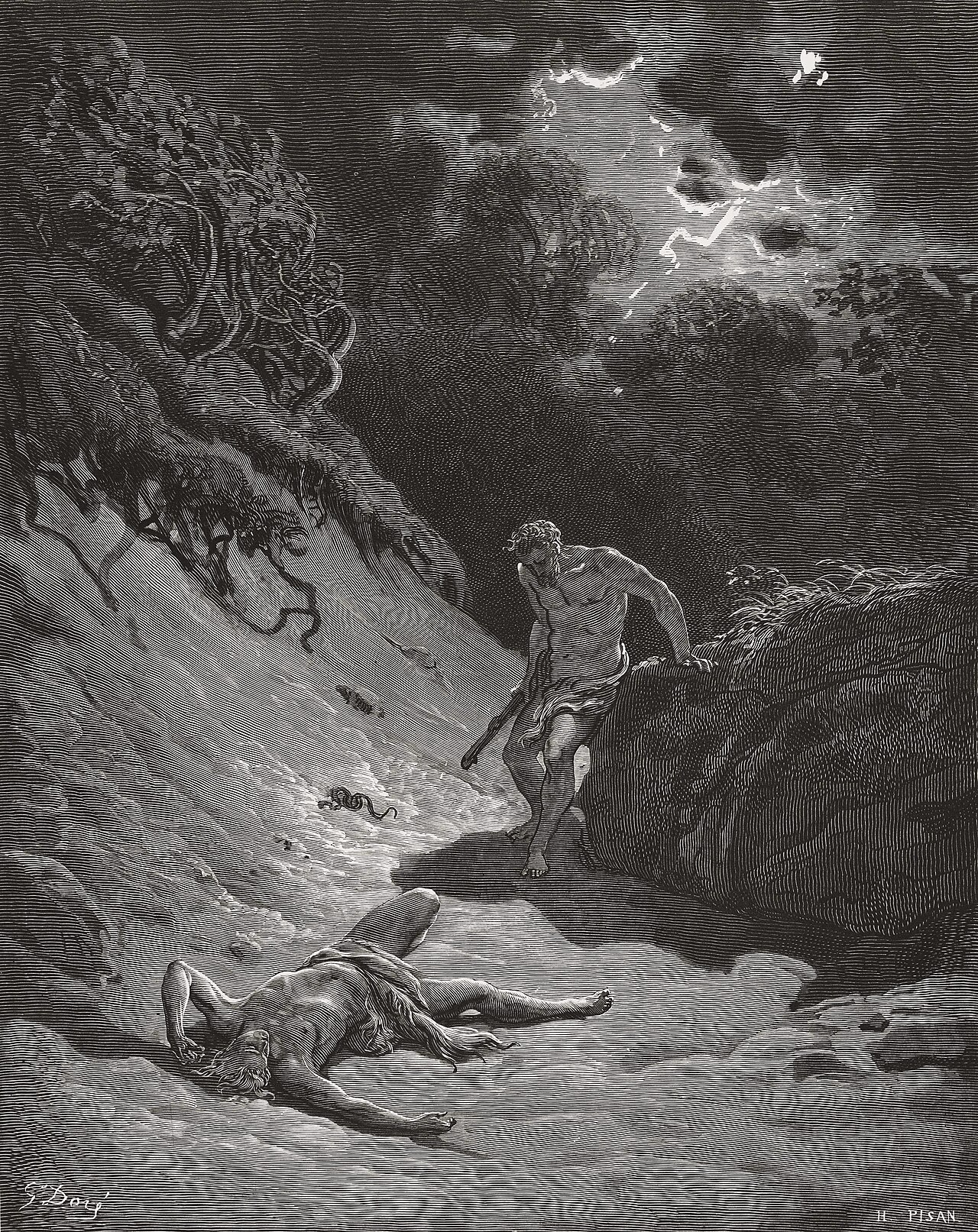
Genesischapter 4
26 verses · Moses, by tradition · 15th to 13th century BC · The Law
In Jewish life
The reading
Weekly portion 1 of 54
בְּרֵאשִׁית Bereshit, Genesis 1:1 to 6:8
Read with it: Isaiah 42:5 to 43:10 in Ashkenazi use, and Isaiah 42:5 to 42:21 in Sephardi use.
The verse numbers here are the ones a Hebrew Bible carries, which differ from an English Bible by a verse or two in several places. The Sephardi reading is named only where this site records a difference; communities vary beyond what is listed. What these books are, and how a Christian reader meets them →
What is done
This chapter is heard inside the opening portion of the annual cycle, which runs from the first verse of Genesis into Genesis 6 and is read in one sitting (src/lib/hebraic/readings.ts). The first murder is therefore read on the same Sabbath as the creation account and the fall. The card above carries the portion and the prophetic reading set beside it.
How it is read
Rashi is the main voice on this chapter in the corpus, in the public domain edition of M. Rosenbaum and A. M. Silbermann, Pentateuch with Rashi's commentary, 1929 to 1934. Radak stands beside him on two verses, in the CC-BY translation of Eliyahu Munk, HaChut Hameshulash.
Rashi reads the offerings by what each brother brought. Abel kept flocks because the ground had been cursed, and Cain brought "of the worst fruits" of the ground (Rashi on Genesis 4:2:1 and 4:3:1, the second citing Genesis Rabbah 22:5). Rashi takes the regard God had for the one offering as a turning toward it, and the lack of regard as a turning away (Rashi on Genesis 4:4:1). He reads the words Cain spoke to his brother as the picking of a quarrel, and he says that the Midrash explains them further while this is the plain sense (Rashi on Genesis 4:8:1).
Radak reads the same two verses toward repentance. He holds that the offering was refused because "His intention had not been good and pure". Cain learned of the refusal when fire came down on his brother's offering and none came down on his own (Radak on Genesis 4:5:1). He reads God's question to Cain as discipline meant to bring him back, and as the teaching of repentance for the generations after him (Radak on Genesis 4:6:1).
The exchange at the ninth and thirteenth verses is read in the same direction. Rashi holds that God asked where Abel was in order to open a friendly conversation, so that Cain might repent and own the killing (Rashi on Genesis 4:9:1, citing Genesis Rabbah 19:11). He reads Cain's answer about his punishment as a question put back to God. The One who bears the worlds above and below is asked whether He can bear one man's sin (Rashi on Genesis 4:13:1, citing Genesis Rabbah 22:11).
Ibn Ezra comments on two verses of this chapter, and the corpus holds the text of neither, because the licence Sefaria reports for that English version keeps it out. They are Ibn Ezra on Genesis 4:14:1 and 4:21:1.
What the rabbis say
Rashi carries three of the best known traditional insights on this chapter, and each stands here as what the rabbis taught.
The first is on the plural word for blood in the tenth verse. He reads it as the blood of Abel together with the blood of the descendants he would have had. His second reading is that Cain struck many blows, because he did not know from which wound the life would leave (Rashi on Genesis 4:10:1, citing Genesis Rabbah 22:9 and Sanhedrin 37b).
The second is on the sons of Lamech. Rashi reports the Midrash that the tents and cattle of the twentieth verse were shrines for idol worship. The harp and pipe of his brother made the music for it (Rashi on Genesis 4:20:1, citing Genesis Rabbah 23:3). Of Tubal-cain he says that the man refined the handicraft of Cain by making weapons for murderers (Rashi on Genesis 4:22:1, same locator).
The third is the story behind the song of Lamech. Rashi reports that Lamech was blind and that Tubal-cain led him about. The son saw Cain at a distance, took him for an animal, and told his father to draw the bow, and so Lamech killed his own forefather. Learning what he had done, Lamech struck his hands together and killed his son between them. This is why the wives of Lamech separated from him and why he sang to win them back (Rashi on Genesis 4:23:1). Rashi reads the sevenfold vengeance of the fifteenth verse in the same story, holding that Lamech was the seventh generation and the one by whom the promise was kept (Rashi on Genesis 4:19:1 and 4:24:1).
The corpus records forty places where the Midrash and the Talmud cite this chapter, thirty two under Midrash and eight under Talmud, with the locator for each one and no text. Bereshit Rabbah runs the length of the chapter. It reads the first verse at 21:9 and 22:1, the second at 22:3 and 30:8, the third at 22:4 and 22:5, the fourth at 22:6 and the eighth at 22:7. It reads the ninth verse at 19:11, the eleventh at 22:10, the thirteenth at 22:11 and the seventeenth at 23:1. It reads the eighteenth at 23:2, the twentieth at 23:3, the twenty third at 22:8 and the twenty sixth at 2:3.
Bamidbar Rabbah reads the fourth verse at 13:2, the tenth at 20:6, the twelfth at 9:7 and the fifteenth at 7:5. Bereshit Rabbati reads the ninth verse at Parashat Bereshit 80, the twelfth at Parashat Noah 6, the fourteenth at Parashat Bereshit 86 and the nineteenth at Parashat Vayishlach 36. Midrash Sekhel Tov reads the sixth verse at Bereshit 20:16:3 and 40:6:2, and the Mekhilta of Rabbi Shimon ben Yochai reads the eleventh at 15:12.
The Talmud is cited at Arakhin 15b:19 on the thirteenth verse and at Jerusalem Talmud Bava Batra 2:2:2 on the twenty second. Avot DeRabbi Natan carries the other six, at 16:3 and 31:2 and 14:6, and in its second recension at 44:1, 45:5 and 44:2.
The text, verse by verse
Each word shows the Hebrew, the English under it, how it sounds and its Strong’s number. A rule between verses marks where the Hebrew manuscripts end a paragraph.
Two Brothers, Two Offerings
Ramban on Genesis 4:1
The sense of it is that she gave birth to a son, and she called his name Cain [from the word kanah, acquisition], because she said, I have gotten a man with [the help of] the Eternal.
Read it in full at Sefaria · Commentary on the Torah by Ramban (Nachmanides). Translated and annotated by Charles B. Chavel. New York, Shilo Pub. House, 1971-1976
Cain Kills His Brother Abel
Ibn Ezra on Genesis 4:10
Crieth unto Me is not connected to voice of ( kol ). 19 It is connected to thy brother’s blood.
Read it in full at Sefaria · Ibn Ezra's commentary on the Pentateuch, tran. and annot. by H. Norman Strickman and Arthur M. Silver. Menorah Pub., 1988-2004
Ramban on Genesis 4:11
CURSED ART THOU FROM THE GROUND — more than it has already been cursed on account of its sin. In this, too, it has further sinned in that it hath opened its mouth to take thy brother’s blood.
Read it in full at Sefaria · Commentary on the Torah by Ramban (Nachmanides). Translated and annotated by Charles B. Chavel. New York, Shilo Pub. House, 1971-1976
Ramban on Genesis 4:13
This is in the form of a question: “You bear the worlds above and below, and is it impossible for You to bear my sin?” Thus the words of Rashi quoting Bereshith Rabbah. 439:25. The correct plain interpretation is that it is a confession.
Read it in full at Sefaria · Commentary on the Torah by Ramban (Nachmanides). Translated and annotated by Charles B. Chavel. New York, Shilo Pub. House, 1971-1976
Ibn Ezra on Genesis 4:14
[AND FROM THY FACE SHALL I BE HID.] All the world is full of God’s glory.
Read it in full at Sefaria · Ibn Ezra's commentary on the Pentateuch, tran. and annot. by H. Norman Strickman and Arthur M. Silver. Menorah Pub., 1988-2004
Cain's Line and Lamech's Boast
Seth, and Calling on the Lord
Hebrew words in this chapter
The 40 most used Hebrew words of the chapter, counted by lemma. The article, the object marker, the negatives and the common prepositions are left out.
| Word | Sense here | Uses | Strong’s |
|---|---|---|---|
| קַיִןQayin | cain | 16 | H7014 |
| יָלַדyâlad | and she bore | 11 | H3205 |
| יְהֹוָהYᵉhôvâh | yahweh | 10 | H3068 |
| אָמַרʼâmar | and she said | 9 | H559 |
| אָחʼâch | brother | 8 | H251 |
| הֶבֶלHebel | Abel | 8 | H1893 |
| שֵׁםshêm | name | 8 | H8034 |
| אִשָּׁהʼishshâh | wife his | 6 | H802 |
| אֲדָמָהʼădâmâh | ground | 6 | H127 |
| הָרַגhârag | to kill | 5 | H2026 |
| לֶמֶךְLemek | Lamech | 5 | H3929 |
| יָדַעyâdaʻ | to know | 4 | H3045 |
| פָּנִיםpânîym | face | 4 | H6440 |
| קָרָאqârâʼ | to call | 4 | H7121 |
| תּוּבַל קַיִןTûwbal Qayin | tubal- | 4 | H8423 |
| מִנְחָהminchâh | offering | 3 | H4503 |
| אֶרֶץʼerets | land | 3 | H776 |
| חֲנוֹךְChănôwk | Enoch | 3 | H2585 |
| בֵּןbên | son | 3 | H1121 |
| עָדָהʻÂdâh | Adah | 3 | H5711 |
| Word | Sense here | Uses | Strong’s |
|---|---|---|---|
| צִלָּהTsillâh | Zillah | 3 | H6741 |
| הָרָהhârâh | and she conceived | 2 | H2029 |
| אִישׁʼîysh | man | 2 | H376 |
| יָסַףyâçaph | and she repeated | 2 | H3254 |
| צֹאןtsôʼn | flock | 2 | H6629 |
| עָבַדʻâbad | a tiller of | 2 | H5647 |
| יוֹםyôwm | day | 2 | H3117 |
| בּוֹאbôwʼ | and he brought | 2 | H935 |
| שָׁעָהshâʻâh | and he looked | 2 | H8159 |
| חָרָהchârâh | and burned | 2 | H2734 |
| נָפַלnâphal | and they fell | 2 | H5307 |
| יָטַבyâṭab | you will do well | 2 | H3190 |
| שָׂדֶהsâdeh | in the field | 2 | H7704 |
| קוֹלqôwl | voice | 2 | H6963 |
| דָּםdâm | blood | 2 | H1818 |
| לָקַחlâqach | to receive | 2 | H3947 |
| נוּעַnûwaʻ | a wanderer | 2 | H5128 |
| נוּדnûwd | and a fugitive | 2 | H5110 |
| מָצָאmâtsâʼ | to find | 2 | H4672 |
| שִׁבְעָתַיִםshibʻâthayim | sevenfold | 2 | H7659 |
Keep studying
Studies13
Words12
Subjects1
Sources for this chapter
The Hebrew text
STEP Bible, the tagged Hebrew text and its English glosses and James Strong, Strong's Exhaustive Concordance.
In Jewish life
Rashi, Rashi on Genesis 4, in Pentateuch with Rashi's commentary by M. Rosenbaum and A. M. Silbermann, 1929 to 1934, public domain; Radak, Radak on Genesis 4:5:1 and 4:6:1, in HaChut Hameshulash, translated by Eliyahu Munk, CC-BY; Ibn Ezra, his two comments on Genesis 4, cited by reference; the licence Sefaria reports for the English version keeps the text out of the corpus; The Midrash and the Talmud, the forty locators on Genesis 4 in scripts/data/sources/sefaria/genesis/4.json and MannaFest, the annual cycle table at src/lib/hebraic/readings.ts.
The rabbinic texts
Ramban, Commentary on the Torah by Ramban (Nachmanides). Translated and annotated by Charles B. Chavel. New York, Shilo Pub. House, 1971-1976; Ibn Ezra, Ibn Ezra's commentary on the Pentateuch, tran. and annot. by H. Norman Strickman and Arthur M. Silver. Menorah Pub., 1988-2004 and Sefaria, texts and citation data.