
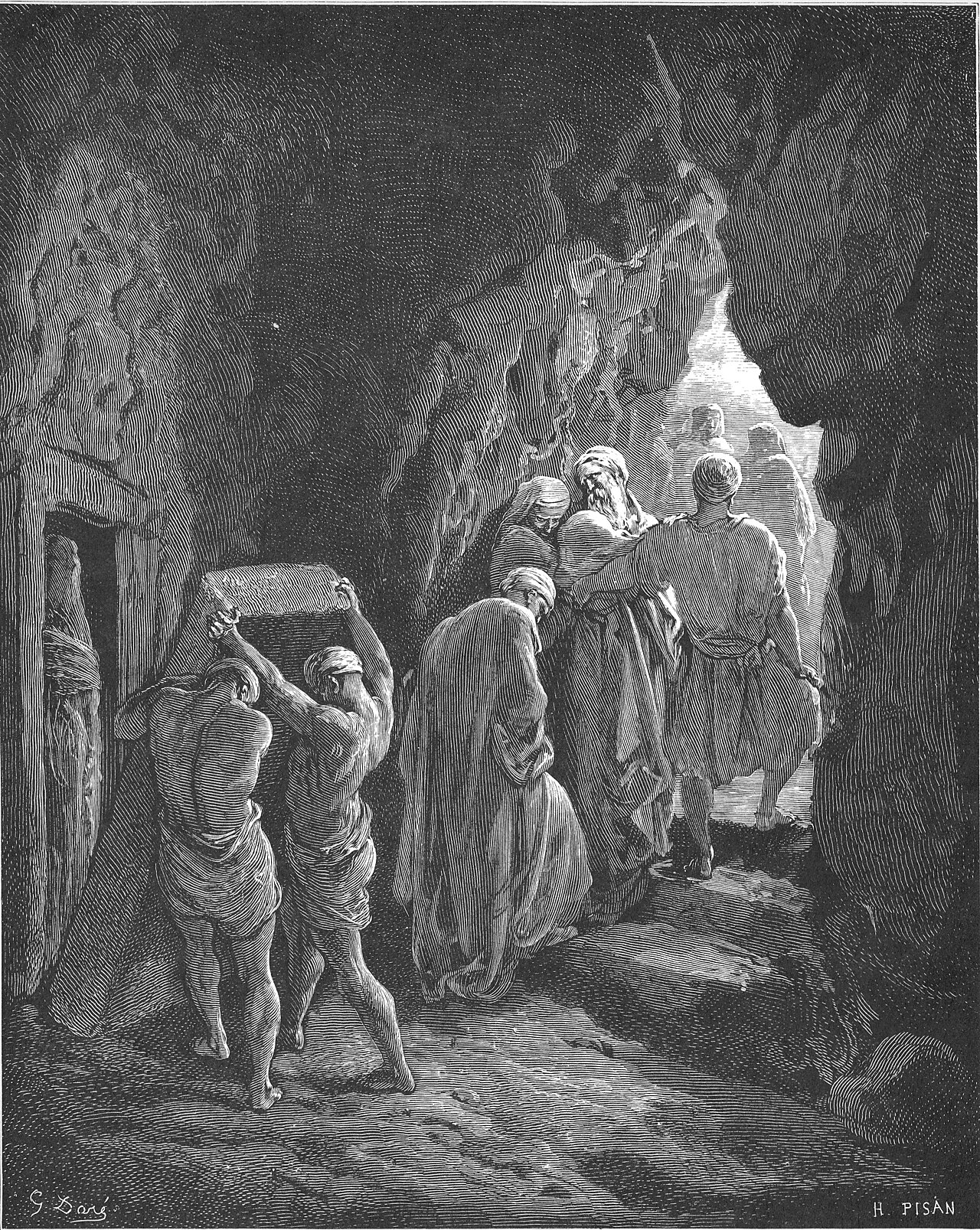
Genesischapter 23
20 verses · Moses, by tradition · 15th to 13th century BC · The Law
Now Sarah lived to be 127 years old.
Introduction
Moses, by tradition, The Law, Genesis Overview.
Moses, by tradition, Narrative, The Law, The Abraham cycle, Genesis Overview. Genesis was given to a nation marching toward the land it had been promised, and this chapter records the first piece of that land the family ever owned. It is a death and a purchase, told at the pace of a real negotiation. The first hearers knew how business was done at a town gate and would have followed every courtesy and every figure. Listen for the words Abraham uses of his own standing, for the gift that is offered and declined, and for the care with which the property is described. Read it as a deed kept in the family's file.
Context
- Who
- Israel in the wilderness, whose claim on Canaan began with one grave that had been paid for
- What
- A narrative of Sarah's death and Abraham's public purchase of the field and cave of Machpelah for her grave.
- Where
- Hebron, at the gate of the town, and the cave of Machpelah near Mamre.
- When
- The patriarchal age, about 2029 BC on the traditional dating, fixed by Sarah's age at her death.
- Why
- To record the family's first lawful hold on the promised land, bought at full price before witnesses.
Historical context
The chapter belongs to Abraham as a widower and to Ephron the Hittite as a landowner, with the elders of the town standing as witnesses.
Show the rest of the historical context, 6 more paragraphs
The date is about 2029 BC on the traditional reckoning, fixed by Sarah's age at her death.
The place is Kiriath-arba, which the text itself glosses as Hebron, and the field with a cave at its end that lay near Mamre.
The occasion is a death in a country where the family owned nothing, and the need for a grave.
A first hearer knew that the words Abraham uses of himself at verse 4 are a legal status rather than a mood. A resident foreigner was allowed to live and graze and was not allowed to own, so the request is a request to change his standing.
He also knew that business of this kind was done at the gate in the hearing of everyone who came in, that silver was weighed rather than counted because coinage did not yet exist, and that a conveyance named the seller, the property, its boundaries and its trees, which is what verses 17 and 18 do.
The offer at verse 11 would have sounded to him like the opening of a bargain rather than the end of one, and the price named in passing at verse 15 would have sounded steep.
Significance
The only ground Abraham ever owned in the land he had been promised was a grave, and he paid the full price for it in public so that no one could later call it a gift or a loan.
Show the rest of the significance, 1 more paragraph
For a nation marching to claim that country, this chapter was the deed in the file. It was also a picture of what believing looked like, since he buried his wife in a land God had promised him and stayed there.
This chapter in Jewish lifeWhat this chapter is in Jewish life and reading.
What is done
This chapter opens the fifth portion of the annual cycle, and the portion runs from its first verse to Genesis 25:18 (src/lib/hebraic/readings.ts). A congregation hears the death of Sarah, the buying of the cave, the finding of Rebecca and the death of Abraham in one sitting. The card above carries the portion and the prophetic reading set beside it.
How it is read
Rashi is quoted here from the public domain Rosenbaum and Silbermann edition. Radak and Malbim are quoted from the CC-BY translation of Eliyahu Munk, HaChut Hameshulash.
The chapter is a purchase, and the classical comment reads it as a legal record. Rashi reads the standing of Abraham in the fourth verse two ways. The plain sense is a man from another land who has settled among them. The Midrashic sense is an offer and a claim together, that he will buy as a stranger or take as a settler by the promise given him (Rashi on Genesis 23:4:1, citing Genesis Rabbah 58:6).
Malbim reads the answer of the sons of Heth as the custom of the place. A man of his standing "may have the best grave in the public cemetery", or may ask for the private plot of any man in town. Their own custom keeps a plot of his own out of the hands of a sojourner (Malbim on Genesis 23:5:1). Radak adds that the townspeople were willing, and wanted Abraham to hold a burial plot among them (Radak on Genesis 23:20:1).
Rashi reads the sitting of Ephron in the tenth verse from a missing letter. The man had been made an officer that same day, so that Abraham would deal with someone of standing (Rashi on Genesis 23:10:1, citing Genesis Rabbah 58:7). He reads the name of Ephron in the sixteenth verse as written short because the man was short in his dealing, promising much and doing little (Rashi on Genesis 23:16:1, citing Bava Metzia 87a). He notes that Abraham paid in shekels that passed everywhere at full weight.
Ibn Ezra carries four comments on this chapter that the corpus holds by reference alone, at Ibn Ezra on Genesis 23:3:1, 23:7:1, 23:12:1 and 23:19:1.
What the rabbis say
Rashi carries three sayings of the rabbis on this chapter, and each stands here as what they taught.
The first is on the years of Sarah. Rashi reads the repeated word for years in the first verse as a sign that each number stands on its own. At a hundred she was as a woman of twenty as to sin, and the years were all equally good (Rashi on Genesis 23:1:1 and 23:1:2).
The second is on the name of the city. Rashi reports that Kiriath-arba is the city of the four, named either for the four giants who lived there or for the four couples buried there. The couples he names are Adam and Eve, Abraham and Sarah, Isaac and Rebecca, and Jacob and Leah (Rashi on Genesis 23:2:1, citing Genesis Rabbah 58:4). He reads the name of the cave in the same way, as a double cave with a chamber above and below, or as doubled by those couples (Rashi on Genesis 23:9:1, citing Eruvin 53a).
The third is on what the sale did to the field. Rashi reports the reading that the field rose in standing, since it passed from a commoner to a king. He gives the plain sense of the verse beside it (Rashi on Genesis 23:17:1, citing Genesis Rabbah 58:8).
The corpus records forty places where the Midrash and the Talmud cite this chapter, twenty seven under Midrash and thirteen under Talmud, which is the heaviest Talmud weight of these twenty five. The weight falls on the purchase, because the tractates that argue about sale and title are the tractates that cite it.
The Talmud is cited at Bava Kamma 93a:3 on the mourning, Berakhot 18a:3 on the rising from the dead, Chullin 120a:18 on the eighth verse and Bekhorot 50a:8 on the tenth. It is cited at Bava Metzia 87a:3 and Avot DeRabbi Natan 13:3 on the fifteenth verse, and at Bava Batra 69b:1 on the seventeenth. The Jerusalem Talmud is cited at Bava Metzia 9:11:1 on the fourth verse and Kiddushin 1:3:4 on the eighth. It is cited at Berakhot 4:3:5 and Kiddushin 1:1:3 on the thirteenth verse, Berakhot 9:5:2 on the eighteenth and Sotah 5:6:2 on the twenty first.
Bereshit Rabbah reads the first verse at 58:1, the second at 58:4, the tenth at 58:7 and the twelfth at 58:6. It reads the sixteenth verse at 79:7, the seventeenth at 58:8 and the nineteenth at 58:9. Bereshit Rabbati reads four places in Parashat Chayei Sarah, at 9, 10, 11 and 12. Aggadat Bereshit reads the fourth verse at 58:4, the sixth at 29:3 and 56:1, and the nineteenth at 34:1. Bamidbar Rabbah reads the first verse at 14:11 and the third at 2:26, and the Mekhilta of Rabbi Yishmael reads the fifth and sixth at Tractate Pischa 18:2.
Sources: Rashi, Rashi on Genesis 23, in Pentateuch with Rashi's commentary by M. Rosenbaum and A. M. Silbermann, 1929 to 1934, public domain, about 1090; Radak, Radak on Genesis 23:3:1, 23:5:1 and 23:20:1, in HaChut Hameshulash, translated by Eliyahu Munk, CC-BY, about 1200; Malbim, Malbim on Genesis 23:5:1, in HaChut Hameshulash, translated by Eliyahu Munk, CC-BY, about 1870; Ibn Ezra, his four comments on Genesis 23, cited by reference; the licence Sefaria reports for the English version keeps the text out of the corpus; The Midrash and the Talmud, the forty locators on Genesis 23 in scripts/data/sources/sefaria/genesis/23.json; MannaFest, the annual cycle table at src/lib/hebraic/readings.ts, 2026.
The heads below are this chapter's scenes. The numbered points under each are its verses.
Sarah Dies at Hebron
Sarah lived to be 127 years old: Sarah lived to be 127, and she is the only woman in Scripture whose years are counted at her death. Calvin notes that Moses gives the death in one word and then spends a whole chapter on the field and the cave. Genesis gives no cause. The death comes straight after the binding of Isaac, and Gill reports an old Jewish reading that word of it killed her.
Genesis 23:1
“And Sarah was an hundred and seven and twenty years old It is remarkable that Moses, who relates the death of Sarah in a single word, uses so many in describing her burial: but we shall soon see that the latter record is not superfluous.”
John Calvin · Commentaries (1554)reformed
1 more voice on this verseWhat preachers and commentators have said about this verse, in their own words.
Genesis 23:1
“Sarah was an hundred and seven and twenty years old, &c.--Sarah is the only woman in Scripture whose age, death, and burial are mentioned, probably to do honor to the venerable mother of the Hebrew people.”
Jamieson, Fausset & Brown · Commentary Critical and Explanatory on the Whole Bible (1871)reformed
to mourn and to weep for her: Kiriath-arba, which is Hebron, means the city of Arba, and Joshua 14:15 calls Arba the greatest man among the Anakim. The first grave in the covenant family is dug in the town named after him. Two verbs stand over Abraham, mourn and weep. Henry takes the pair as grief that was felt as well as shown.
Genesis 23:2
“Sarah died in Kirjath-arba - Literally in the city of the four. Some suppose this place was called the city of the four because it was the burial place of Adam, Abraham, Isaac, and Jacob; others, because according to the opinion of the rabbins, Eve was buried there. with Sarah, Rebekah, and Leah.”
Adam Clarke · Commentary on the Bible (1810-1826)evangelical
2 more voices on this verse
Genesis 23:2
“And Sarah died in Kirjath-arba. It appears from Joshua 15:54, that this was the more ancient name of the city, which afterwards began to be called Hebron. But there is a difference of opinion respecting the etymology.”
John Calvin · Commentaries (1554)reformed
Genesis 23:2
“Abraham's mourning for her; and he was a true mourner. He did not only perform the ceremonies of mourning according to the custom of those time, as the mourners that go about the streets, but he did sincerely lament the great loss he had of a good wife, and gave proof of the constancy of his affection to her to the last. Two words are used: he came both to mourn and to weep.”
Matthew Henry · Commentary on the Whole Bible (1707-1721)puritan
Buying the Cave of Machpelah
Abraham got up from beside his dead wife: Abraham rises from the ground where mourners sat and turns to the Hittites, who hold the country God had promised him. He owns none of it. Stephen says at Acts 7:5 that God gave Abraham no inheritance in the land, no foot of ground at all. The promise now has a dead wife to bury and no ground to put her in.
Genesis 23:3
“Abraham stood up from before his dead - He had probably sat on the ground some days in token of sorrow, as the custom then was, (see Tobit 2:12, 13; Isa 47:1; and Gen 37:35); and when this time was finished he arose and began to treat about a burying place.”
Adam Clarke · Commentary on the Bible (1810-1826)evangelical
1 more voice on this verse
Genesis 23:3
“Abraham stood up, &c.--Eastern people are always provided with family burying-places; but Abraham's life of faith--his pilgrim state--had prevented him acquiring even so small a possession (Ac 7:5). spake unto the sons of Heth--He bespoke their kind offices to aid him in obtaining possession of a cave that belonged to Ephron--a wealthy neighbor.”
Jamieson, Fausset & Brown · Commentary Critical and Explanatory on the Whole Bible (1871)reformed
The man promised the whole country calls himself a foreigner and an outsider in it. Hebrews 11:13 takes the words up for all the patriarchs, who died in faith as strangers and exiles on the earth. Leviticus 25:23 puts the same phrase in God's mouth about Israel, that the land is His and they are foreigners and residents with Him. He asks for a burial site to bury his dead.
Genesis 23:4
“I am a stranger and a sojourner with you - Therefore I am unprovided, and must become a suiter to you for a burying-place. This was one occasion which Abraham took to confess that he was a stranger and a pilgrim upon earth. The death of our relations should effectually mind us that we are not at home in this world.”
John Wesley · Explanatory Notes upon the Old Testament (1765)evangelical
1 more voice on this verse
Genesis 23:4
“I am a stranger and a sojourner - It appears from Heb 11:13-16; 1Pe 2:11, that these words refer more to the state of his mind than of his body. He felt that he had no certain dwelling place, and was seeking by faith a city that had foundations.”
Adam Clarke · Commentary on the Bible (1810-1826)evangelical
Genesis 23:5-6
The Hittites replied to Abraham: They answer with high courtesy and call him God's chosen one among us, which Clarke gives literally as a prince of God. The foreigner of verse 4 is named a prince by the people of the land. They offer the finest of their tombs and promise that none will withhold a grave. A tomb lent to him would stay theirs.
Genesis 23:5
“With a title of respect: Thou art a prince of God among us, so the word is; not only great, but good. He called himself a stranger and a sojourner; they call him a great prince; for those that humble themselves shall be exalted. God had promised to make Abraham's name great.”
Matthew Henry · Commentary on the Whole Bible (1707-1721)puritan
the finest of our tombs: The Hittites call Abraham God's chosen one among them, where he had called himself a foreigner and an outsider. John Wesley gives their title as a prince of God, good as well as great. Their offer is the finest of their tombs.
Genesis 23:6
“Thou art a prince of God among us - So the word is; not only great, but good. He called himself a stranger and a sojourner, they call him a great prince.”
John Wesley · Explanatory Notes upon the Old Testament (1765)evangelical
1 more voice on this verse
Genesis 23:6
“Thou art a mighty prince - נשיא אלהים nesi Elohim, a prince of God - a person whom we know to be Divinely favored, and whom, in consequence, we deeply respect and reverence.”
Adam Clarke · Commentary on the Bible (1810-1826)evangelical
Genesis 23:7-9
Abraham rose and bowed down before the people of the land: Abraham bows down before the people of the land, and it is the first of two bows in this chapter. He asks them to approach Ephron for the cave of Machpelah at the end of his field. He has already found the spot. He fixes his terms before a price is named, full price paid in their presence.
Genesis 23:7
“He then pitches upon the place he thinks most convenient, namely, the cave of Machpelah, which probably lay near him, and had not yet been used for a burying-place. The present owner was Ephron. Abraham cannot pretend to any interest in him, but he desires that they would improve theirs with him to get the purchase of that cave, and the field in which it was.”
Matthew Henry · Commentary on the Whole Bible (1707-1721)puritan
approach Ephron son of Zohar on my behalf: Abraham asks the Hittites to approach Ephron son of Zohar for him. Adam Clarke places the scene at the gate, where the elders judged and every sale was witnessed, and he thinks Ephron was unknown to Abraham by sight. So the people of the land speak for him.
Genesis 23:8
“Entreat for me to Ephron - Abraham had already seen the cave and field, and finding to whom they belonged, and that they would answer his purpose, came to the gate of Hebron, where the elders of the people sat to administer justice, etc., and where bargains and sales were made and witnessed, and having addressed himself to the elders, among whom Ephron was, though it appears he was not personally known to Abraham, he begged them to use their influence with the owner of the cave and field to sell it to him, that it might serve him and…”
Adam Clarke · Commentary on the Bible (1810-1826)evangelical
the cave of Machpelah that belongs to him: Abraham asks for the cave of Machpelah, at full price. John Gill notes that the Targum of Jonathan reads verse 4 as a request to sell a possession, so Abraham meant to pay from the start.
Genesis 23:10-11
Ephron was sitting among the sons of Heth: Ephron has been sitting among the sons of Heth the whole time, at the gate where the elders sat and where a sale was made binding. He offers the ground as a gift in the presence of his people, saying I give you three times in one verse. Abraham asked for the cave, and Ephron adds the field. Jamieson, Fausset and Brown read the speech as generosity that expected to be paid for.
Genesis 23:10
“And Ephron dwelt among the children of Heth - And Ephron ישב yosheb, was sitting among the children of Heth, but, as was before conjectured, was personally unknown to Abraham; he therefore answered for himself, making a free tender of the field, etc., to Abraham, in the presence of all the people, which amounted to a legal conveyance of the whole property to the patriarch.”
Adam Clarke · Commentary on the Bible (1810-1826)evangelical
I give you the field: Adam Clarke reads the public offer as amounting to a legal conveyance, since it was made before the people at the gate. Ephron closes, as the Hittites did in verse 6, with the words bury your dead. Abraham refuses the gift.
Genesis 23:11
“Ephron answered, Nay, my lord, &c.--Here is a great show of generosity, but it was only a show; for while Abraham wanted only the cave, he joins "the field and the cave"; and though he offered them both as free gifts, he, of course, expected some costly presents in return, without which, he would not have been satisfied.”
Jamieson, Fausset & Brown · Commentary Critical and Explanatory on the Whole Bible (1871)reformed
Genesis 23:12-13
Again Abraham bowed down before the people of the land: He bows a second time and turns the gift down. He asks to pay silver for the field, so the only ground he will ever hold in the land of promise is bought at a witnessed price. Henry draws the rule that grace gives no man title to another man's land. The promise of Canaan gave Abraham no claim on Hittite ground.
Genesis 23:12
“And Abraham bowed down himself before the people of the land. Showing hereby great respect, and giving much honour both to them and Ephron; and signifying that he had something to say, and desired audience of them, and humbly submitted to them what he should say.”
John Gill · Exposition of the Old Testament (1748-1763)Reformed Baptist
1 more voice on this verse
Genesis 23:12
“It was not in pride that Abraham refused the gift, or because he scorned to be beholden to Ephron; but, 1. Abraham was rich in silver and gold ( ch. xiii. 2 ) and was able to pay for the field, and therefore would not take advantage of Ephron's generosity.”
Matthew Henry · Commentary on the Whole Bible (1707-1721)Puritan
pay you the price of the field: Abraham will pay the price of the field and asks Ephron to accept it in the presence of the people. John Wesley says he paid so that Ephron could never reproach him with a gift. Adam Clarke notes that the price was silver weighed out.
Genesis 23:13
“I will give thee money for the field - It was not in pride that Abraham refused the gift; but 1. Abraham was rich in silver and gold, and therefore would not take advantage of Ephron's generosity. He would pay for it, lest Ephron, when this good humour was over, should upbraid him with it.”
John Wesley · Explanatory Notes upon the Old Testament (1765)evangelical
1 more voice on this verse
Genesis 23:13
“If thou wilt give it - Instead of, if thou wilt give it, we should read, But if thou wilt sell it, I will give thee money for the field; כסף keseph, silver, not coined money, for it is not probable that any such was then in use.”
Adam Clarke · Commentary on the Bible (1810-1826)evangelical
Genesis 23:14-16
Ephron answered Abraham: The price comes wrapped as a courtesy: four hundred shekels of silver, and what is that between you and me. Jeremiah pays seventeen shekels for a field at Anathoth, and David pays fifty for a threshing floor and its oxen. Abraham does not argue. He weighs the silver out according to the standard of the merchants, which was metal on a scale.
Genesis 23:14
“Great courtesy, and obligingness to his friend and neighbour. Ephron was not jealous of Abraham as a resident foreigner, nor envious at him as a man likely to thrive and grow rich. He bore him no ill-will for his singularity in religion, but was much kinder to him than most people now-a-days are to their own brothers: What is that between me and thee?”
Matthew Henry · Commentary on the Whole Bible (1707-1721)puritan
but what is that between you and me?: Ephron names the price as four hundred shekels of silver. Adam Clarke notes that the words is worth are added in English to suit its idiom. Matthew Henry and John Wesley call Ephron sincere, and Jamieson, Fausset and Brown call his offer a show.
Genesis 23:15
“The land is worth four hundred shekels of silver - Though the words is worth are not in the text, yet they are necessarily expressed here to adapt the Hebrew to the idiom of our tongue.”
Adam Clarke · Commentary on the Bible (1810-1826)evangelical
1 more voice on this verse
Genesis 23:15
“The land is worth four hundred shekels of silver - About fifty pounds of our money, but what is that between me and thee? - He would rather oblige his friend than have so much money.”
John Wesley · Explanatory Notes upon the Old Testament (1765)evangelical
according to the standard of the merchants: Abraham weighed out the four hundred shekels of silver in the hearing of the Hittites. Adam Clarke reads the standard of the merchants as the weight in use among travelling traders, and Jamieson, Fausset and Brown add that merchants at the gate carried scales. Matthew Henry commends a sale made in public.
Genesis 23:16
“Current with the merchant - עבר לסחר ober lassocher, passing to or with the traveler - such as was commonly used by those who traveled about with merchandise of any sort. The word signifies the same as hawker or peddler among us.”
Adam Clarke · Commentary on the Bible (1810-1826)evangelical
1 more voice on this verse
Genesis 23:16
“Observe, Though all the land of Canaan was Abraham's by promise, yet, the time of his possessing not having come, what he had now occasion for he bought and paid for. Note, Dominion is not founded in grace. The saints' title to an eternal inheritance does not entitle them to the possessions of this world, nor justify them in doing wrong.”
Matthew Henry · Commentary on the Whole Bible (1707-1721)puritan
The Field Deeded to Abraham
Genesis 23:17-18
all the trees within the boundaries of the field: The wording turns into a deed, listing the field, the cave, and all the trees inside the boundaries of the field. Trees are named because trees mark a boundary and a later claimant would argue over them. The transfer is made in front of the Hittites who had come to the city gate. Clarke calls this the earliest record of a land purchase.
Genesis 23:17
“Abraham, thereupon, takes possession, and buries Sarah in the cave or vault (whether framed by nature or art is not certain) which was in the purchased field. It is probable that Abraham had buried servants out of his family since he came to Canaan, but the graves of the common people ( 2 Kings xxiii.”
Matthew Henry · Commentary on the Whole Bible (1707-1721)puritan
1 more voice on this verse
Genesis 23:17
“All the trees that were in the field - It is possible that all these were specified in the agreement.”
Adam Clarke · Commentary on the Bible (1810-1826)evangelical
in the presence of all the Hittites: The deed is done at the city gate before all the Hittites who had come there, the same witnesses as verse 10. Adam Clarke reads the verb of verse 20 as made to stand, the sale fixed by the law of the day. The field is now Abraham's possession.
Abraham buried his wife Sarah in the cave: Sarah is the first of six laid in this cave at Machpelah. Jacob names the rest buried there on his deathbed at 49:31, Abraham and his wife Sarah, Isaac and Rebekah, and Leah. He makes Joseph swear to carry him up out of Egypt and lay him here. The field Abraham bought pulls the family back to Canaan.
Genesis 23:19
“Abraham buried Sarah--Thus he got possession of Machpelah and deposited the remains of his lamented partner in a family vault which was the only spot of ground he owned.”
Jamieson, Fausset & Brown · Commentary Critical and Explanatory on the Whole Bible (1871)reformed
the field and its cave were deeded by the Hittites: The chapter closes on a legal formula, the field and its cave deeded by the Hittites as a burial site. Jacob buys the second and last parcel any patriarch owns in Canaan, a field at Shechem for a hundred pieces of silver. That field becomes Joseph's grave at Joshua 24:32.
Genesis 23:20
“And the field, etc. were made sure - ויקם vaiyakom, were established, caused to stand; the whole transaction having been regulated according to all the forms of law then in use. 1. In this transaction between Abraham and the sons of Heth concerning the cave and field of Machpelah, we have the earliest account on record of the purchase of land. The simplicity, openness, and candour on both sides cannot be too much admired.”
Adam Clarke · Commentary on the Bible (1810-1826)evangelical
1 more voice on this verse
Genesis 23:20
“A burying place - 'Tis worth noting, 1. That a burying-place was the first spot of ground Abraham was possessed of in Canaan. That it was the only piece of land he was ever possessed of, tho' it was all his own in reversion.”
John Wesley · Explanatory Notes upon the Old Testament (1765)evangelical
How this psalm is built
The form: A burial account that spends one word on the death and the rest of the chapter on the ground, as Calvin classes it.
The patterns in this chapter
| Device | What it does | Where to see it |
|---|---|---|
| Listen to me, said by both sides | The negotiation is carried on one phrase. The Hittites open with it at verse 6, Abraham uses it at verse 8 and again at verse 13, and Ephron uses it at verse 11 and at verse 15. Each time it introduces an offer that sounds like a courtesy and moves the price. The whole exchange is conducted at the city gate in public hearing, which is what makes the words binding. | Genesis 23:6, Genesis 23:8, Genesis 23:11, Genesis 23:13, Genesis 23:15 |
| Abraham bowed down before the people of the land, twice | Verse 7 has him rise and bow before the Hittites after their first offer, and verse 12 has him bow again before he refuses the gift. John Gill reads the second bow as respect paid to the people and to Ephron at the moment Abraham declines what they are pressing on him. The courtesy and the refusal come in the same gesture.John Gill, Exposition of the Old Testament, 1748 to 1763, on Genesis 23:12. | Genesis 23:7, Genesis 23:12 |
| The deed, item by item | Verses 17 and 18 stop telling a story and start reading like a conveyance. The field at Machpelah near Mamre, the cave that was in it, and all the trees within the boundaries of the field are named in order and deeded over in the presence of the Hittites at the gate. Adam Clarke suggests all of these were specified in the agreement itself, and notes that the closing verb of verse 20 means the transaction was established and made to stand.Adam Clarke, Commentary on the Bible, 1832, on Genesis 23:17. | Genesis 23:17, Genesis 23:18, Genesis 23:20 |
| The city of the four | Adam Clarke gives Kiriath-arba literally as the city of the four, and reports the suggestion that the name came from its being the burial place of four patriarchs. Joshua 14:15 supplies the other account, that Arba was the greatest man among the Anakim and the town carried his name. The first grave of the covenant family is dug in a town named either for giants or for graves.Adam Clarke, Commentary on the Bible, 1832, on Genesis 23:2. | Genesis 23:2, Genesis 23:19 |
The New Testament's use
11 more paragraphs on the patterns
Abraham's own description of himself at verse 4 is taken up twice in the New Testament. Hebrews 11:13 to 16 reads the patriarchs as dying in faith, strangers and exiles on the earth, looking for a country of their own, and Adam Clarke reads the words of verse 4 as describing the state of Abraham's mind rather than only his legal standing, citing that passage and 1 Peter 2:11.
Stephen states the plain fact at Acts 7:5, that God gave Abraham no inheritance in the land, no foot of ground at all, and then gave it by promise to his offspring. Jamieson, Fausset and Brown read this chapter against that verse, since a pilgrim life had left Abraham without the family burying place that people of that country ordinarily had.
Leviticus 25:23 turns the same word back on Israel, where God calls them foreigners and residents with Him, so the description Abraham gives himself here becomes the description of the nation that will hold the land.
The debated concept
The first question is what Ephron was doing. Jamieson, Fausset and Brown read the offer of verse 11 as a great show of generosity that was only a show, since Abraham wanted the cave alone and Ephron joined the field to it, which raised the price and left Abraham with more land than he had asked for. Matthew Henry reads the same verses as real courtesy and obligingness from a neighbour who was neither jealous of Abraham nor envious of his prosperity. The text supports both readings by giving Ephron's words without giving his motive.
The second is why Abraham refused a gift he was pressed to take. Matthew Henry and John Wesley both answer the charge of pride directly. Abraham was rich in silver and gold, as Genesis 13:2 says, so he had no need to take advantage of a neighbour's good humour, and Wesley adds the practical reason, that Ephron might have upbraided him with the gift once the good humour had passed. Behind both stands a legal point the chapter is built on, that a tomb lent to him would have stayed Ephron's.
The third is the meaning of the town's name. Adam Clarke gives Kiriath-arba as the city of the four and reports the tradition that four patriarchs were buried there. Joshua 14:15 names Arba as the greatest man among the Anakim, which makes the name a man's rather than a count.
The fourth is what Sarah died of. John Gill reports an old Jewish reading that news of the binding of Isaac killed her, which places her death immediately after Genesis 22. Genesis states no cause at all, and the reading rests on the order of the chapters rather than on anything in the text.
The divine connection
The chapter is the promise of the land measured against what the man who received it actually held. God had said at Genesis 15:18 that the land from the river of Egypt to the Euphrates was given to Abraham's descendants, and here Abraham stands in the middle of it and asks permission to bury his wife. He buys one field with a cave in it and pays full price in public, and that is the whole of his estate in Canaan.
The purchase is an act of faith rather than of resignation. A grave fixes a family to a place. Jacob will insist on being carried back to this cave from Egypt, and Joseph will make the same demand about his own bones. The field bought in this chapter is the anchor that holds the family to the land through four hundred years away from it.
Keep studying
Sources for this chapter
The summary
Jamieson, Fausset & Brown, Commentary Critical and Explanatory; John Calvin, Commentaries; John Wesley, Notes on the Old Testament and Matthew Henry, Complete Commentary.
The form and classifications
Adam Clarke, Commentary on the Bible, 1832, on Genesis 23:20; Jamieson, Fausset and Brown, Commentary Critical and Explanatory on the Whole Bible, 1871, on Genesis 23:1; John Calvin, Commentaries, 1554, on Genesis 23:1 and John Wesley, Explanatory Notes upon the Old Testament, 1765, on Genesis 23:20.
The exposition
Adam Clarke, Commentary on the Bible; Jamieson, Fausset & Brown, Commentary Critical and Explanatory on the Whole Bible; John Calvin, Commentary on Genesis; John Gill, Exposition of the Old Testament; John Wesley, Explanatory Notes upon the Old Testament and Matthew Henry, Commentary on the Whole Bible.