
Genesis 23:3
in Genesis 23Then Abraham got up from beside his dead wife and said to the Hittites,
BSB
The same verse in ASV and KJV ▾
ASV
And Abraham rose up from before his dead, and spake unto the children of Heth, saying,
KJV
And Abraham stood up from before his dead, and spake unto the sons of Heth, saying,
⋯
This verse in Genesis 23
Commentary
7 notes on this verseAbraham stood up from before his dead - He had probably sat on the ground some days in token of sorrow, as the custom then was, (see Tobit 2:12, 13; Isa 47:1; and Gen 37:35); and when this time was finished he arose and began to treat about a burying place.
This site's exposition
Abraham got up from beside his dead wife
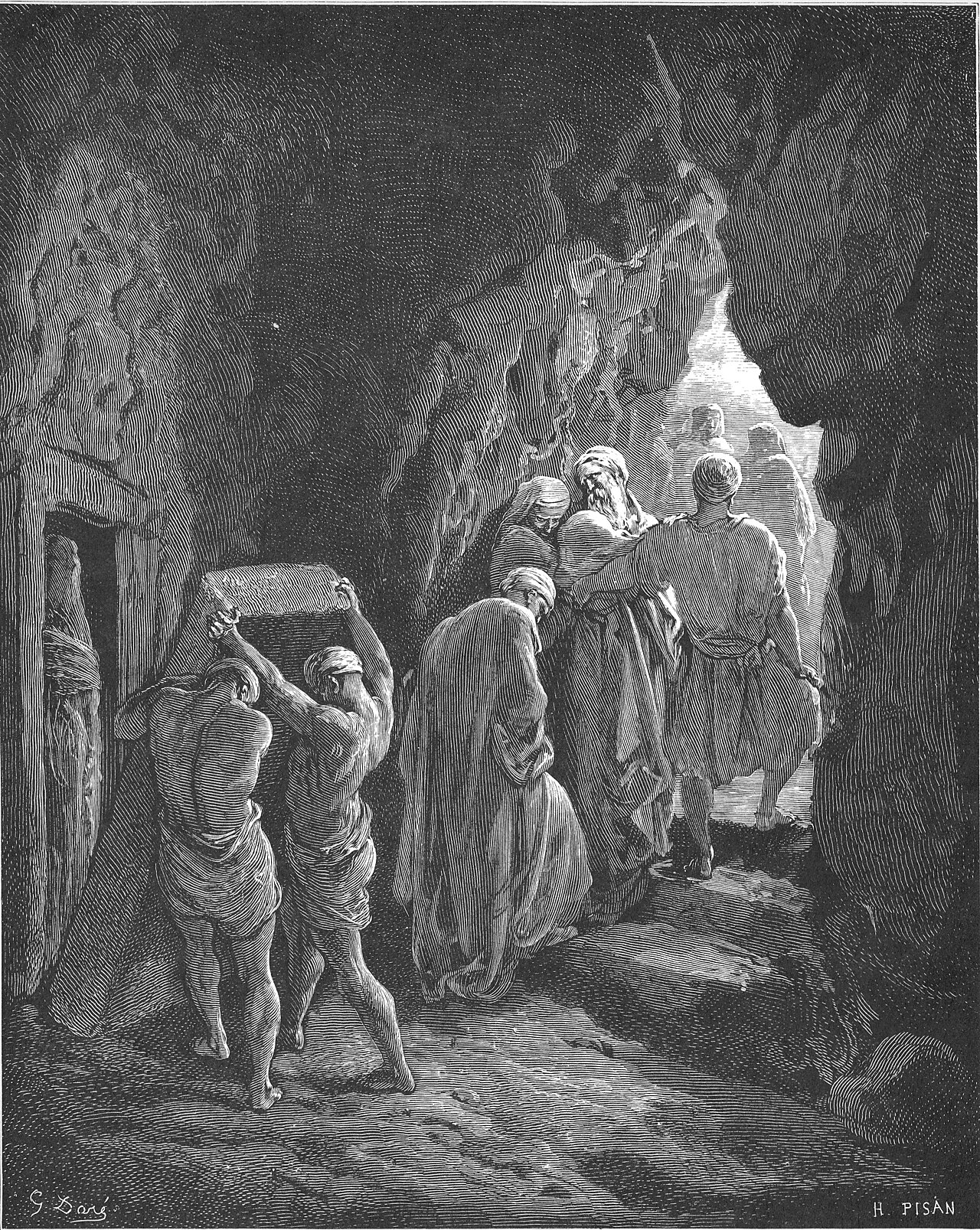
Abraham rises from the ground where mourners sat and turns to the Hittites, who hold the country God had promised him. He owns none of it. Stephen says at Acts 7:5 that God gave Abraham no inheritance in the land, no foot of ground at all. The promise now has a dead wife to bury and no ground to put her in.
The record, by era
The Puritans and the Awakening3 voices
And Abraham stood up from before his dead,.... The corpse of Sarah, by which he sat pensive and mourning, perhaps upon the ground, as was the custom of mourners, Job 1:13; where having sat awhile, he rose up and went out of the tent, to provide for the funeral of his wife as became him: and spake unto the sons of Heth; the descendants of Heth the son of Canaan, see Gen 10:15; who were at this time the inhabitants and proprietors of that part of the land where Abraham now was: saying; as follows:
The argument he used with the children of Heth, which was this: " I am a stranger and a sojourner with you, therefore I am unprovided, and must become a humble suitor to you for a burying-place." This was one occasion which Abraham took to confess that he was a stranger and a pilgrim upon earth; he was not ashamed to own it thus publicly, Heb. xi.
The argument he used with the children of Heth, which was this: " I am a stranger and a sojourner with you, therefore I am unprovided, and must become a humble suitor to you for a burying-place." This was one occasion which Abraham took to confess that he was a stranger and a pilgrim upon earth; he was not ashamed to own it thus publicly, Heb. xi.
The Nineteenth Century2 voices
A commentator
Jamieson, Fausset & Brown1802–1910
Commentary Critical and Explanatory on the Whole Bible (1871)
Abraham stood up, &c.--Eastern people are always provided with family burying-places; but Abraham's life of faith--his pilgrim state--had prevented him acquiring even so small a possession (Ac 7:5). spake unto the sons of Heth--He bespoke their kind offices to aid him in obtaining possession of a cave that belonged to Ephron--a wealthy neighbor.
A commentator
Jamieson, Fausset & Brown1802–1910
Commentary Critical and Explanatory on the Whole Bible (1871)
proposed
Abraham stood up, &c.--Eastern people are always provided with family burying-places; but Abraham's life of faith--his pilgrim state--had prevented him acquiring even so small a possession (Ac 7:5). spake unto the sons of Heth--He bespoke their kind offices to aid him in obtaining possession of a cave that belonged to Ephron--a wealthy neighbor.
The words behind it
10 Hebrew wordsEvery Hebrew word of this verse in the order it stands, with what it means and the door to its own study. The last column counts the times a word stands in the whole Bible: the rarer the word, the more the places it appears belong together.
| Hebrew | Sound | Meaning | Word study | In the Bible |
|---|---|---|---|---|
| וַיָּ֙קָם֙ | vaiyakom | and he arose | H6965 → | 628 times |
| אַבְרָהָ֔ם | ʾavraham | Abraham | H85 → | 175 times |
| מֵעַ֖ל | meal | from on | H5921 → | 5755 times |
| פְּנֵ֣י | penei | [the] face of | H6440 → | 2123 times |
| מֵת֑וֹ | meto | dead his | H4191 → | 839 times |
| וַיְדַבֵּ֥ר | vaydaber | and he spoke | H1696 → | 1141 times |
| אֶל־ | ʾel- | to | H413 → | 5510 times |
| בְּנֵי־ | benei- | [the] people of | H1121 → | 4930 times |
| חֵ֖ת | chet | Heth | H2845 → | 14 times |
| לֵאמֹֽר׃ | lemor | <to> saying | H559 → | 5305 times |
וַיָּ֙קָם֙and he arose
vaiyakomH6965 →628 times
אַבְרָהָ֔םAbraham
ʾavrahamH85 →175 times
מֵעַ֖לfrom on
mealH5921 →5755 times
פְּנֵ֣י[the] face of
peneiH6440 →2123 times
מֵת֑וֹdead his
metoH4191 →839 times
וַיְדַבֵּ֥רand he spoke
vaydaberH1696 →1141 times
אֶל־to
ʾel-H413 →5510 times
בְּנֵי־[the] people of
benei-H1121 →4930 times
חֵ֖תHeth
chetH2845 →14 times
לֵאמֹֽר׃<to> saying
lemorH559 →5305 times
A shaded row is a word that stands 400 times or fewer in the Bible.
The walk
8 stopsEach card is a verse this one points to, and under it the verses that one points to in turn. Where several paths arrive at the same place, that place is listed first: the text keeps returning to it.
Through
1 Samuel 26:6And David asked Ahimelech the Hittite and Abishai son of Zeruiah, Joab’s brother, “Who will go down with me to Saul in the camp?” “I will go with you,” answered Abishai.
it leads to
- Judges 7:10–11
But if you are afraid to do so, then go down to the camp with your servant Purah
- Judges 7:10–11
Through
Genesis 27:46Then Rebekah said to Isaac, “I am weary of my life because of these Hittite women. If Jacob takes a Hittite wife from among them, what good is my life?”
it leads to
- Genesis 26:34–35
When Esau was forty years old, he took as his wives Judith daughter of Beeri the Hittite and Basemath daughter of Elon the Hittite.
- Genesis 24:3
and I will have you swear by the LORD, the God of heaven and the God of earth, that you will not take a wife for my son from the daughters of the Canaanites…
- Genesis 28:8
And seeing that his father Isaac disapproved of the Canaanite women,
- Genesis 34:1–2
Now Dinah, the daughter Leah had borne to Jacob, went out to visit the daughters of the land.
- Genesis 26:34–35
Through
Genesis 10:15And Canaan was the father of Sidon his firstborn, and of the Hittites,
it leads to
- Numbers 34:2–15
“Command the Israelites and say to them: When you enter the land of Canaan, it will be allotted to you as an inheritance with these boundaries:
- Exodus 34:11
Observe what I command you this day. I will drive out before you the Amorites, Canaanites, Hittites, Perizzites, Hivites, and Jebusites.
- 1 Chronicles 1:13
And Canaan was the father of Sidon his firstborn, and of the Hittites,
- Numbers 34:2–15
Where this verse is studied
On this page
About Genesis
Who and where
1 name in this verse with a page on the site.
This page draws on Adam Clarke, Commentary on the Bible; Jamieson, Fausset & Brown, Commentary Critical and Explanatory on the Whole Bible; John Gill, Exposition of the Old Testament (1748-1763) and Matthew Henry, Commentary on the Whole Bible.