
Genesis 23:13
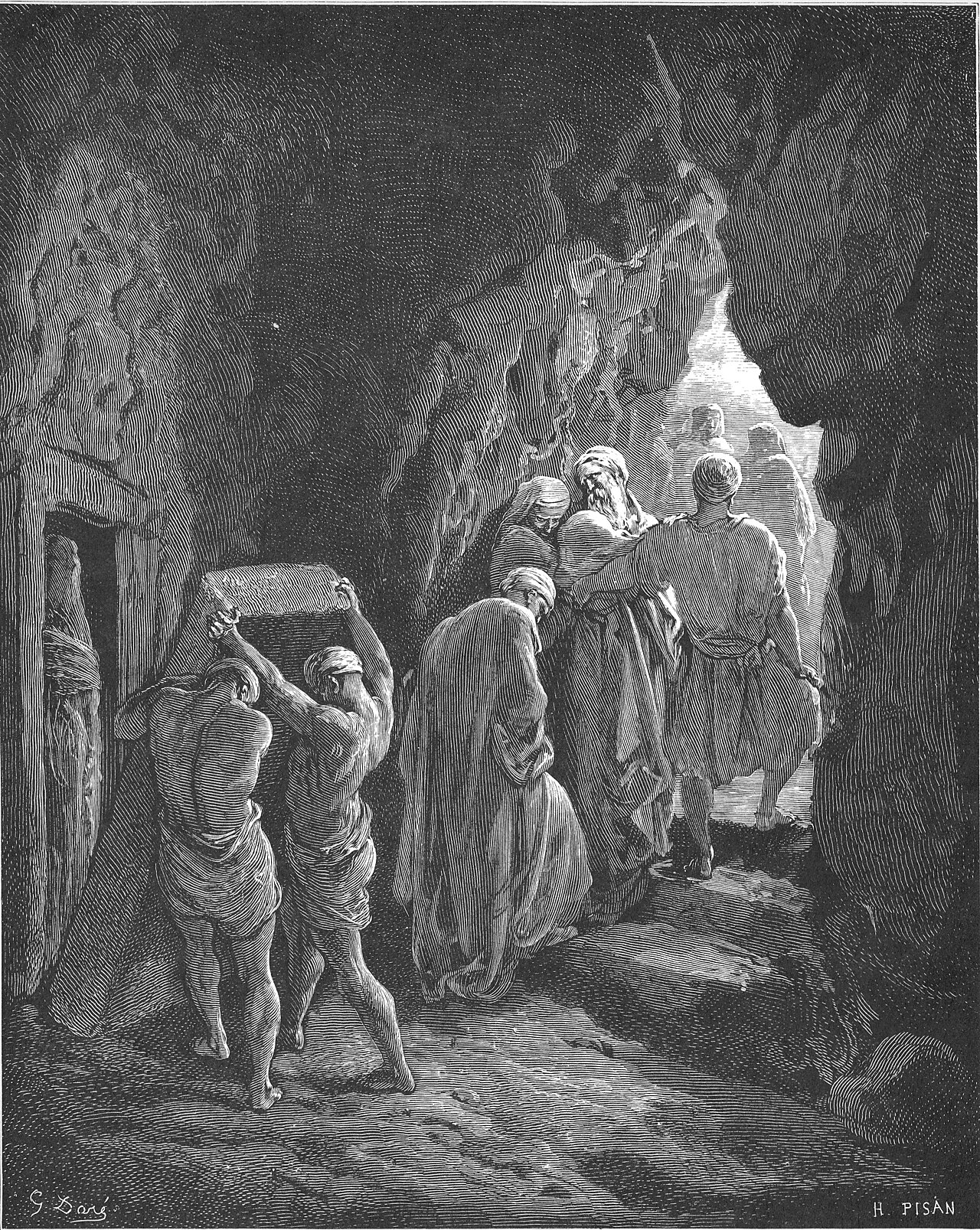
in Genesis 23and said to Ephron in their presence, “If you will please listen to me, I will pay you the price of the field. Accept it from me, so that I may bury my dead there.”
BSB
The same verse in ASV and KJV ▾
ASV
And he spake unto Ephron in the audience of the people of the land, saying, But if thou wilt, I pray thee, hear me: I will give the price of the field; take it of me, and I will bury my dead there.
KJV
And he spake unto Ephron in the audience of the people of the land, saying, But if thou wilt give it, I pray thee, hear me: I will give thee money for the field; take it of me, and I will bury my dead there.
⋯
This verse in Genesis 23
Commentary
8 notes on this verseIf thou wilt give it - Instead of, if thou wilt give it, we should read, But if thou wilt sell it, I will give thee money for the field; כסף keseph, silver, not coined money, for it is not probable that any such was then in use.
This site's exposition
Again Abraham bowed down before the people of the land
on Genesis 23:12-13
He bows a second time and turns the gift down. He asks to pay silver for the field, so the only ground he will ever hold in the land of promise is bought at a witnessed price. Henry draws the rule that grace gives no man title to another man's land. The promise of Canaan gave Abraham no claim on Hittite ground.
This site's exposition
pay you the price of the field
Abraham will pay the price of the field and asks Ephron to accept it in the presence of the people. John Wesley says he paid so that Ephron could never reproach him with a gift. Adam Clarke notes that the price was silver weighed out.
The record, by era
The Church Fathers1 voice
Notice, however, how the good man instructs even those people with his characteristic common sense, through his very actions, by forbearing to take possession of it before paying a just price. "Even if you for your part … have proved so kindly disposed toward me, I still cannot bring myself to take the tomb from you unless first I pay the proper price." He gave them money, the text says, took possession of the tomb "and buried his wife Sarah in the double cave of the field overlooking Mamre." The man who was so famous and respected, who enjoyed such confidence with God and was the object of such attention from everyone, so to say, in that place that even the Hittites called him king—he owned not even one foot of land. Hence blessed Paul also celebrated this good man's virtue in writing these words: "By faith Abraham dwelt in the land of promise, like a foreigner living in tents with Isaac and Jacob, coheirs of the same promise." Then to teach us how it was through faith that he dwelt there, he added, "He looked forward, you see, to the city built on foundations of which the builder and creator was God." In the hope of things to come, he is saying, he overlooked present realities, and, in the expectation of greater things, he set less store by those of this life—and this before the law and the age of grace.So what excuse will we have, tell me, who despite such wonderful promises and guarantees of ineffable blessings hanker for present realities, buying up property, ever concerned for our image, amassing all these possessions out of greed and avarice and fulfilling in practice what the blessed prophet said in his lament, "Woe to those who pile house on house and add property to property for the purpose of robbing their neighbor of something." Do we not see this happening each day—widows being robbed, orphans despoiled and the weak oppressed by the strong?
The Puritans and the Awakening3 voices
I will give thee money for the field - It was not in pride that Abraham refused the gift; but 1. Abraham was rich in silver and gold, and therefore would not take advantage of Ephron's generosity. He would pay for it, lest Ephron, when this good humour was over, should upbraid him with it.
I will give thee money for the field - It was not in pride that Abraham refused the gift; but 1. Abraham was rich in silver and gold, and therefore would not take advantage of Ephron's generosity. He would pay for it, lest Ephron, when this good humour was over, should upbraid him with it.
And he spake unto Ephron in the audience of the people of the land,....
The Nineteenth Century1 voice
A commentator
Jamieson, Fausset & Brown1802–1910
Commentary Critical and Explanatory on the Whole Bible (1871)
Ephron answered, Nay, my lord, &c.--Here is a great show of generosity, but it was only a show; for while Abraham wanted only the cave, he joins "the field and the cave"; and though he offered them both as free gifts, he, of course, expected some costly presents in return, without which, he would not have been satisfied.
How the passage was read
What the Jewish commentators add
‘LU’ (IF) THOU WILT HEAR ME. This is equivalent to saying, “If you, if you will hear me,” and the purport thereof is like, “if you, if you would hear me,” the redundancy being for the purpose of emphasizing the matter.
1 more on this passage, in their own words ▾
Abraham bowed before Ephron in the presence of the people of the land in order to honor him.
This section is reception history: how the passage was read and kept in the Jewish tradition. Where a reading parts from an essential of the Christian faith, the section says so at that point.
Texts and citation data: Sefaria; each excerpt follows its version’s licence. 5 further sources are cited on this chapter that carry no English text this site may quote or only restate the verse.
The words behind it
21 Hebrew wordsEvery Hebrew word of this verse in the order it stands, with what it means and the door to its own study. The last column counts the times a word stands in the whole Bible: the rarer the word, the more the places it appears belong together.
| Hebrew | Sound | Meaning | Word study | In the Bible |
|---|---|---|---|---|
| וַיְדַבֵּ֨ר | vaydaber | and he spoke | H1696 → | 1141 times |
| אֶל־ | ʾel- | to | H413 → | 5510 times |
| עֶפְר֜וֹן | efron | Ephron | H6085 → | 14 times |
| בְּאָזְנֵ֤י | beazenei | in [the] ears of | H241 → | 187 times |
| עַם־ | ʾam- | [the] people of | H5971 → | 1873 times |
| הָאָ֙רֶץ֙ | haaretz | the land | H776 → | 2504 times |
| לֵאמֹ֔ר | lemor | <to> saying | H559 → | 5305 times |
| אַ֛ךְ | ʾakh | nevertheless | H389 → | 161 times |
| אִם־ | ʾim- | if | H518 → | 1069 times |
| אַתָּ֥ה | ʾatah | you | H859 → | 1094 times |
| ל֖וּ | lu | if | H3863 → | 22 times |
| שְׁמָעֵ֑נִי | shemaeni | listen to me | H8085 → | 1159 times |
| נָתַ֜תִּי | natati | I give | H5414 → | 2011 times |
| כֶּ֤סֶף | kesef | [the] money of | H3701 → | 403 times |
| הַשָּׂדֶה֙ | hasadeh | the field | H7704 → | 334 times |
| קַ֣ח | kach | take [it] | H3947 → | 966 times |
| מִמֶּ֔נִּי | mimeni | from me | H4480 → | 1188 times |
| וְאֶקְבְּרָ֥ה | veekberah | so let me bury | H6912 → | 133 times |
| אֶת־ | ʾet- | <obj.> | H853 → | 10935 times |
| מֵתִ֖י | meti | dead my | H4191 → | 839 times |
| שָֽׁמָּה׃ | shamah | there <towards> | H8033 → | 834 times |
וַיְדַבֵּ֨רand he spoke
vaydaberH1696 →1141 times
אֶל־to
ʾel-H413 →5510 times
עֶפְר֜וֹןEphron
efronH6085 →14 times
בְּאָזְנֵ֤יin [the] ears of
beazeneiH241 →187 times
עַם־[the] people of
ʾam-H5971 →1873 times
הָאָ֙רֶץ֙the land
haaretzH776 →2504 times
לֵאמֹ֔ר<to> saying
lemorH559 →5305 times
אַ֛ךְnevertheless
ʾakhH389 →161 times
אִם־if
ʾim-H518 →1069 times
אַתָּ֥הyou
ʾatahH859 →1094 times
ל֖וּif
luH3863 →22 times
שְׁמָעֵ֑נִיlisten to me
shemaeniH8085 →1159 times
נָתַ֜תִּיI give
natatiH5414 →2011 times
כֶּ֤סֶף[the] money of
kesefH3701 →403 times
הַשָּׂדֶה֙the field
hasadehH7704 →334 times
קַ֣חtake [it]
kachH3947 →966 times
מִמֶּ֔נִּיfrom me
mimeniH4480 →1188 times
וְאֶקְבְּרָ֥הso let me bury
veekberahH6912 →133 times
אֶת־<obj.>
ʾet-H853 →10935 times
מֵתִ֖יdead my
metiH4191 →839 times
שָֽׁמָּה׃there <towards>
shamahH8033 →834 times
A shaded row is a word that stands 400 times or fewer in the Bible.
The walk
8 stopsEach card is a verse this one points to, and under it the verses that one points to in turn. Where several paths arrive at the same place, that place is listed first: the text keeps returning to it.
Through
Hebrews 13:5Keep your lives free from the love of money and be content with what you have, for God has said: “Never will I leave you, never will I forsake you.”
it leads to
- Deuteronomy 31:8
The LORD Himself goes before you; He will be with you. He will never leave you nor forsake you. Do not be afraid or discouraged.”
- Joshua 1:5
No one shall stand against you all the days of your life. As I was with Moses, so will I be with you; I will never leave you nor forsake you.
- Deuteronomy 31:6
Be strong and courageous; do not be afraid or terrified of them, for it is the LORD your God who goes with you; He will never leave you nor forsake you.”
- 1 Samuel 12:22
Indeed, for the sake of His great name, the LORD will not abandon His people, because He was pleased to make you His own.
- Isaiah 41:17
The poor and needy seek water, but there is none; their tongues are parched with thirst. I, the LORD, will answer them; I, the God of Israel, will not forsake them.
- Deuteronomy 31:8
Through
Acts 20:35In everything, I showed you that by this kind of hard work we must help the weak, remembering the words of the Lord Jesus Himself: ‘It is more blessed to give than to receive.’”
it leads to
- Hebrews 13:16
And do not neglect to do good and to share with others, for with such sacrifices God is pleased.
- Hebrews 13:16
Through
Romans 13:8Be indebted to no one, except to one another in love. For he who loves his neighbor has fulfilled the law.
it leads to
- Romans 13:10
Love does no wrong to its neighbor. Therefore love is the fulfillment of the law.
- Matthew 22:39–40
And the second is like it: ‘Love your neighbor as yourself.’
- Romans 13:10
Where this verse is studied
On this page
About Genesis
This page draws on Adam Clarke, Commentary on the Bible; Jamieson, Fausset & Brown, Commentary Critical and Explanatory on the Whole Bible; John Chrysostom, HOMILIES ON GENESIS 48.3-4; John Gill, Exposition of the Old Testament; John Gill, Exposition of the Old Testament (1748-1763); John Wesley, Explanatory Notes upon the Old Testament and Matthew Henry, Commentary on the Whole Bible.