
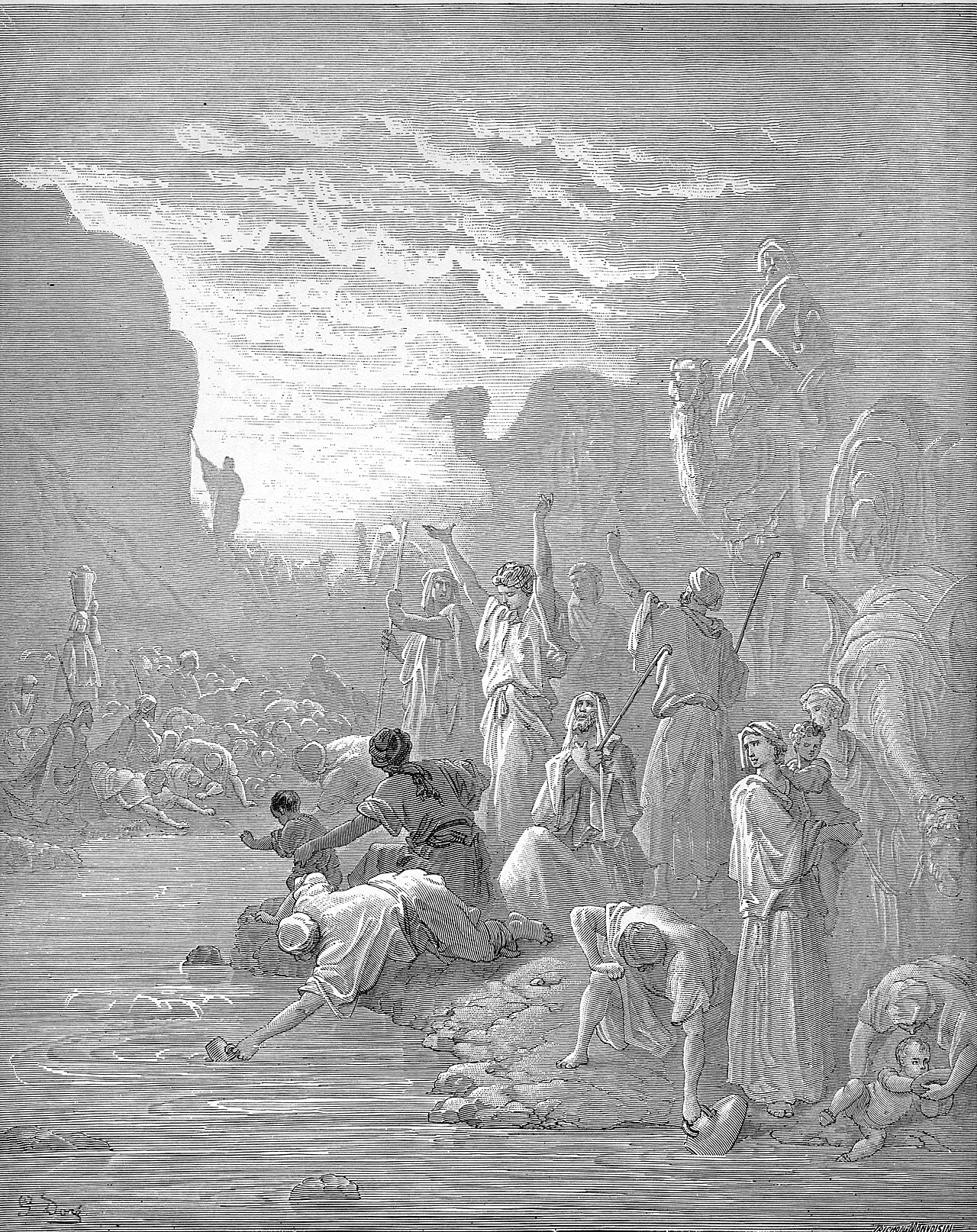
Exoduschapter 17
16 verses · Moses, by tradition · 15th or 13th century BC · The Law
Behold, I will stand there before you by the rock at Horeb. And when you strike the rock, water will come out of it for the people to drink.” So Moses did this in the sight of the elders of Israel.
Introduction
Moses, by tradition, The Law, Exodus Overview.
Exodus comes down under the name of Moses, and this chapter holds the first place in Scripture where he is told to write something down. He had kept sheep in this wilderness for forty years before he led a nation through it. Its first hearers were the generation that grew up in the desert and knew these camps as places their parents had passed. The chapter closes the run of trials between the sea and the mountain of God. Listen for the question the people ask and the two answers the chapter gives it. Listen too for Israel's first enemy.
Context
- Who
- Israel in the wilderness, living under a standing order about Amalek
- What
- Exodus 17 is the account of the water from the rock at Rephidim and of Israel's first battle, fought against Amalek at the same camp.
- Where
- Rephidim, the last camp before Sinai, near the rock at Horeb; the site is unlocated, and Wadi Feiran in the south of the Sinai peninsula is the place most often proposed.
- When
- Between the middle of the second month and the third month after Israel left Egypt, and the exodus itself is dated to the fifteenth century BC or to the thirteenth century BC by the two main datings, both held, with Exodus 12:40 to 41 and 1 Kings 6:1 bearing on the question.
- Why
- It answers the people's doubt that the LORD was among them, and it begins the written record of the LORD's war with Amalek.
Historical context
The chapter is told of the whole congregation moving as the LORD commanded, with Moses, Aaron, Hur and Joshua each named in it, Joshua for the first time in Scripture.
Show the rest of the historical context, 5 more paragraphs
It falls between the Desert of Sin and the arrival at Sinai. The early dating puts it about 1446 BC from the four hundred and eighty years of 1 Kings 6:1 read literally, while Kenneth Kitchen and James Hoffmeier date the exodus to the thirteenth century from the store cities of Exodus 1:11, and the chapter names no Pharaoh and no year.
The place is Rephidim, and the rock Moses is sent to is placed at Horeb, which is the mountain the next chapters camp at.
The occasion is thirst that turned into a legal quarrel, and the first battle Israel ever fought.
A first hearer knew where water came from in that country, which is springs, cisterns and seasonal wadis, and he knew that a camp of that size could drain a source in a day. He knew the two names Moses gave the place, Massah and Meribah, as the words for testing and quarrelling, so the naming records a charge laid against the people. He knew the Amalekites as desert raiders of the Negev and Sinai, and Deuteronomy 25:17 to 19 adds that they cut off the stragglers at the rear, which is how raiders worked a migrating column and why the judgment on them is so heavy. He also knew that a banner was the standard an army rallied to, which is the name Moses gave the altar he built.
The LORD's words at the rock put him in the place of the accused, since he says he will stand there before Moses on the rock while the elders watch.
Significance
Water out of a struck rock in front of the elders answered the question the people had actually asked, which was whether the LORD was among them or not.
Show the rest of the significance, 1 more paragraph
The first battle Israel fought was won with a staff held up on a hill and two men holding the arms steady. That was said to men who would shortly be fighting for Canaan, about where their strength came from.
This chapter in Jewish lifeWhat this chapter is in Jewish life and reading.
What is done
One rule of the synagogue is drawn from this chapter. Rashi reads the three men named at verse 10, Moses and Aaron and Hur, as the pattern for a public fast day, on which three men stand before the ark to lead the prayer. He infers it from the fasting Israel was engaged in during the battle, and cites the Mekhilta (Rashi on Exodus 17:10:1).
How it is read
Rashi guards the miracle at the rock against a later doubt. The elders were taken along as witnesses, he says, so that nobody could claim "that there had been springs there from time immemorial" (Rashi on Exodus 17:5:2). At verse 6 he reads the wording closely, holding that Moses was told to strike into the rock rather than on its face (Rashi on Exodus 17:6:1). At verse 8 he explains why Amalek follows the question whether the LORD is among us. He gives the parable of a son carried on his father's shoulder who asks a passer-by where his father is (Rashi on Exodus 17:8:1). At verse 9 he reads the words choose out men for us as Moses setting Joshua beside himself, and the Rabbis drew a rule of honour from it (Rashi on Exodus 17:9:1). At verse 12 he explains the heavy hands as a consequence, since Moses had sent another man to the fighting (Rashi on Exodus 17:12:1). The text is the Rosenbaum and Silbermann Rashi of 1929 to 1934, in the public domain. Ramban reads the complaint of verse 3 as a practical one. The people named their cattle in it, so the whole matter needed counsel (Ramban on Exodus 17:3:1, the Chavel translation, Shilo, 1971 to 1976).
What the rabbis say
The rabbis take up the quarrel over water at Arakhin 15a:20 and Bekhorot 5b:4. On Moses fearing to be stoned they taught in the Mekhilta at Tractate Vayassa 7:8. On the rock at Horeb they taught at Bava Metzia 86b:13 and Bamidbar Rabbah 14:2. On the coming of Amalek they taught at Jerusalem Talmud Megillah 3:7:1 and Jerusalem Talmud Taanit 4:3:2. On the lifted hands they taught in Ein Yaakov (Glick Edition), Rosh Hashanah 3:1.
Sources: Rashi, Rashi on Exodus 17:5:2, 17:6:1, 17:8:1, 17:9:1, 17:10:1 and 17:12:1, Pentateuch with Rashi's commentary by M. Rosenbaum and A. M. Silbermann, 1929 to 1934 (public domain); Ramban, Ramban on Exodus 17:3:1, Commentary on the Torah translated by Charles B. Chavel, Shilo, 1971 to 1976 (CC-BY); Ibn Ezra, Ibn Ezra on Exodus 17:7:1 and 17:8:1, cited by ref alone under the corpus licence rule; The Babylonian Talmud, Arakhin 15a:20, Bekhorot 5b:4 and Bava Metzia 86b:13, cited by ref; The Jerusalem Talmud, Jerusalem Talmud Megillah 3:7:1 and Taanit 4:3:2, cited by ref; The Midrash, Mekhilta DeRabbi Yishmael, Tractate Vayassa 7:8, Bamidbar Rabbah 14:2, and Ein Yaakov (Glick Edition), Rosh Hashanah 3:1, cited by ref.
The heads below are this chapter's scenes. The numbered points under each are its verses.
Water from the Rock at Horeb
They came to Rephidim at the commandment of the LORD and found no water there, so the obedience and the hardship arrive together. The people bring two charges in one breath and the text keeps them apart, since chiding is aimed at Moses and tempting is aimed at the LORD. This is the fourth complaint in four chapters, after the sea at 14:11, the bitter water at 15:24 and the hunger at 16:2.
Exodus 17:1
“According to their journeys - The Israelites rested at two stations before they reached Rephidim, namely, Dophkah and Alush Num 33:12-14. Dophkah was in the Wady Sih, a day’s journey from the Wady Nasb. The wilderness of Sin Exo 16:1 properly speaking ends here, the sandstone ceases, and is replaced by the porphyry and granite which belong to the central formation of the Sinaitic group. Alush may have been near the entrance to the Wady Sheikh. Rephidim - (Variously placed at Feiran at the base of Mount Serbal, or at the pass of El Watiyeh.)”
1 more voice on this verseWhat preachers and commentators have said about this verse, in their own words.
Exodus 17:1
“The same phraseology occurs elsewhere (Nu 9:18, 19). pitched in Rephidim--now believed, on good grounds, to be Wady Feiran, which is exactly a day's march from Mount Sinai, and at the entrance of the Horeb district. It is a long circuitous defile about forty feet in breadth, with perpendicular granite rocks on both sides.”
Jamieson, Fausset & Brown · Commentary Critical and Explanatory on the Whole Bible (1871)reformed
Exodus 17:2
“Why chide ye with me? - God is your leader, complain to him; Wherefore do ye tempt the Lord? As he is your leader, all your murmurings against me he considers as directed against himself; why therefore do ye tempt him? Has he not given you sufficient proofs that he can destroy his enemies and support his friends? And is he not among you to do you good? Exo 17:7. Why therefore do ye doubt his power and goodness, and thus provoke him to treat you as his enemies?”
Adam Clarke · Commentary on the Bible (1810-1826)evangelical
1 more voice on this verse
Exodus 17:2
“Tempt the Lord - It is a general characteristic of the Israelites that the miracles, which met each need as it arose, failed to produce a habit of faith: but the severity of the trial, the faintness and anguish of thirst in the burning desert, must not be overlooked in appreciating their conduct.”
Exodus 17:3-4
The accusation is the one they made at the sea and in the wilderness of Sin, that Moses brought them out of Egypt in order to kill them, and this time it takes in the children and the cattle. Moses answers the crowd by turning to God rather than by arguing back, which is what he does at every one of these scenes. They be almost ready to stone me is the first time the anger turns toward killing him, and Numbers 14:10 records the whole congregation taking up stones.
Exodus 17:3
“And the people murmured - The reader must not forget what has so often been noted relating to the degraded state of the minds of the Israelites. A strong argument however may be drawn from this in favor of their supernatural escape from Egypt. Had it been a scheme concerted by the heads of the people, provision would necessarily have been made for such exigencies as these.”
Adam Clarke · Commentary on the Bible (1810-1826)evangelical
Then Moses cried out to the LORD: Cried out is the verb of Israel's cry under the taskmasters at 3:7 and at the sea at 14:10, and here Moses cries to the LORD about these people. Jerome reads the cry as intercession for people who were ready to stone him. He likens Moses to the Shepherd who carries the wandering sheep.
Exodus 17:4
“When [Moses] was being stoned by the people, he made intercession for them. Even more so he wished to be blotted out of God's book sooner than that the flock committed to him should perish. He sought to imitate the Shepherd who would, he knew, carry on his shoulders even the wandering sheep.”
Jerome · written before 420 · LETTER 82.3patristic
God sends Moses out in front of the people who were ready to stone him, and tells him what to carry. The rod is identified by what it last did, and it is one stick doing the whole book's work, the shepherd's staff that became a serpent at 4:3, the rod that turned the Nile to blood at 7:20 and the rod that divided the sea at 14:16. The elders are taken along so that the water has witnesses who watched it happen.
Exodus 17:5
“And the Lord said unto Moses,.... Out of the pillar of cloud: go on before the people, lead them on nearer to Mount Sinai or Horeb, within sight of which they now were.”
1 more voice on this verse
Exodus 17:5
“Upon God's providence even in the greatest straits and difficulties; And upon Christ's grace; that rock was Christ, 1 Cor. x, 4. The graces and comforts of the Spirit are compared to rivers of living waters, John vii, 38, 39; iv, 14.”
John Wesley · Explanatory Notes upon the Old Testament (1765)evangelical
God puts himself at the place the blow lands, standing on the rock that Moses is told to strike. The word rock occurs here for the first time in Scripture, and Horeb is the mountain where the bush burned at 3:1 and where the law will be given. Paul writes at 1 Corinthians 10:4 that they drank of that spiritual Rock that followed them, and that Rock was Christ, which is the New Testament drawing the line itself. Matthew Henry and John Wesley both read the struck rock this way in their comments on the verse.
Exodus 17:6
“I will stand before thee there, upon the rock in Horeb - The rock, הצור hatstsur. It seems as if God had directed the attention of Moses to a particular rock, with which he was well acquainted; for every part of the mount and its vicinity must have been well known to Moses during the time he kept Jethro’s flocks in those quarters.”
Adam Clarke · Commentary on the Bible (1810-1826)evangelical
1 more voice on this verse
Exodus 17:6
“Upon Christ's grace: That rock was Christ, 1 Cor. x. The graces and comforts of the Spirit are compared to rivers of living water, John vii. These flow from Christ, who is the rock smitten by the law of Moses, for he was made under the law.”
Matthew Henry · Commentary on the Whole Bible (1707-1721)puritan
Massah means temptation and Meribah means strife, so the place is named after what Israel did there rather than after what God did. Their question, Is the LORD among us, or not, is asked by people standing under a pillar of cloud and drinking water out of a stone. Psalm 95:8 makes this the pattern of a hard heart, and Hebrews 3:7 to 3:11 quotes that psalm and applies it to its own readers. Exodus answers every one of these complaints with water, bread, meat or a dry road, and the same complaints in Numbers bring judgment instead, which is a change neither book states on its own.
Exodus 17:7
“He called the name of the place Massah, and Meribah - מסה Massah signifies temptation or trial; and מריבה Meribah, contention or litigation. From 1Co 10:4, we learn that this rock was a type of Christ, and their drinking of it is represented as their being made partakers of the grace and mercy of God through Christ Jesus; and yet many who drank fell and perished in the wilderness in the very act of disobedience! Reader, be not high minded, but fear!”
Adam Clarke · Commentary on the Bible (1810-1826)evangelical
1 more voice on this verse
Exodus 17:7
“They do, in effect, suppose that Moses was an impostor, Aaron a deceiver, the pillar of cloud and fire a mere sham and illusion, which imposed upon their senses, that long series of miracles which had rescued them, served them, and fed them, a chain of cheats, and the promise of Canaan a banter upon them; it was all so, if the Lord was not among them.”
Matthew Henry · Commentary on the Whole Bible (1707-1721)puritan
Hands Held Up Against Amalek
This is the first war Israel fights as a nation, and it comes before the law, before the tabernacle and directly after the water. Matthew Henry and Adam Clarke both trace Amalek to Esau by way of Eliphaz at Genesis 36:12, which would make the first nation to attack Israel a relative. John Gill records the objection that the desert Amalekites look older than that son of Eliphaz, so the descent is a reading held by named men rather than a settled fact. Deuteronomy 25:18 supplies what Exodus leaves out, that they struck the faint and weary at the back of the column.
Exodus 17:8
“The Amalekites were the posterity of Esau, who hated Jacob because of the birthright and blessing, and this was an effort of the hereditary enmity, a malice that ran in the blood, and perhaps was now exasperated by the working of the promise towards an accomplishment.”
Matthew Henry · Commentary on the Whole Bible (1707-1721)puritan
Exodus 17:9-10
Joshua is named here for the first time in Scripture, and the man who will lead Israel into the land is introduced choosing men for a fight. The work is split between a valley and a hilltop, with the sword below and the rod of God above. Hur arrives in verse 10 with no introduction at all, and he stands with Aaron again at 24:14 when Moses goes up the mountain. Josephus and the rabbis make him the husband of Miriam, which is tradition rather than anything the text says.
Exodus 17:9
“When the Egyptians pursued them Israel must stand still and see what God would do; but now it was required that they should bestir themselves. Note, God is to be trusted in the use of means.”
Matthew Henry · Commentary on the Whole Bible (1707-1721)puritan
Moses, Aaron, and Hur went up: Joshua does as Moses instructed him, and obedience is the first thing recorded of him. Adam Clarke identifies the Hur who went up the hill with the Hur of 1 Chronicles 2:19, a son of Caleb in the line of Judah. On that reading he is Bezalel's grandfather.
Exodus 17:11-13
The battle rises and falls with the hand on the hill rather than with the fighting in the valley, and the verse says it twice so the reader cannot miss it. What the raised hand means has been read two ways, as a banner lifted to rally the men, and as the posture of prayer, which is how the Targum renders it and how John Gill reports the older Jewish readers. A stone is put under Moses and two men hold his arms steady until sundown, so the thing the day turns on is the thing that gives out first. Joshua wins the field with the edge of the sword, and the account still gives him the credit by name.
Exodus 17:11
“And it came to pass, when Moses held up his hand, that Israel prevailed,.... With his rod in it as a banner displayed, as some think, which inspired the Israelites with courage to fight, and they had the better of it; though Aben Ezra rejects that notion, observing, that if that had been the case, Aaron or Hur would have lifted it up, or fixed it in a high place on the mount, that it might have been seen standing; and therefore he thinks the sense of the ancients the most correct, that it was a prayer gesture.”
1 more voice on this verse
Exodus 17:11
“For my own warfare, however, I am at a loss what course to pursue, what alliance, what word of wisdom, what grace to devise, with what panoply to arm myself against the wiles of the wicked one. What Moses did is to conquer him by stretching out his hands upon the mount, in order that the cross, thus typified and prefigured, may prevail.”
Gregory of Nazianzus · written before 390 · ORATION 2.88patristic
his hands remained steady until the sun went down: Steady translates emunah, the Hebrew noun used elsewhere for faithfulness, as at Habakkuk 2:4. Albert Barnes takes the length of the fight, a full day to sundown, as a mark of Amalek's strength, a people he thinks were trained by wars with Egypt. He calls it a deliberate attack.
Exodus 17:12
“Until the going down of the sun - The length of this first great battle indicates the strength and obstinacy of the assailants. It was no mere raid of Bedouins, but a deliberate attack of the Amalekites, who had been probably thoroughly trained in warfare by their struggles with Egypt.”
1 more voice on this verse
Exodus 17:12
“No doubt it was a great encouragement to the people to see Joshua before them in the field of battle and Moses above them upon the top of the hill: Christ is both to us--our Joshua, the captain of our salvation who fights our battles, and our Moses, who, in the upper world, ever lives making intercession, that our faith fail not.”
Matthew Henry · Commentary on the Whole Bible (1707-1721)puritan
Joshua overwhelmed Amalek and his army: The verse names Amalek and his army as two parties. John Gill records the reading that Amalek was the title of their king, as Pharaoh was the title of Egypt's, and finds no ground for it in Scripture. He takes the army as the allies Amalek brought to the fight.
Exodus 17:13
“And Joshua discomfited Amalek and his people with the edge of the sword. Amalek being distinguished from "his people", has led some to think that Amalek was the name of the king, or general of the army, and that it was a common name to the kings of that nation, as Pharaoh was to the kings of Egypt; but for this there is no foundation in the Scriptures: as Amelek signifies the Amalekites, his people may design the confederates and auxiliaries, the other people, as Ben Gersom expresses it, they brought with them to fight against Israel.”
1 more voice on this verse
Exodus 17:13
“Note, Weapons formed against God's Israel cannot prosper long, and shall be broken at last. The cause of God and his Israel will be victorious. Though God gave the victory, yet it is said, Joshua discomfited Amalek, because Joshua was a type of Christ, and of the same name, and in him it is that we are more than conquerors.”
Matthew Henry · Commentary on the Whole Bible (1707-1721)puritan
This is the first command in Scripture to write anything, and the subject of it is the blotting out of Amalek. The word memorial was used at 3:15 of the name of God, and here it is attached to a written record meant to outlast the men who fought. Moses is told to rehearse it in the ears of Joshua, which puts it in front of the man who will still be leading forty years later. Deuteronomy 25:17 to 25:19 repeats the charge, 1 Samuel 15 is where Saul is sent to carry it out, and Haman is still called the Agagite at Esther 3:1.
Exodus 17:14
“Write this for a memorial in a book - This is the first mention of writing on record: what it signified, or how it was done, we cannot tell. But it is evident that either this passage is introduced here instead of Deu 25:17, by way of anticipation, or that by the words כתב שפר kethob and sepher was intended only a monumental declaration of the defeat of Amalek by Joshua, by some action or symbolical representation; for it is immediately subjoined, “And Moses built an altar, and called the name of it Jehovah-nissi.” See Dr. A.”
Adam Clarke · Commentary on the Bible (1810-1826)evangelical
1 more voice on this verse
Exodus 17:14
“Write this for a memorial--If the bloody character of this statute seems to be at variance with the mild and merciful character of God, the reasons are to be sought in the deep and implacable vengeance they meditated against Israel (Ps 83:4).”
Jamieson, Fausset & Brown · Commentary Critical and Explanatory on the Whole Bible (1871)reformed
Exodus 17:15-16
And Moses built an altar: The name is given to the altar rather than to the place, and the name is Jehovah-nissi, the LORD my banner. Verse 16 is one of the hardest lines in the book to render, since the Hebrew reads a hand upon the throne of the LORD, and translators differ over whose hand it is. The King James takes it as an oath sworn by God, while Adam Clarke reads it as the hand of Amalek set against the throne of God. Both readings leave the same result standing, that the war runs from generation to generation, and the rest of the Old Testament treats it as still open.
Exodus 17:15
“Jehovah-nissi - See the margin, “Jehovah my banner.” As a proper name the Hebrew word is rightly preserved. The meaning is evidently that the name of Yahweh is the true banner under which victory is certain; so to speak, the motto or inscription on the banners of the host. Inscriptions on the royal standard were well known. Each of the Pharaohs on his accession adopted one in addition to his official name.”
In the throne of the LORD the name is Yah, the short form used before this only in the song at 15:2. The word for throne is a shortened form, kes. The LORD's war against Amalek reaches David at 1 Samuel 30 and ends at 1 Chronicles 4:43, where men of Simeon strike the last of Amalek in Hezekiah's day.
Exodus 17:16
“The Lord hath sworn that the Lord will have war with Amalek, etc. - This is no translation of the words כי יד על כס יה מלחמה ki yad al kes yah milckamah, which have been variously rendered by different translators and critics; the most rational version of which is the following: Because the hand of Amalek is against the throne of God, therefore will I have war with Amalek from generation to generation. This gives a tolerably consistent sense, yet still there is considerable obscurity in the passage.”
Adam Clarke · Commentary on the Bible (1810-1826)evangelical
How this psalm is built
The form: A wilderness narrative in two episodes, a quarrel at a dry camp and the first battle Israel fought, as Barnes classes it.
The patterns in this chapter
| Device | What it does | Where to see it |
|---|---|---|
| Massah and Meribah, a place named after what was done there | Verse 7 says Moses named the place Massah and Meribah because the Israelites quarrelled and because they tested the LORD. The two Hebrew words are testing and quarrelling, so the name of the camp is the charge against the people, carried on the map. Matthew Henry reads it as a remembrance of the sin kept for the disgrace of the sinners.Matthew Henry, Commentary on the Whole Bible, 1710, on Exodus 17:7. | Exodus 17:7 |
| The staff, carried from the Nile to the rock to the hilltop | Verse 5 tells Moses to take the staff with which he struck the Nile. Verse 9 has the same staff in his hand on the hill above the battle. The object that had been used against Egypt is used first to bring water and then to hold a battle, and the chapter names it each time. | Exodus 17:5, Exodus 17:9 |
| Hands up and hands down, the battle turning with them | Verse 11 sets the two halves against one another in one sentence: as long as Moses held up his hands Israel prevailed, and when he lowered them Amalek prevailed. The verse is built as a pair and the whole account of the battle rests on it. | Exodus 17:11 |
| The chapter bracketed by two namings | Verse 7 names a place for the sin committed there and verse 15 names an altar for the God who won the battle. The first naming records a charge against Israel and the second records a victory, and between them stand the two episodes the chapter is made of. | Exodus 17:7, Exodus 17:15 |
The chapter stands at the last camp before Sinai and it is the third wilderness test in three chapters. Marah was bitter water, the Desert of Sin was hunger, and Rephidim is no water at all, and each time the complaint is louder. At Marah the people grumbled. Here Moses says they are nearly ready to stone him.
9 more paragraphs on the patterns
The pattern in the first half is a trial reversed. The people put God on trial, which is what the name Massah records, and the LORD answers by saying he will stand before Moses on the rock, which is where the accused stands. Adam Clarke works the Hebrew of that clause closely on verse 6.
The pattern in the second half is dependence made visible. Israel has soldiers and a commander for the first time, and the chapter takes care to say that the outcome tracked the arms on the hill rather than the arms in the valley. Matthew Henry reads verse 12 as the plain fact that the strongest arm fails when it is extended long enough, and that it is God alone whose hand is stretched out still.
The New Testament's use
Paul reads the rock of this chapter at 1 Corinthians 10:4, where the fathers drank from the spiritual rock that accompanied them and that rock was Christ. The camp itself is named in the New Testament through Psalm 95, which Hebrews 3:7 to 11 quotes at length: the rebellion, the day of testing in the wilderness, where the fathers tried God and saw his works for forty years. The Greek of Psalm 95 renders Massah and Meribah as testing and rebellion, so the argument of Hebrews 3 and 4 about hardening the heart rests on the quarrel in this chapter.
The debated points
The first is what verse 16 says. The line about a hand lifted up toward the throne of the LORD is difficult in Hebrew and the versions and commentators differ on how to read it. Albert Barnes takes the name of the altar at verse 15 as Jehovah my banner and holds that it is properly kept as a proper name. The reading of verse 16 turns on the same image of a standard raised, and the site states the difficulty rather than a verdict.
The second is the severity of the standing order against Amalek. Jamieson, Fausset and Brown raise the question directly, that the bloody character of the statute at verse 14 appears to be at variance with the mild character of the law. The answer commonly given points to Deuteronomy 25:17 to 19, which records that Amalek cut off the stragglers at the rear of the column, the faint and the weary. Both the question and the answer are old, and the chapter itself gives no reason for the sentence.
Where to go deeper
The striking of the rock is set out at Moses strikes the rock and the reading Paul gives it at the rock in the wilderness. The subject of the first half is set out at water and the country at the wilderness. The people who attacked here have no page of their own yet, and this lane has added a row for them to docs/lanes/FEATURE-PAGES-OWED.md.
Keep studying
Studies6
Places1
Sources for this chapter
The summary
Jamieson, Fausset & Brown, Commentary Critical and Explanatory; John Calvin, Commentaries; John Wesley, Notes on the Old Testament and Matthew Henry, Complete Commentary.
The context
C. H. Spurgeon, The Treasury of David, on Psalm 95; John Gill, Exposition of the Old Testament and Matthew Henry, Commentary on the Whole Bible.
The form and classifications
Albert Barnes, Notes, Explanatory and Practical, on the Old and New Testaments, on Exodus 17:11 and John Chrysostom, Homilies on the Gospel of John 14, 407.
The exposition
Adam Clarke, Commentary on the Bible; Albert Barnes, Notes, Explanatory and Practical, on the Old and New Testaments; Charles Spurgeon, The Metropolitan Tabernacle Pulpit, Sermon No. 712: War With Amalek; Jamieson, Fausset & Brown, Commentary Critical and Explanatory on the Whole Bible; Jerome, Letter 82; John Gill, Exposition of the Old Testament; Keil and Delitzsch, Biblical Commentary on the Old Testament: The Pentateuch and Matthew Henry, Commentary on the Whole Bible.