
Amoschapter 1
15 verses · KJVAmos book hub →
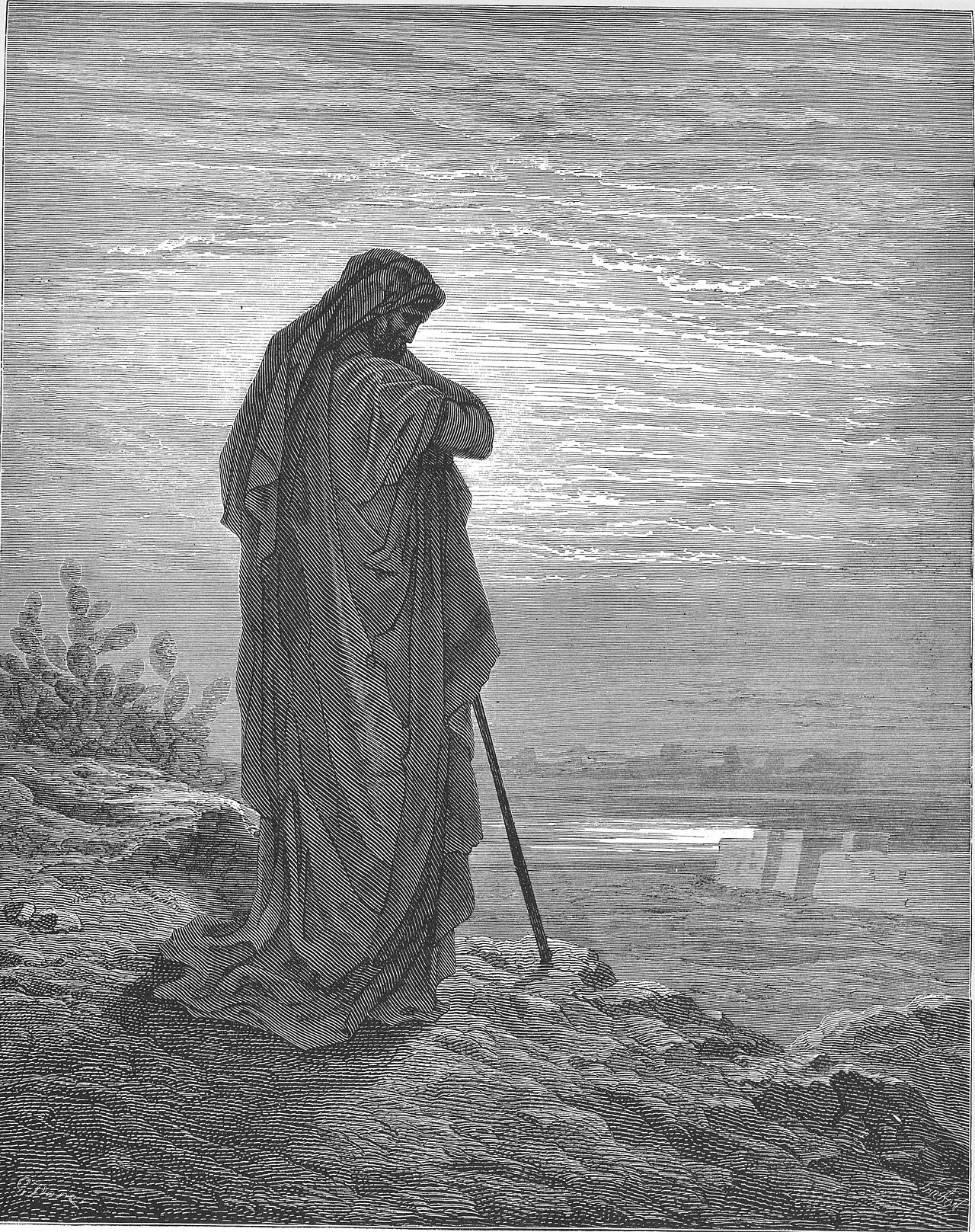
Gustave Doré, 1866The Prophet Amos, Gustave Doré, Doré's English Bible (1866), public domain
Key verse
The words of Amos, who was among the herdmen of Tekoa, which he saw concerning Israel in the days of Uzziah king of Judah, and in the days of Jeroboam the son of Joash king of Israel, two years before the earthquake.
It stands in The LORD roars from Zion: the words of a herdsman, verses 1 to 2.
The chapter
Chapter summary
A Judean herdsman of Tekoa prophesies to the north 'two years before the earthquake,' and the book opens like thunder: 'Jehovah will roar from Zion… and the pastures of the shepherds shall mourn.' Then the oracle wheel begins, each rung with the same formula: 'For three transgressions of Damascus, yea, for four, I will not turn away the punishment thereof.' Damascus threshed Gilead with instruments of iron; Gaza carried away a whole people to sell to Edom; Tyre broke a brotherly covenant to do the same; Edom pursued his brother with the sword and cast off all pity; Ammon ripped up the women with child of Gilead to enlarge his border.
Context
Prophecy · Amos · Amos overview
The world behind this chapter
Amos 1The history
The earthquake in the opening line was real enough to date a book by. It was still being remembered two centuries later by Zechariah, and excavations at Hazor and other northern sites show a destruction layer from roughly this period that archaeologists have linked to a major quake.
Amos came from Tekoa, a hill town about six miles south of Bethlehem in Judah, on the edge of the wilderness. He was a Judean speaking in Israel, which made him a foreigner in the room before he opened his mouth.
The rest of the history, and what it meant to them
The oracles work like a tightening noose, and the geography is the trick. Damascus is far to the north-east, Gaza far to the south-west, Tyre on the north-west coast, Edom to the south-east, a listener in Bethel could watch the circle closing on him and would keep cheering anyway.
The crimes named are specific war atrocities, not general wickedness. Threshing Gilead with sledges of iron describes a real machine: a heavy wooden board studded on its underside with basalt or iron teeth, dragged over grain by oxen to cut the straw and free the kernels. Using it on people is what the words say. Gaza and Tyre are charged with rounding up whole populations and selling them on to Edom, the slave trade again, run through the coastal ports.
What it meant to them
For hearers this was the most agreeable sermon they had heard in years. Every nation on the list had hurt Israel or its neighbours, and the formula, for three transgressions and for four, meant the cup had finally run over.
That agreement was the trap. Amos was establishing, oracle by oracle, that God holds nations accountable for how they treat people, including nations that never had his law. When the circle closed on Israel in the next chapter, the standard had already been set by the audience's own applause.
Sources cited
- John H. Walton, Victor H. Matthews, Mark W. Chavalas, The IVP Bible Background Commentary: Old Testament
- Edwin R. Thiele, The Mysterious Numbers of the Hebrew Kings
Where the chapter sits
Amos 1 falls in Oracles against the nations (chapters 1–2). Damascus, Gaza, Tyre, Edom, Ammon, Moab, then Judah, then Israel. The rhetorical net tightens until it catches the audience.
After it: Sermons against Israel, chapters 3–6.
The whole shape of Amos→The structure of this chapter
The heads below are this chapter's scenes. The numbered points under each are its verses.
A. The LORD roars from Zion: the words of a herdsmanvv. 1-2
the herdmen of Tekoa: Amos names himself plainly: a herdman of Tekoa, not a member of the prophetic guild or a prophet's son, called out of the fields of Judah to prophesy against the northern kingdom under Jeroboam II. The earthquake he dates his book by is remembered independently at Zechariah 14:5, a rare external synchronism the bench reads as sober history rather than literary flourish. Verse 2 sets the whole book's theme in one image, the Lord roaring from Zion like a lion over prey, and the shepherds' pastures mourning while Carmel, the most fertile ridge in the land, withers at the sound of his voice.
Amos 1:1
“Chapter 1 - Verse 1. The words of Amos, who was among the shepherds of Tekoa, which he saw concerning Israel. However, the Septuagint, wanting to add something, interpreted it as: The words of Amos, who was among the vine-dressers of Tekoa, which he saw for Jerusalem.”
Jerome· written before 420· Commentary on Amospatristic
3 more voices on this verseWhat preachers and commentators have said about this verse, in their own words.
Amos 1:1
“The words of Amos,.... Not which he spoke of or for himself, but from the Lord; all the prophecies, visions, and revelations made unto him, are intended: who was among the herdsmen of Tekoa; which was not in the tribe of Asher, as Kimchi; nor of Zebulun, as Pseudo-Epiphanius (i); but in the tribe of Judah, 2Ch 11:5. It lay to the south, and was six miles from Bethlehem.”
Amos 1:1
“These two things then, well agree together, -- that the prophecies which follow were the words of Amos and that they were words revealed to him from above; for the word chzh, chese, which Amos uses, properly means, to see by revelation; and these revelations were called prophecies. But he says, that he was among the shepherds of Tekoa.”
John Calvin· Commentaries (1554)reformed
Amos 1:1
“Israel - The kingdom of the ten tribes. Jeroboam - The great grand-son of Jehu. The earth- quake - Of which, only this text, and Zech xiv, 5, make any particular mention.”
John Wesley· Explanatory Notes upon the Old Testament (1765)evangelical
Amos 1:2
“The Lord will roar from Zion - It is a pity that our translators had not followed the hemistich form of the Hebrew: - Jehovah from Zion shall roar, And from Jerusalem shall give forth his voice; And the pleasant dwellings of the shepherds shall mourn, And the top of mount Carmel shall wither. Carmel was a very fruitful mountain in the tribe of Judah, Jos 15:56; Isa 35:2. This introduction was natural in the mouth of a herdsman who was familiar with the roaring of lions, the bellowing of bulls, and the lowing of kine.”
Adam Clarke· Commentary on the Bible (1810-1826)evangelical
2 more voices on this verse
Amos 1:2
“Our God, whose special residence is there, will issue out warrants, given at that court, as it were, for the executing of judgments on the land. In Zion was the mercy-seat; thence the Lord roars, intimating that God's acts of justice are consistent with mercy, allayed and mitigated by mercy, nay, as they are warnings, they are really acts of mercy.”
Matthew Henry· Commentary on the Whole Bible (1707-1721)puritan
Amos 1:2
“Whereas Jehovah is there represented roaring in Israel's behalf, here He roars against her (compare Ps 18:13; Jer 25:30). from Zion . . . Jerusalem--the seat of the theocracy, from which ye have revolted; not from Dan and Beth-el, the seat of your idolatrous worship of the calves. habitations . . . mourn--poetical personification.”
Jamieson, Fausset & Brown· Commentary Critical and Explanatory on the Whole Bible (1871)reformed
B. For three transgressions of Damascus, and for fourvv. 3-5
For three transgressions of Damascus: The formula that structures the whole opening section appears first here and the bench reads it once for all eight oracles: three transgressions, and for four is not a literal count but a Hebrew idiom for a full and overflowing measure of guilt, the last straw named while the pile beneath it is assumed. Damascus is charged with threshing Gilead with iron implements, a war crime against Israel's own territory east of Jordan under the Hazael-Ben-hadad dynasty of 2 Kings 13:7. The sentence, captivity unto Kir, reverses the very place Amos 9:7 says Syria came from, and Keil and the historians alike set its fulfilment under Tiglath-pileser III at 2 Kings 16:9.
Amos 1:3
“For three - This certain number is put for an uncertain: three, that is, many. Of Damascus - Here Damascus is put for the whole kingdom of Syria. Threshed - Treated it with the utmost cruelty.”
John Wesley· Explanatory Notes upon the Old Testament (1765)evangelical
1 more voice on this verse
Amos 1:3
“The order of God’s threatenings seems to have been addressed to gain the hearing of the people. The punishment is first denounced upon their enemies, and that, for their sins, directly or indirectly, against themselves, and God in them. Then, as to those enemies themselves, the order is not of place or time, but of their relation to God’s people.”
Amos 1:4
“But I will send a fire into the house of Hazael,.... For so doing; into his family, his sons' sons, one of whom perhaps was Rezin, that Tiglathpileser king of Assyria slew, as Aben Ezra observes.”
1 more voice on this verse
Amos 1:4
“Ben-hadad - He was son and successor of Hazael. See the cruelties which they exercised upon the Israelites, 2Ki 10:32; 2Ki 13:7, etc., and see especially 2Ki 8:12, where these cruelties are predicted. The fire threatened here is the war so successfully carried on against the Syrians by Jeroboam II., in which he took Damascus and Hamath, and reconquered all the ancient possessions of Israel. See 2Ki 14:25, 2Ki 14:26, 2Ki 14:28.”
Adam Clarke· Commentary on the Bible (1810-1826)evangelical
Amos 1:5
“The bar - Literally the bar with which the city gates were shut, and fastened. Of Eden - Some royal seat, of the kings of Syria. Kir - Kir of Media, Isaiah xxii, 6, thither did Tiglath-Pilneser carry the conquered Syrians, 2 Kings xvi, 9, and placed them captives in that barren mountainous country, about fifteen years after it was foretold by Amos.”
John Wesley· Explanatory Notes upon the Old Testament (1765)evangelical
1 more voice on this verse
Amos 1:5
“I will also break the bar of Damascus - In the East, every city was fortified; the gates of the stronger cities were cased in iron, that they might not be set on fire by the enemy; they were fastened within with bars of brass 1Ki 4:13 or iron (Psa 107:16; Isa 45:2; compare Isa 48:14; Jer 51:3 O). They were flanked with towers, and built over, so that what was naturally the weakest point and the readiest access to an enemy became the strongest defense.”
C. Gaza and Tyre, who sold off whole captivities
1. (vv. 6-8)
Amos 1:6
“Gaza--the southernmost of the five capitals of the five divisions of Philistia, and the key to Palestine on the south: hence put for the whole Philistine nation. Uzziah commenced the fulfilment of this prophecy (see 2Ch 26:6). because they carried away . . . the whole captivity--that is, they left none.”
Jamieson, Fausset & Brown· Commentary Critical and Explanatory on the Whole Bible (1871)reformed
1 more voice on this verse
Amos 1:6
“They carried away captive - Gaza is well known to have been one of the five lordships of the Philistines; it lay on the coast of the Mediterranean Sea, near to Egypt. Erkon, Ashdod, and Askelon, were other signories of the same people, which are here equally threatened with Gaza. The captivity mentioned here may refer to inroads and incursions made by the Philistines in times of peace. See 2Ch 21:16. The margin reads, an entire captivity. They took all away; none of them afterwards returned.”
Adam Clarke· Commentary on the Bible (1810-1826)evangelical
Amos 1:7
“But - Literally, “and.” Thus had Gaza done, and thus would God do; “I will send a fire upon Gaza.” The sentence on Gaza stands out, probably in that it was first in power and in sin. It was the merchant-city of the five; the caravans parted from it or passed through it; and so this sale of the Jewish captives was ultimately effected through them. First in sin, first in punishment.”
Amos 1:8
“Ashdod, &c.--Gath alone is not mentioned of the five chief Philistine cities. It had already been subdued by David; and it, as well as Ashdod, was taken by Uzziah (2Ch 26:6). Gath perhaps had lost its position as one of the five primary cities before Amos uttered this prophecy, whence arose his omission of it.”
Jamieson, Fausset & Brown· Commentary Critical and Explanatory on the Whole Bible (1871)reformed
For three transgressions of Gaza: Philistia's crime is named as a slave trade, carrying away the whole captivity to deliver up to Edom, treating a defeated people as merchandise rather than prisoners of war. Four of the five Philistine cities are named in judgment, Gaza, Ashdod, Ashkelon and Ekron, with Gath left out because Gath had already fallen before Amos wrote, a detail the older commentators note as an incidental mark of the book's accuracy. The remnant of the Philistines shall perish closes an oracle that gives no covenant reason as Israel's own oracle will, only the plain inhumanity of the trade itself.
2. (vv. 9-10)
Amos 1:9
“The last crowning sin, for which judgment is pronounced on Tyre, is the same as that of Philistia, and probably was enacted in concert with it. In Tyre, there was this aggravation, that it was a violation of a previous treaty and friendship. It was not a covenant only, nor previous friendliness only; but a specific covenant, founded on friendship which they forgat and brake. If they retained the memory of Hiram’s contact with David and Solomon, it was a sin against light too.”
Amos 1:10
“But I will send a fire on the wall of Tyrus,.... An enemy to destroy the walls of it: this was done either by Shalmaneser king of the Assyrians, in the times of Eulaeus king of the Tyrians, of whose expedition against it Josephus (s) makes mention: or by Nebuchadnezzar, who took it after thirteen years' siege of it, in the time of Ithobalus (t): or by Alexander, by whom it was taken, as Curtius (u) relates, after it had been besieged seven months: which shall devour the palaces thereof; of the governor, the great men and merchants in it.”
1 more voice on this verse
Amos 1:10
“I will send a fire on the wall of Tyrus - The destructive fire or siege by Nebuchadnezzar, which lasted thirteen years, and ended in the destruction of this ancient city; see on Eze 26:7-14 (note), as above. It was finally ruined by Alexander, and is now only a place for a few poor fishermen to spread their nets upon.”
Adam Clarke· Commentary on the Bible (1810-1826)evangelical
For three transgressions of Tyrus: Tyre repeats Gaza's crime, delivering up the whole captivity to Edom, but the oracle adds a clause Gaza's did not carry, and remembered not the brotherly covenant. The bench reads this as the treaty of friendship between Hiram of Tyre and David and Solomon in 1 Kings 5, a bond of kinship in trade and building that Tyre's slave dealing broke outright, which is why the sentence falls on Tyre though her actual offense matches her neighbor's. Breach of a sworn covenant is judged more heavily than the bare act, the pattern the whole chapter's escalating list will return to at Edom.
D. Edom's endless anger and Ammon's cruelty
1. (vv. 11-12)
Amos 1:11
“Edom - God had impressed on Israel its relation of brotherhood to Edom. Moses expressed it to Edom himself , and, after the suspicious refusal of Edom to allow Israel to march on the highway through his territory, he speaks as kindly of him, as before; “And when we passed by from our brethren, the children of Esau” Deu 2:8. It was the unkindness of worldly politics, and was forgiven.”
Amos 1:12
“But I will send a fire upon Teman,.... A principal city of Edom or Idumea, so called from Teman a grandson of Esau, Gen 36:11. Jerom (x) says there was in his time a village called Theman, five miles distant from the city Petra, and had a Roman garrison; and so says Eusebius (y); who places it in Arabia Petraea; it is put for the whole country; it signifies the south.”
For three transgressions of Edom: Edom's charge is family betrayal named as such, he did pursue his brother with the sword, the brother being Jacob, Edom's own ancestor Esau's kin, and did cast off all pity. His anger did tear perpetually and he kept his wrath for ever describes not a single act but a settled national temperament, a grudge nursed across generations rather than a war ended and forgiven. Fire falls on Teman and Bozrah, Edom's chief cities, and the bench sets this oracle beside Obadiah's whole burden as the fuller statement of the same charge against the same brother nation.
2. (vv. 13-15)
Amos 1:14
Rabbah--the capital of Ammon: meaning "the Great." Distinct from Rabbah of Moab. Called Philadelphia, afterwards, from Ptolemy Philadelphus. tempest--that is, with an onset swift, sudden, and resistless as a hurricane. day of the whirlwind--parallel to "the day of battle"; therefore meaning "the day of the foe's tumultuous assault."
Jamieson, Fausset & Brown· Commentary Critical and Explanatory on the Whole Bible (1871)reformed
1 more voice on this verse
Amos 1:14
“With shouting in the day of battle - They shall be totally subdued. This was done by Nebuchadnezzar. See Jer 27:3, Jer 27:6.”
Adam Clarke· Commentary on the Bible (1810-1826)evangelical
Amos 1:15
“And their king - The king was commonly, in those nations, the center of their energy. When “he and his princes” were “gone into captivity,” there was no one to make head against the conqueror, and renew revolts. Hence, as a first step in the subdual, the reigning head and those who shared his counsels were removed. Ammon then, savage as it was in act, was no ill-organized horde. On the contrary, barren and waste as all that country now is, it must once have been highly cultivated by a settled and laborious people.”
1 more voice on this verse
Amos 1:15
“And their king shall go into captivity,.... Not only the common people that are left of the sword shall be carried captive, but their king also. This was, Baalis their last king, who was accessary to the murder of Gedaliah, Jer 40:14; whom the king of Babylon had set over the remnant of the Jews left in Judea; which might provoke him to send Nebuzaradan his general against him, who put his country to fire and sword, destroyed his chief city Rabbah, and carried him and his nobles into captivity.”
For three transgressions of the children of Ammon: Ammon's crime closes the ring of neighbor nations at its most brutal, ripping up the women with child of Gilead simply that they might enlarge their border, an atrocity against the unborn committed for real estate rather than for revenge or survival. Fire falls in the wall of Rabbah with shouting in the day of battle, and their king shall go into captivity, he and his princes together, a sentence the bench notes reads almost like an epitaph for the whole Ammonite royal house. With Ammon judged the oracle has circled Israel's entire border, Aramean, Philistine, Phoenician, Edomite and Ammonite, before the next chapter turns the same measure on Judah and then Israel herself.
This page carries no textual note on Amos 1. Where this site has examined a place the manuscripts differ, the examination is in the manuscripts room. Every place this site examines →
Sources for this chapter
The summary
Jamieson, Fausset & Brown, Commentary Critical and Explanatory; John Calvin, Commentaries; John Wesley, Notes on the Old Testament and Matthew Henry, Complete Commentary.
The exposition
Adam Clarke, Commentary on the Bible; Albert Barnes, Notes on the Old Testament; Carl Friedrich Keil, The Twelve Minor Prophets; Edward Bouverie Pusey, The Minor Prophets: A Commentary; Jamieson, Fausset and Brown, Commentary Critical and Explanatory on the Whole Bible; John Calvin, Commentaries on the Twelve Minor Prophets; John Gill, Exposition of the Old Testament and Matthew Henry, Commentary on the Whole Bible.
Keep studying
On this page
Studies3
On this verse
On this chapter
On this book