
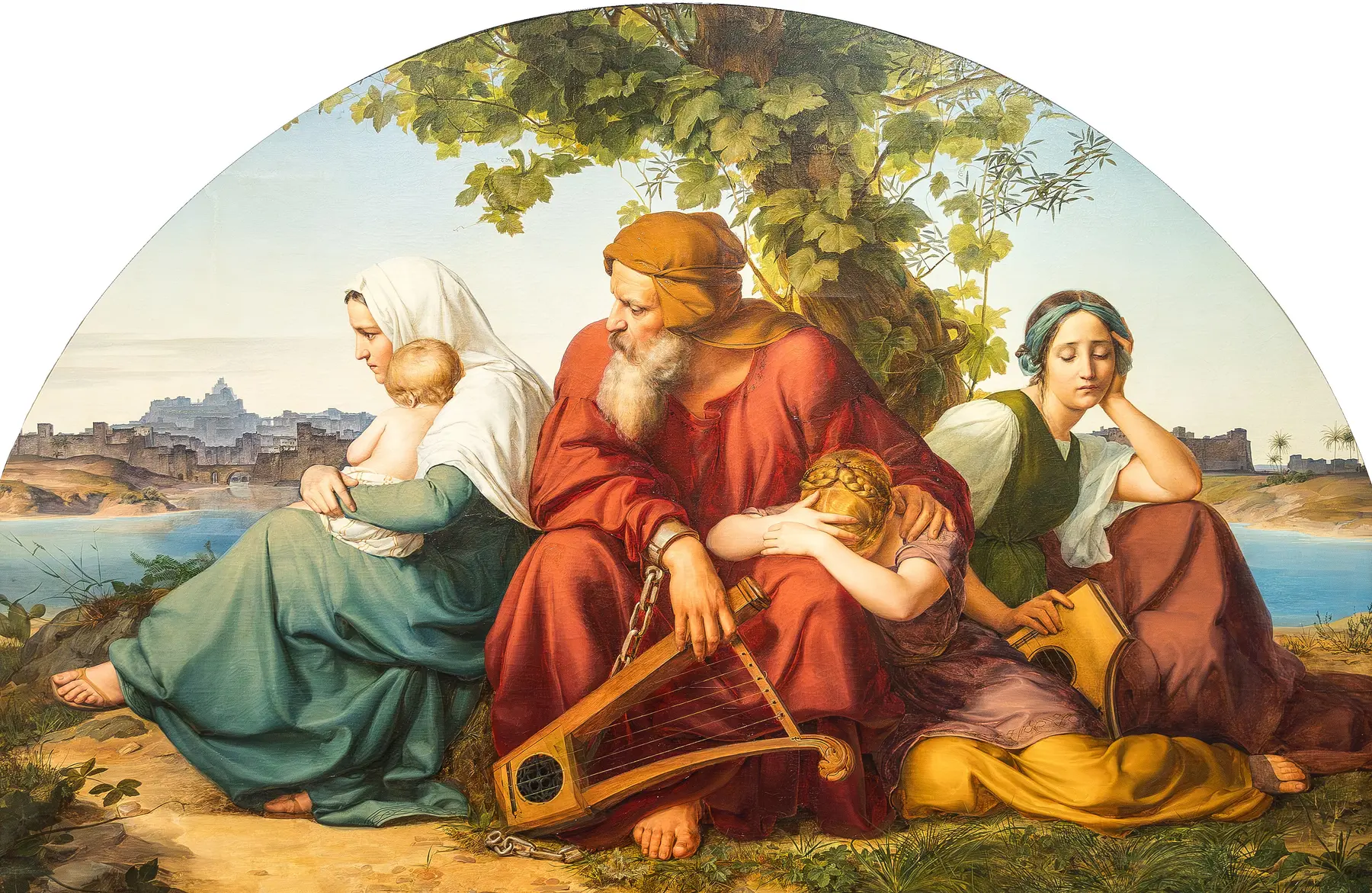
2 Kingschapter 8
29 verses · Jeremiah, by tradition · 6th century BC · History
And Gehazi was telling the king how Elisha had brought the dead back to life. Just then the woman whose son Elisha had revived came to appeal to the king for her house and her land. So Gehazi said, “My lord the king, this is the woman, and this is the son Elisha restored to life.”
Introduction
Jeremiah, by tradition, History, 2 Kings Overview.
This chapter is a hinge in the book, closing the stories of Elisha's household and opening the reigns that follow. It moves from Israel's court to a sickroom in Damascus and then to the throne in Jerusalem. Its first hearers knew the property law behind a returning widow's petition and the weight of a gift sent from one king to another's prophet. Listen for the prophet's tears as he looks at a servant of a foreign king. Listen also for the marriage that ties Judah's throne to the house of Ahab. One promise to David keeps that throne standing.
Context
- Who
- Israelites watching the house of Ahab marry its way into the southern throne
- What
- An account of a widow's land restored, of Hazael's rise in Damascus, and of two kings of Judah who follow the ways of Ahab's house.
- Where
- The court of Israel, the sickroom of Ben-hadad in Damascus, and Jerusalem.
- When
- About 845 to 841 BC, the reigns of Jehoram and Ahaziah of Judah.
- Why
- To show God's word shaping the rise of a foreign king, and His promise to David holding Judah's throne through unfaithful reigns.
Historical context
The chapter belongs to three people at once, Elisha in his prophetic office, Hazael as a servant at the court of Damascus, and Jehoram of Judah as a king newly on his father's throne. The years are about 845 to 841 BC on Thiele's reconstruction of the regnal numbers, which is the chronology this site follows.
Show the rest of the historical context, 4 more paragraphs
The places are Israel's own court, the sickroom of a Syrian king in Damascus, and Jerusalem. The occasion is a woman's petition for her land, a foreign king's question about his illness, and two accessions in Judah.
A first hearer knew the property law the opening scene turns on. Land left vacant during a famine could be claimed or taken over by the crown, and a returning owner had to petition to recover the estate and whatever income it had produced. Her case is settled in minutes because she arrives while the king is asking for stories about the prophet.
A first hearer also knew what forty camel loads meant. A sick king sending that much to ask a foreign prophet whether he would recover is a measure of how far Elisha's name had travelled.
Hazael is well attested outside the Bible. Assyrian records of Shalmaneser III call him a son of nobody, their term for a usurper with no royal line, which matches a servant who took the throne. The Tel Dan Stele, an Aramaic victory inscription from the same period, is dated in this estate's record at about 840 to 835 BC and names the house of David as a ruling dynasty.
Significance
Israel was being told who Hazael was before Hazael was anything, and the prophet wept while telling him.
Show the rest of the significance, 1 more paragraph
Judah was being told the price of a marriage. Jehoshaphat had married his son to Ahab's daughter, and the next two kings of Judah walked in the way of the kings of Israel because of it. The one thing holding the southern throne up is named in the same chapter, a promise made to David.
This chapter in Jewish lifeWhat this chapter is in Jewish life and reading.
How it is read
The corpus keeps thirteen notes on this chapter, all of them Rashi in the Metsudah Tanach translation of Lakewood, New Jersey, under a CC-BY licence. The chapter opens by looking back, and Rashi dates the look. Elisha's word to the woman about the famine was spoken seven years before the scene in this chapter, and he points the reader back to the account of the Shunammite in chapter 4 (Rashi on II Kings 8:1:1). Her petition to the king he explains by what happened to an abandoned estate, that robbers had occupied the house and the field she left for seven years (Rashi on II Kings 8:3:1).
Elisha's errand to Damascus draws the most interesting note in the chapter. Rashi gives the purpose as causing Gehazi to repent, citing the tractate Sotah, and the Metsudah footnote sets two further readings beside it, Radak's that the errand carried out the command given to Elijah at Horeb, and another that Gehazi had gone to Damascus to ask Naaman for help (Rashi on II Kings 8:7:1). The classical tradition therefore follows Gehazi past his judgment and holds that the prophet went after him, which a Christian reader who leaves that man at the end of chapter 5 should know.
The word Elisha sends to the sick Syrian king is the hardest line in the chapter to read, because the written text and the read text differ there, and Rashi takes the difficulty head on rather than passing over it. He applies the promise of life to Hazael, who would live and hold the throne in the king's place. The Metsudah footnote sets out the mechanics plainly, that the word is read as one form meaning tell him he will surely recover and written as another meaning say he will surely not recover, with Rashi applying the read form to Hazael and the written form to the king, and it gives two further readings, one that the king would not die of the illness and would die by assassination, and Radak's that the written form reflects what was in the prophet's mind while the read form is what he said (Rashi on II Kings 8:10:1). Elisha's fixed face Rashi reads as grief held in. He wanted to cry, he held it in so that he would not cry in front of Hazael, and he made a concentrated effort to stand and control himself (Rashi on II Kings 8:11:1). The verb in the prophecy of what Hazael will do to Israel's children Rashi defines from a parallel in Isaiah, with the footnote giving Radak's alternative of dashing against a wall or the ground and Ralbag's of leaving infants abandoned by killing their parents (Rashi on II Kings 8:12:1). The cloth Hazael uses to smother his master Rashi renders through Targum Jonathan as a blanket, pointing at the same word used of Jael, with two further renderings in the footnote (Rashi on II Kings 8:15:1).
The regnal material of the second half is where Rashi works hardest, and the work is chronological. At the accession notice he sets out a reckoning from Seder Olam, that Jehoshaphat crowned his son to reign two years in his own lifetime on their return from the war with Moab, and he ties the arrangement to the decree that Jehoshaphat would be killed at Ramoth-gilead, reprieved for seven years because he cried out (Rashi on II Kings 8:16:1). This is the note a reader should hold beside any modern discussion of the regnal numbers of Kings, because it shows the classical tradition solving the same arithmetic with coregencies and a dated decree. The lamp promised to David's house Rashi glosses as kingdom, through the Targum's rendering of a related word (Rashi on II Kings 8:19:1).
The revolt of Edom draws the longest note in the chapter, and it is a piece of historical argument. Rashi holds that Edom had no king of its own from the time of David, citing two verses that say so, and he sets the eight kings who reigned in Edom before any king reigned in Israel, listed in Genesis, against eight kings of Israel who reigned while Edom had none, naming them in order as Ish-bosheth, David, Solomon, Rehoboam, Abijam, Asa, Jehoshaphat and Jehoram. He then resolves the king of Edom who went up against Moab in chapter 3 by making him a governor called a king, which is what the verse he cites says (Rashi on II Kings 8:20:1). The enemies around Jehoram he identifies as those near the border, with Radak's alternative in the footnote (Rashi on II Kings 8:21:1). On the revolt of Libnah he states plainly what he does not know. He says he does not know what nation they were, because Libnah is part of the land of Israel, and he gives his own judgment that they were of the tribe of Judah and rebelled against the king, with Radak's alternative that Libnah was an Edomite border town that joined the revolt later (Rashi on II Kings 8:22:1). The burial notice he corrects from Chronicles, which says the king was buried in the City of David and outside the graves of the kings (Rashi on II Kings 8:24:1).
Eleven further notes stand on this chapter with no English text in the corpus and are cited here unquoted. They are Radak on II Kings 8:6:1, 8:9:1, 8:17:1, 8:25:1 and 8:26:1, Metzudat David on II Kings 8:4:1, 8:5:1, 8:13:1 and 8:27:1, and Malbim on II Kings 8:2:1 and 8:23:1.
What the rabbis say
The corpus carries forty rabbinic locators on this chapter, thirty Midrash and ten Talmud, and the text of none, so each is cited and linked here rather than quoted. The seven years of famine draw nine, the heaviest single anchor in this half of the book. They are Berakhot 55a:10, Ein Yaakov (Glick Edition), Taanit 1:10, Ein Yaakov, Berakhot 9:7, Ein Yaakov, Taanit 1:12, Midrash Lekach Tov on Ruth, Introduction 1, Midrash Tanchuma Buber, Shmini 5:1, Midrash Tanchuma, Shmini 3:1, Otzar Midrashim, Chuppah of Eliyahu, Chuppat Eliyahu Rabbah 25 and Otzar Midrashim, Pirkei Rabbeinu HaKadosh 1:51. Two of those sit in tractates about fasting for rain and one in the Midrash on Ruth, where another famine sends a family away from its land.
Gehazi telling the king of Elisha's deeds draws Ein Yaakov (Glick Edition), Megillah 4:1, Jerusalem Talmud Megillah 3:1:4, Megillah 27a:3, Mekhilta DeRabbi Yishmael, Tractate Pischa 1:24 and Yalkut Shimoni on Torah 187:2. The raising of the woman's son coming up in that conversation draws Ein Yaakov (Glick Edition), Sanhedrin 11:60, Sanhedrin 100a:5 and Vayikra Rabbah 16:4, and the restoring of her land draws Jerusalem Talmud Bava Batra 3:3:4, which is the tractate that governs a claim on occupied property.
Elisha's arrival at Damascus draws six, Ein Yaakov (Glick Edition), Berakhot 9:3, Ein Yaakov (Glick Edition), Sanhedrin 11:106, Ein Yaakov, Sotah 9:9, Jerusalem Talmud Sanhedrin 10:2:26, Sanhedrin 107b:5 and Sotah 47a:9. Those are the same tractates and chapters that carry Gehazi in chapters 5, 6 and 7, so the tradition's account of the errand is held across the corpus. Hazael's gift draws Shir HaShirim Rabbah 4:8:2, and the divided word about the king's recovery draws Midrash Shmuel 14:1 and Tractate Soferim 6:6, the second of which is the tractate about how a scroll is written, which is where a difference between the written and the read text belongs.
The accession of Jehoram of Judah draws Seder Olam Rabbah 17:2, the same chronological work the kept note above reasons from. His marriage into the house of Ahab draws Aggadat Bereshit 49:4 and Midrash Tanchuma Buber, Vayetzei 14:1. The lamp promised to David draws Midrash Lekach Tov, Numbers 21:30:1. The revolt of Libnah draws the last nine, Bamidbar Rabbah 18:1, Ein Yaakov (Glick Edition), Yoma 3:6, Ein Yaakov, Shevuot 1:7, Ein Yaakov, Yoma 3:11, Midrash Lekach Tov, Leviticus 16:16:1, Midrash Tanchuma Buber, Korach 1:1, Midrash Tanchuma, Korach 1:1, Shevuot 12b:7 and Sifra, Acharei Mot, Chapter 4 3. Several of those expound Korah's rebellion and the Day of Atonement, so the tradition reads a town's revolt beside the archetype of revolt and beside the day that answers it. What each of them teaches is a saying of the rabbis, and is reported as theirs wherever this site quotes one. The quotations wait on a fetch that carries the text.
Sources: Rashi, Rashi on II Kings 8:1:1 to 8:24:1, thirteen notes, the Metsudah Tanach series, Lakewood, N.J, CC-BY; Radak, Radak on II Kings 8:6:1, 8:9:1, 8:17:1, 8:25:1 and 8:26:1, cited by ref because the corpus carries no English text; and reported inside the Metsudah footnotes at 8:7:1, 8:10:1, 8:12:1, 8:15:1, 8:21:1 and 8:22:1; Metzudat David, Metzudat David on II Kings 8:4:1, 8:5:1, 8:13:1 and 8:27:1, cited by ref because the corpus carries no English text; Malbim, Malbim on II Kings 8:2:1 and 8:23:1, cited by ref because the corpus carries no English text; The Sefaria corpus, scripts/data/sources/sefaria/2-kings/8.json, the 40 rabbinic locators of this chapter, 30 Midrash and 10 Talmud.
The heads below are this chapter's scenes. The numbered points under each are its verses.
Seven years abroad, and a king who restores all her fields
2 Kings 8:1-3
Elisha sends away the woman whose son he raised in chapter 4, telling her that “the LORD has decreed a seven-year famine”. She and her household live “as foreigners for seven years in the land of the Philistines” and return at the end of the term.
2 Kings 8:1
“The famine here recorded, and the conversation of the monarch with Gehazi, must have been anterior to the events related in 2 Kings 5 since we may be sure that a king of Israel would not have entered into familiar conversation with a confirmed leper. The writer of Kings probably col ected the miracles of Elisha from various sources, and did not always arrange them chronologically. Here the link of connection is to be found in the nature of the miracle. As Elisha on one occasion prophesied plenty, so on another he had prophesied a famine.”
in the land of the Philistines: Albert Barnes describes the land of the Philistines as the rich grain plain along the coast, a place of plenty beside the highlands. When crops failed there, food could be shipped in from Egypt by sea. The family stayed the full seven years.
2 Kings 8:2
“The country of the Philistines - the rich low grain-growing plain along the seacoast of Judah - was always a land of plenty compared with the highlands of Palestine. Moreover, if food failed there, it was easily imported by sea from the neighboring Egypt.”
to appeal for her house and her land: Albert Barnes supposes that someone had taken over her house and fields while she was away and refused to give them back. A direct appeal to the king was common in the East, and Barnes sets her beside petitioners at 2 Samuel 14:4 and 1 Kings 3:16.
2 Kings 8:3
“During the Shunammite’s absence in Philistia, her dwelling and her grain-fields had been appropriated by some one who refused to restore them. She therefore determined to appeal to the king. Such direct appeals are common in Oriental countries. Compare 2Ki 6:26; 2Sa 14:4; 1Ki 3:16.”
2 Kings 8:4-6
Gehazi is telling the king “all the great things Elisha has done” when the woman walks in. His words, “this is the woman, and this is the son Elisha restored to life”, prove her claim before she speaks. The king restores her land and all its proceeds.
2 Kings 8:4
“The king talked with Gehazi - This is supposed to have happened before the cleansing of Naaman, for is it likely that the king would hold conversation with a leprous man; or that, knowing Gehazi had been dismissed with the highest disgrace from the prophet’s service, he could hold any conversation with him concerning his late master, relative to whom he could not expect him to give either a true or impartial account?”
Adam Clarke · Commentary on the Bible (1810-1826)evangelical
this is the woman: The woman comes to press the claim Albert Barnes describes, for a house and fields someone had seized while she lived in Philistia. Her son comes with her. Gehazi names them both as living proof of the story he is telling.
2 Kings 8:5
“And it came to pass, as he was telling the king how he had restored a dead body to life,.... Which was the Shunammite's son: that, behold, the woman whose son he had restored to life cried to the king for her house, and for her land; came and presented her petition to the king at that very instant: and Gehazi said, my lord, O king, this is the woman, and this is her son, whom Elisha restored to life; the very person I am speaking of.”
1 more voice on this verse
2 Kings 8:5
“This is the woman, and this is her son, whom Elisha restored to life - This was a very providential occurrence in behalf of the Shunammite. The relation given by Gehazi was now corroborated by the woman herself; the king was duly affected, and gave immediate orders for the restoration of her land.”
Adam Clarke · Commentary on the Bible (1810-1826)evangelical
appointed for her an officer: The officer is literally a eunuch, and Albert Barnes observes that eunuchs were by now common at the court of Samaria, as 9:32 shows again. Chronicles places them at David's court in 1 Chronicles 28:1. Barnes finds no further trace of them in Judah until Hezekiah's reign.
2 Kings 8:6
“A certain officer - literally, “a certain eunuch” (margin). Eunuchs were now in common use at the Samaritan court (compare 2Ki 9:32). They are ascribed to the court of David in Chronicles 1Ch 28:1; and we may conjecture that they were maintained by Solomon. But otherwise we do not find them in the kingdom of Judah until the time of Hezekiah Isa 56:3-4.”
Elisha weeps at what Hazael will do
2 Kings 8:7-8
Elisha's work reaches a foreign capital: Ben-hadad lies sick at Damascus and sends to “inquire of the LORD through him”, passing over his own gods. The king whose army besieged Samaria at 6:24 now sends a servant with a gift to ask the prophet a question.
2 Kings 8:7
“The hour had come for carrying out the command given by God to Elijah (marginal reference “e”), and by him probably passed on to his successor. Elisha, careless of his own safety, quitted the land of Israel, and proceeded into the enemy’s country, thus putting into the power of the Syrian king that life which he had lately sought so eagerly 2Ki 6:13-19. The man of God - The Damascenes had perhaps known Elisha by this title from the time of his curing Naaman.”
1 more voice on this verse
2 Kings 8:7
“This is the more observable, (1.) Because it was not long since a king of Israel had, in his sickness, sent to enquire of the god of Ekron ( ch. i. 2 ), as if there had been no God in Israel. Note, God sometimes fetches to himself that honour from strangers which is denied him and alienated from him by his own professing people.”
Matthew Henry · Commentary on the Whole Bible (1707-1721)puritan
inquire of the LORD through him: John Wesley notes Ben-hadad bowed in the house of Rimmon while he was well and sends to the God of Israel once he is sick. Wesley counts it among the ways affliction changes men's minds. Sickness taught the king to value a prophet he had once hunted.
2 Kings 8:8
“Inquire of the Lord,&c. - In his health he bowed down in the house of Rimmon; but now he tends to inquire of the God of Israel. Among other instances of the change of mens minds by affliction or sickness, this is one; that it often gives them other thoughts of God's ministers, and teacheth them to value those whom they before hated and despised.”
John Wesley · Explanatory Notes upon the Old Testament (1765)evangelical
2 Kings 8:9-10
taking with him a gift of forty camel loads: Hazael brings “forty camel loads of every good thing from Damascus” and asks whether Ben-hadad will recover. Elisha's answer carries the message, “You will surely recover”, and the fact behind it, “the LORD has shown me that in fact he will die”. The sickness is not what will kill him.
2 Kings 8:9
“So Hazael went to meet him, and took a present with him,.... As was usual when a prophet or seer was consulted, see 1Sa 9:7. even of every good thing of Damascus; which was a very fruitful place, and had abundance of gardens and orchards in it, which yielded excellent fruit, and of such it is probable the present consisted, and which was large: even forty camels' burden: which, as they are strong creatures, will bear a great deal.”
2 more voices on this verse
2 Kings 8:9
“Every good thing of Damascus - Probably, besides rich robes and precious metals, the luscious wine of Helbon, which was the drink of the Persian kings, the soft white wool of the anti-Libanus Eze 27:18, damask coverings of couches Amo 3:12, and numerous manufactured articles of luxury, which the Syrian capital imported from Tyre, Egypt, Nineveh, and Babylon. Forty camels were laden with it, and this goodly caravan paraded the streets of the town, conveying to the prophet the splendid gift designed for him.”
2 Kings 8:9
“The Orientals are fond of display, and would, ostentatiously, lay upon forty beasts what might very easily have been borne by four. Thy son Ben-hadad--so called from the established usage of designating the prophet "father." This was the same Syrian monarch who had formerly persecuted him (see 2Ki 6:13, 14).”
Jamieson, Fausset & Brown · Commentary Critical and Explanatory on the Whole Bible (1871)reformed
the LORD has shown me: Jamieson, Fausset and Brown take the second half of the answer as meant for Hazael alone, who would carry back only what suited him. Adam Clarke reads the death as the work of Hazael's betrayal, which God foresaw and permitted. John Wesley holds the king could have survived the disease.
2 Kings 8:10
“Thou mayest certainly recover: howbeit the Lord hath showed me that he shall surely die - That is, God has not determined thy death, nor will it be a necessary consequence of the disease by which thou art now afflicted; but this wicked man will abuse the power and trust thou hast reposed in him, and take away thy life. Even when God has not designed nor appointed the death of a person, he may nevertheless die, though not without the permission of God.”
Adam Clarke · Commentary on the Bible (1810-1826)evangelical
2 more voices on this verse
2 Kings 8:10
“Howbeit - Here is no contradiction: for the first words contain an answer to Benhadad's question, shall I recover? To which the answer is, thou mayest, notwithstanding thy disease, which is not mortal.”
John Wesley · Explanatory Notes upon the Old Testament (1765)evangelical
2 Kings 8:10
“Thou mayest certainly recover--There was no contradiction in this message. This part was properly the answer to Ben-hadad's inquiry [2Ki 8:9]. The second part was intended for Hazael, who, like an artful and ambitious courtier, reported only as much of the prophet's statement as suited his own views (compare 2Ki 8:14).”
Jamieson, Fausset & Brown · Commentary Critical and Explanatory on the Whole Bible (1871)reformed
2 Kings 8:11-13
Elisha fixed his gaze steadily on him: Elisha fixes his gaze on Hazael until Hazael is uncomfortable, then weeps, “Because I know the evil you will do to the Israelites”. Hazael asks how “a mere dog” could do “such a monstrous thing”. Elisha answers, “The LORD has shown me that you will be king over Aram”.
2 Kings 8:11
That is, “And he (Elisha) settled his conntenance, and set it (toward Hazael), until he (Hazael) was ashamed.” Elisha fixed on Hazael a long and meaning look, until the latter’s eyes fell before his, and his cheek flushed. Elisha, it would seem, had detected the guilty thought that was in Hazael’s heart, and Hazael perceived that he had detected it. Hence the “shame.”
1 more voice on this verse
2 Kings 8:11
“The man of God could outface the man of war. It was not in Hazael's countenance that Elisha read what he would do, but God did, at this time, reveal it to him, and it fetched tears from his eyes. The more foresight men have the more grief they are liable to.”
Matthew Henry · Commentary on the Whole Bible (1707-1721)puritan
I know the evil you will do: Adam Clarke points to the fulfilment of this vision at 10:32 and 33 and at 13:3 and 7. Matthew Henry notes that Israel's sins gave the nation into these cruel hands. Elisha foretold that day and still wept over it.
2 Kings 8:12
“I know the evil that thou wilt do - We may see something of the accomplishment of this prediction, 2Ki 10:32, 2Ki 10:33; 2Ki 13:3, 2Ki 13:7.”
Adam Clarke · Commentary on the Bible (1810-1826)evangelical
1 more voice on this verse
2 Kings 8:12
“The sins of Israel provoked God to give them up into the hands of their cruel enemies, yet Elisha wept to think that ever Israelites should be thus abused; for, though he foretold, he did not desire the woeful day. See what havock war makes, what havock sin makes, and how the nature of man is changed by the fall, and stripped even of humanity itself.”
Matthew Henry · Commentary on the Whole Bible (1707-1721)puritan
a mere dog: Albert Barnes reads Hazael's words as a lowly man's wonder that he could achieve so great a thing, with no shrinking from the deed. John Wesley hears horror at cruelty fit for a dog, and Matthew Henry sets Hazael beside Peter, sure of his strength before his fall.
2 Kings 8:13
“But what, is thy servant a dog? - This is a mistranslation, and conveys to the English reader a sense quite different from that of the original. Hazael’s speech runs thus - “But what is thy servant, this dog, that he should do this great thing?” He does not shrink from Elisha’s words, or mean to say that he would be a dog, could he act so cruelly as Elisha predicts he will.”
2 more voices on this verse
2 Kings 8:13
“Note, We are apt to think ourselves sufficiently armed against those sins which yet we are afterwards overcome by, as Peter, Matt. xxvi. In answer to this Elisha only told him he should be king over Syria; then he would have power to do it, and then he would find in his heart to do it.”
Matthew Henry · Commentary on the Whole Bible (1707-1721)puritan
2 Kings 8:13
“A dog - So fierce, barbarous, and inhuman. King - And when thou shalt have power in thy hand, thou wilt discover that bloody disposition, and that hatred against God's people, which now lies hid from others, and possibly from thyself.”
John Wesley · Explanatory Notes upon the Old Testament (1765)evangelical
2 Kings 8:14-15
Hazael reports only half of Elisha's answer, “He told me that you would surely recover”, and leaves out the death. The next day he “took a thick cloth, dipped it in water, and spread it over the king’s face”, and “Hazael reigned in his place”.
2 Kings 8:14
“Hazael omitted the clause by which Elisha had shown how those words were to be understood. He thus deceived his master, while he could flatter himself that he had not uttered a lie.”
took a thick cloth: Albert Barnes takes the thick cloth for a bed mat. Barnes answers the charge that Elisha prompted the murder: David was anointed king in Saul's place and never struck Saul down. Matthew Henry notes that some think Hazael was never suspected, and that only this inspired record exposed him.
2 Kings 8:15
“A thick cloth - Probably, a cloth or mat placed between the head and the upper part of the bedstead, which in Egypt and Assyria was often so shaped that pillows (in our sense) were unnecessary. The objection that Elisha is involved in the guilt of having suggested the deed, has no real force or value. Hazael was no more obliged to murder Benhadad because a prophet announced to him that he would one day be king of Syria, than David was obliged to murder Saul because another prophet anointed him king in Saul’s room 1Sa 16:1-13.”
1 more voice on this verse
2 Kings 8:15
“Hazael, who was Ben-hadad's confidant, was his murderer, and some think, was not suspected, nor did the truth ever come out but by the pen of this inspired historian.”
Matthew Henry · Commentary on the Whole Bible (1707-1721)puritan
Jehoram of Judah, married into the house of Ahab
2 Kings 8:16-18
In the fifth year of the reign of Joram son of Ahab over Israel: Jehoram of Judah begins his eight-year reign, and one clause gives the reason for what follows: “he married a daughter of Ahab”. He “walked in the ways of the kings of Israel”, departing from his father Jehoshaphat. She is the Athaliah who will seize David's throne in chapter 11.
2 Kings 8:16
“Jehoram - Jehoram was first made king or vice-roy, by his father divers years before this time, at his expedition to Ramoth- Gilead, which dominion of his, ended at his father's return.”
John Wesley · Explanatory Notes upon the Old Testament (1765)evangelical
he reigned in Jerusalem eight years: Adam Clarke counts the eight years from the fifth year of Joram of Israel. Three were shared with his father Jehoshaphat, Clarke says. He follows Archbishop Ussher's dating, from the year of the world 3112 to 3119.
2 Kings 8:17
“He reigned eight years in Jerusalem - Beginning with the fifth year of Joram, king of Israel. He reigned three years with Jehoshaphat his father, and five years alone; i.e., from A.M. 3112 to 3119, according to Archbishop Usher.”
Adam Clarke · Commentary on the Bible (1810-1826)evangelical
he married a daughter of Ahab: Adam Clarke names the wife as Athaliah and notes that the marriage bound Jehoshaphat and Ahab as allies, a friendship that lasted past Ahab's death. John Wesley thought Jehoshaphat may have meant the match to unite the two kingdoms. Scripture, Wesley adds, marks it as the root of what followed.
2 Kings 8:18
“The daughter of Ahab was his wife - This was the infamous Athaliah; and through this marriage Jehoshaphat and Ahab were confederates; and this friendship was continued after Ahab’s death.”
Adam Clarke · Commentary on the Bible (1810-1826)evangelical
1 more voice on this verse
2 Kings 8:18
“This unequal marriage, though Jehoshaphat possibly designed it as a means of uniting the two kingdoms under one head, is here and elsewhere noted, as the cause both of the great wickedness of his posterity, and of those sore calamities which befel them. No good could be reasonably expected from such an union. Those that are ill matched are already half-ruined.”
John Wesley · Explanatory Notes upon the Old Testament (1765)evangelical
the LORD was unwilling to destroy Judah: Judah's king marries into Ahab's house and does evil, yet “the LORD was unwilling to destroy Judah”. The promise to David spares Jerusalem again at 19:34. Each king is measured by his own conduct and by a covenant he did not make, and here the covenant prevails.
2 Kings 8:19
“Yet the Lord would not destroy Judah for David his servant's sake,.... Not for his merits, but for the mercy he assured him of: as he promised him to give to him always a light, and to his children; or a kingdom, as the Targum; therefore he would not utterly destroy the tribe, nor suffer the sceptre or government to depart from it till the Messiah came, see Psa 132:11.”
1 more voice on this verse
2 Kings 8:19
“But when the Messiah, was once come, there was no more need of any succession, and the scepter might and did without any inconvenience depart from Judah, and from all the succeeding branches of David's family, because the Messiah was to hold the kingdom forever in his own person, though not in so gross a way as the carnal Jews imagined.”
John Wesley · Explanatory Notes upon the Old Testament (1765)evangelical
2 Kings 8:20-22
Edom rebelled against the hand of Judah: Edom throws off Judah's rule and “appointed their own king”, undoing David's conquest at 2 Samuel 8:14. Jehoram attacks by night, yet “His troops, however, fled to their homes”, and Edom stays “in rebellion against the hand of Judah”. Libnah, a town of Judah itself, rebels at the same time.
2 Kings 8:20
“In his days Edom revolted from under the hand of Judah,.... Who had been tributary to Judah ever since the times of David, for the space of one hundred and fifty years: and made a king over themselves; for though they are said to have kings, those were only deputy kings, as in 1Ki 22:47 and now the prediction of Isaac began to be accomplished, Gen 27:40.”
1 more voice on this verse
2 Kings 8:20
“Edom, which had been reduced by David 2Sa 8:14; 1Ki 11:15-16, but had apparently revolted from Solomon 1Ki 11:14, was again subjected to Judah in the reign of Jehoshaphat 2 Kings 3:8-26. The Edomites had, however, retained their native kings, and with them the spirit of independence. They now rose in revolt, and fulfilled the prophecy Gen 27:40, remaining from henceforth a separate and independent people (Jer 25:21; Jer 27:3; Amo 1:11, etc.). Kings of Edom, who seem to be independent monarchs, are often mentioned in the Assyrian inscriptions.”
crossed over to Zair: Albert Barnes suggests that Zair is Seir, the mountain country of Edom named at Genesis 14:6. Barnes takes the people who fled to their homes as the Edomites, where the Berean reads Jehoram's own troops. Barnes adds that Jehoram still had to withdraw.
2 Kings 8:21
“Zair - Perhaps Seir, the famous mountain of Edom Gen 14:6. The people - i. e., The Edomites. Yet, notwithstanding his success, Joram was forced to withdraw from the country, and to leave the natives to enjoy that independence 2Ki 8:22, which continued until the time of John Hyrcanus, who once more reduced them.”
Libnah rebelled at the same time: Albert Barnes places Libnah in the southwest of Judah, far from Edom, and names two possible causes for its revolt. It had been the seat of a Canaanite king before Joshua took it and may have kept a large Canaanite population. Barnes names the Philistine raids of 2 Chronicles 21.
2 Kings 8:22
“Libnah revolted - Libnah being toward the southwest of Palestine Jos 15:42, its revolt cannot well have had any direct connection with that of Edom. It had been the capital of a small Canaanite state under a separate king before its conquest by Joshua Jos 10:30; Jos 12:15, and may perhaps always have retained a considerable Canaanite population. Or its loss may have been connected with the attacks made by the Philistines on Jehoram’s territories 2Ch 21:16-17.”
2 Kings 8:23-24
As for the rest of the acts of Jehoram: The closing formula points past the text to “the book of the Chronicles of the Kings of Judah”, a record now lost. Jehoram is buried, and “his son Ahaziah reigned in his place”, so the narrator passes from death to succession without a word of mourning.
2 Kings 8:23
“And the rest of the acts of Joram, and all that he did, are they not written in the book of the chronicles of the kings of Judah? Not in the canonical book of Chronicles, though some of his acts are recorded there, see 2Ch 21:1 but in the annals of the kings of Judah, written by persons appointed for that purpose.”
buried with them in the City of David: John Gill, drawing on 2 Chronicles 21, notes that Jehoram lay outside the tombs of the kings, with no funeral honours and no mourning. Albert Barnes notes that the son Ahaziah also bears the name Jehoahaz. The two parts of the name are reversed.
2 Kings 8:24
“And Joram slept with his fathers,.... Died as they did: and was buried with his fathers in the city of David; but not in the sepulchres of the kings, and without any funeral pomp, and without any mourning and lamentation for him, he being not beloved, and his life not at all desirable, 2Ch 21:19, and Ahaziah his son reigned in his stead; of whom more is said in the following verses.”
1 more voice on this verse
2 Kings 8:24
“On the death of Jehoram, see 2Ch 21:12-19. His son is also called Jehoahaz (margin) by a transposition of the two elements of the name.”
Ahaziah joins Joram at Ramoth-gilead
2 Kings 8:25-27
In the twelfth year of the reign of Joram son of Ahab over Israel: Ahaziah begins a one-year reign in the twelfth year of Joram, and the text names his mother, Athaliah. The verdict that he “walked in the ways of the house of Ahab” echoes what verse 18 said of his father. Two generations of Judah's kings are now bound into Ahab's family.
2 Kings 8:25
“In the twelfth year of Joram the son of Ahab, king of Israel did Ahaziah the son of Jehoram king of Judah begin to reign. He is called Jehoahaz, and said to be the youngest son of Jehoram, 2Ch 21:17.”
twenty-two years old: In the text Adam Clarke read, 2 Chronicles 22:2 gives Ahaziah's age as forty-two, and Clarke calls the difference a heavy difficulty. His father Jehoram began to reign at thirty-two and died eight years later at forty. That makes the son two years older than his father.
walked in the ways of the house of Ahab: John Gill names the ways of the house of Ahab as the worship of the calves and of Baal. Gill explains the relationship: Ahaziah was the son of Jehoram, who had married Ahab's daughter. The idolatry came into Judah through that marriage.
2 Kings 8:27
“And he walked in the way of the house of Ahab, and did evil in the sight of the Lord, as did the house of Ahab,.... Worshipping the calves, and Baal also: for he was the son in law of the house of Ahab; he was the son of Jehoram, who was son-in-law to Ahab, having married his daughter, which accounts for his being guilty of the same idolatrous practices.”
2 Kings 8:28-29
to fight against Hazael king of Aram at Ramoth-gilead: Ahaziah joins Joram of Israel against the Hazael whose crown Elisha wept over, and the Syrians wound Joram at Ramah. Joram withdraws to Jezreel to recover, and Ahaziah goes down to see him there. Jezreel is Jezebel's city and Naboth's field, and the next chapter opens on that same ground.
2 Kings 8:28
“And he went with Joram the son of Ahab,.... His mother's brother, and so his uncle: to the war against Hazael king of Syria in Ramothgilead; which he went to recover out of the hands of the king of Syria, as his father Ahab had attempted in his time; in which he was assisted by Jehoshaphat, as now Joram was by a grandson of his: and the Syrians wounded Joram; as they did his father Ahab at the same place, though his wound was not mortal, as his father's was.”
returned to Jezreel to recover: John Gill identifies Ramah with Ramoth-gilead and says Joram had taken the town and left his army there. Adam Clarke notes that Jehu killed Joram there. Matthew Henry sees providence bringing Ahaziah to Jezreel so that the man drawn into Ahab's sins would fall with Ahab's house.
2 Kings 8:29
“From Ramoth, having taken it, and left his army there: to be healed in Jezreel of the wounds which the Syrians had given him at Ramah; the same with Ramothgilead: when he fought against Hazael king of Syria; for Benhadad being dead, he was now king in his room, 2Ki 8:15.”
2 more voices on this verse
2 Kings 8:29
“Went back to be healed in Jezreel - And there he continued till Jehu conspired against and slew him there. And thus the blood of the innocents, which had been shed by Ahab and his wife Jezebel, was visited on them in the total extinction of their family. See the following chapters, where the bloody tale of Jehu’s conspiracy is told at large. I Have already had to remark on the chronological difficulties which occur in the historical books; difficulties for which copyists alone are responsible.”
Adam Clarke · Commentary on the Bible (1810-1826)evangelical
2 Kings 8:29
“Providence so ordered it, that he who had been debauched by the house of Ahab might be cut off with them, when the measure of their iniquity was full, as we shall find in the next chapter. Those who partake with sinners in their sins must expect to partake with them in their plagues.”
Matthew Henry · Commentary on the Whole Bible (1707-1721)puritan
How this psalm is built
The form: Historical narrative, two prophetic episodes set before two regnal notices, as Keil classes it.
The patterns in this chapter
| Device | What it does | Where to see it |
|---|---|---|
| You will surely recover, and he will surely die | Elisha gives Hazael two clauses that answer two different questions. Jamieson, Fausset and Brown read the first as the answer to Ben-hadad's own question about the disease, and the second as the fact behind it. Hazael carries the first clause home and drops the second, and the omission is the first move of the murder he commits the next day.Jamieson, Fausset and Brown, Commentary Critical and Explanatory on the Whole Bible, 1871, on 2 Kings 8:10. | 2 Kings 8:10, 2 Kings 8:14 |
| The four things Hazael will do | Elisha names the coming evil in four strokes that climb. Fortresses set on fire, young men killed with the sword, little ones dashed to pieces, pregnant women ripped open. The list is what makes the prophet weep before Hazael understands anything, and chapter 10 records the first instalment of it on Israel's eastern territory.Matthew Henry, Commentary on the Whole Bible, 1710, on 2 Kings 8:11. | 2 Kings 8:12, 2 Kings 10:32 |
| He walked in the ways of the house of Ahab | The same verdict falls on Jehoram at verse 18 and on his son Ahaziah at verse 27, and the reason given each time is a marriage into Ahab's family. The chapter states the fact twice in eleven verses rather than once. Two generations of David's throne are bound to Jezebel's household before the reader reaches Jehu.F. W. Farrar, The Second Book of Kings, in the Expositor's Bible, 1894, on 2 Kings 8:25. | 2 Kings 8:18, 2 Kings 8:27 |
| Your servant, a mere dog | Hazael answers the vision by naming himself as a dog, the smallest thing he can call a servant. Keil reads the protest as the honest horror of a man who does not yet know what a throne will make of him. Elisha answers the protest with the one fact that explains it, that Hazael will be king over Aram.Keil, The Books of the Kings, in the Biblical Commentary on the Old Testament, 1857 to 1878, on 2 Kings 8. | 2 Kings 8:13 |
The debated concept
6 more paragraphs on the patterns
The first question is whether Elisha told Hazael to lie. Adam Clarke answers that God had not determined Ben-hadad's death and that the disease itself was not fatal, so the first clause is true of the sickness. Albert Barnes reads the sentence as an instruction to say what a courtier had already decided to say, with the fact stated alongside it, and compares Micaiah at 1 Kings 22:15. John Wesley puts it shortest, that there is no contradiction, since the first words answer Ben-hadad's question and the second answer Elisha's own sight. Jamieson, Fausset and Brown add the point that decides it on the surface, that Hazael reported only as much as suited him.
The second is the year Ahaziah began to reign. Verse 25 gives the twelfth year of Joram and 2 Kings 9:29 gives the eleventh. Albert Barnes explains the difference from two ways of reckoning an accession, with Ahaziah likely regent for his father for a year, and cites 2 Chronicles 21:19. Adam Clarke gives the same account in the form of a viceroyalty during his father's sickness at 2 Chronicles 21:18 to 19, followed by a sole reign from the twelfth year. John Gill offers a second route to the same result, that the accession fell at the close of one year and the opening of the next.
The third is Athaliah's descent. Verse 26 calls her the granddaughter of Omri, and verse 18 calls Jehoram's wife a daughter of Ahab. Both statements stand in the same chapter, and a reader who takes daughter of Omri in the wider sense of the house of Omri holds them together without strain. The wider Kings chronology is argued in this estate at the dossier's difficulties section, and the regnal-numbers question is carried there with its positions (src/components/book/dossier-content/2-kings.ts).
Where the chapter reaches
Verse 19 is the first Davidic-lamp verse in this book, and it is the promise the whole downward run of Kings rests on. The dossier states the point directly. Judah earns destruction under Jehoram and does not receive it, and the survival of the line rests on a covenant word rather than on the conduct of the kings it preserves. The same clause returns at 2 Kings 19:34 when Jerusalem stands under Assyrian siege, and the book's last scene at 25:27 to 30 shows the lamp still burning in a foreign palace. Matthew 1:11 to 12 picks the line up from there.
Elisha's tears at verse 11 reach forward into chapters 10, 12 and 13, where Hazael takes Israel's eastern territory, takes Gath, threatens Jerusalem and grinds Jehoahaz's army down to fifty horsemen. The prophet sees the whole of it before Hazael has a throne.
Keep studying
Sources for this chapter
The summary
Jamieson, Fausset & Brown, Commentary Critical and Explanatory; John Wesley, Notes on the Old Testament and Matthew Henry, Complete Commentary.
The context
Keil, The Books of the Kings and Matthew Henry, Commentary on the Whole Bible.
The form and classifications
Albert Barnes, Notes, Explanatory and Practical, on the Old and New Testaments, 1832 to 1869, on 2 Kings 8:1; F. W. Farrar, The Second Book of Kings, in the Expositor's Bible, 1894, on 2 Kings 8 and Keil, The Books of the Kings, in the Biblical Commentary on the Old Testament, 1857 to 1878, on 2 Kings 8.
The exposition
Adam Clarke, Commentary on the Bible; Albert Barnes, Notes, Explanatory and Practical, on the Old and New Testaments; Alfred Edersheim, Bible History: Old Testament; F. W. Farrar, The Second Book of Kings (Expositor's Bible); Jamieson Fausset and Brown, Commentary Critical and Explanatory on the Whole Bible; Jamieson, Fausset & Brown, Commentary Critical and Explanatory on the Whole Bible; John Gill, Exposition of the Old Testament; John Wesley, Explanatory Notes upon the Old Testament; Keil, The Books of the Kings and Matthew Henry, Commentary on the Whole Bible.