
2 Kingschapter 6
33 verses · Jeremiah, by tradition · 6th century BC · History
Key verse
And the man of God said, Where fell it? And he shewed him the place. And he cut down a stick, and cast it in thither; and the iron did swim.
It stands in The iron did swim, verses 1 to 7.
The chapter
Chapter summary
A borrowed axe head falls into the Jordan and iron swims. Then the Syrian king finds his ambushes betrayed, and his servants tell him Elisha declares in Israel 'the words that thou speakest in thy bedchamber.' Horses and chariots surround Dothan by night, and the servant despairs until his eyes are opened and the mountain is full of horses and chariots of fire: 'Fear not; for they that are with us are more than they that are with them.' Elisha prays blindness on the raiders, leads them into Samaria, and feeds them home. Later the mercy is gone: Ben-hadad besieges Samaria until an ass's head sells for eighty pieces of silver and two women agree to eat their sons.
Context
History · Jeremiah · 2 Kings overview
The world of this chapter
- Who
- Israelites living with border raids and, eventually, a starving capital
- Where
- The Jordan riverbank, the hill town of Dothan, and Samaria under siege
- When
- The Aramean wars under Joram of Israel. c. 849 to 845 BC, on Thiele's chronology
Historical context
The lost axe head is a small story about a real economy. Iron tools were expensive and often borrowed, and the man's cry that it was borrowed means he was liable for the replacement, a debt he could not pay, of the kind that put children into service in chapter 4.
The raiding described next is how Aram actually fought Israel between the big campaigns, small mobile companies crossing the border to ambush, plunder and withdraw. A king who kept avoiding those ambush points would look to the Aramean court like a man with a spy in the room, which is why the accusation of a leak is the first assumption.
Dothan sat on a mound above a main north-south trade route and was easy to surround, and the servant's morning panic and Elisha's prayer that his eyes be opened to the horses and chariots of fire around the mountain use the same imagery as Elijah's ascent. The Arameans are then struck with confusion, led into Samaria and fed, which was extraordinary by regional standards, since a captured raiding party would normally be killed or maimed.
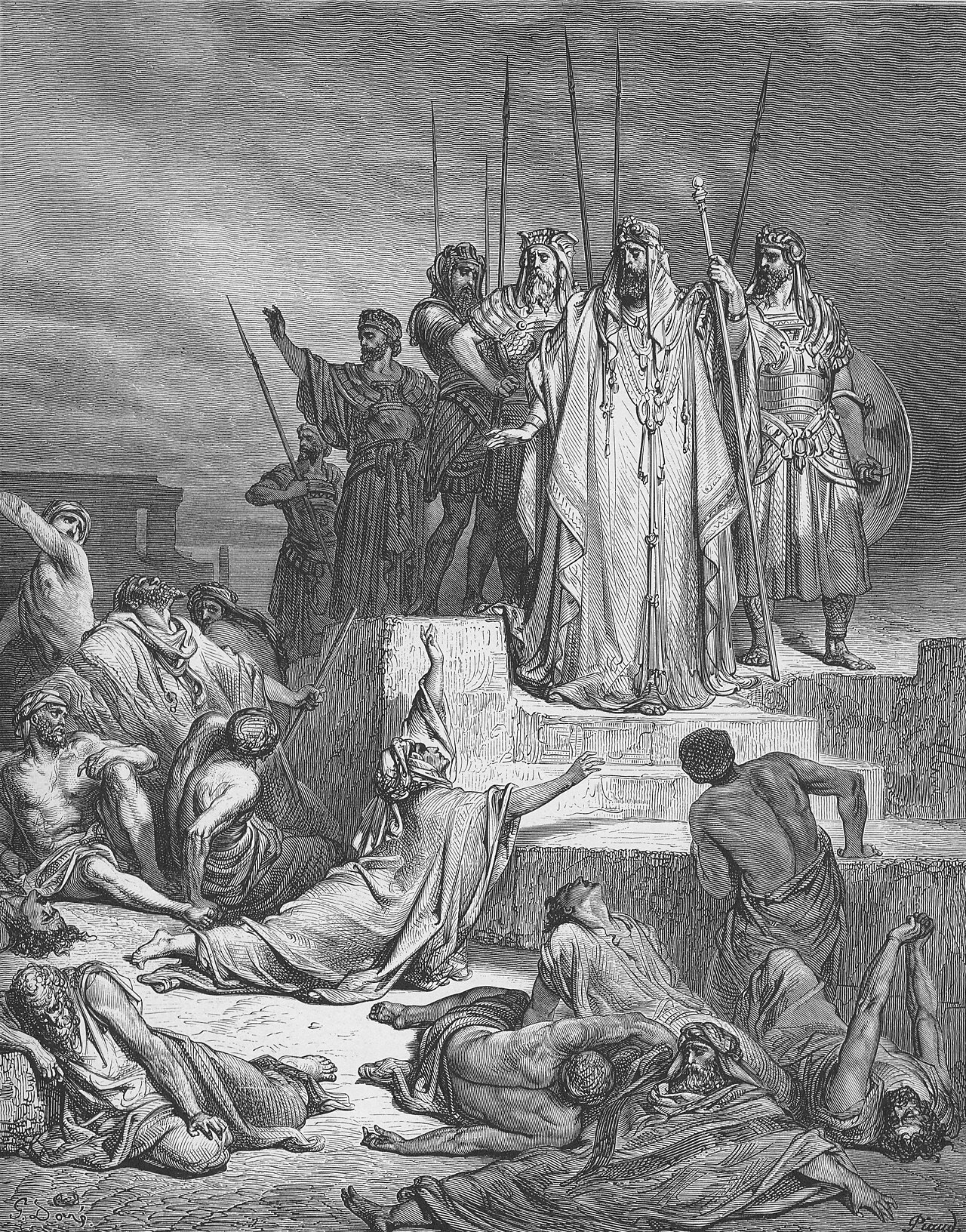
The siege at the end shows a city's economy collapsing. A donkey's head, the least edible part of an unclean animal, sold for eighty shekels of silver, and a small measure of what the text calls dove's dung for five; that last item is either literally what people were burning or eating at the end or a folk name for a cheap plant, and both readings are old. The mothers' agreement to eat their sons is the horror the Law had warned of by name in its list of covenant curses, and the same curse sequence, running from siege and famine reaching cannibalism through to exile, is the common legal language of the age, attested in the Succession Treaty of Esarhaddon of 672 BC. The king, tearing his robe, is seen to be wearing sackcloth underneath it, mourning in private while blaming the prophet in public.
Significance
The first hearers were given a sentence to hold onto in a siege: those who are with us are more than those who are with them. The odds are never the whole picture.
They were also shown a starving king who knew the disaster was from the LORD and concluded he should kill the prophet. Recognizing God's hand and repenting are two different things.
Where the chapter sits
2 Kings 6 falls in Elijah's ascension; Elisha's ministry (chapters 1–13). Elijah taken up by whirlwind; double portion; widow's oil; the Shunammite's son raised; Naaman healed; siege of Samaria broken; Elisha dies and his bones raise a man.
The opened eyes at Dothan. ‘They that be with us are more than they that be with them’; the mountain full of chariots of fire.
After it: Northern kingdom's fall, chapters 14–17.
The whole shape of 2 Kings→The structure of this chapter
People1
The heads below are this chapter's scenes. The numbered points under each are its verses.
The iron did swim
is too strait for us: The sons of the prophets are Elisha's school, grown large enough that their meeting house no longer holds them. Their request to build at Jordan still asks his leave rather than acting alone, and his answer is two words, Go ye. The same open door runs through the whole chapter: whoever comes to Elisha, whether over lost timber or a besieged capital, finds him attending to it.
2 Kings 6:1
“The writer returns here to the series of miracles which Elisha performed for the benefit of the prophetical schools under his care. The connection, in this point of view, is with 2Ki 4:44. The place where we dwell with thee - literally, “the place where we sit before thee,” i. e. “the place where we assemble and sit to bear thy teaching.” Elisha visited the sons of the prophets in circuit, staying a short time at each place where a “school” was established. Perhaps he was now visiting Jericho. Compare 2Ki 2:5.”
2 Kings 6:2
“Take every man a beam - Trees were rare in most parts of Palestine, but plentiful in the Jordan Valley. Jericho was known in early times as “the city of palms” Deu 34:3; Jdg 1:16.”
go with thy servants: One of the company presses Elisha to come himself, and he agrees with the same brevity, I will go. A prophet who has raised the dead and multiplied oil at Gehazi's hand does not treat a day cutting beams as beneath him. The text spends two verses on an errand with no miracle in it yet, because the ordinary labor is what sets up the loss that follows.
2 Kings 6:3
“And one said, be content, I pray thee, and with thy servants,.... Or be pleased to go with us; he begged it as a favour, that, being awed by his presence, they might preserve peace and order, and have his advice as to the spot of ground to erect their edifice on, and might be protected by him from harm and mischief by men or wild beasts: and he answered, I will go; he consented to it, knowing perhaps before hand that he should have an opportunity of working a miracle there, as he did.”
1 more voice on this verse
2 Kings 6:3
“When one of them, accidentally fetching too fierce a stroke (as those that work seldom are apt to be violent), threw off his axe-head into the water, he did not say, "It was a mischance, and who can help it? It was the fault of the helve, and the owner deserved to stand to the loss." No, he cries out with deep concern, Alas, master!”
Matthew Henry· Commentary on the Whole Bible (1707-1721)puritan
2 Kings 6:4
“Elisha, by casting a stick into the river Jordan, recovered the iron part of the axe with which the sons of the prophets had gone to cut down trees to build the house in which they wished to read and study the law and commandments of God; even as our Christ, by being crucified on the tree, and by purifying us with water, has redeemed us, though plunged in the direst offences which we have committed, and has made us a house of prayer and adoration.”
Justin Martyr· written before 165· Dialogue with Trypho, Chapter LXXXVIpatristic
for it was borrowed: The axe head is the smallest of Elisha's recorded miracles, iron made to swim rather than a resurrection or a plague answered, and the text is careful to say why it mattered: the tool was borrowed, and a poor man who lost another's iron in the river could not simply replace it. Elisha cuts a stick, casts it in, and the iron rises, an act with nothing spectacular in its staging. The scale of the miracle is itself the point the commentators return to: the power that sent fire from heaven at Carmel also troubles itself with one man's debt.
2 Kings 6:5
“The ax head - literally, as in the margin. The Jews used iron for the heads of axes at a very early date (see Deu 19:5). They probably acquired a knowledge of the smelting process in Egypt, where iron was employed at least from the time of the third Rameses.”
2 Kings 6:6
“He cut down a stick - This had no natural tendency to raise the iron; it was only a sign or ceremony which the prophet chose to use on the occasion. The iron did swim - This was a real miracle; for the gravity of the metal must have for ever kept it at the bottom of the water.”
Adam Clarke· Commentary on the Bible (1810-1826)evangelical
2 more voices on this verse
2 Kings 6:6
“And accordingly Elisha, having taken "wood" and cast it into that place where the iron had been submerged, forthwith it rose and swam on the surface, and the "wood" sank, which the sons of the prophets recovered. Thus they understood that the spirit of Elijah was presently conferred on him.”
Tertullian· written before 220· AN ANSWER TO THE JEWS 13patristic
2 Kings 6:6
“We need not double the miracle by supposing that the stick sunk to fetch up the iron, it was enough that it was a signal of the divine summons to the iron to rise. God's grace can thus raise the stony iron heart which has sunk into the mud of this world, and raise up affections naturally earthly, to things above.”
Matthew Henry· Commentary on the Whole Bible (1707-1721)puritan
2 Kings 6:7
“Therefore said he, take it up to thee,.... This the prophet said to the man that had lost it: and he put out his hand, and took it; it being on the top of the water within his reach.”
The prophet who hears what Syria whispers in the bedchamber
took counsel with his servants: The king of Syria plans his raids in secret councils, and each time the man of God sends word to the king of Israel of the place to avoid. The title man of God, used of Elisha here and repeatedly through the chapter's first half, is the same office worn by the prophet of 1 Kings 13 and by Elijah before him, a man whose access runs past locked bedchambers and closed camps. The king of Israel is saved not once nor twice, the text's own count of a pattern that will soon draw Syria's suspicion.
2 Kings 6:8
“The king of Syria - Probably the great Benhadad (see 2Ki 6:24).”
1 more voice on this verse
2 Kings 6:8
“The work of God's prophets is to give us warning; if, being warned, we do not save ourselves, it is our own fault, and our blood will be upon our own head. The king of Israel would regard the warnings Elisha gave him of his danger by the Syrians, but not the warnings he gave him of his danger by his sins.”
Matthew Henry· Commentary on the Whole Bible (1707-1721)puritan
2 Kings 6:9
“And the man of God sent unto the king of Israel,.... That is, Elisha sent to him: saying: beware that thou pass not such a place: not go to it, but avoid it, and pass another way: for thither the Syrians are come down: are hidden, as the Targum; lie covered at the bottom of the hill, so as not to be seen.”
2 Kings 6:10
“Sent to the place - To see if it were so. But the Vulgate gives it quite a different turn: Misit rex Israel ad locum, et praeoccupavit eum. The king of Israel sent previously to the place, and took possession of it; and thus the Syrians were disappointed. This is very likely, though it is not expressed in the Hebrew text. The prophet knew the Syrians marked such a place; he told the king of Israel, and he hastened and sent a party of troops to pre-occupy it; and thus the Syrians found that their designs had been detected.”
Adam Clarke· Commentary on the Bible (1810-1826)evangelical
sore troubled for this thing: Ben-hadad assumes a spy sits inside his own council, until a servant names the true source: Elisha tells the king of Israel the words spoken in the king of Syria's own bedchamber. No human informant is blamed once the servant answers; the prophet's knowledge is treated as a plain fact of the campaign rather than a mystery still needing a solution. The scene sets the king of Syria against an intelligence he cannot bribe or intercept.
2 Kings 6:11
Benhadad supposed that there must be a traitor in his camp. He asks therefore, “Will no one denounce him?”
2 Kings 6:12
“In thy bedchamber - literally, “in the secret place of thy bedchamber,” i. e.,” in the greatest possible secrecy.” The seclusion of the harem must be taken into account for the full appreciation of the force of the phrase. Probably the Syrian lord who answered Benhadad had received his intelligence from some of the Israelites.”
1 more voice on this verse
2 Kings 6:12
“Here a confession of the boundless knowledge, as before of the boundless power, of Israel's God, is extorted from Syrians. Nothing done, said, thought, by any person, in any place, at any time, is out of the reach of God's cognizance. 13 And he said, Go and spy where he is, that I may send and fetch him.”
Matthew Henry· Commentary on the Whole Bible (1707-1721)puritan
They that are with us are more: horses and chariots of fire
Go and spy where he is: Ben-hadad sends to find one man, and learns he is in Dothan, a small town north of Samaria. The force dispatched against him is horses, chariots and a great host, arriving by night to surround the whole city for a single unarmed prophet. The scale answers its own question: a king who cannot out-hear Elisha tries to out-number him instead.
2 Kings 6:13
“And he said, go, and spy where he is, that I may send and fetch him,.... But how could he expect to take him, who could give the king of Israel such intelligence of his designs against him, that he might escape his snares? and it was told him, saying, behold, he is in Dothan; a city in the tribe of Manasseh, not far from Shechem; see Gen 37:17.”
1 more voice on this verse
2 Kings 6:13
“Dothan - See the marginal reference note. It was at no great distance from Shechem. Its ancient name still attaches to a Tel or hill of a marked character (compare 2Ki 6:17), from the foot of which arises a copious fountain.”
2 Kings 6:14
“Therefore sent he thither horses and chariots, and a great host,.... To terrify the inhabitants from attempting to defend the prophet, but deliver him up at once: and they came by night; that they might come upon them unawares, and their design not be discovered, so as to have timely help from Samaria, which was not far off: and compassed the city about; that the prophet might not make his escape out of it.”
2 more voices on this verse
2 Kings 6:14
“He sent thither horses - It is strange he did not think that he who could penetrate his secrets with respect to the Israelitish army, could inform himself of all his machinations against his own life.”
Adam Clarke· Commentary on the Bible (1810-1826)evangelical
2 Kings 6:14
“Naaman could tell him that Elisha dwelt not in any strong-hold, nor was attended with any guards, nor had any such great interest in the people that he needed to fear a tumult among them; what occasion then was there for this great force?”
Matthew Henry· Commentary on the Whole Bible (1707-1721)puritan
how shall we do?: Elisha's servant wakes to an army surrounding the city and asks the question fear always asks first. Elisha answers with the ratio that matters, they that be with us are more than they that be with them, and then prays not for deliverance but for sight, Lord, open his eyes. What the servant sees is a mountain full of horses and chariots of fire, the words that named Elijah's own departure at 2:11, their only other occurrence in Scripture, the unseen army standing guard the whole time the servant could see only the siege.
2 Kings 6:15
“This was a new servant, who had only been with him since Gehazi's dismissal and consequently had little or no experience of his master's powers. His faith was easily shaken by so unexpected an alarm.”
Jamieson, Fausset & Brown· Commentary Critical and Explanatory on the Whole Bible (1871)reformed
2 Kings 6:16
“And he answered, fear not, for they that be with us are more than they that be with them. Meaning the legions of angels that encamped around them.”
3 more voices on this verse
2 Kings 6:16
“They that be with us ... - Elisha gave utterance to the conviction of all God’s saints when the world persecutes them (compare marginal references). God - they know - is on their side; they need “not fear what flesh can do unto them.” His angels - an innumerable host - are ever guarding those who love Him.”
2 Kings 6:16
“If, then, justice is binding, even in war, how much more ought we to observe it in time of peace. Such favor the prophet showed to those who came to seize him. We read that the king of Syria had sent his army to lie in wait for him, for he had learned that it was Elisha who had made known to all his plans and consultations. And Gehazi, the prophet's servant, seeing the army, began to fear that his life was in danger.”
Ambrose of Milan· written before 397· On the Duties of the Clergy 1.29.140patristic
2 Kings 6:16
“For they that be with us are more, etc. - What astonishing intercourse had this man with heaven! It seems the whole heavenly host had it in commission to help him.”
Adam Clarke· Commentary on the Bible (1810-1826)evangelical
2 Kings 6:17
“Elisha prayed, and said, Lord, I pray thee, open his eyes, that he may see--The invisible guard of angels that encompass and defend us (Ps 34:7). The opening of the eyes, which Elisha prayed for, were those of the Spirit, not of the body--the eye of faith sees the reality of the divine presence and protection where all is vacancy or darkness to the ordinary eye.”
Jamieson, Fausset & Brown· Commentary Critical and Explanatory on the Whole Bible (1871)reformed
1 more voice on this verse
2 Kings 6:17
“Open his eyes that he may see - Elisha’s servant lacked the faith of his master. Elisha therefore prays that he may be given a vision of the spiritual world, and see, as if with the bodily eye, the angelic host (marginal references) which he himself knows to be present.”
Smite this people, I pray thee: Elisha prays a second time, now for blindness rather than sight, and the army that came to take one prophet is led wherever he chooses to lead it. He tells the blinded Syrians this is neither the way nor the city, technically true and aimed at his own purpose, and marches the whole host into Samaria before praying a third time to open their eyes. The men who came by night to surround Dothan wake to find themselves standing disarmed in the middle of the enemy capital.
2 Kings 6:18
“Smite this people - with blindness - Confound their sight so that they may not know what they see, and so mistake one place for another.”
Adam Clarke· Commentary on the Bible (1810-1826)evangelical
1 more voice on this verse
2 Kings 6:18
“9 For this twofold judgment Christ came into this world, that those who see not might see, and that those who see might be made blind ( John ix. 39 ), a savour of life to some, of death to others.”
Matthew Henry· Commentary on the Whole Bible (1707-1721)puritan
2 Kings 6:19
“This was humane advice; it was contrary to the usage of war to put war captives to death in cold blood, even when taken by the point of the sword, much more those whom the miraculous power and providence of God had unexpectedly placed at his disposal.”
Jamieson, Fausset & Brown· Commentary Critical and Explanatory on the Whole Bible (1871)reformed
2 Kings 6:20
“And it came to pass, when they were come into Samaria, that Elisha said, Lord, open the eyes of these men, that they may see,....”
1 more voice on this verse
2 Kings 6:20
“Open the eyes of these men - Take away their confusion of vision, that they may discern things as they are, and distinguish where they are.”
Adam Clarke· Commentary on the Bible (1810-1826)evangelical
My father, shall I smite them?: The king of Israel, calling Elisha father as Elisha once called Elijah father at his departure, asks leave to kill a captured army inside his own capital. Elisha refuses on the ground of plain military custom rather than sentiment, wouldest thou smite those whom thou hast taken captive with thy sword and with thy bow, men taken by no weapon of the king's own. He orders a feast instead of an execution, and the text records the result in one line, the bands of Syria came no more into the land of Israel, mercy accomplishing what the earlier warnings only interrupted.
2 Kings 6:21
“My father - A term of respect used by Jehoram in his joy at seeing an army of Syrians delivered up to him by the prophet. That the king’s character was not changed appears from 2Ki 6:31-32. Shall I smite them? shall I smite them? - The repetition of the words mean, “Shall I utterly smite them?” Compare similar repetitions with similar meanings in Gen 22:17; Luk 22:15.”
2 Kings 6:22
“Whom thou hast taken captive - Those who in open battle either lay down their arms, or are surrounded, and have their retreat cut off, are entitled to their lives, much more those who are thus providentially put into thy hand, without having been in actual hostility against thee. Give them meat and drink, and send them home to their master, and let them thus know that thou fearest him not, and art incapable of doing an ungenerous or unmanly action.”
Adam Clarke· Commentary on the Bible (1810-1826)evangelical
1 more voice on this verse
2 Kings 6:22
“Set bread - Give them meat and drink, which may refresh and strengthen them for their journey. This was an action of singular piety and charity, in doing good to their enemies, which was much to the honour of the true religion; and of no less prudence, that hereby the hearts of the Syrians might be mollified towards the Israelites.”
John Wesley· Explanatory Notes upon the Old Testament (1765)evangelical
2 Kings 6:23
“Jehoram did not merely follow the letter of the prophet’s direction, but understood its spirit and acted accordingly. The plundering bands which had been in the habit of ravaging the territory 2Ki 5:2 ceased their incursions in consequence either of the miracle, or of the kind treatment which Elisha had recommended.”
Famine so deep a mother eats her son
gathered all his host: The mercy of verse 23 buys Israel a season, not permanence. Ben-hadad returns with his full army and lays a formal siege against Samaria rather than a raiding party, and the famine inside the walls is priced in the text itself: an ass's head, an unclean animal not normally eaten, sold for eighty pieces of silver, and a small measure of dove's dung, likely a cheap seed husk by most readings rather than the substance itself, at five. Whatever the exact commodity, the prices mark a siege economy that has run out of anything better to sell.
2 Kings 6:24
“Ben-hadad - He whom Ahab wickedly spared, now comes to requite his kindness, and to fulfil that Divine prediction. Ben- hadad was a name very frequent among the kings of Syria, if not common to them all.”
John Wesley· Explanatory Notes upon the Old Testament (1765)evangelical
2 Kings 6:25
“As the donkey was “unclean,” it would not be eaten except in the last resort; and its head would be its worst and cheapest part. Cab - This measure is not mentioned elsewhere in Scripture. According to the rabbinical writers it was the smallest of all the dry measures in use among the Jews, being the sixth part of a seah, which was the third part of an ephah. If it was about equal to two of our quarts, the “fourth part of a cab” would be about a pint.”
1 more voice on this verse
2 Kings 6:25
“Famine in Samaria - Probably the siege was so sudden, that they had no time to lay in provisions. Pieces - Supposed to be shekels; and the common shekel being valued at fifteen pence of English money, this amounts to five pounds.”
John Wesley· Explanatory Notes upon the Old Testament (1765)evangelical
there cried a woman unto him: A woman appeals to the king as he walks the wall, and his first answer names the real source of help correctly before he can act on it, if the Lord do not help thee, whence shall I help thee. The barnfloor and winepress are the ordinary places grain and wine come from in a working land, and both stand empty in a siege, so the king's question is an honest description of a kingdom with nothing left to give, not an evasion of hers.
2 Kings 6:26
“The walls of fortified towns had a broad space at the top, protected toward the exterior by battlements, along which the bulk of the defenders were disposed, and from which they hurled their missiles and shot their arrows. The king seems to have been going his rounds, to inspect the state of the garrison and the defenses.”
2 Kings 6:27
“If the Lord do not help - The translation in the text is decidedly better than the marginal rendering. Some prefer to render - “Nay ... let Jehovah help thee. Whence, shall I help thee?” Out of the barnfloor ... - The king means that both were empty - that he had no longer any food in store; and therefore could not help the woman. Compare Hos 9:2.”
1 more voice on this verse
2 Kings 6:27
“Whence shall I help thee - Dost thou ask of me corn or wine, which I want for myself? If God does not, I cannot help thee. Creatures are helpless things without God.”
John Wesley· Explanatory Notes upon the Old Testament (1765)evangelical
What aileth thee?: The king asks what troubles her and hears an agreement between two mothers to eat their own sons in turn, one boiled and eaten already, the second hidden once her turn came. Deuteronomy had named this exact horror as the covenant's own last curse on a besieged and disobedient people, thine eye shall be evil toward the son of thy bosom in the siege and in the straitness wherewith thine enemy shall distress thee. The chapter does not soften the scene or explain it away; it reports the curse of Deuteronomy 28 arriving on schedule inside the city's own walls.
2 Kings 6:28
“The king had assumed that the cry of the woman was for food. Her manner indicated that it was not so. He therefore proceeded to inquire what she wanted of him. This woman - Both women, it would seem, were present; and the aggrieved one pointed to the other.”
2 Kings 6:29
“So we boiled my son, and did eat him,.... Thus what was predicted, by way of threatening, began to be accomplished, Deu 28:53; see Gill on Deu 28:53, and of which there were other instances of a like kind at the siege of Jerusalem, both by Nebuchadnezzar and Vespasian: and I said unto her on the next day; after her child had been wholly ate up: give thy son, that we may eat him; according to agreement: and she hath hid her son; either to save him alive, or to eat him herself alone.”
1 more voice on this verse
2 Kings 6:29
“The prophecy alluded to in the marginal references was now fulfilled, probably for the first time. It had a second accomplishment when Jerusalem was besieged by Nebuchadnezzar Lam 4:10, and a third in the final siege of the same city by Titus.”
he rent his clothes: The king tears his royal robe in public grief, and underneath it the people see sackcloth already worn against his own skin, a penitential garment put on before this one horror ever reached his ears. The hidden sackcloth says the king already knew the city's condition was covenant judgment even while he kept looking for someone else to blame. What he does next shows which way that blame is about to fall.
2 Kings 6:30
“Sackcloth - Jehoram hoped perhaps to avert Yahweh’s anger, as his father had done 1Ki 21:29. But there was no spirit of self-humiliation, or of true pentitence in his heart 2Ki 5:7. See the next verse.”
God do so and more also to me: The king swears an oath to have Elisha's head before the day ends, naming him son of a murderer rather than prophet, laying blame on the man who warned him rather than on the sin that brought the siege. Elisha, sitting with the elders, already knows the messenger is coming and has the door held against him, telling them to listen for the sound of his master's feet close behind, the king following his own errand in person. When the king himself arrives he speaks the chapter's last line, this evil is of the Lord, what should I wait for the Lord any longer, laying the famine at God's door in the same breath he has just laid the prophet's death at his own hand.
2 Kings 6:31
“God do so ... - Jehoram uses almost the very words of his wicked mother, when she sought the life of Elijah (marginal reference). The head of Elisha - Beheading was not an ordinary Jewish punishment. The Law did not sanction it. But in Assyria, Babylonia, and generally through the East, it was the most conmon form of capital punishment. It is not quite clear why Elisha was to be punished. Perhaps Jehoram argued from his other miracles that he could give deliverance from the present peril, if he liked.”
1 more voice on this verse
2 Kings 6:31
“What had Elisha done? his head is the most innocent and valuable in all Israel, and yet that must be devoted, and made an anathema. Thus in the days of the persecuting emperors, when the empire groaned under any extraordinary calamity, the fault was laid on the Christians, and they were doomed to destruction. Christianos ad leones--Away with the Christians to the lions.”
Matthew Henry· Commentary on the Whole Bible (1707-1721)puritan
2 Kings 6:32
“This son of a murderer - Jehoram, the son of Ahab and Jezebel. But Ahab is called a murderer because of the murder of Naboth. Shut the door - He was obliged to make use of this method for his personal safety, as the king was highly incensed. The sound of his master’s feet behind him? - That is, King Jehoram is following his messenger, that he may see him take off my head.”
Adam Clarke· Commentary on the Bible (1810-1826)evangelical
2 more voices on this verse
2 Kings 6:32
“The same spirit of prophecy that enabled Elisha to tell him what was done at a distance authorized him to call the king the son of a murderer, which, unless we could produce such an extraordinary commission, it is not for us to initiate; far be it from us to despise dominion and to speak evil of dignities.”
Matthew Henry· Commentary on the Whole Bible (1707-1721)puritan
2 Kings 6:32
“A meeting, probably a prayer-meeting, of those was held in the house where he lodged, for he had none of his own (1Ki 19:20, 21); and them he not only apprised of the king's design against himself, but disclosed to them the proof of a premeditated deliverance.”
Jamieson, Fausset & Brown· Commentary Critical and Explanatory on the Whole Bible (1871)reformed
2 Kings 6:33
“The messenger - It has been proposed to change “messenger” into “king,” the two words being in Hebrew nearly alike, and the speech with which the chapter ends being considered only suitable in the mouth of the king, whose presence is indicated in 2Ki 7:2, 2Ki 7:17. Others think that the words “and the king after him” have fallen out of the text. Came down - The messenger came down from off the wall to the level of the streets.”
1 more voice on this verse
2 Kings 6:33
“This evil - This dreadful famine, which is now so extreme, that women are forced to eat their own children. The Lord - Hath inflicted it, and (for ought I see) he will not remove it. All penal evil is of the Lord, as the first cause and sovereign judge.”
John Wesley· Explanatory Notes upon the Old Testament (1765)evangelical
Keep studying
On this page
Studies4
On this verse
On this chapter
On this book
People1
Sources for this chapter
The summary
Jamieson, Fausset & Brown, Commentary Critical and Explanatory; John Wesley, Notes on the Old Testament and Matthew Henry, Complete Commentary.
The exposition
Adam Clarke, Commentary on the Bible; Albert Barnes, Notes on the Old Testament; F. W. Farrar, The Second Book of Kings (Expositor's Bible); John Gill, Exposition of the Old Testament; John Wesley, Explanatory Notes upon the Old Testament; Keil, The Books of the Kings and Matthew Henry, Commentary on the Whole Bible.