
2 Kings 6:29
in 2 Kings 6So we boiled my son and ate him, and the next day I said to her, ‘Give up your son, that we may eat him.’ But she had hidden her son.”
BSB
The same verse in ASV and KJV ▾
ASV
So we boiled my son, and did eat him: and I said unto her on the next day, Give thy son, that we may eat him; and she hath hid her son.
KJV
So we boiled my son, and did eat him: and I said unto her on the next day, Give thy son, that we may eat him: and she hath hid her son.
⋯
This verse in 2 Kings 6
Commentary
7 notes on this verseSo we boiled my son, and did eat him,.... Thus what was predicted, by way of threatening, began to be accomplished, Deu 28:53; see Gill on Deu 28:53, and of which there were other instances of a like kind at the siege of Jerusalem, both by Nebuchadnezzar and Vespasian: and I said unto her on the next day; after her child had been wholly ate up: give thy son, that we may eat him; according to agreement: and she hath hid her son; either to save him alive, or to eat him herself alone.
This site's exposition
What is the matter
on 2 Kings 6:28-29
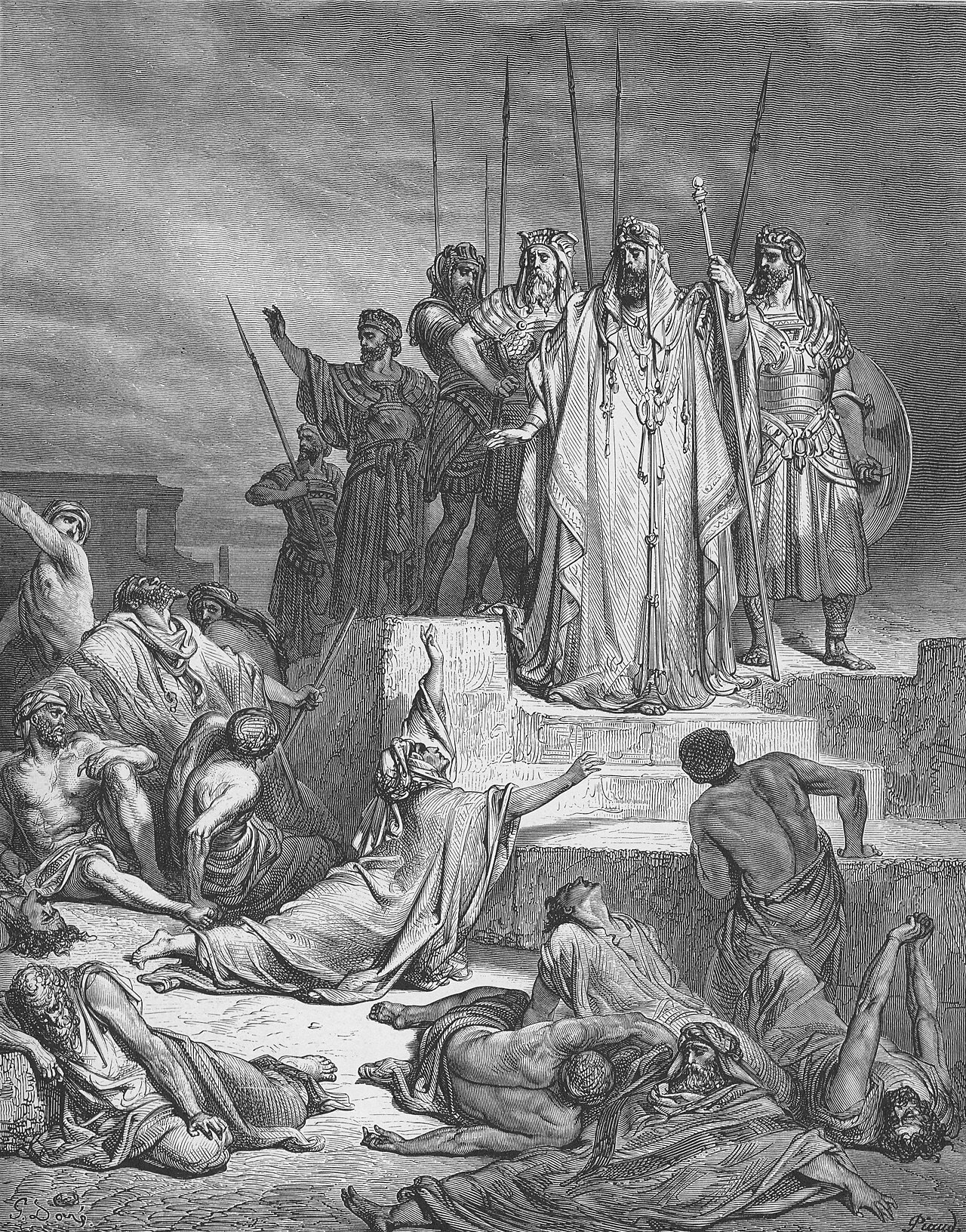
The king hears of two mothers who agreed to eat their sons in turn, and the second hid her son when her turn came. Deuteronomy 28:53-57 named this horror as the last curse on a besieged and disobedient people. The chapter reports that curse falling inside the walls without comment.
This site's exposition
she had hidden her son
Albert Barnes counts this as the first fulfilment of the siege curse, with a second at Lamentations 4:10 and a third when Titus besieged Jerusalem. John Gill leaves open why the second mother hid her son. She meant either to save him or to eat him alone.
The record, by era
The Church Fathers1 voice
"Some time later King Ben-hadad of Aram mustered his entire army; he marched against Samaria and laid siege to it." This is that Ben-hadad who had been condemned to death by God; and Ahab had received the order to execute him. But he spared his …
The Puritans and the Awakening1 voice
Concerning the sons of the prophets, and their condition and character. The college here spoken of seems to be that at Gilgal, for there Elisha was ( ch. iv. 38 ), and it was near Jordan; and, probably, wherever Elisha resided as many as could of the sons of the prophets flocked to him for the advantage of his instructions, counsels, and prayers.
The Nineteenth Century2 voices
A commentator
Albert Barnes1798–1870
Notes, Explanatory and Practical, on the Old and New Testaments (1832-1869)
The prophecy alluded to in the marginal references was now fulfilled, probably for the first time. It had a second accomplishment when Jerusalem was besieged by Nebuchadnezzar Lam 4:10, and a third in the final siege of the same city by Titus.
So we boiled my son - This is horrible; but for the sake of humanity we must allow that the children died through hunger, and then became food for their starved, desperate parents. She hath hid her son - He was already dead, says Jarchi; and she hid him, that she might eat him alone. This very evil Moses had foretold should come upon them if they forsook God; see Deu 28:53-57. The same evil came upon this wretched people when besieged by Nebuchadnezzar; see Eze 5:10. And also when Titus besieged Jerusalem; see Josephus, De Bell. Judaic. lib. vi., cap. 3, and my notes on Mat 24:19.
The words behind it
15 Hebrew wordsEvery Hebrew word of this verse in the order it stands, with what it means and the door to its own study. The last column counts the times a word stands in the whole Bible: the rarer the word, the more the places it appears belong together.
| Hebrew | Sound | Meaning | Word study | In the Bible |
|---|---|---|---|---|
| וַנְּבַשֵּׁ֥ל | vanevashel | and we cooked | H1310 → | |
| אֶת־ | ʾet- | <obj.> | H853 → | 10935 times |
| בְּנִ֖י | beni | son my | H1121 → | 4930 times |
| וַנֹּֽאכְלֵ֑הוּ | vanokhelehu | and we ate him | H398 → | 810 times |
| וָאֹמַ֨ר | vaomar | and I said | H559 → | 5305 times |
| אֵלֶ֜יהָ | ʾeleiha | to her | H413 → | 5510 times |
| בַּיּ֣וֹם | baiyom | on the day | H3117 → | 2304 times |
| הָאַחֵ֗ר | haacher | <the> other | H312 → | 166 times |
| תְּנִ֤י | teni | give | H5414 → | 2011 times |
| אֶת־ | ʾet- | <obj.> | H853 → | 10935 times |
| בְּנֵךְ֙ | benekh | son your | H1121 → | 4930 times |
| וְנֹ֣אכְלֶ֔נּוּ | venokhelenu | so we may eat him | H398 → | 810 times |
| וַתַּחְבִּ֖א | vatachbi' | and she had hidden | H2244 → | |
| אֶת־ | ʾet- | <obj.> | H853 → | 10935 times |
| בְּנָֽהּ׃ | benah | son her | H1121 → | 4930 times |
וַנְּבַשֵּׁ֥לand we cooked
vanevashelH1310 →
אֶת־<obj.>
ʾet-H853 →10935 times
בְּנִ֖יson my
beniH1121 →4930 times
וַנֹּֽאכְלֵ֑הוּand we ate him
vanokhelehuH398 →810 times
וָאֹמַ֨רand I said
vaomarH559 →5305 times
אֵלֶ֜יהָto her
ʾeleihaH413 →5510 times
בַּיּ֣וֹםon the day
baiyomH3117 →2304 times
הָאַחֵ֗ר<the> other
haacherH312 →166 times
תְּנִ֤יgive
teniH5414 →2011 times
אֶת־<obj.>
ʾet-H853 →10935 times
בְּנֵךְ֙son your
benekhH1121 →4930 times
וְנֹ֣אכְלֶ֔נּוּso we may eat him
venokhelenuH398 →810 times
וַתַּחְבִּ֖אand she had hidden
vatachbi'H2244 →
אֶת־<obj.>
ʾet-H853 →10935 times
בְּנָֽהּ׃son her
benahH1121 →4930 times
A shaded row is a word that stands 400 times or fewer in the Bible.
The walk
8 stopsEach card is a verse this one points to, and under it the verses that one points to in turn. Where several paths arrive at the same place, that place is listed first: the text keeps returning to it.
Through
1 Kings 3:26Then the woman whose son was alive spoke to the king because she yearned with compassion for her son. “Please, my lord,” she said, “give her the living baby. Do not kill him!” But…
it leads to
- Isaiah 49:15
“Can a woman forget her nursing child, or lack compassion for the son of her womb? Even if she could forget, I will not forget you!
Reached by 2 separate paths from here.
- Jeremiah 31:20
Is not Ephraim a precious son to Me, a delightful child? Though I often speak against him, I still remember him. Therefore My heart yearns for him; I have great compassion for him,” declares…
- Isaiah 49:15
Through
Isaiah 66:13As a mother comforts her son, so will I comfort you, and you will be consoled over Jerusalem.”
it leads to
- 2 Corinthians 1:4
who comforts us in all our troubles, so that we can comfort those in any trouble with the comfort we ourselves have received from God.
- Isaiah 51:3
For the LORD will comfort Zion and will look with compassion on all her ruins; He will make her wilderness like Eden and her desert like the garden of the LORD. Joy and gladness…
- Isaiah 40:1
“Comfort, comfort My people,” says your God.
- 1 Thessalonians 2:7
On the contrary, we were gentle among you, like a nursing mother caring for her children.
- Psalms 137:6
May my tongue cling to the roof of my mouth if I do not remember you, if I do not exalt Jerusalem as my greatest joy!
- 2 Corinthians 1:4
Through
Deuteronomy 28:53Then you will eat the fruit of your womb, the flesh of the sons and daughters whom the LORD your God has given you, in the siege and distress that your enemy will inflict…
it leads to
- Lamentations 4:10
The hands of compassionate women have cooked their own children, who became their food in the destruction of the daughter of my people.
Reached by 2 separate paths from here.
- Lamentations 4:10
Where this verse is studied
About 2 Kings
This page draws on Adam Clarke, Commentary on the Bible; Albert Barnes, Notes, Explanatory and Practical, on the Old and New Testaments; Albert Barnes, Notes, Explanatory and Practical, on the Old and New Testaments (1832-1869); Ephrem the Syrian, ON THE SECOND BOOK OF KINGS 6:24; John Gill, Exposition of the Old Testament (1748-1763); John Gill, Exposition of the Old Testament; Keil, The Books of the Kings and Matthew Henry, Commentary on the Whole Bible.