
2 Kings 6:27
in 2 Kings 6He answered, “If the LORD does not help you, where can I find help for you? From the threshing floor or the winepress?”
BSB
The same verse in ASV and KJV ▾
ASV
And he said, If Jehovah do not help thee, whence shall I help thee? out of the threshing-floor, or out of the winepress?
KJV
And he said, If the Lord do not help thee, whence shall I help thee? out of the barnfloor, or out of the winepress?
⋯
This verse in 2 Kings 6
Commentary
10 notes on this verseA commentator
Albert Barnes1798–1870
Notes, Explanatory and Practical, on the Old and New Testaments (1832-1869)
If the Lord do not help - The translation in the text is decidedly better than the marginal rendering. Some prefer to render - “Nay ... let Jehovah help thee. Whence, shall I help thee?” Out of the barnfloor ... - The king means that both were empty - that he had no longer any food in store; and therefore could not help the woman. Compare Hos 9:2.
This site's exposition
there cried a woman unto him
on 2 Kings 6:26-27
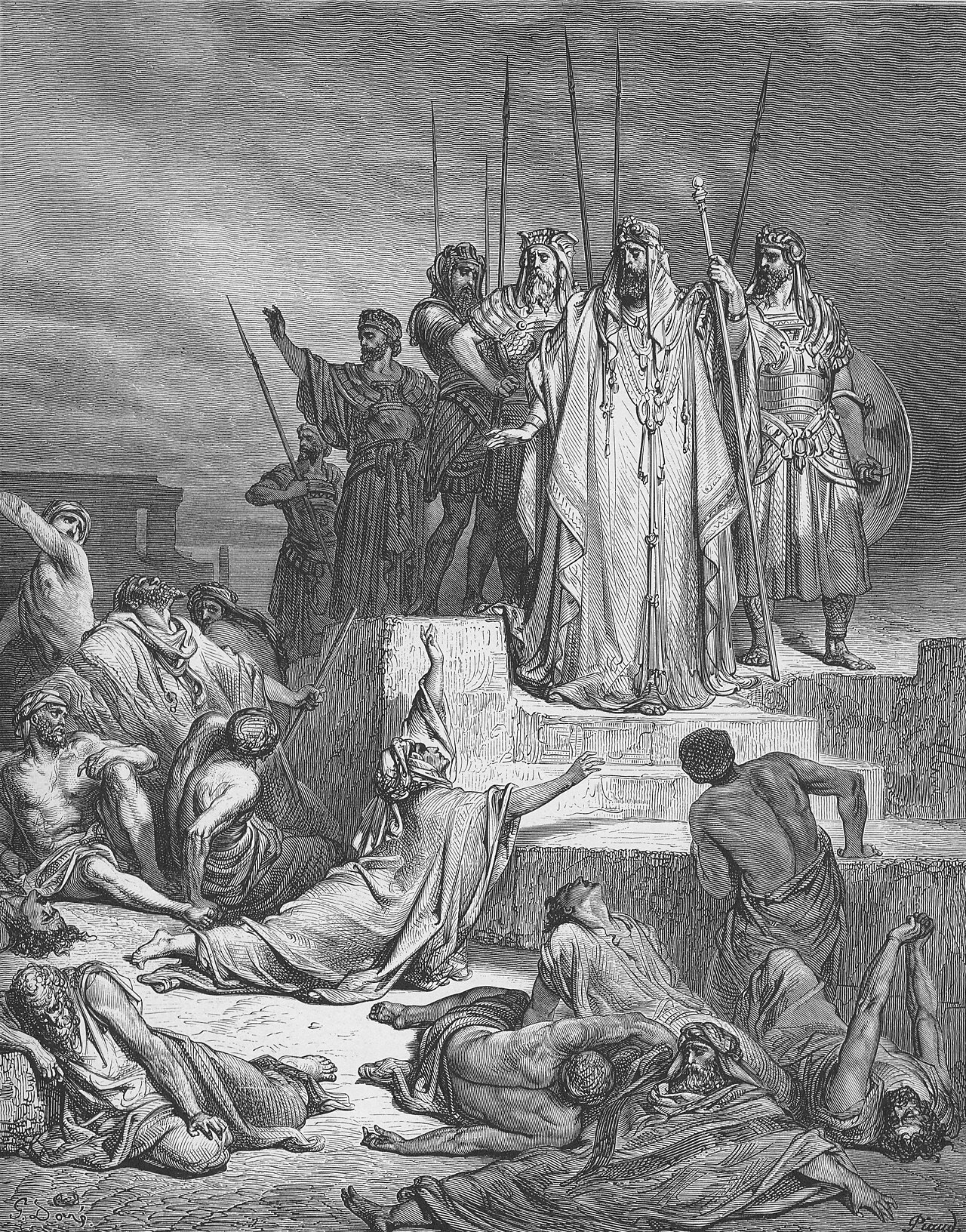
A woman appeals to the king as he walks the wall, and his first answer names the real source of help correctly before he can act on it, if the Lord do not help thee, whence shall I help thee. The barnfloor and winepress are the ordinary places grain and wine come from in a working land, and both stand empty in a siege, so the king's question is an honest description of a kingdom with nothing left to give, not an evasion of hers.
The record, by era
The Church Fathers1 voice
"Some time later King Ben-hadad of Aram mustered his entire army; he marched against Samaria and laid siege to it." This is that Ben-hadad who had been condemned to death by God; and Ahab had received the order to execute him. But he spared his …
The Puritans and the Awakening4 voices
Whence shall I help thee - Dost thou ask of me corn or wine, which I want for myself? If God does not, I cannot help thee. Creatures are helpless things without God.
): If the Lord do not help thee, whence shall I? Some think it was a quarrelling word, and the language of his fretfulness: "Why dost thou expect anything from me, when God himself deals thus hardly with us?" Because he could not help her as he would, out of the floor or the wine-press, he would not help her at all.
quarantine:debris (2026-07-29) — leading-punctuation+unbalanced-parens
And he said, if the Lord do not help thee, whence shall I help thee?....
Concerning the sons of the prophets, and their condition and character. The college here spoken of seems to be that at Gilgal, for there Elisha was ( ch. iv. 38 ), and it was near Jordan; and, probably, wherever Elisha resided as many as could of the sons of the prophets flocked to him for the advantage of his instructions, counsels, and prayers.
3 more voices on this verse
The Nineteenth Century3 voices
A commentator
Charles Spurgeon1834–1892
The Metropolitan Tabernacle Pulpit, Sermon No. 3162: “The Unfailing Help” (lightly modernized text, CCEL edition) · Written before 1892.
proposed
I READ in your hearing the very horrible incident connected with the siege of Samaria. I do not wonder that when the poor woman applied to the king he should have been horrified. He felt that her case, and the case of all about him was a desperate one, so he said, "If Jehovah does not interpose, what can I do?" The winepress is dry and the threshing floor is empty—there is nothing left to alleviate the horrors of famine. "If the Lord does not help you, where can I find help for you?" I.
A commentator
Charles Spurgeon1834–1892
The Metropolitan Tabernacle Pulpit, Sermon No. 3162: “The Unfailing Help” (lightly modernized text, CCEL edition) · Written before 1892.
proposed
I READ in your hearing the very horrible incident connected with the siege of Samaria. I do not wonder that when the poor woman applied to the king he should have been horrified. He felt that her case, and the case of all about him was a desperate one, so he said, "If Jehovah does not interpose, what can I do?" The winepress is dry and the threshing floor is empty—there is nothing left to alleviate the horrors of famine. "If the Lord does not help you, where can I find help for you?" I. Now the CASE OF EVERY UNSAVED MAN IS A VERY TERRIBLE ONE. He is not in dread of immediate death by famine, but if he is at all awakened to know his true condition, he will labor under a fear of something worse than death, and worse than the need of bread. There is many a sinner that I have met with (and I know the feeling myself) who would be glad if death could end it and if that were all. But "there is the dread of something after death"—that wrath to come of which the Word of God speaks in such solemn tones—that fire that never shall be quenched, that worm that dies not—it is that which haunts the sinner's conscience when he is once awakened to know his condition! And horrible as the story was in Samaria, it is not worse than the horrible fate that awaits every man who lives and dies unsaved! Now it is no wonder at all, that when a man is awakened to see his great danger, standing as he does upon the edge of a precipice with a frightful gulf beneath him, he begins to appeal to anybody and everybody and to cry for help.
If the Lord do not help thee - Some read this as an imprecation, May God save thee not! how can I save thee?
The words behind it
11 Hebrew wordsEvery Hebrew word of this verse in the order it stands, with what it means and the door to its own study. The last column counts the times a word stands in the whole Bible: the rarer the word, the more the places it appears belong together.
| Hebrew | Sound | Meaning | Word study | In the Bible |
|---|---|---|---|---|
| וַיֹּ֙אמֶר֙ | vaiyomer | and he said | H559 → | 5305 times |
| אַל־ | ʾal- | may not | H408 → | 724 times |
| יוֹשִׁעֵ֣ךְ | yoshiekh | he save you | H3467 → | 206 times |
| יְהוָ֔ה | yahweh | Yahweh | H3068 → | 6520 times |
| מֵאַ֖יִן | meayin | from where? | H370 → | 17 times |
| אֽוֹשִׁיעֵ֑ךְ | ʾoshiekh | will I save you | H3467 → | 206 times |
| הֲמִן־ | hamin- | ¿ from | H4480 → | 1188 times |
| הַגֹּ֖רֶן | hagoren | the threshing floor | H1637 → | |
| א֥וֹ | ʾo | or? | H176 → | 321 times |
| מִן־ | min- | from | H4480 → | 1188 times |
| הַיָּֽקֶב׃ | haiyakev | the wine-press | H3342 → |
וַיֹּ֙אמֶר֙and he said
vaiyomerH559 →5305 times
אַל־may not
ʾal-H408 →724 times
יוֹשִׁעֵ֣ךְhe save you
yoshiekhH3467 →206 times
יְהוָ֔הYahweh
yahwehH3068 →6520 times
מֵאַ֖יִןfrom where?
meayinH370 →17 times
אֽוֹשִׁיעֵ֑ךְwill I save you
ʾoshiekhH3467 →206 times
הֲמִן־¿ from
hamin-H4480 →1188 times
הַגֹּ֖רֶןthe threshing floor
hagorenH1637 →
א֥וֹor?
ʾoH176 →321 times
מִן־from
min-H4480 →1188 times
הַיָּֽקֶב׃the wine-press
haiyakevH3342 →
A shaded row is a word that stands 400 times or fewer in the Bible.
The walk
8 stopsEach card is a verse this one points to, and under it the verses that one points to in turn. Where several paths arrive at the same place, that place is listed first: the text keeps returning to it.
Through
Psalms 127:1Unless the LORD builds the house, its builders labor in vain; unless the LORD protects the city, its watchmen stand guard in vain.
it leads to
- Proverbs 16:9
A man’s heart plans his course, but the LORD determines his steps.
- 1 Corinthians 3:7
So neither he who plants nor he who waters is anything, but only God, who makes things grow.
- Proverbs 21:30–31
There is no wisdom, no understanding, no counsel that can prevail against the LORD.
- 1 Corinthians 3:9–15
For we are God’s fellow workers; you are God’s field, God’s building.
- Psalms 33:16–18
No king is saved by his vast army; no warrior is delivered by his great strength.
- Proverbs 16:9
Through
Jeremiah 17:5This is what the LORD says: “Cursed is the man who trusts in mankind, who makes the flesh his strength and turns his heart from the LORD.
it leads to
- Psalms 118:8–9
It is better to take refuge in the LORD than to trust in man.
- Psalms 146:3–4
Put not your trust in princes, in mortal man, who cannot save.
- Psalms 118:8–9
Through
Psalms 62:8Trust in Him at all times, O people; pour out your hearts before Him. God is our refuge. Selah
it leads to
- Philippians 4:6
Be anxious for nothing, but in everything, by prayer and petition, with thanksgiving, present your requests to God.
- Philippians 4:6
Where this verse is studied
On this page
About 2 Kings
This page draws on Adam Clarke, Commentary on the Bible; Albert Barnes, Notes, Explanatory and Practical, on the Old and New Testaments (1832-1869); Charles Spurgeon, The Metropolitan Tabernacle Pulpit, Sermon No. 3162: “The Unfailing Help” (lightly modernized text, CCEL edition); Ephrem the Syrian, ON THE SECOND BOOK OF KINGS 6:24; John Gill, Exposition of the Old Testament (1748-1763); John Wesley, Explanatory Notes upon the Old Testament; Keil, The Books of the Kings and Matthew Henry, Commentary on the Whole Bible.