
2 Kings 6:25
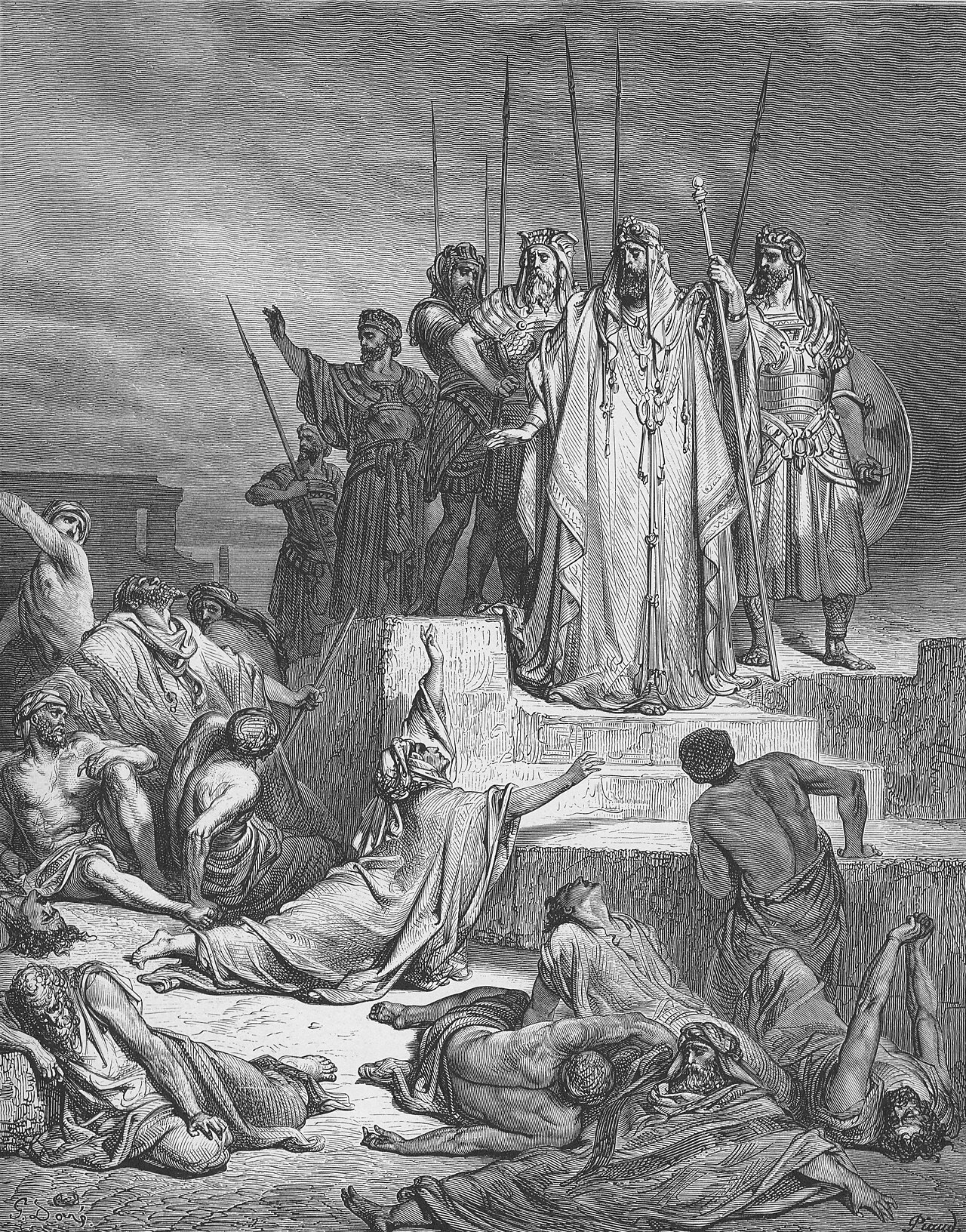
in 2 Kings 6So there was a great famine in Samaria. Indeed, they besieged the city so long that a donkey’s head sold for eighty shekels of silver, and a quarter cab of dove’s dung sold for five shekels of silver.
BSB
The same verse in ASV and KJV ▾
ASV
And there was a great famine in Samaria: and, behold, they besieged it, until an ass’s head was sold for fourscore pieces of silver, and the fourth part of a kab of dove’s dung for five pieces of silver.
KJV
And there was a great famine in Samaria: and, behold, they besieged it, until an ass’s head was sold for fourscore pieces of silver, and the fourth part of a cab of dove’s dung for five pieces of silver.
⋯
This verse in 2 Kings 6
Commentary
10 notes on this verseA commentator
Albert Barnes1798–1870
Notes, Explanatory and Practical, on the Old and New Testaments (1832-1869)
As the donkey was “unclean,” it would not be eaten except in the last resort; and its head would be its worst and cheapest part. Cab - This measure is not mentioned elsewhere in Scripture. According to the rabbinical writers it was the smallest of all the dry measures in use among the Jews, being the sixth part of a seah, which was the third part of an ephah. If it was about equal to two of our quarts, the “fourth part of a cab” would be about a pint.
This site's exposition
gathered all his host
on 2 Kings 6:24-25
The mercy of verse 23 buys Israel a season, not permanence. Ben-hadad returns with his full army and lays a formal siege against Samaria rather than a raiding party, and the famine inside the walls is priced in the text itself: an ass's head, an unclean animal not normally eaten, sold for eighty pieces of silver, and a small measure of dove's dung, likely a cheap seed husk by most readings rather than the substance itself, at five. Whatever the exact commodity, the prices mark a siege economy that has run out of anything better to sell.
The record, by era
The Church Fathers2 voices
"Famine in Samaria became so great that a donkey's head was sold for eighty shekels of silver." The donkey's head, which the Scripture reports here to be so expensive, signifies the teaching coming from the ravings of the philosophers and the scientists of the world. …
"Some time later King Ben-hadad of Aram mustered his entire army; he marched against Samaria and laid siege to it." This is that Ben-hadad who had been condemned to death by God; and Ahab had received the order to execute him. But he spared his …
The Puritans and the Awakening3 voices
Famine in Samaria - Probably the siege was so sudden, that they had no time to lay in provisions. Pieces - Supposed to be shekels; and the common shekel being valued at fifteen pence of English money, this amounts to five pounds.
The dearth which had of late been in the land was probably the occasion of the emptiness of their stores, or the siege was so sudden that they had not time to lay in provisions; so that, while the sword devoured without, the famine within was more grievous ( Lam. iv.
quarantine:debris (2026-07-29) — unbalanced-parens
And there was a great famine in Samaria,....
3 more voices on this verse
The Puritans and the Awakening1 voice
Concerning the sons of the prophets, and their condition and character. The college here spoken of seems to be that at Gilgal, for there Elisha was ( ch. iv. 38 ), and it was near Jordan; and, probably, wherever Elisha resided as many as could of the sons of the prophets flocked to him for the advantage of his instructions, counsels, and prayers.
The Nineteenth Century2 voices
A commentator
Jamieson, Fausset & Brown1802–1910
Commentary Critical and Explanatory on the Whole Bible (1871)
proposed
an ass's head was sold for fourscore pieces of silver--Though the ass was deemed unclean food, necessity might warrant their violation of a positive law when mothers, in their extremity, were found violating the law of nature. The head was the worst part of the animal.
quarantine:debris (2026-07-29) — starts-lowercase
And, behold, they besieged it - They had closed it in on every side, and reduced it to the greatest necessity. An ass’s head was sold for fourscore pieces of silver - I suppose we are to take the ass’s head literally; and if the head sold for so much, what must other parts sell for which were much to be preferred? The famine must be great that could oblige them to eat any part of an animal that was proscribed by the law; and it must be still greater that could oblige them to purchase so mean a part of this unclean animal at so high a price. The piece of silver was probably the drachm, worth about seven pence three farthings of our money; the whole amounting to about two pounds nine shillings. And the fourth part of a cab of dove’s dung - The cab was about a quart or three pints. Dove’s dung, חריונים chiriyonim. Whether this means pigeon’s dung literally, or a kind of pulse, has been variously disputed by learned men. After having written much upon the subject, illustrated with quotations from east, west, north, and south, I choose to spare my reader the trouble of wading through them, and shall content myself with asserting that it is probable a sort of pease are meant, which the Arabs to this day call by this name. “The garvancos, cicer, or chick pea,” says Dr. Shaw, “has been taken for the pigeon’s dung, mentioned in the siege of Samaria; and as the cicer is pointed at one end, and acquires an ash color in parching, the first of which circumstances answers to the figure, the second to the usual color of dove’s dung, the supposition is by no means to be disregarded.” I should not omit saying that dove’s dung is of great value in the East, for its power in producing cucumbers, melons, etc., which has induced many learned men to take the words literally. Bochart has exhausted this subject, and concludes that a kind of pulse is meant. […]
The words behind it
18 Hebrew wordsEvery Hebrew word of this verse in the order it stands, with what it means and the door to its own study. The last column counts the times a word stands in the whole Bible: the rarer the word, the more the places it appears belong together.
| Hebrew | Sound | Meaning | Word study | In the Bible |
|---|---|---|---|---|
| וַיְהִ֨י | vayhi | and it was | H1961 → | 3559 times |
| רָעָ֤ב | raav | a famine | H7458 → | 101 times |
| גָּדוֹל֙ | gadol | great | H1419 → | 526 times |
| בְּשֹׁ֣מְר֔וֹן | beshomeron | in Samaria | H8111 → | 109 times |
| וְהִנֵּ֖ה | vehineh | and there! | H2009 → | 843 times |
| צָרִ֣ים | tzarim | [they were] laying siege | H6696 → | 38 times |
| עָלֶ֑יהָ | ʾaleiha | on it | H5921 → | 5755 times |
| עַ֣ד | ʾad | until | H5704 → | 1261 times |
| הֱי֤וֹת | heyot | was | H1961 → | 3559 times |
| רֹאשׁ־ | rosh- | [the] head of | H7218 → | 599 times |
| חֲמוֹר֙ | chamor | a donkey | H2543 → | 96 times |
| בִּשְׁמֹנִ֣ים | bishmonim | for eighty | H8084 → | 38 times |
| כֶּ֔סֶף | kesef | silver | H3701 → | 403 times |
| וְרֹ֛בַע | veroa' | and [the] fourth part of | H7255 → | |
| הַקַּ֥ב | hakav | the kab | H6894 → | |
| דִּבְיוֹנִ֖ים | chareiyonim | quano<s> | H1686 → | |
| בַּחֲמִשָּׁה־ | bachamishah- | for five | H2568 → | 343 times |
| כָֽסֶף׃ | khasef | silver | H3701 → | 403 times |
וַיְהִ֨יand it was
vayhiH1961 →3559 times
רָעָ֤בa famine
raavH7458 →101 times
גָּדוֹל֙great
gadolH1419 →526 times
בְּשֹׁ֣מְר֔וֹןin Samaria
beshomeronH8111 →109 times
וְהִנֵּ֖הand there!
vehinehH2009 →843 times
צָרִ֣ים[they were] laying siege
tzarimH6696 →38 times
עָלֶ֑יהָon it
ʾaleihaH5921 →5755 times
עַ֣דuntil
ʾadH5704 →1261 times
הֱי֤וֹתwas
heyotH1961 →3559 times
רֹאשׁ־[the] head of
rosh-H7218 →599 times
חֲמוֹר֙a donkey
chamorH2543 →96 times
בִּשְׁמֹנִ֣יםfor eighty
bishmonimH8084 →38 times
כֶּ֔סֶףsilver
kesefH3701 →403 times
וְרֹ֛בַעand [the] fourth part of
veroa'H7255 →
הַקַּ֥בthe kab
hakavH6894 →
דִּבְיוֹנִ֖יםquano<s>
chareiyonimH1686 →
בַּחֲמִשָּׁה־for five
bachamishah-H2568 →343 times
כָֽסֶף׃silver
khasefH3701 →403 times
A shaded row is a word that stands 400 times or fewer in the Bible.
The walk
8 stopsEach card is a verse this one points to, and under it the verses that one points to in turn. Where several paths arrive at the same place, that place is listed first: the text keeps returning to it.
Through
Jeremiah 14:18If I go out to the country, I see those slain by the sword; if I enter the city, I see those ravaged by famine! For both prophet and priest travel to a land…
it leads to
- Ezekiel 7:15
The sword is outside; plague and famine are within. Those in the country will die by the sword, and those in the city will be devoured by famine and plague.
- Lamentations 1:20
See, O LORD, how distressed I am! I am churning within; my heart is pounding within me, for I have been most rebellious. Outside, the sword bereaves; inside, there is death.
- Ezekiel 7:15
Through
Jeremiah 32:24See how the siege ramps are mounted against the city to capture it. And by sword and famine and plague, the city has been given into the hands of the Chaldeans who are fighting…
it leads to
- Jeremiah 32:36
Now therefore, about this city of which you say, ‘It will be delivered into the hand of the king of Babylon by sword and famine and plague,’ this is what the LORD, the God…
- Joshua 23:15–16
But just as every good thing the LORD your God promised you has come to pass, likewise the LORD will bring upon you the calamity He has threatened, until He has destroyed you from…
- Jeremiah 33:4
For this is what the LORD, the God of Israel, says about the houses of this city and the palaces of the kings of Judah that have been torn down for defense against the…
- Deuteronomy 4:26
I call heaven and earth as witnesses against you this day that you will quickly perish from the land that you are crossing the Jordan to possess. You will not live long upon it,…
- Jeremiah 32:36
Through
Jeremiah 52:6By the ninth day of the fourth month, the famine in the city was so severe that the people of the land had no food.
it leads to
- Jeremiah 39:2
And on the ninth day of the fourth month of Zedekiah’s eleventh year, the city was breached.
- Isaiah 3:1
For behold, the Lord GOD of Hosts is about to remove from Jerusalem and Judah both supply and support: the whole supply of food and water,
- Jeremiah 39:2
Where this verse is studied
On this page
About 2 Kings
Who and where
1 name in this verse with a page on the site.
This page draws on 9 works. Open the list of works
This page draws on Adam Clarke, Commentary on the Bible; Albert Barnes, Notes, Explanatory and Practical, on the Old and New Testaments (1832-1869); Ephrem the Syrian, ON THE SECOND BOOK OF KINGS 6:25; Ephrem the Syrian, ON THE SECOND BOOK OF KINGS 6:24; Jamieson, Fausset & Brown, Commentary Critical and Explanatory on the Whole Bible; John Gill, Exposition of the Old Testament; John Gill, Exposition of the Old Testament (1748-1763); John Wesley, Explanatory Notes upon the Old Testament and Matthew Henry, Commentary on the Whole Bible.