
2 Kings 6:21
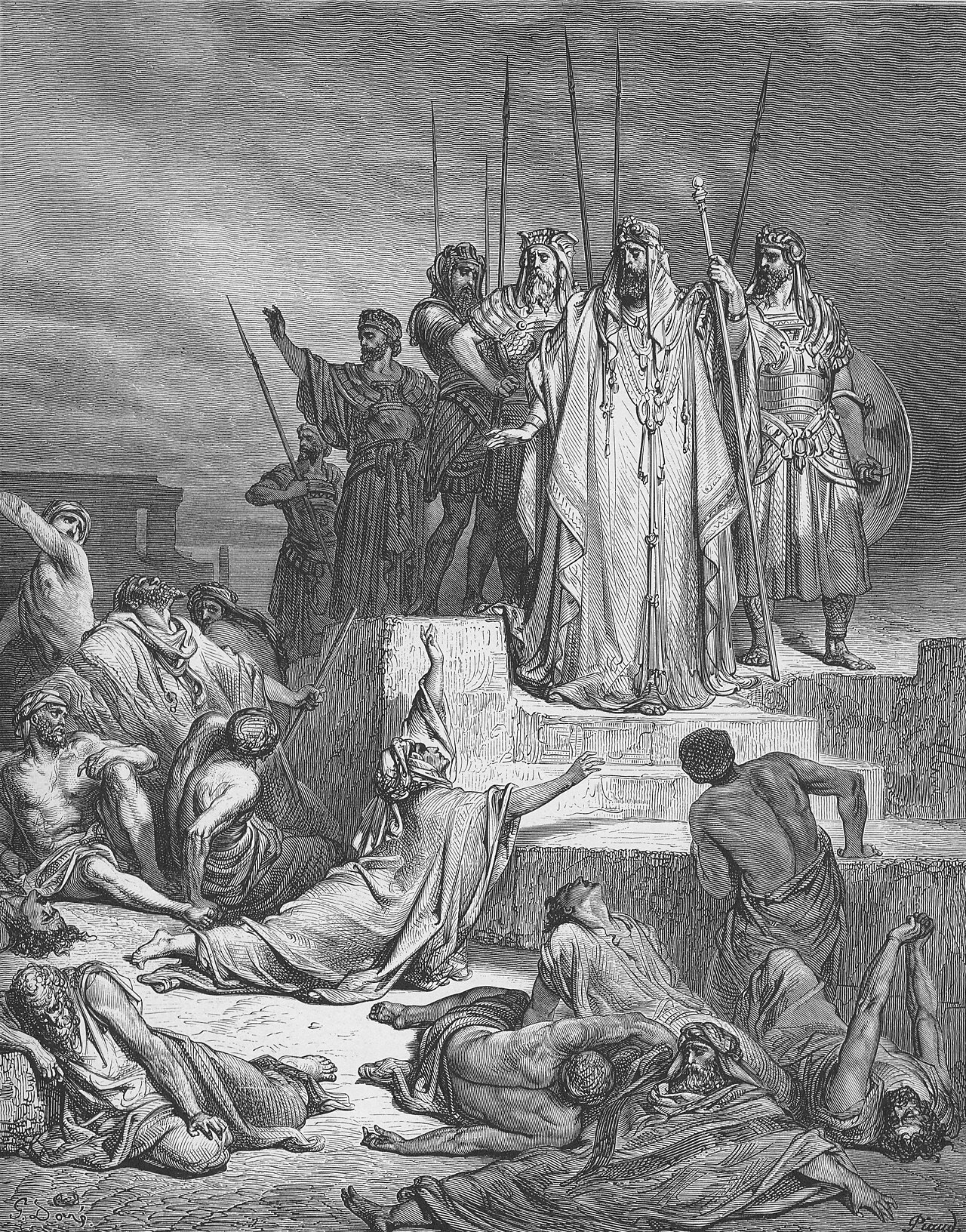
in 2 Kings 6And when the king of Israel saw them, he asked Elisha, “My father, shall I kill them? Shall I kill them?”
BSB
The same verse in ASV and KJV ▾
ASV
And the king of Israel said unto Elisha, when he saw them, My father, shall I smite them? shall I smite them?
KJV
And the king of Israel said unto Elisha, when he saw them, My father, shall I smite them? shall I smite them?
⋯
This verse in 2 Kings 6
Commentary
10 notes on this verseA commentator
Albert Barnes1798–1870
Notes, Explanatory and Practical, on the Old and New Testaments (1832-1869)
My father - A term of respect used by Jehoram in his joy at seeing an army of Syrians delivered up to him by the prophet. That the king’s character was not changed appears from 2Ki 6:31-32. Shall I smite them? shall I smite them? - The repetition of the words mean, “Shall I utterly smite them?” Compare similar repetitions with similar meanings in Gen 22:17; Luk 22:15.
This site's exposition
My father, shall I smite them
on 2 Kings 6:21-23
The king of Israel, calling Elisha father as Elisha once called Elijah father at his departure, asks leave to kill a captured army inside his own capital. Elisha refuses on the ground of plain military custom rather than sentiment, wouldest thou smite those whom thou hast taken captive with thy sword and with thy bow, men taken by no weapon of the king's own. He orders a feast instead of an execution, and the text records the result in one line, the bands of Syria came no more into the land of Israel, mercy accomplishing what the earlier warnings only interrupted.
The record, by era
The Church Fathers4 voices
If, then, justice is binding, even in war, how much more ought we to observe it in time of peace. Such favor the prophet showed to those who came to seize him. We read that the king of Syria had sent his army to lie in wait for him, for he had learned that it was Elisha who had made known to all his plans and consultations. And Gehazi, the prophet's servant, seeing the army, began to fear that his life was in danger. But the prophet said to him, "Do not fear, for they who are with us are more than they who are with them." And when the prophet asked that the eyes of his servant might be opened, they were opened. Then Gehazi saw the whole mountain full of horse and chariots round about Elisha. As they came down to him the prophet says, "Strike, O God, the army of Syria with blindness." And this prayer being granted, he says to the Syrians, "Follow me, and I will bring you to the man whom you seek." Then they saw Elisha, whom they were endeavoring to lay hold of, and seeing him they could not hold him fast. It is clear from this that faith and justice should be observed even in war; and that it could not but be a disgraceful thing if faith were violated.
Elisha prayed before the Lord and said, "strike this people with blindness." And he struck them with blindness according to the words of Elisha. Ben-hadad, king of the Arameans, sent a large army to surround the city of Dothan and ordered them to arrest Elisha, …
Elsewhere, also, that is, in the books of Kings we read that Elisha was in Samaria, and suddenly an army of Syrians surrounded and set on him. Gehazi saw them and said to his master, "O master, what shall we do?" And Elisha the prophet said, "Do not fear, for there are more with us than with them." And he prayed that the Lord would open the eyes of Gehazi. And his eyes were opened, and he saw the mountain full of horses and chariots around Elisha. And Elisha prayed that God would strike them with blindness.
But, as many delight in warfare, which is the most glorious, to bring a battle to an end by the strength of a great army or by merits before God alone? Elisha rested in one place while the king of Syria waged a great war against the people of our ancestors, and was adding to its terrors by various treacherous plans and was endeavoring to catch them in an ambush. But the prophet found out all their preparations, and being by the grace of God present everywhere in mental vigor, he told the thoughts of their enemies to his countrymen and warned them of what places to beware. And when this was known to the king of Syria, he sent an army and shut in the prophet. Elisha prayed and caused all of them to be struck with blindness and made those who had come to besiege him enter Samaria as captives.
The Puritans and the Awakening1 voice
And the king of Israel said unto Elisha, when he saw them,.... The Syrian army thus in his hands: my father, shall I smite them? shall I smite them? he speaks with great reverence and respect to the prophet, whom at other times he neglected and despised; and the repetition of his words shows the eagerness of his mind to fall upon his enemy when they where at a disadvantage.
3 more voices on this verse
The Puritans and the Awakening1 voice
And, again, as if he longed for the assault, Shall I smite them? Perhaps, he remembered how God was displeased at his father for letting go out of his hands those whom he had put it in his power to destroy, and he would not offend in like manner; yet such a reverence has he for the prophet that he will not strike a stroke without his commission.
The Nineteenth Century2 voices
A commentator
Jamieson, Fausset & Brown1802–1910
Commentary Critical and Explanatory on the Whole Bible (1871)
This was humane advice; it was contrary to the usage of war to put war captives to death in cold blood, even when taken by the point of the sword, much more those whom the miraculous power and providence of God had unexpectedly placed at his disposal.
My father, shall I smite - This was dastardly; the utmost he could have done with these men, when thus brought into his hand, was to make them prisoners of war.
The words behind it
10 Hebrew wordsEvery Hebrew word of this verse in the order it stands, with what it means and the door to its own study. The last column counts the times a word stands in the whole Bible: the rarer the word, the more the places it appears belong together.
| Hebrew | Sound | Meaning | Word study | In the Bible |
|---|---|---|---|---|
| וַיֹּ֤אמֶר | vaiyomer | and he said | H559 → | 5305 times |
| מֶֽלֶךְ־ | melekh- | [the] king of | H4428 → | 2525 times |
| יִשְׂרָאֵל֙ | yisrael | Israel | H3478 → | 2507 times |
| אֶל־ | ʾel- | to | H413 → | 5510 times |
| אֱלִישָׁ֔ע | ʾelisha' | Elisha | H477 → | 58 times |
| כִּרְאֹת֖וֹ | kiroto | when saw he | H7200 → | 1300 times |
| אוֹתָ֑ם | ʾotam | <obj.> them | H853 → | 10935 times |
| הַאַכֶּ֥ה | haakeh | ¿ will I strike [them] down | H5221 → | 499 times |
| אַכֶּ֖ה | ʾakeh | will I strike [them] down? | H5221 → | 499 times |
| אָבִֽי׃ | ʾavi | O father my | H1 → | 1212 times |
וַיֹּ֤אמֶרand he said
vaiyomerH559 →5305 times
מֶֽלֶךְ־[the] king of
melekh-H4428 →2525 times
יִשְׂרָאֵל֙Israel
yisraelH3478 →2507 times
אֶל־to
ʾel-H413 →5510 times
אֱלִישָׁ֔עElisha
ʾelisha'H477 →58 times
כִּרְאֹת֖וֹwhen saw he
kirotoH7200 →1300 times
אוֹתָ֑ם<obj.> them
ʾotamH853 →10935 times
הַאַכֶּ֥ה¿ will I strike [them] down
haakehH5221 →499 times
אַכֶּ֖הwill I strike [them] down?
ʾakehH5221 →499 times
אָבִֽי׃O father my
ʾaviH1 →1212 times
A shaded row is a word that stands 400 times or fewer in the Bible.
The walk
8 stopsEach card is a verse this one points to, and under it the verses that one points to in turn. Where several paths arrive at the same place, that place is listed first: the text keeps returning to it.
Through
1 Samuel 24:4So David’s men said to him, “This is the day about which the LORD said to you, ‘Behold, I will deliver your enemy into your hand, that you may do with him as you…
it leads to
- 1 Samuel 26:23
May the LORD repay every man for his righteousness and faithfulness. For the LORD delivered you into my hand today, but I would not stretch out my hand against the LORD’s anointed.
Reached by 2 separate paths from here.
- 1 Samuel 26:8–11
Abishai said to David, “Today God has delivered your enemy into your hand. Now, therefore, please let me thrust the spear through him into the ground with one stroke. I will not need to…
- 1 Samuel 24:10
Behold, this day you have seen with your own eyes that the LORD delivered you into my hand in the cave. I was told to kill you, but I spared you and said, ‘I…
- 1 Samuel 25:28–30
Please forgive your servant’s offense, for the LORD will surely make a lasting dynasty for my lord, because he fights the LORD’s battles. May no evil be found in you as long as you…
- 1 Samuel 26:23
Through
2 Kings 2:12As Elisha watched, he cried out, “My father, my father, the chariots and horsemen of Israel!” And he saw Elijah no more. So taking hold of his own clothes, he tore them in two.
it leads to
- 2 Kings 13:14
When Elisha had fallen sick with the illness from which he would die, Jehoash king of Israel came down to him and wept over him, saying, “My father, my father, the chariots and horsemen…
Reached by 2 separate paths from here.
- 2 Kings 13:14
Through
2 Kings 5:13Naaman’s servants, however, approached him and said, “My father, if the prophet had told you to do some great thing, would you not have done it? How much more, then, when he tells you,…
it leads to
- Revelation 7:14
“Sir,” I answered, “you know.” So he replied, “These are the ones who have come out of the great tribulation; they have washed their robes and made them white in the blood of the…
- 2 Kings 2:12
As Elisha watched, he cried out, “My father, my father, the chariots and horsemen of Israel!” And he saw Elijah no more. So taking hold of his own clothes, he tore them in two.
- Revelation 7:14
Through
1 Samuel 26:8Abishai said to David, “Today God has delivered your enemy into your hand. Now, therefore, please let me thrust the spear through him into the ground with one stroke. I will not need to…
it leads to
- 1 Samuel 24:4
So David’s men said to him, “This is the day about which the LORD said to you, ‘Behold, I will deliver your enemy into your hand, that you may do with him as you…
- 1 Samuel 24:4
Where this verse is studied
On this page
About 2 Kings
Who and where
1 name in this verse with a page on the site.
This page draws on 10 works. Open the list of works
This page draws on Adam Clarke, Commentary on the Bible; Albert Barnes, Notes, Explanatory and Practical, on the Old and New Testaments (1832-1869); Albert Barnes, Notes on the Old Testament; Ambrose of Milan, On the Duties of the Clergy 1.29.140; Ambrose of Milan, ON THE DEATH OF THEODOSIUS 10; Ambrose of Milan, On the Duties of the Clergy 3.1.5; Ephrem the Syrian, ON THE SECOND BOOK OF KINGS 6:18; Jamieson, Fausset & Brown, Commentary Critical and Explanatory on the Whole Bible; John Gill, Exposition of the Old Testament (1748-1763) and Matthew Henry, Commentary on the Whole Bible.