
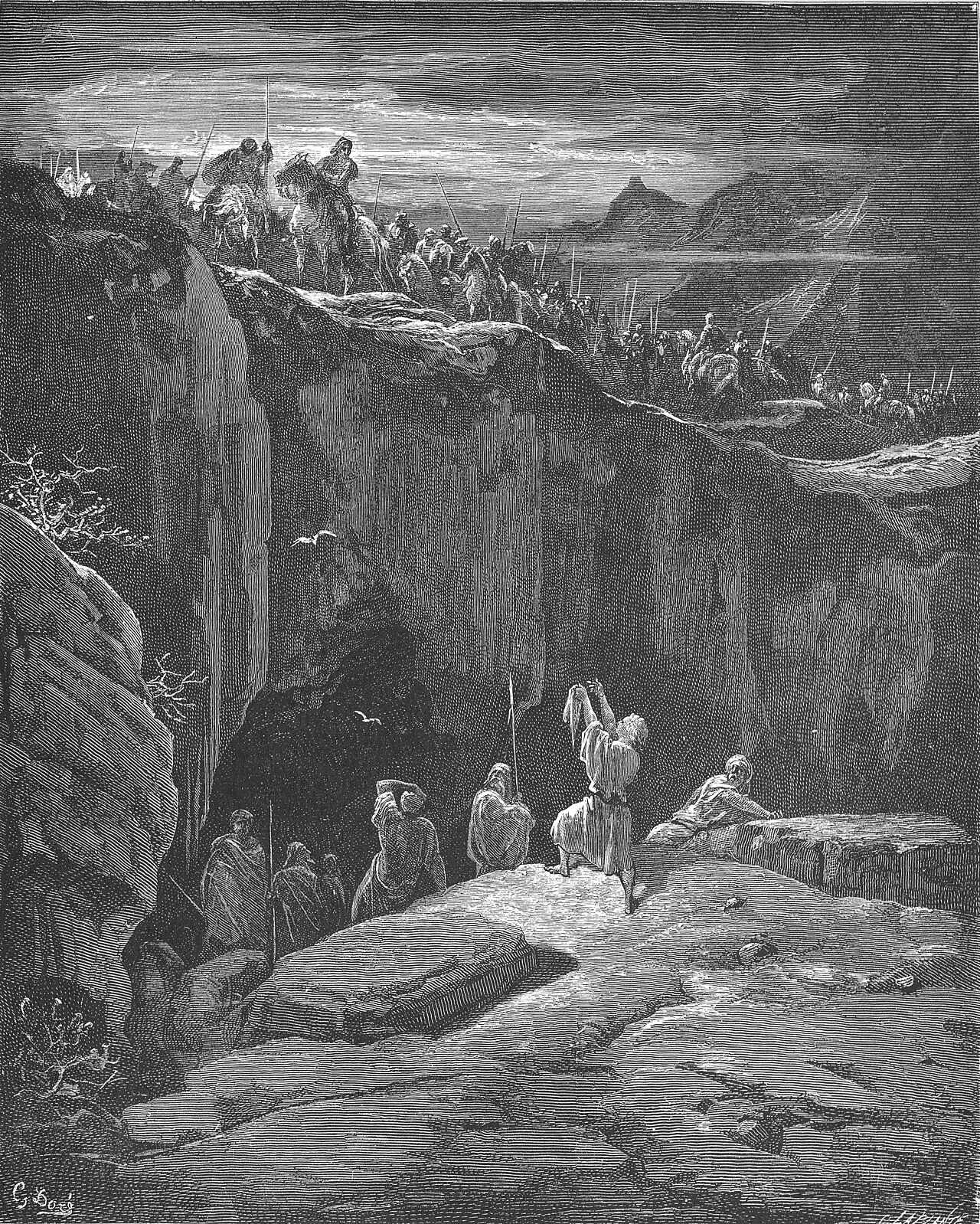
1 Samuelchapter 24
22 verses · Samuel, Nathan and Gad, by tradition · 10th century BC · History
And he came to the sheepcotes by the way, where was a cave; and Saul went in to cover his feet: and David and his men remained in the sides of the cave.
Introduction
Samuel, Nathan and Gad, by tradition, History, 1 Samuel Overview.
This chapter was written for Israel under its kings, a people who held that the man the LORD anointed was not to be struck by any subject. David has the power to end his exile in a moment, and his own men tell him the LORD has arranged it. Listen for the argument David makes against himself, and for the small act that still troubles his conscience. Listen to the speech he calls after the king and to the images he uses for himself. Then hear what Saul admits, and ask whether his words change anything.
Context
- Who
- Israelites who held that an anointed king's person was sacred
- What
- An account of David sparing Saul in a cave at En-gedi, and of the exchange between them that follows.
- Where
- A cave among the Rocks of the Wild Goats at En-gedi, on the cliffs above the western shore of the Dead Sea.
- When
- The text gives no date; on the common reckoning it falls about 1016 BC.
- Why
- To show David refusing to take by his own hand the throne God had promised him.
Historical context
David is anointed, hunted and uncrowned, with the king one stroke away from him in the dark. Saul is the reigning king, already rejected by the word of the LORD in chapter 15, turning from a Philistine war to take three thousand chosen men after one man.
Show the rest of the historical context, 4 more paragraphs
The time is about 1016 BC on the traditional conservative reckoning, and the chapter follows directly on the one before it, which leaves David in this ground at 23:29. The place is En-gedi, a green gorge of waterfalls and palms breaking out of bare cliffs on the western shore of the Dead Sea, with ibex on the rocks and caves in the limestone.
The occasion is Saul stopping in one of those caves while David's men are already in its recesses. Albert Barnes describes the caverns there as deep enough that a man near the mouth stays visible while men further in remain hidden even by daylight. John Wesley notes that the rocks of the wild goats are steep and dangerous to an ordinary traveller.
A first hearer knew what covering the feet meant, a plain way of naming a private need, with a man setting his outer robe aside and at his most exposed while his guard waited outside.
He also knew that the corner of a robe carried a man's identity and his authority, and Samuel had already read a torn robe corner as the tearing away of Saul's kingdom. And he knew what anointing did, since it conferred an office God had given, and the site's published word ladder records mashiach entering Scripture as a title for a king in Hannah's song at 2:10.
Significance
Saul weeps and says it aloud, that David is the more righteous of the two and has repaid good for evil, and he says he knows David will surely be king. Then he goes home, and the pursuit resumes two chapters later at Hachilah.
Show the rest of the significance, 2 more paragraphs
Saul's tears were genuine and they were worth nothing, and the site's published guide reads the second sparing at chapter 26 as the proof that David's refusal was conviction rather than an impulse taken once.
The request Saul makes is the one Jonathan had already made at 20:15, an oath that David will not cut off his descendants once the throne is his. It comes here from a man with a far worse claim on it, and David swears it and goes back up to the stronghold rather than to court.
This chapter in Jewish lifeWhat this chapter is in Jewish life and reading.
How it is read
The commentators read the cave at En-gedi as a test of David's restraint, and they read Saul's own conduct there with care. On the king entering the cave Rashi gives the plain sense of the euphemism the Hebrew uses (Rashi on I Samuel 24:4:1, the Metsudah Tanach series, Lakewood, N.J., CC-BY). He carries Radak's note beside it, that Maseches Yevamos 103a marks the phrase as a euphemism, and that Maseches Berachos 62b reports Saul covering himself with his clothing out of great modesty (same ref). On the order of the verses he reads the account as told out of sequence. David spoke of cutting the robe and finished everything about it, including his regret, before returning to answer his men (Rashi on I Samuel 24:7:1, same edition). He notes Radak's reading against his own, that the verses do stand in chronological order (same ref). On David holding his men back he glosses the verb as dividing them, so the words broke their one mind (Rashi on I Samuel 24:8:1, same edition). On David's question to Saul about listening to men he reads the singular as a pointer to Doeg and his slander (Rashi on I Samuel 24:10:1, same edition). On the proverb David quotes he reads the ancient one as the Ancient One of the world, so the proverb is the Torah itself (Rashi on I Samuel 24:14:1, same edition). On Saul's admission that David would reign he gives the king's reason, that God had saved David from his hand. He hands on the Midrash Aggadah that Samuel gave Saul a sign, that the man who tore his robe would reign after him (Rashi on I Samuel 24:21:1, same edition). Radak stands as a citation at I Samuel 24:3:1, 24:4:1, 24:5:1, 24:6:1, 24:7:1, 24:9:1, 24:15:1, 24:19:1, 24:20:1 and 24:22:1. Metzudat David stands at 24:5:1 and 24:13:1, and Malbim at 24:16:1 and 24:18:1. The corpus holds no English version of them.
What the rabbis say
The corpus records thirty-eight rabbinic locators on this chapter, twenty-seven of them Midrash and eleven Talmud, each a locator without text. The rocks of the wild goats draw Berakhot 62b:9, Yevamot 103a:15, Midrash Sekhel Tov, Shemot 8:16:4 and Yalkut Shimoni on Torah 938:17. Saul alone in the cave draws Berakhot 62b:10, Midrash Lekach Tov, Exodus 8:16:3 and Otzar Midrashim, Hashkem, Midrash Hashkem ('Arise Early') 4. The cutting of the robe draws Tractate Soferim 7:3. David's question about slander draws Bamidbar Rabbah 4:20, Berakhot 62b:7, Jerusalem Talmud Sanhedrin 2:4:4 and Jerusalem Talmud Sukkah 5:4:4. The same verse draws Midrash Tehillim 7:5 and Otzar Midrashim, Pirkei Rabbeinu HaKadosh 1:75. David's mercy in the cave draws the largest cluster of the chapter. It draws Bamidbar Rabbah 19:2, Jerusalem Talmud Peah 1:1:47, Jerusalem Talmud Sotah 1:8:10, Vayikra Rabbah 26:2 and Pesikta DeRav Kahana 4:2. It also draws Midrash Tanchuma, Chukat 4:1, Midrash Tehillim 58:1 and Otzar Midrashim, Chuppah of Eliyahu, Chuppat Eliyahu Rabbah 44. The corner of the robe held up as evidence draws Mekhilta DeRabbi Yishmael, Tractate Nezikin 4:14 and Midrash Tanchuma Buber, Chukat 8:2. The appeal to the LORD as judge draws Makkot 10b:3, Shir HaShirim Rabbah 1:1:6 and Yalkut Shimoni on Torah 323:1. The proverb of the ancients draws Ein Yaakov, Makkot 2:8, Ein Yaakov (Glick Edition), Makkot 2:5, Midrash Lekach Tov, Exodus 21:13:1 and Otzar Midrashim, Midrashim on Missing and Extra Letters 2:3. Saul weeping draws Tractate Soferim 7:2, and his word that David is the more righteous draws Midrash Tehillim 57:2. His admission that David will reign draws Midrash Tanchuma Buber, Vayetzei 5:1, Midrash Tehillim 4:7, Yalkut Shimoni on Torah 168:1 and Otzar Midrashim, Midrashim on Missing and Extra Letters 2:4. The stronghold David went up to draws Midrash Aggadah, Exodus 2:21:1. The rabbis teach in these places, and this site reports them as their teaching rather than as a rule of the text.
Sources: Rashi, Rashi on I Samuel 24:4:1, 24:7:1, 24:8:1, 24:10:1, 24:14:1 and 24:21:1, the Metsudah Tanach series, Lakewood, N.J., CC-BY; Radak, Radak on I Samuel 24:3:1, 24:4:1, 24:5:1, 24:6:1, 24:7:1, 24:9:1, 24:15:1, 24:19:1, 24:20:1 and 24:22:1, cited only, no English version in the corpus; and Radak on the euphemism and on the order of the verses as Rashi carries him; Metzudat David, Metzudat David on I Samuel 24:5:1 and 24:13:1, cited only; and Metzudos on the dividing of David's men as Rashi carries it; Malbim, Malbim on I Samuel 24:16:1 and 24:18:1, cited only.
The heads below are this chapter's scenes. The numbered points under each are its verses.
A cave at En-gedi and a skirt cut off in the dark
1 Samuel 24:1-2
returned from following the Philistines: Saul turns from a Philistine war he has just fought to hunt one man, and commits three thousand chosen men to the search, the same size force he once led against the whole Philistine army at 13:2. Wesley notes the rocks of the wild goats are steep and dangerous even to an ordinary traveler, so the king's anger over David outweighs his own safety. En-gedi's cliffs along the Dead Sea shore give the outlaw band exactly the kind of ground three thousand soldiers cannot easily search.
1 Samuel 24:1
“Saul was returned - It is very probable that it was only a small marauding party that had made an excursion in the Israelitish borders, and this invasion was soon suppressed.”
Adam Clarke · Commentary on the Bible (1810-1826)evangelical
Clarke gives the Hebrew for the Rocks of the Wild Goats as tsurey haiyeelim and sets out how the old versions read it. The Latin Vulgate speaks of steep rocks crossed only by ibexes, the Targum of caves in the rocks, and the Greek of a place name. Barnes reads it as craggy ground in the wilderness of En-gedi.
1 Samuel 24:2
“Rocks of the wild goats - The original (צורי היעלים tsurey haiyeelim) is variously understood. The Vulgate makes a paraphrase: Super abruptissimas petras quae solis ibicibus perviae sunt; “On the most precipitous rocks over which the ibexes alone can travel.” The Targum: the caverns of the rocks. The Septuagint make the original a proper name; for out of צרוי היעלים tsurey haiyeelim, they make Σαδδαιεμ Saddaiem, and in some copies Αειαμειν Aeiamein, which are evidently corruptions of the Hebrew.”
Adam Clarke · Commentary on the Bible (1810-1826)evangelical
1 more voice on this verse
1 Samuel 24:2
“These very rocks are exceeding steep, and full of precipices, and dangerous to travelers, as an eye-witness hath left upon record. And yet Saul was so transported with rage, as to venture himself and his army here, that he might take David, who, as he thought, would judge himself safe, and therefore be secure in such inaccessible places.”
John Wesley · Explanatory Notes upon the Old Testament (1765)evangelical
went in to cover his feet: Saul stops in a cave to cover his feet, a common way of naming a private need, while David's men are already waiting unseen in its recesses. Henry allows two readings, easing nature or simply resting from the heat, and either way providence has walked the hunter into the hunted man's own hiding place. Barnes describes these En-gedi caverns as deep enough that a man near the mouth stays visible while men further in remain hidden even by daylight.
1 Samuel 24:3
“Some by the covering of the feet understand the easing of nature, and think that this was Saul's errand into the cave: but the former interpretation is more probable.”
Matthew Henry · Commentary on the Whole Bible (1707-1721)puritan
2 more voices on this verse
1 Samuel 24:3
“Remained in the sides - Rather, “were in the sides of the cave dwelling or abiding there.” Some of these caverns are very deep and spacious. Any one near the mouth of the cave would be visible, but those in the recesses would be quite in the dark and invisible, especially if the incident occurred at night. Psa 67:1-7, according to the title, was composed on this occasion.”
1 Samuel 24:3
“And it is not improbable, that being weary with his eager and almost incessant pursuit, first of David, then of the Philistines, and now of David again, he both needed and desired some sleep, God also disposing him thereto, that David might have this eminent occasion to demonstrate his integrity to Saul, and to all Israel.”
John Wesley · Explanatory Notes upon the Old Testament (1765)evangelical
1 Samuel 24:4-5
cut off the skirt of Saul’s robe: David's men read Saul's arrival as the answer to a promise David had received of the throne, though Clarke and Jamieson, Fausset and Brown both note that God had never actually promised to deliver Saul himself into David's hand that day. David cuts off the skirt of Saul's robe rather than take the life his men are urging, and the next verse turns the whole scene on its hinge: his heart smites him for the cloth alone. Gill reads that reaction as conscience working on a lesser act than the one his men proposed, which measures how far David will not go.
1 Samuel 24:4
“And the men of David said - We know not to what promise of God the men of David refer; they perhaps meant no more than to say, “Behold, the Lord hath delivered thine enemy into thy land, now do to him as he wishes to do to thee.” Then David arose - Though I have a high opinion of the character of David, yet the circumstances of the case seem to indicate that he arose to take away the life of Saul, and that it was in reference to this that his heart smote him.”
Adam Clarke · Commentary on the Bible (1810-1826)evangelical
1 more voice on this verse
1 Samuel 24:4
“When, therefore, he was alone and had removed his robe and laid it down somewhere beside him, the light from the mouth of the cave made him visible to those hidden within the darkness. All of David's companions wanted to rush upon the enemy and avenge themselves on the one who had come to kill them, since God had given the enemy into the hands of those who were being pursued for slaughter. But David forbade them to attack, considering an assault against their king unlawful. He drew his own sword from its sheath and imperceptibly stood behind Saul.”
Gregory of Nyssa · written before 395 · ON THE INSCRIPTIONS OF THE PSALMS 2.14.227-28patristic
Barnes reads the reaction as David's sense of the respect he owed the king. Augustine sees reverence for the anointing Saul still carried. The same stricken heart returns at 2 Samuel 24:10, after David counts the people.
1 Samuel 24:5
“And it came to pass afterward, that David's heart smote him,.... His conscience accused him, and he repented of what he had done: because he had cut off Saul's skirt; which though less than what his servants put him upon, and he might have thoughts of doing, yet was considered by him as a great indignity to his sovereign, and therefore sat uneasy on his mind.”
1 Samuel 24:6-7
to stretch forth mine hand against him: David states the anointed argument at full length for the first time in the book, the Lord forbid that I should do this thing unto my master, the Lord's anointed, seeing he is the anointed of the Lord. The title had entered Scripture as an office at 2:10 and had been fixed on David himself at 16:6, and here he refuses to let his own anointing become grounds for touching Saul's. He does not merely hold his own hand but stays his servants with these words, and Henry calls the restraint a type of Christ, who saved his persecutors rather than striking them down.
1 Samuel 24:6
“The Lord’s anointed - However unworthily Saul was now acting, he had been appointed to his high office by God himself, and he could only be removed by the authority which placed him on the throne. Even David, who knew he was appointed to reign in his stead, and whose life Saul had often sought to destroy, did not conceive that he had any right to take away his life; and he grounds the reasons of his forbearance on this - He is my master, I am his subject.”
Adam Clarke · Commentary on the Bible (1810-1826)evangelical
1 more voice on this verse
1 Samuel 24:6
“What a virtuous action that was, when David wished rather to spare the king his enemy, though he could have injured him! How useful, too, it was, for it helped him when he succeeded to the throne. For all learned to be faithful to their king and not to seize the kingdom but to fear and reverence him. Thus what is virtuous was preferred to what was useful, and then usefulness followed on what was virtuous.”
Ambrose of Milan · written before 397 · On the Duties of the Clergy 3.9.60patristic
Clarke holds that David, able to restrain his men, was bound to restrain them, and had he let them rise up against Saul he would have been the murderer. Chrysostom credits the grace of God on David's lips and the training he had given his men before. Saul went on his way knowing nothing.
1 Samuel 24:7
“Suffered them not to rise against Saul - As he could restrain them, it was his duty to do so; had he connived at their killing him, David would have been the murderer. In praying for the king we call God the only Ruler of princes, for this simple reason, that their authority is the highest among men, and next to that of God himself; hence he alone is above them. We find this sentiment well expressed by an elegant poet: - Regum timendorum in proprios greges, Reges in ipsos imperium est Jovis.”
Adam Clarke · Commentary on the Bible (1810-1826)evangelical
1 more voice on this verse
1 Samuel 24:7
“He would not only not do this evil thing himself, but he would not suffer those about him to do it. Thus did he render good for evil to him from whom he had received evil for good, and was herein both a type of Christ, who saved his persecutors, and an example to all Christians not to be overcome of evil, but to overcome evil with good.”
Matthew Henry · Commentary on the Whole Bible (1707-1721)puritan
After whom is the king come out? A dead dog, a flea
1 Samuel 24:8-9
My lord the king: David waits until Saul is safely out of the cave before calling after him, and bows to the earth even as he prepares to charge the king with wrongdoing. His opening question names the real danger at Saul's court, men whose words Gill identifies with Doeg and the flatterers who kept feeding the king's suspicion of David. Barnes reads David's own psalms of complaint against false accusers as the record of exactly this pressure.
1 Samuel 24:8
“Saul, therefore, came out of the cave unaware of what had happened, wearing the little garment which had been trimmed all around. David came out behind him in self-assurance, and having seized the hill lying above the cave in advance, held out the end [of Saul's robe] in his hand. This was nothing other than a bloodless trophy against his enemies.”
Gregory of Nyssa · written before 395 · ON THE INSCRIPTIONS OF THE PSALMS 2.14.229-30patristic
1 more voice on this verse
1 Samuel 24:8
“He seems to have been naturally susceptible of strong, and, as in this instance, of good and grateful impressions. The improvement of his temper, indeed, was but transient--his language that of a man overwhelmed by the force of impetuous emotions and constrained to admire the conduct, and esteem the character, of one whom he hated and dreaded.”
Jamieson, Fausset & Brown · Commentary Critical and Explanatory on the Whole Bible (1871)reformed
David blames the king's advisers and spares Saul himself. The reports had come from Doeg at 22:9 and from the Ziphites at 23:19. Henry reads what follows as a solemn protest of innocence, backed by the evidence in David's hand.
1 Samuel 24:9
“And David said to Saul, wherefore hearest thou men's words,.... The false charges and accusations, that some of Saul's courtiers brought against David, as Doeg the Edomite, and such like sycophants and flatterers, to whom Saul hearkened, and believed what they said, and acted upon it.”
1 more voice on this verse
1 Samuel 24:9
“David was quite aware that there were flatterers at Saul’s court who were continually inflaming the King’s mind by their false accusations against him. This explains the language of many of the Psalms, e. g. Ps. 10; Psa 11:1-7; Psa 12:1-8; 35; and many more.”
1 Samuel 24:10-11
this day thine eyes have seen: David repeats the anointed argument at verse 10, this day thine eyes have seen how the Lord had delivered thee into mine hand, and some bade me kill thee, but mine eye spared thee, for he is the Lord's anointed. He holds up the skirt itself as evidence a knife could just as easily have written, and calls the difference between the cloth and the man proof that there is neither evil nor transgression in his hand. The closing clause turns the argument on Saul without warning: I have not sinned against thee, yet thou huntest my soul to take it.
Barnes explains that calling Saul father is the respectful address of a younger man, and he compares 2 Kings 5:13. Henry adds that Saul was David's father-in-law as well as his king. Saul answers in kind at verse 16.
1 Samuel 24:11
"He is my lord, and the Lord's anointed, whom I ought to protect, and to whom I owe faith and allegiance, and therefore I said, I will not touch a hair of his head." Such a happy command he had of himself that his nature, in the midst of the greatest provocation, was not suffered to rebel against his principles.
Matthew Henry · Commentary on the Whole Bible (1707-1721)puritan
1 Samuel 24:12-13
The Lord judge between me and thee: David hands the case to heaven rather than to his own hand, the Lord judge between me and thee, and the Lord avenge me of thee, but mine hand shall not be upon thee. Clarke compares the appeal to a wider human instinct, the common refuge of the poor and oppressed to call on God as judge when no earthly court will hear them. He backs it with a proverb already old in his own day, wickedness proceedeth from the wicked, and lets the maxim argue that a man who has spared his enemy twice is not the wicked man Saul's court has painted him.
1 Samuel 24:12
“The Lord judge between me and thee,.... And make it appear who is in the right, and who in the wrong: and the Lord avenge me of thee; if he continued thus to persecute him: but mine hand shall not be upon thee; to kill thee, though it may be in my power again to do it, as it has been; but this I am determined upon, let me suffer what I will, I will not lay hands on thee to do thee any hurt, but leave thee with God to requite all the evil done to me by thee.”
1 more voice on this verse
1 Samuel 24:12
“The Lord judge between me and thee - Appeals of this kind to God are the common refuge of the poor and oppressed people. So also among the Hindoos: God will judge between us. Mother Kalee will judge. Sometimes this springs from a consciousness of innocence, and sometimes from a desire of revenge.”
Adam Clarke · Commentary on the Bible (1810-1826)evangelical
Henry notes that such sayings carried the wisdom of earlier generations, and this one was already old in David's day. Wesley applies it to the courtiers who called David wicked. The pledge that closes verse 12 is repeated word for word.
1 Samuel 24:13
“Wickedness proceeded from the wicked - This proverb may be thus understood: He that does a wicked act, gives proof thereby that he is a wicked man. From him who is wicked, wickedness will proceed; he who is wicked will add one iniquity to another. Had I conspired to dethrone thee, I should have taken thy life when it was in my power, and thus added wickedness to wickedness.”
Adam Clarke · Commentary on the Bible (1810-1826)evangelical
1 Samuel 24:14-15
after a dead dog, after a flea: David measures himself down to nothing in the same breath he measures Saul's whole army, after whom is the king of Israel come out, after a dead dog, after a flea. Clarke reads the two images together as total contempt joined to total harmlessness, a target too small to justify three thousand men in pursuit. The appeal opened at verse 12 closes here with three verbs stacked on one judge, be judge, and plead my cause, and deliver me, leaving the outcome entirely outside David's own hand.
1 Samuel 24:14
“After a dead dog - A term used among the Hebrews to signify the most sovereign contempt; see 2Sa 16:9. One utterly incapable of making the least resistance against Saul, and the troops of Israel. The same idea is expressed in the term flea. The Targum properly expresses both thus: one who is weak, one who is contemptible.”
Adam Clarke · Commentary on the Bible (1810-1826)evangelical
Gill says David leaves his own cause for God to judge. Saul had done exactly that at Nob, where he sentenced Ahimelech himself at 22:16. Henry finds it strange that Saul heard the whole speech to its end.
1 Samuel 24:15
“The Lord therefore be Judge, and judge between me and thee,.... Signifying he did not desire to be judge in his own cause, but leave it with God to determine it for him in his providence: and see, and plead my cause; look with pity upon him, take his cause in his hand, plead it, and do him justice: and deliver me out of thine hand: which was a prayer of faith, believing he would do it in due time, see Psa 7:6.”
1 more voice on this verse
1 Samuel 24:15
“Saul's penitent reply to David's speech. It was strange that he had patience to hear him out, considering how outrageous he was against him, and how cutting David's discourse was. But God restrained him and his men; and we may suppose Saul struck with amazement at the singularity of the event, and much more when he found how much he had lain at David's mercy.”
Matthew Henry · Commentary on the Whole Bible (1707-1721)puritan
Saul weeps: thou art more righteous than I
1 Samuel 24:16-17
Is this thy voice, my son David?: Saul knows David's voice before he can make out his face at that distance, and Wesley reads the weeping that follows as grief over his own sin against God as much as his cruelty to David. Saul's confession goes only so far, thou art more righteous than I, and Henry marks the limit precisely: bad men will commonly go no further than this, owning there are those better than they rather than owning their own wickedness outright.
1 Samuel 24:16
“Thy voice - He knew his voice, though being at a great distance from him, he could not discern his face. Wept - From the sense of his sin against God, and his base carriage to David.”
John Wesley · Explanatory Notes upon the Old Testament (1765)evangelical
Basil notes that the change in Saul was brief. Saul gathered an army again, and David spared the king's life a second time in chapter 26. Basil calls envy the most savage form of hatred, and Saul had rewarded David's good with evil from the day of his jealousy at 18:9.
1 Samuel 24:17
“He should have said, Thou are righteous, but I am wicked; but the utmost he will own is this: Thou art more righteous than I. Bad men will commonly go no further than this in their confessions; they will own they are not so good as some others are; there are those that are better than they, and more righteous.”
Matthew Henry · Commentary on the Whole Bible (1707-1721)puritan
1 more voice on this verse
1 Samuel 24:17
“Not even this act of benevolence moved Saul, however. Again he gathered an army and again he set out in pursuit, until he was a second time apprehended by David in the cave where he more clearly revealed his own iniquity and made the virtue of David even more resplendent. Envy is the most savage form of hatred. Favors render those who are hostile to us for any other reason more tractable, but kind treatment shown to an envious and spiteful person only aggravates his dislike.”
Basil of Caesarea · written before 379 · CONCERNING ENVYpatristic
1 Samuel 24:18-20
thou hast dealt well with me: Saul states the plain fact of the day, when the Lord had delivered him into David's hand, David killed him not, and reasons from ordinary custom that no man lets his enemy go well away without cause. The confession climaxes at verse 20 with Saul saying outright what he had resisted for years, I know well that thou shalt surely be king, and that the kingdom of Israel shall be established in thine hand. Clarke notes the bitter edge under the admission: Saul knew this before, and pursued David to the death anyway.
Clarke renders the question as whether a man sends his enemy away on a good road. Henry commends Saul here for dropping a suspicion once it was proved false. Saul then leaves David's reward to the LORD.
1 Samuel 24:19
“If a man find his enemy, will he let him go well away? - Or rather, Will he send him in a good way?”
Adam Clarke · Commentary on the Bible (1810-1826)evangelical
Henry reads Saul's admission that David will be king of Israel as a support to David's faith, coming from the man with most reason to deny it. He compares Revelation 3:9, where enemies are made to acknowledge those God has loved. Saul now knows for sure what Jonathan told David at 23:17.
1 Samuel 24:20
“I know well that thou shalt surely be king - Hebrew, Reigning, thou shalt reign. He knew this before; and yet he continued to pursue him with the most deadly hatred.”
Adam Clarke · Commentary on the Bible (1810-1826)evangelical
1 more voice on this verse
1 Samuel 24:20
“Note, Sooner or later, God will force even those that are of the synagogue of Satan to know and own those that he has loved, and to worship before their feet; for so is the promise, Rev. iii. This acknowledgement which Saul made of David's incontestable title to the crown was a great encouragement to David himself and a support to his faith and hope.”
Matthew Henry · Commentary on the Whole Bible (1707-1721)puritan
1 Samuel 24:21-22
Swear now therefore unto me: Saul asks for one thing only, an oath that David will not cut off his descendants once the throne is his, the same request Jonathan had already made of David at 20:15. David swears it and Saul goes home, but the scene does not close in reconciliation: David and his men go back up to the stronghold rather than to Saul's court. Clarke reads the parting plainly, David could not trust Saul with his life, for an evil spirit still had dominion over him, and chapter 26 will run this same cave scene almost beat for beat.
1 Samuel 24:21
“Saul by his disobedience had ruined his own soul, and never took care by repentance to prevent that ruin, and yet is very solicitous that his name might not be destroyed nor his seed cut off.”
Matthew Henry · Commentary on the Whole Bible (1707-1721)puritan
Barnes notes that Saul returned home to Gibeah without inviting David. Henry compares Jesus, who would not entrust Himself to those who believed in Him at John 2:24. Clarke reports that the Syriac and Arabic versions name the stronghold David and his men went up to as Mizpeh.
1 Samuel 24:22
“Saul went home - Confounded at a sense of his own baseness, and overwhelmed with a sense of David’s generosity. David and his men gat them up unto the hold - Went up to Mizpeh, according to the Syriac and Arabic. David could not trust Saul with his life; the utmost he could expect from him was that he should cease from persecuting him; but even this was too much to expect from a man of such a character as Saul. He was no longer under the Divine guidance; an evil spirit had full dominion over his soul.”
Adam Clarke · Commentary on the Bible (1810-1826)evangelical
1 more voice on this verse
1 Samuel 24:22
“It is dangerous venturing upon the mercy of a reconciled enemy. We read of those who believed in Christ, and yet he did not commit himself to them because he knew all men. Those that like David are innocent as doves must thus like him be wise as serpents.”
Matthew Henry · Commentary on the Whole Bible (1707-1721)puritan
How this psalm is built
The form: A narrative of restraint in prose, built on the anointed argument stated twice and closed by a formal appeal to God as judge, as 24 classes it.
The patterns in this chapter
| Device | What it does | Where to see it |
|---|---|---|
| The anointed argument, stated twice | David gives his reason in the cave at verse 6, where he stays his servants with it as well as his own hand. He gives it again to Saul from outside the cave at verse 10. The site's published exposition pass records that the title had entered Scripture as an office at 2:10 and had been fixed on David himself at 16:6. Here a man refuses to let his own anointing become grounds for touching another's. Matthew Henry calls the restraint a type of Christ, who saved his persecutors rather than striking them down.The site's published exposition notes on 1 Samuel 24:6 to 7 and 24:10 to 11, data/commentary/1-samuel-24-exposition.json, catchwords "to stretch forth mine hand against him" and "this day thine eyes have seen", citing Matthew Henry, Commentary on the Whole Bible, Adam Clarke, Commentary on the Bible, and Bede, Commentary on Samuel. | 1 Samuel 24:6, 1 Samuel 24:7, 1 Samuel 24:10 |
| The one word for a hand, through the whole scene | The word runs through every stage of the chapter. David refuses to stretch out his hand at verse 6, and holds up what his hand took instead at verses 10 and 11. He swears at verse 12 that his hand will stay off the king while he asks God to judge. He hears Saul say at verse 20 that the kingdom will be established in David's hand. The site's published exposition pass carries each of those phrases as the catchword of its own note. Chapter 23 works the same word through four mouths, which is why the two chapters read as a pair on this point. That the chain runs the length of the chapter is the writer's reading.The site's published exposition pass on 1 Samuel 24, data/commentary/1-samuel-24-exposition.json, the notes at 24:6 to 7, 24:10 to 11, 24:12 to 13 and 24:18 to 20, citing Matthew Henry, Commentary on the Whole Bible, Adam Clarke, Commentary on the Bible, and John Gill, Exposition of the Old Testament. | 1 Samuel 24:6, 1 Samuel 24:10, 1 Samuel 24:12, 1 Samuel 24:20 |
| The cloth set against the man | David's men urge him to take the life; he takes the corner of the robe, and his heart smites him for the cloth alone at verse 5. John Gill reads that reaction as conscience working on the lesser act, which measures how far David will not go. At verse 11 David holds the corner up as evidence of the greater act he declined, the argument being that the knife which cut cloth could as easily have cut the man.The site's published exposition notes on 1 Samuel 24:4 to 5 and 24:10 to 11, data/commentary/1-samuel-24-exposition.json, catchwords "cut off the skirt of Saul's robe" and "this day thine eyes have seen", citing Adam Clarke, Commentary on the Bible, John Gill, Exposition of the Old Testament, and Matthew Henry, Commentary on the Whole Bible. | 1 Samuel 24:4, 1 Samuel 24:5, 1 Samuel 24:11 |
| The case handed to a judge | David turns from arguing with Saul to calling on God at verse 12. He closes at verse 15 with three verbs stacked on the one judge, asking God to judge, to plead the cause and to deliver. Adam Clarke compares the appeal to a wider human instinct, the common refuge of the poor and the oppressed who call on God as judge when no earthly court will hear them. Between the two David measures himself small twice over at verse 14, a dead dog and a flea. Clarke reads those as total contempt joined to total harmlessness, and as a target too small to justify three thousand men.The site's published exposition notes on 1 Samuel 24:12 to 13 and 24:14 to 15, data/commentary/1-samuel-24-exposition.json, catchwords "The Lord judge between me and thee" and "after a dead dog, after a flea", citing Adam Clarke, Commentary on the Bible, and John Gill, Exposition of the Old Testament. | 1 Samuel 24:12, 1 Samuel 24:14, 1 Samuel 24:15 |
| The hunt that turns around | The chapter opens at verses 1 and 2 with Saul turning from a Philistine war to take three thousand chosen men after one man. That is the same size force the site's published exposition pass records him leading against the whole Philistine army at 13:2. It closes at verse 22 with the king asking his quarry for an oath and going home. That the frame is the reversal of the hunt is the writer's reading; the two ends are the catchwords the exposition pass carries.The site's published exposition notes on 1 Samuel 24:1 to 2 and 24:21 to 22, data/commentary/1-samuel-24-exposition.json, catchwords "returned from following the Philistines" and "Swear now therefore unto me", citing John Wesley, Explanatory Notes upon the Old Testament, Adam Clarke, Commentary on the Bible, and Albert Barnes, Notes on the Old Testament. | 1 Samuel 24:1, 1 Samuel 24:2, 1 Samuel 24:21, 1 Samuel 24:22 |
The structure of the chapter in the book's argument
12 more paragraphs on the patterns
The chapter opens on the ground the chapter before it ended on. David goes up from the rock of divisions to the strongholds of En-gedi at 23:29, and Saul turns from a Philistine war and follows him there. What chapter 23 left open is whether the pursuit that broke off at Maon would be resumed, and this chapter answers it within two verses.
What the chapter hands forward is the argument, rather than the ending. Saul goes home and David goes up to the stronghold instead of to court, so nothing is settled by the confession. Chapter 26 runs the same scene again at Hachilah, with a spear and a water cruse in place of a robe corner. The site's published guide reads the repeat as the proof that the first refusal was conviction.
The chapter also states the standard by which the whole third act is to be read. David's refusal rests on the office rather than on the man holding it. The site's published dossier states that position as a theme of the book, that the office outlasts the man holding it. David honours the office in a king who is hunting him.
The historical value
En-gedi is a real place with permanent springs in otherwise waterless country, a green gorge of waterfalls and palms breaking out of bare cliffs on the western shore of the Dead Sea. The site's published dossier for the Song of Solomon records the excavation at Tel Goren and the oasis. That excavation found a settled Iron Age town with installations connected to the perfume industry the site was later famous for. It is the obvious refuge in that country and the obvious place to search for a fugitive, which is why three thousand men are sent into it.
The word the chapter turns on is the word behind the office. The site's published word ladder for this book carries mashiach, h4899, from the site's own lexicon entries. The ladder notes that it is first spoken of a king in Hannah's song at 2:10, before Israel had a king to name. It records that the word becomes the book's title for the office David refuses to strike at 24:6 and 26:9.
Saul's statement at verse 20 that the kingdom will be established in David's hand is the claim the archaeology of this book bears on most directly. The site's published dossier carries the Tel Dan Stele, an Aramaic victory inscription found in Avraham Biran's excavation at Tel Dan. The inscription was discovered in 1993 and 1994 and is dated about 850 to 835 BC. It names the house of David as a ruling dynasty roughly a century after David's own lifetime. The dossier records that it is the earliest extrabiblical reference to David's line and that it answered a school of thought which had treated David as a literary invention. The inscription attests the dynasty rather than this scene, which is the whole of what it is offered for here.
Where the chapter reaches
The Greek rendering of the word David refuses to act against is Christos, which the site's published word ladder states in its entry for h4899. The chapter is therefore the place in the narrative where the word that becomes the title of Christ is given its plainest working definition in the Old Testament. That definition is an office held by a man under God's own appointment.
Matthew Henry reads David's restraint as a type of Christ, who saved his persecutors rather than striking them down. The site's published guide records the typological reading of David's decade as anointed but uncrowned, a pattern of humbled before exalted. The guide records it without claiming it as a New Testament cited fulfilment, and this row keeps it at that level. The site's feature page on David as a type of Christ carries the argument.
The oath Saul asks for at verse 21 is the oath Jonathan had already asked of David at 20:15. The site's published word ladder carries chesed, h2617, as the covenant loyalty Jonathan binds on David's house after him. That is the clause David honours when he looks for Saul's grandson years later.
The cave of this chapter is one of the two candidates behind the titles of Psalm 57 and Psalm 142, the other being Adullam at 22:1. The site's published feature page on David's life in the Psalms states the question and leaves it open, naming both.
Keep studying
Studies1
Sources for this chapter
The summary
Jamieson, Fausset & Brown, Commentary Critical and Explanatory; John Wesley, Notes on the Old Testament and Matthew Henry, Complete Commentary.
The form and classifications
The site's published exposition pass on 1 Samuel 24, data/commentary/1-samuel-24-exposition.json, its note on the chapter, which names the anointed argument with its two restraint beats at 24:6 and 24:10 and the appeal to heaven at 24:12 and 24:15; The site's published guide for 1 Samuel, src/components/book/guides/1-samuel/Book1SamuelGuide.tsx, the turning points at lines 146 to 153, entry for chapter 24 and The site's published pericope table for 1 Samuel, scripts/data/pericopes-josh-1sam.mjs, the entries for chapter 24.
The exposition
Adam Clarke, Commentary on the Bible; Albert Barnes; Augustine of Hippo, THE CITY OF GOD 17.6; Basil of Caesarea, CONCERNING ENVY; Bede, Commentary on Samuel; John Chrysostom, HOMILIES ON DAVID AND SAUL 2; John Gill; John Wesley, Explanatory Notes upon the Old Testament and Matthew Henry, Commentary on the Whole Bible.