
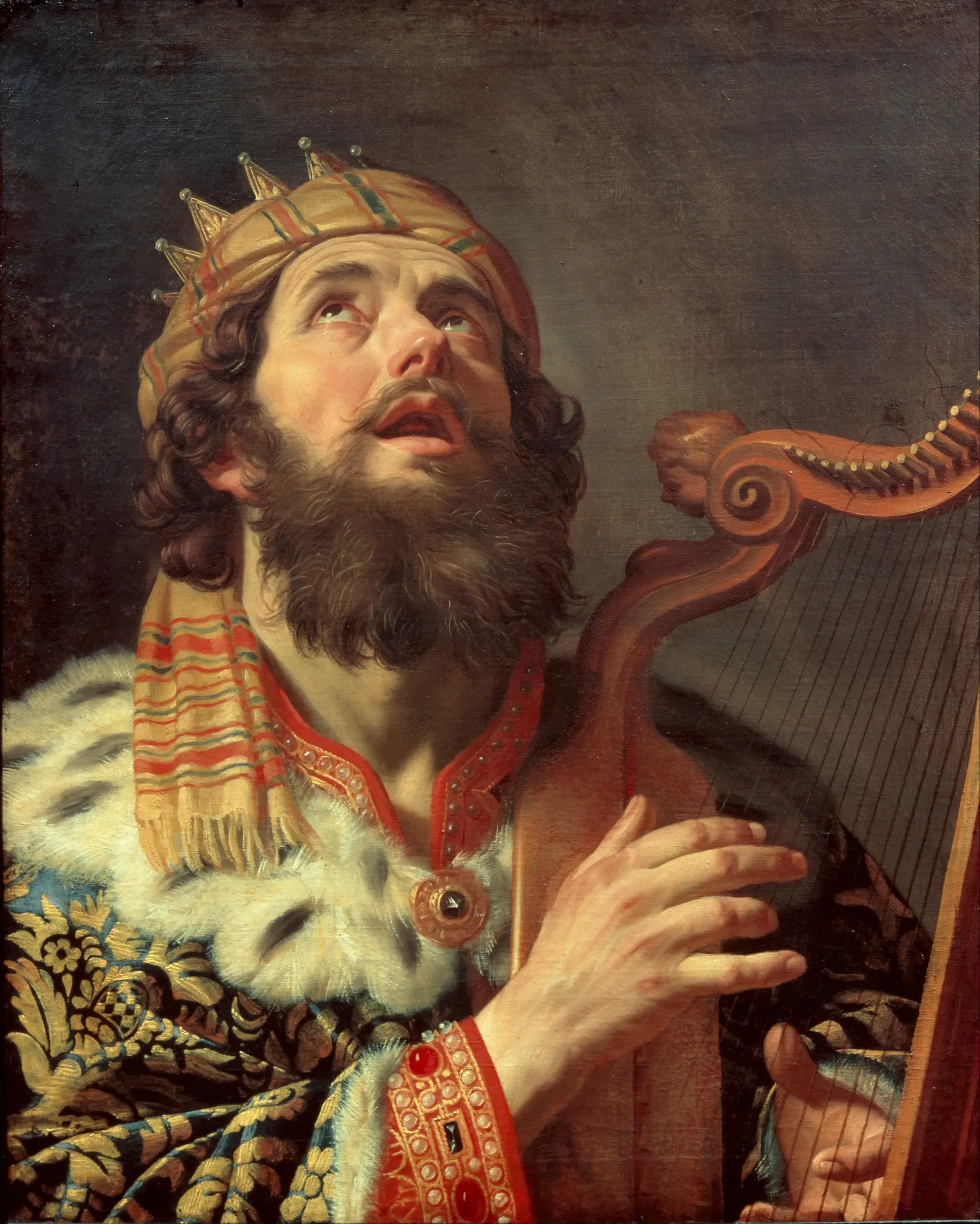
1 Chronicleschapter 17
27 verses · Ezra, by tradition · 450 to 400 BC · History
Now then, you are to tell My servant David that this is what the LORD of Hosts says: I took you from the pasture, from following the flock, to be the ruler over My people Israel.
Introduction
Ezra, by tradition, History, 1 Chronicles Overview.
This chapter was written for a people living under Persian rule with no king of their own, and it tells them why the line of David still mattered. David has a palace and a settled capital, and he makes an offer that every king of his age made to his god. God answers through the prophet Nathan and turns the offer around. The whole chapter hangs on one Hebrew word that means a building, a household and a dynasty at once. Listen for that word each time it returns. Then listen to the king's answer, which is a prayer of wonder and thanks.
Context
- Who
- A people living under Persian rule with no king of their own
- What
- A prophetic oracle through Nathan promising David a lasting house, followed by David's prayer of thanks.
- Where
- David's cedar palace in Jerusalem, near the tent where the ark stood.
- When
- The middle of David's reign, about 1000 BC, a date the book implies and does not state.
- Why
- To state the promise on which the survival of David's line, and the hope of a coming king, would rest.
Historical context
The chapter belongs to David, king over all Israel, settled in his capital with the wars of the next chapter still ahead of him. Nathan the prophet stands beside him, a man attached to the court with the standing to bring the king a word he did not commission.
Show the rest of the historical context, 5 more paragraphs
The time is the middle of the reign, about 1000 BC on the reckoning this site carries, after the ark had been brought to Jerusalem in chapter 16.
The place is Jerusalem, the stronghold David had taken and made his city, where a palace of cedar stood and the ark still sat under a tent.
The occasion is David's own proposal. He sees the difference between his house and the ark's covering and offers to build a temple.
A first hearer knew what that offer meant in the politics of the age. Kings in the ancient Near East built temples for their gods, and a king who housed the god secured his own dynasty by doing it. Building the god's house and receiving the god's blessing on your own house were two halves of one transaction, and the inscriptions of neighbouring kingdoms say so openly.
He also knew that the Hebrew word for house covers a building, a household and a dynasty at once, which is the hinge the whole chapter turns on. David offers to build God a house, and God announces that He will build David one.
Significance
This is the load-bearing wall of the book. Every later chapter about a failing king is measured against it, and the reason the dynasty survives disaster after disaster is stated here in advance.
Show the rest of the significance, 1 more paragraph
For men and women under a Persian governor with no throne of their own, David's own response was the one still available to them. He sat before the LORD, which is no posture of petition, and asked only that God do as He had said.
This chapter in Jewish lifeWhat this chapter is in Jewish life and reading.
What is done
1 Chronicles carries no weekly portion and no Haftarah, and no part of it is read in the synagogue service on any Sabbath of the year. In the Hebrew Bible Chronicles stands among the Writings, and the Haftarah is drawn from the Prophets, so the yearly cycle passes this book over entirely. This site's own table of synagogue readings records the same absence. It holds no portion, no Haftarah use and no festival reading for any of the twenty-nine chapters of the book.
How it is read
The corpus carries seventeen kept notes of Rashi for this chapter in The Judaica Press complete Tanach with Rashi, translated by A. J. Rosenberg, under CC-BY, more than for any chapter of 16 to 29 except the last two. He opens by supplying David's reasoning from the Torah. The rest God has given fulfils one verse of Deuteronomy, and David takes the verse standing next to it as his own obligation. The plan to build therefore follows from the law rather than from ambition (Rashi on I Chronicles 17:1:1).
On the night message Rashi brings the Midrash, and what it teaches is why the answer had to come at once. On one explanation God tells Nathan that "This man to whom I am sending you is a vower", so the word must reach him before he swears to build. On the other the man is zealous, and the word must reach him "before he hires workers" (Rashi on I Chronicles 17:3:1). At the fifth verse he lists the stages of the tent itself, from Gilgal to Shiloh, from Shiloh to Nob, and from Nob to Gibeon (Rashi on I Chronicles 17:5:1). At the sixth he reads the question about a house of cedar as a denial that the thought had ever come from God or from the tribes (Rashi on I Chronicles 17:6:1). At the seventh he takes the oracle that follows as a repayment for what had entered David's mind (Rashi on I Chronicles 17:7:1).
The promises are read against the history the book has already told. The name made great is the name of the great kings. Rashi points back to the notice a few chapters earlier that David's fame went out through all the lands (Rashi on I Chronicles 17:8:1). The place appointed for Israel is read as the end of the exposure of Saul's day, when Saul was killed and the Philistines settled where Israel had lived (Rashi on I Chronicles 17:9:1). The rest promised is measured against the whole era of the judges (Rashi on I Chronicles 17:10:1). At the eleventh verse Rashi hears reassurance in the timing, that the matter will not be hastened and will come when David's days are finished (Rashi on I Chronicles 17:11:1).
The most exact note in the chapter is the one that accounts for a difference between two books. Where Samuel has God say of the son that when he goes astray he will be chastened with the rod of men, this chapter has no such clause, and Rashi says why it is missing. He explains that the clause means the son will be corrected at once if he sins, and that the adversaries raised up against Solomon were that correction. Then he gives the reason for the silence here. It is passed over "because of David's honor, for he does not wish to speak of this in this Book, because it is denigrating to the house of David" (Rashi on I Chronicles 17:13:1). A Christian reader should notice that the omission is treated as deliberate by the classical commentary itself.
David's prayer closes the chapter, and Rashi keeps his notes on it short. Being brought thus far means being brought "From the sheepcote" to the kingdom (Rashi on I Chronicles 17:16:1). The small thing in God's eyes is the gift of the kingdom itself (Rashi on I Chronicles 17:17:1). At the twentieth verse he guards the confession against a lesser reading. Someone might allow that none is as great as God while holding that one stands a little below him. The clause that no god is besides him closes that off (Rashi on I Chronicles 17:20:1). At the twenty-first he reads the uniqueness of Israel as lying in the redemption God performed himself (Rashi on I Chronicles 17:21:1). Two further notes gloss the wording of the prayer (Rashi on I Chronicles 17:18:1, 17:19:1 and 17:24:1).
Metzudat David and Malbim comment on this chapter as well. The corpus carries their refs with the reason that Sefaria holds no English version of them, so they stand here cited and unquoted. Metzudat David comments at I Chronicles 17:2:1, 17:12:1, 17:14:1, 17:15:1, 17:22:1 and 17:23:1. Malbim comments at I Chronicles 17:4:1.
What the rabbis say
The corpus carries forty rabbinic locators for this chapter and the text of none, so each is cited and linked here rather than quoted. Nineteen of the forty stand on one verse, the twenty-first, where Israel is called one nation on the earth whom God went to redeem for himself. In the Babylonian Talmud they are Bava Batra 10b:7, Berakhot 6a:20 and 6a:22, and Chagigah 3b:1, with Ein Yaakov (Glick Edition), Berakhot 1:21 and Ein Yaakov, Berakhot 1:32 beside them. The midrashic run on the same verse is longer. It holds Bamidbar Rabbah 10:5, Bereshit Rabbati, Parashat Vayetze 48, and Kohelet Rabbah 7:1:2. It holds Mekhilta DeRabbi Shimon Ben Yochai 15:2 and 19:6, with Mekhilta DeRabbi Yishmael, Tractate Bachodesh 2:16 and Tractate Shirah 3:5. It holds Midrash Lekach Tov on Deuteronomy 26:17:1 and on Exodus 19:6:4, and Midrash Shmuel 27:3. It closes with Midrash Tanchuma, Lech Lecha 9:3, and Midrash Tanchuma Buber, Lech Lecha 12:1 and Sh'lach 26:1.
Five stand on the sixteenth verse, where David sits before the LORD and asks who he is. They are Jerusalem Talmud Pesachim 5:10:3, Jerusalem Talmud Sotah 7:7:2, Mekhilta DeRabbi Shimon Ben Yochai, Additions 3:2, Yalkut Shimoni on Torah 96:1, and Yoma 69b:1. Four stand on the fourth, where David is told that he is not the man to build the house. The first is Midrash Shmuel 26:2, the midrash Rashi himself draws on in his note. The others are Midrash Tehillim 62:6, Pesikta Rabbati 2:1 and Vayikra Rabbah 11:7. Three stand on the first, David settled in his house of cedar: Esther Rabbah, Petichta 11, Jerusalem Talmud Ketubot 5:7:3, and Pesikta Rabbati 6:1. Three stand on the last verse, the blessing asked on the house of David: Midrash Lekach Tov, Deuteronomy 1:5:1, Sifrei Devarim 4:1, and Yalkut Shimoni on Torah 801:1.
The rest are single locators. Devarim Rabbah 5:3 is carried across the third to the fifth verses together. Otzar Midrashim, Baraita of The 32 Midot of Aggadah 1:13 stands on the fifth. Berakhot 7b:24 and Pirkei DeRabbi Eliezer 19:12 stand on the ninth. Jerusalem Talmud Moed Katan 3:7:19 stands on the eleventh, and Ein Yaakov (Glick Edition), Khagigah 1:4 on the twenty-second. What each of them teaches is a saying of the rabbis, and is reported as theirs wherever this site quotes one. The quotations wait on a fetch that carries the text.
Sources: Rashi, Rashi on I Chronicles 17:1:1 to 17:24:1, seventeen kept notes in The Judaica Press complete Tanach with Rashi, translated by A. J. Rosenberg, CC-BY; Metzudat David, Metzudat David on I Chronicles 17:2:1, 17:12:1, 17:14:1, 17:15:1, 17:22:1 and 17:23:1, cited by ref because the corpus carries no English text; Malbim, Malbim on I Chronicles 17:4:1, cited by ref because the corpus carries no English text; The Sefaria corpus, scripts/data/sources/sefaria/1-chronicles/17.json, the 40 Talmud and Midrash locators of this chapter; This site's table of synagogue readings, src/lib/hebraic/readings.ts, which records no portion, no Haftarah use and no festival reading for 1 Chronicles.
The heads below are this chapter's scenes. The numbered points under each are its verses.
David's house of cedar and God's tent of curtains
1 Chronicles 17:1-3
David had settled into his palace: Chronicles opens the scene without the notice in 2 Sam 7:1 that the LORD had given David rest from all his enemies around him. It moves straight from David's “house of cedar” to the ark “under a tent”, keeping the chapter's attention on the sanctuary.
1 Chronicles 17:1
“The date was towards the latter end of David's reign, for it is expressly said in the former book to have been at the cessation of all his wars. But as to narrate the preparations for the removal of the ark and the erection of the temple was the principal object of the historian, the exact chronology is not followed.”
Jamieson, Fausset & Brown · Commentary Critical and Explanatory on the Whole Bible (1871)reformed
all that is in your heart: Nathan the prophet gives David a quick yes. He tells the king to do what is in his heart, for God is with him. Adam Clarke sends the reader to 2 Samuel 7, where the same answer stands in the parallel account.
that night the word of God: The correction comes the same night Nathan spoke. The word of God reaches the prophet before David can act on the answer of verse 2. Adam Clarke points to 2 Samuel 7, which tells of this night in the same terms.
1 Chronicles 17:4-6
You are not the one to build Me a house: One word differs at verse 6. Where the Hebrew of 2 Sam 7:7 has the tribes of Israel, the Hebrew here has the judges of Israel. Older commentators read the change as a scribal shift between two similar Hebrew words or as a narrowing to the period's rulers.
1 Chronicles 17:4
“He must prepare for it, but not do it; as Moses must bring Israel within sight of Canaan, but must them leave it to Joshua to put them in possession of it. It is the prerogative of Christ to be both the author and finisher of his work. Yet David must not think that, because he was not permitted to build the temple, 1.”
Matthew Henry · Commentary on the Whole Bible (1707-1721)puritan
moved from tent to tent: From the Exodus onward the LORD dwelt in a tent that moved. Adam Clarke gives the Targum and Jarchi, who trace the tent's moves from Gilgal to Nob, from Nob to Shiloh, and from Shiloh to Gibeon. Gibeon is where 16:39 places the tabernacle in David's own day.
1 Chronicles 17:5
“But have gone from tent to tent - “I have transferred my tabernacle from Gilgal to Nob, from Nob to Shiloh, and from Shiloh to Gibeon.” - Targum and Jarchi.”
Adam Clarke · Commentary on the Bible (1810-1826)evangelical
leaders I appointed to shepherd: The LORD asks whether He ever told any shepherd of Israel to build Him a house of cedar. The cedar house recalls David's palace in verse 1. Adam Clarke's note on verse 5 lists the places the tent stood in all those years of travel, from Gilgal to Gibeon.
I will build you a house, and your throne shall stand forever
1 Chronicles 17:7-10
I took you from the pasture: The promise to plant His people in a place of their own follows, matching 2 Sam 7:8-11. Where 2 Sam 7:11 promises David rest from all his enemies, Chronicles has “I will subdue all your enemies”. Verse 10 turns David's plan around: “the LORD will build a house for you”.
a name like the greatest: The LORD reviews David's past: He has been with David on every road and has cut off his enemies. The promise then turns to the future, a great name in the land. Adam Clarke sends the reader to 2 Samuel 7 for the same promise.
I will provide a place: The promise turns from David to the whole people of Israel. The LORD will plant them in a place of their own, safe at last from the sons of wickedness. Adam Clarke refers readers to 2 Samuel 7 for the same words.
1 Chronicles 17:9
“Neither shall the children of wickedness - They shall no more be brought into servitude as they were in the time they sojourned in Egypt. This is what is here referred to.”
Adam Clarke · Commentary on the Bible (1810-1826)evangelical
1 more voice on this verse
1 Chronicles 17:9
“That must be his work, who is a man of war and fit for it, and he must let the building of churches be left to one that was never cut out for a soldier.”
Matthew Henry · Commentary on the Whole Bible (1707-1721)puritan
I will subdue all your: The LORD promises to subdue all of David's enemies. He then turns David's plan around, for the LORD will build a house for David, a line of kings. Adam Clarke sends the reader to 2 Samuel 7, where the same promise stands.
1 Chronicles 17:11-13
I will raise up your descendant after you: Chronicles lacks the warning of 2 Sam 7:14 that the LORD will discipline this son when he does wrong. Albert Barnes ties this to the book's silence on Solomon's turn to idols in 1 Kings 11. Here “I will never remove My loving devotion from him” stands alone.
1 Chronicles 17:11
There is no doubt that Solomon was the son of David and his successor in the kingdom. And he first built the temple of God at Jerusalem, and perhaps the Jews understand him to be the subject of the prophecy. But we may fairly ask them whether the oracle applies to Solomon, which says, "And I will set up his throne for ever," and also where God swore with the affirmation of an oath by his holy one, "The throne of him that is foretold shall be as the sun and the days of heaven."
Eusebius of Caesarea · written before 339 · Proof of the Gospel 7.3patristic
He will build a house: The son of verse 11 will build the LORD's house. Eusebius of Caesarea grants that Solomon built the first temple but asks how a throne forever can fit Solomon alone. Adam Clarke and Matthew Henry read the promise as reaching to Christ, with Clarke citing Isaiah 9:7.
1 Chronicles 17:12
“I will establish his throne for ever - David was a type of Christ; and concerning him the prophecy is literally true. See Isa 9:7, where there is evidently the same reference.”
Adam Clarke · Commentary on the Bible (1810-1826)evangelical
I will be his Father: The predecessor who lost the LORD's loving devotion is Saul. Albert Barnes notes that Samuel adds a warning at this point about punishing the son's sins. Barnes ties its absence here to the book's silence on Solomon's sins and the troubles of 1 Kings 11:9-40.
1 Chronicles 17:13
“My son - The minatory clause which occurs after this in Samuel is here omitted, because the writer is not about to record the sins of Solomon, or the sufferings 1 Kings 11:9-40 which he thereby brought upon himself.”
1 Chronicles 17:14-15
set him over My house and My kingdom: In 2 Sam 7:16 the promise is that David's own house and kingdom will endure forever. Chronicles has “I will set him over My house and My kingdom forever”. Jamieson, Fausset and Brown tie this to 28:5 and 29:23, where Solomon sits on the throne of the LORD.
1 Chronicles 17:14
“We naturally expect the prophet to revert to David before concluding, after having spoken (1Ch 17:12) of the building of Solomon's temple. The promise that his house should be blessed was intended as a compensation for the disappointment of his wish to build the temple, and hence this assurance is appropriately repeated at the conclusion of the prophet's address [BERTHEAU].”
Jamieson, Fausset & Brown · Commentary Critical and Explanatory on the Whole Bible (1871)reformed
all the words of this: Nathan relayed the words of the whole vision to David, the vision God gave him that night in verse 3. The message reverses Nathan's own quick answer to David in verse 2. Adam Clarke points to 2 Samuel 7 for it.
Who am I, O LORD? David sits down and prays
1 Chronicles 17:16-17
David's prayer opens with “Who am I, O LORD God, and what is my house”, matching 2 Sam 7:18. Verse 17 says God has “regarded me as a man of great distinction”. Barnes reads the phrase as David set above other men, a rank he had no natural claim to.
1 Chronicles 17:16
“And what is mine house, that thou hast brought me hitherto? - I am not of any regal family, and have no natural right to the throne.”
Adam Clarke · Commentary on the Bible (1810-1826)evangelical
1 more voice on this verse
1 Chronicles 17:16
“Kingdom - In God's kingdom in a large and general sense. And this, as well as the former phrase, singularly belongs to the Messiah, who was not only to be the king of Israel, but also of all nations.”
John Wesley · Explanatory Notes upon the Old Testament (1765)evangelical
a small thing in Your: What God has done so far is called a small thing beside His word about David's future house. Albert Barnes reads the man of great distinction as David raised above other men by a kingdom that lasts forever. Barnes compares 2 Samuel 7:19.
1 Chronicles 17:17
“Hast regarded me ... - i. e., “Thou hast elevated me above other men, by making my kingdom perpetual, regarding me as if I were a man of high degree.” Compare the 2Sa 7:19 note.”
1 Chronicles 17:18-19
What more can David say to You: The prayer's ground shifts in one word. Where 2 Sam 7:21 has for the sake of Your word, Chronicles has “For the sake of Your servant”. Both grounds meet in the one greatness David says he cannot add to, “For You know Your servant”.
1 Chronicles 17:18
“For the honor of thy servant - i. e., “for the honor which Thou hast done for Thy servant.” The Septuagint omits “Thy servant,” and renders it: “What can David say more to Thee to glorify Thee? For Thou knowest,” etc.”
For the sake of Your servant: The promise has two grounds, the servant and God's heart. Where 2 Samuel 7 has the word's sake, this verse has the servant's sake. Matthew Henry reads the servant as Christ, for whose sake the promises are made and kept for all believers.
1 Chronicles 17:19
“Jesus Christ is both the Word of God ( Rev. xix. 13 ) and the servant of God ( Isa. xlii. 1 ), and it is for his sake, upon the score of his meditation, that the promises are both made and made good to all believers; it is in him that they are yea and amen.”
Matthew Henry · Commentary on the Whole Bible (1707-1721)puritan
1 Chronicles 17:20-22
there is none like You: Praise widens from David's house to God Himself: “O LORD, there is none like You, and there is no God but You”. The lines match 2 Sam 7:22-24 closely. The question “who is like Your people Israel” then binds the covenant just given to the redemption from Egypt.
who is like Your people: David sets Israel beside God Himself: the LORD stands alone in verse 20, and Israel stands alone among the nations. God went out to redeem them from Egypt. John Wesley reads the kingdom language of this prayer as reaching past Israel to the Messiah, king of all nations.
Your very own forever: Israel is the LORD's own people forever. He has become their God, and the two halves form the covenant pair, His people and their God. John Wesley reads the kingdom in David's prayer as God's kingdom in the wide sense, reaching all nations through the Messiah.
1 Chronicles 17:23-25
let the word You have spoken: The prayer asks, “let the word You have spoken concerning Your servant and his house be established forever”. It confesses “that You will build a house for him”. Verse 25 closes as David “has found the courage to pray”, which the Targum reads as an opening of the mouth.
Your name will be established: David asks that God's name be established and magnified forever, with the confession that the LORD of Hosts rules as God over Israel. Albert Barnes notes a reading some prefer: let Your name stand firm and be held in honor, along with Your promise. David's house is set before God.
1 Chronicles 17:24
“Some prefer, “And let Thy name be established and magnified forever:” i. e., “Let not only Thy promise stand firm, but let Thy Name also stand firm (continue to be held in honor) and be magnified,” etc.”
found the courage to pray: God revealed that He would build David a house, and that promise gave David the courage to pray. Adam Clarke gives the Targum's reading, that the servant found an opening of mouth to pray before God. The prayer rests on what God first said.
1 Chronicles 17:25
“Hath found in his heart to pray - The Targum expresses a full sense: “Therefore thy servant hath found an opening of mouth, that he might pray before Thee.”
Adam Clarke · Commentary on the Bible (1810-1826)evangelical
1 Chronicles 17:26-27
You are God! And You have promised: The closing line changes mood, for 2 Sam 7:29 asks, may it please You to bless the house of Your servant. Chronicles states it as done: “So now You have been pleased to bless the house of Your servant”. What the king asked for he declares true.
You have been pleased to: The prayer closes on a statement of faith. Matthew Henry calls the closing line of 2 Samuel 7 a holy desire and this one a most holy faith. Adam Clarke gives the Targum, where God begins to bless the house of His servant, so it will be blessed forever.
1 Chronicles 17:27
“For thou blessest, O Lord - “Thou beginnest to bless the house of thy servant, therefore it shall be blessed for ever.” - T. The reader is requested to refer to 2 Samuel 7 (note), and the notes there for many particulars that belong to the parallel places here, and which it should answer no good purpose to repeat in this place.”
Adam Clarke · Commentary on the Bible (1810-1826)evangelical
How this psalm is built
The form: Narrative carrying a prophetic oracle and a royal prayer, the hinge the rest of the book turns on, as guide classes it.
The patterns in this chapter
| Device | What it does | Where to see it |
|---|---|---|
| House, meaning a palace, a temple and a dynasty | One Hebrew word carries David's cedar palace at verse 1, the house he offers to build at verse 4, and the house God promises to build him at verse 10. The guide names bayith as a keynote of the book for this chapter's sake, glossing it as the house David proposes and the dynasty God promises. The whole oracle turns on the shift from the second sense to the third.This site's published book guide, src/components/book/guides/1-chronicles/Book1ChroniclesGuide.tsx, the KEYNOTES row bayith at h1004. | 1 Chronicles 17:1, 1 Chronicles 17:4, 1 Chronicles 17:10, 1 Chronicles 17:12 |
| A house of cedar at the opening, a house blessed forever at the close | The chapter opens with a king settled in a house of cedar while the ark of the covenant stands under a tent, and it closes with the house of the servant blessed and continuing forever. The same word stands at both ends with the sense changed between them. The first house is the one David lives in and the last is the one he could never have built. | 1 Chronicles 17:1, 1 Chronicles 17:27 |
| Forever, at the end of each limb of the promise | The word closes the throne clause at verse 12, the house and kingdom clause at verse 14, the gift of Israel at verse 22, and the prayer at verse 27. Keil reads the Chronicler holding the oracle's language steady where the parallel account varies it. The repetition is what makes the promise larger than the son it first names.Carl Friedrich Keil, The Books of the Chronicles, 1872, on 1 Chronicles 17. | 1 Chronicles 17:12, 1 Chronicles 17:14, 1 Chronicles 17:22, 1 Chronicles 17:27 |
| Who am I, O LORD God | David answers the oracle with a question rather than a request, and the prayer keeps returning to what God has done rather than to what David wants. Verse 16 opens on the question, verse 20 turns from his own house to the nature of God, and verse 27 closes on a statement of fact about the blessing. The petitions at verses 23 to 25 sit inside that frame.Adam Clarke, Commentary on the Bible, 1832, on 1 Chronicles 17:16. | 1 Chronicles 17:16, 1 Chronicles 17:20, 1 Chronicles 17:27 |
What the Chronicler changed
11 more paragraphs on the patterns
The chapter runs close to 2 Samuel 7 and parts from it at seven points, each named in the site's published exposition for the chapter. Samuel's notice that the LORD had given David rest from all his enemies is missing at verse 1, which keeps the scene on the sanctuary. At verse 6 the LORD asks about the leaders appointed to shepherd Israel where 2 Samuel 7:7 has the tribes of Israel. The variant is read either as an old scribal shift between two similar Hebrew words or as a narrowing to the period's rulers. At verse 10 the subduing of the enemies stands in the future where Samuel has a rest already given, which suits a book written for a people with no standing army.
The largest omission is at verse 13. Samuel's warning that the son, if he commits iniquity, will be chastened with the rod of men has no place here. Albert Barnes reads the cut as the Chronicler's method at work across the whole book, which never narrates Solomon's later fall. At verse 19 the ground of the prayer is the servant's sake where Samuel has the word's sake, a difference Matthew Henry marks by name. The last verse ends on settled faith, that the LORD has blessed the house and it will be blessed forever, where 2 Samuel 7:29 ends on the request. Henry calls the one a holy desire and the other a most holy faith.
Whose throne it is
Verse 14 is the load-bearing change. The guide sets the two verses side by side and states the difference in its own comparison block. At 2 Samuel 7:16 every pronoun is second person, David's house, David's kingdom and David's throne. Here the pronouns are God's own, My house and My kingdom. Jamieson, Fausset and Brown read the Chronicler as stating at the moment of the promise what 28:5 and 29:23 say later of Solomon. Those verses put him on the throne of the kingdom of the LORD.
The dossier carries the same point as a theology entry under the title The throne of the LORD. A reader who has only the Samuel account meets a dynasty guaranteed to a man. A reader who has this one meets a dynasty that was always God's own seat, held by the son He names.
The New Testament's use
The guide's Christ table gives the refs as 17:11 to 14 with Luke 1:32 to 33 and Acts 2:30, and links the feature page on the Davidic covenant. Gabriel tells Mary that the Lord God will give Him the throne of His father David and that His kingdom will never end. Peter at Pentecost argues from the oath sworn to David that one of his descendants would sit on his throne.
The dossier's Christ entry adds Hebrews 1:5, which takes the father and son clause of the covenant and applies it to Christ directly. Its own line on the near horizon is short: Solomon built a house that burned, and the promise ran on past him. The chapter that promises the house and the chapter that names Solomon are five chapters apart, and 22:10 repeats the sonship clause in the son's own hearing.
The debated reading this chapter sits inside
The omission at verse 13 belongs to a larger question the dossier carries as one of its six difficulties, why Bathsheba and Absalom are absent from this book. The dossier names two positions. The first reads the selection as governed by the subject, since the spine of the book is the ark, the covenant, the temple site and the orders of service. It is held by most of Chronicles scholarship, including Martin Selman in 1 Chronicles, Tyndale Old Testament Commentaries, 1994, and Roddy Braun in 1 Chronicles, Word Biblical Commentary, 1986. It observes that the Chronicler keeps what no cleaned up portrait would keep, the census, David's confession at 21:17, and the word that barred him from building at 22:8.
The second reads the book as a David idealized for a later and more devotional audience. It is held by Julius Wellhausen in Prolegomena to the History of Israel, 1878, and the historical critical tradition following him. The guide states the same dispute in its own contested table under the idealized portrait of David. This page states no verdict, and the dossier's door on the omitted material is /featured/david-and-bathsheba.
Keep studying
Places1
Sources for this chapter
The summary
Jamieson, Fausset & Brown, Commentary Critical and Explanatory; John Wesley, Notes on the Old Testament and Matthew Henry, Complete Commentary.
The form and classifications
This site's published book guide; This site's published book sections table, src/lib/bible/book-sections.ts, the entry "1 Chronicles": "history" and This site's published dossier for 1 Chronicles, src/components/book/dossier-content/1-chronicles.ts, the theology entry "The covenant retold at chapter 17".
The exposition
Adam Clarke, Commentary on the Bible; Albert Barnes; Eusebius of Caesarea, PROOF OF THE GOSPEL 7.3; Jamieson Fausset and Brown, Commentary Critical and Explanatory on the Whole Bible; John Gill, Exposition of the Old Testament; John Wesley, Explanatory Notes upon the Old Testament; Keil, The Books of the Chronicles and Matthew Henry, Commentary on the Whole Bible.