
1 Samuel 19:13
in 1 Samuel 19Then Michal took a household idol and laid it in the bed, placed some goat hair on its head, and covered it with a garment.
BSB
The same verse in ASV and KJV ▾
ASV
And Michal took the teraphim, and laid it in the bed, and put a pillow of goats’ hair at the head thereof, and covered it with the clothes.
KJV
And Michal took an image, and laid it in the bed, and put a pillow of goats’ hair for his bolster, and covered it with a cloth.
⋯
This verse in 1 Samuel 19
Commentary
11 notes on this verseNow Michal's name means "reign," because sin reigned over our nature up to that time. And at the very time he himself was born, he [the Lord in the figure of David] went out through a window. And the window indicates the return to the light again of the one who made himself known to those sitting in darkness and the shadow of death.And his image is seen on the bed. For the angel says to those seeking the Lord in the tomb, "Why do you seek the living with the dead? He is not here; he is risen."
This site's exposition
Then Saul sent messengers to David’s house to watch him and kill him in the morning
on 1 Samuel 19:11-13
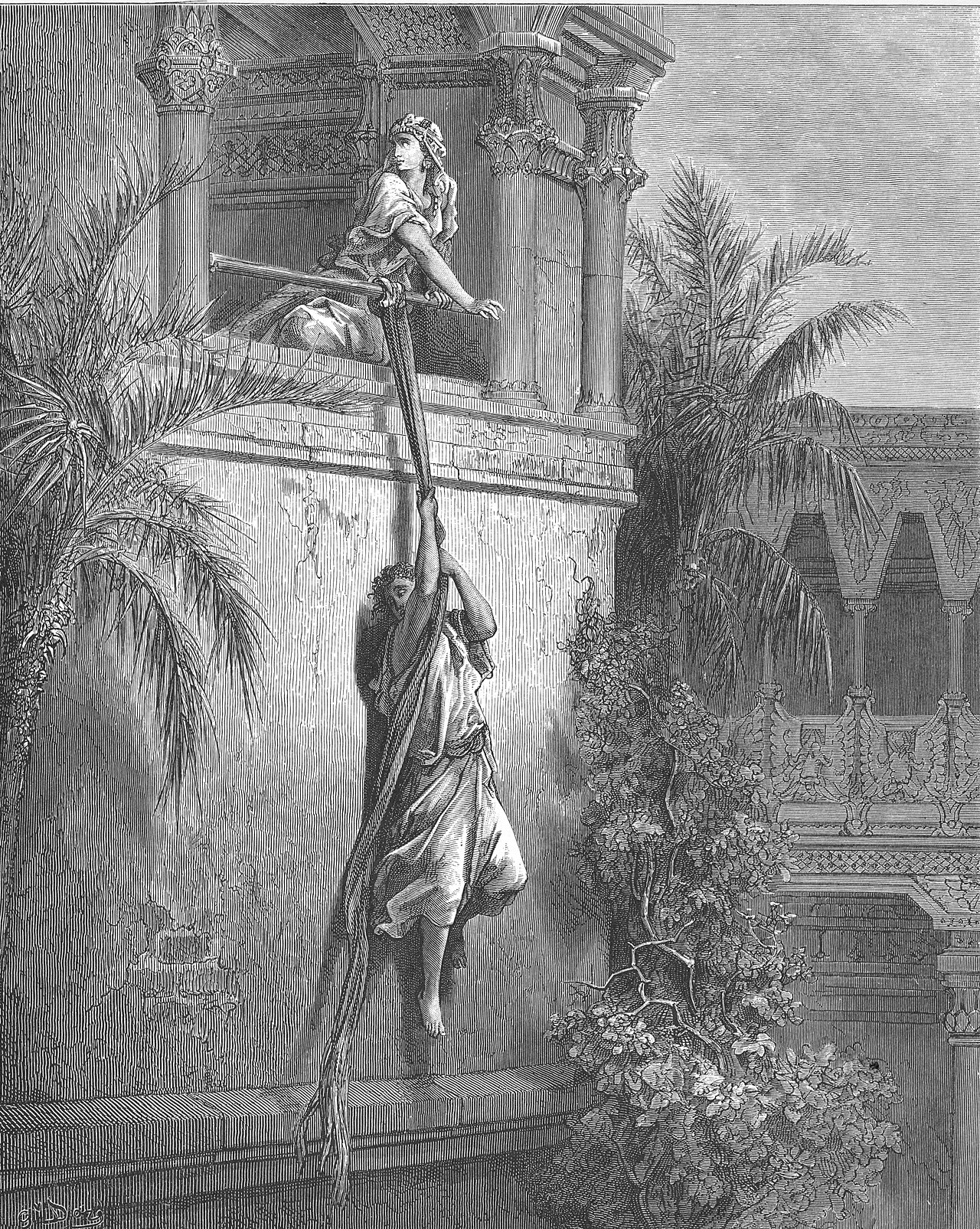
Saul sets messengers "to watch him and kill him in the morning," and Michal lowers David from the window, a rescue the older commentators compare to Rahab lowering the spies. She lays "a household idol" in the bed with goat hair on its head. The text never says why such an image was in the house, and Gill notes that David would not have allowed it had he known.
This site's exposition
Michal took a household idol
Albert Barnes describes the household idol as a figure in human form, as large as life, laid in the bed to pass for David. John Gill connects it with the idol Rachel took from her father at Genesis 31:19 and 34. A daughter deceives her father with such an idol both times.
The record, by era
The Church Fathers1 voice
And not in war only, but also in peace the need of deceit may be found, not merely in reference to the affairs of the state but also in private life, in the dealings of husband with wife and wife with husband, son with father, friend with friend, and also children with a parent. For the daughter of Saul would not have been able to rescue her husband out of Saul's hands except by deceiving her father. And her brother, wishing to save him whom she had rescued when he was again in danger, made use of the same weapon as the wife.
The Medieval Church1 voice
But Michal took an image and laid it on the bed, etc. The history of the hairy skin, of the skins of goats, is evident; for there was a cushion sewn of goat's skin, which, with its unshorn hairs, feigned the head of a man …
The Puritans and the Awakening3 voices
And Michal took an image,.... Or "teraphim", as the word is; which, if the same with those that Rachel stole from her father, they seem to be of the same sort with the penates or household gods of the Heathens, which were privately kept by Michal; for, had David known of them, he would not have suffered them to have been in his house. Aben Ezra supposes they were images made in the form of men under such a constellation, a sort of talismans, to receive the heavenly influences, and which being consulted, foretold things to come; and R.
) she had put a wooden image in the bed, and wrapped it up close and warm as if it had been David asleep, not in a condition to be spoken to; the goats' hair about the image was to resemble David's hair, the better to impose upon them. Michal can by no means be justified in telling a lie, and covering it thus with a cheat.
quarantine:debris (2026-07-29) — leading-punctuation+unbalanced-parens
"God," says Mr. Henry, "inclined the heart of Saul to hearken to the voice of Jonathan." 8. And David, &c. - So David continues his good service, tho' it was ill requited. They who are ill paid for doing good, yet must not be weary of well doing, remembering how bountiful a benefactor God is, even to the evil and unthankful.
3 more voices on this verse
The Nineteenth Century3 voices
A commentator
Albert Barnes1798–1870
Notes, Explanatory and Practical, on the Old and New Testaments (1832-1869)
An image - “Teraphim” (see the margin), an image, or bust in human form, and as large as life, of a kind of household god, to the worship of which the Israelites, and especially women, were much addicted. A pillow - It was probably a quilt or blanket of goats’ hair and of common use as a bed-covering. Whether Michal drew it over the head of the teraphim, as if for warmth, and so covered it, or whether she disposed it about the head so as to look like hair, is not clear.
A commentator
Jamieson, Fausset & Brown1802–1910
Commentary Critical and Explanatory on the Whole Bible (1871)
And Michal took an image, and laid it in the bed--"an image," literally, "the teraphim," and laid, not in the bed, but literally on the "divan"; and "the pillows," that is, the cushion, which usually lay at the back of the divan and was stuffed with "goat's hair," she took from its bolster or heading at the upper part of the divan.
Michal took an image - את התרפים eth hatteraphim, the teraphim. The Hebrew word appears to mean any kind of image, in any kind of form, as a representative of some reality. Here it must have been something in the human form; because it was intended to represent a man lying in bed indisposed. A pillow of goats’ hair - Perhaps she formed the appearance of a sick man’s head muffled up by this pillow or bag of goats’ hair. So I think the original might be understood. The goats’ hair was merely accidental; unless we could suppose that it was designed to represent the hair of David’s head, which is not improbable.
How the passage was read
What the Jewish commentators add
Michal took. So that they would not realize that he fled, and pursue him.
This section is reception history: how the passage was read and kept in the Jewish tradition. Where a reading parts from an essential of the Christian faith, the section says so at that point.
Texts and citation data: Sefaria; each excerpt follows its version’s licence. 6 further sources are cited on this chapter that carry no English text this site may quote or only restate the verse.
The words behind it
14 Hebrew wordsEvery Hebrew word of this verse in the order it stands, with what it means and the door to its own study. The last column counts the times a word stands in the whole Bible: the rarer the word, the more the places it appears belong together.
| Hebrew | Sound | Meaning | Word study | In the Bible |
|---|---|---|---|---|
| וַתִּקַּ֨ח | vatikach | and she took | H3947 → | 966 times |
| מִיכַ֜ל | mikhal | Michal | H4324 → | 18 times |
| אֶת־ | ʾet- | <obj.> | H853 → | 10935 times |
| הַתְּרָפִ֗ים | haterafim | the teraphim | H8655 → | 15 times |
| וַתָּ֙שֶׂם֙ | vatasem | and she put [it] | H7760 → | 584 times |
| אֶל־ | ʾel- | into | H413 → | 5510 times |
| הַמִּטָּ֔ה | hamitah | the bed | H4296 → | 29 times |
| וְאֵת֙ | veet | and <obj.> | H853 → | 10935 times |
| כְּבִ֣יר | kevir | <the> quilt of | H3523 → | |
| הָֽעִזִּ֔ים | haizim | <the> goat hair<s> | H5795 → | 74 times |
| שָׂ֖מָה | samah | she put | H7760 → | 584 times |
| מְרַֽאֲשֹׁתָ֑יו | meraashotav | [the] place of head its | H4763 → | 8 times |
| וַתְּכַ֖ס | vatekhas | and she covered [it] | H3680 → | |
| בַּבָּֽגֶד׃ ס | babaged | with the garment | H899 → | 217 times |
וַתִּקַּ֨חand she took
vatikachH3947 →966 times
מִיכַ֜לMichal
mikhalH4324 →18 times
אֶת־<obj.>
ʾet-H853 →10935 times
הַתְּרָפִ֗יםthe teraphim
haterafimH8655 →15 times
וַתָּ֙שֶׂם֙and she put [it]
vatasemH7760 →584 times
אֶל־into
ʾel-H413 →5510 times
הַמִּטָּ֔הthe bed
hamitahH4296 →29 times
וְאֵת֙and <obj.>
veetH853 →10935 times
כְּבִ֣יר<the> quilt of
kevirH3523 →
הָֽעִזִּ֔ים<the> goat hair<s>
haizimH5795 →74 times
שָׂ֖מָהshe put
samahH7760 →584 times
מְרַֽאֲשֹׁתָ֑יו[the] place of head its
meraashotavH4763 →8 times
וַתְּכַ֖סand she covered [it]
vatekhasH3680 →
בַּבָּֽגֶד׃ סwith the garment
babagedH899 →217 times
A shaded row is a word that stands 400 times or fewer in the Bible.
The walk
8 stopsEach card is a verse this one points to, and under it the verses that one points to in turn. Where several paths arrive at the same place, that place is listed first: the text keeps returning to it.
Through
Genesis 31:19Now while Laban was out shearing his sheep, Rachel stole her father’s household idols.
it leads to
- Hosea 3:4
For the Israelites must live many days without king or prince, without sacrifice or sacred pillar, and without ephod or idol.
Reached by 2 separate paths from here.
- Genesis 31:30
Now you have gone off because you long for your father’s house. But why have you stolen my gods?”
Reached by 2 separate paths from here.
- Ezekiel 21:21
For the king of Babylon stands at the fork in the road, at the junction of the two roads, to seek an omen: He shakes the arrows, he consults the idols, he examines the…
- Genesis 35:2
So Jacob told his household and all who were with him, “Get rid of the foreign gods that are among you. Purify yourselves and change your garments.
- Hosea 3:4
Through
Hosea 3:4For the Israelites must live many days without king or prince, without sacrifice or sacred pillar, and without ephod or idol.
it leads to
- Judges 17:5
Now this man Micah had a shrine, and he made an ephod and some household idols, and ordained one of his sons as his priest.
Reached by 2 separate paths from here.
- Judges 17:5
Through
Judges 17:5Now this man Micah had a shrine, and he made an ephod and some household idols, and ordained one of his sons as his priest.
it leads to
- Judges 18:14
Then the five men who had gone to spy out the land of Laish said to their brothers, “Did you know that one of these houses has an ephod, household gods, a graven image,…
Reached by 2 separate paths from here.
- Judges 8:27
From all this Gideon made an ephod, which he placed in Ophrah, his hometown. But soon all Israel prostituted themselves by worshiping it there, and it became a snare to Gideon and his household.
Reached by 2 separate paths from here.
- Genesis 31:19
Now while Laban was out shearing his sheep, Rachel stole her father’s household idols.
Reached by 2 separate paths from here.
- Judges 18:14
Where this verse is studied
On this page
About 1 Samuel
This page draws on 11 works. Open the list of works
This page draws on Adam Clarke, Commentary on the Bible; Albert Barnes, Notes on the Old Testament; Albert Barnes, Notes, Explanatory and Practical, on the Old and New Testaments (1832-1869); Bede, Commentary on Samuel; Gregory of Nyssa, ON THE INSCRIPTIONS OF THE PSALMS 2.16.272-73; Jamieson, Fausset & Brown, Commentary Critical and Explanatory on the Whole Bible; John Chrysostom, ON THE PRIESTHOOD 1.8; John Gill, Exposition of the Old Testament; John Gill, Exposition of the Old Testament (1748-1763); John Wesley, Explanatory Notes upon the Old Testament and Matthew Henry, Commentary on the Whole Bible.