
Psalms 87:1
in Psalms 87He has founded His city on the holy mountains.
BSB
The same verse in ASV and KJV ▾
ASV
His foundation is in the holy mountains.
KJV
His foundation is in the holy mountains.
⋯
This verse in Psalms 87
Commentary
12 notes on this verseHis foundation is in the holy mountains. The Psalm begins abruptly, the poet's heart was full, and it gained vent on a sudden. Sudden passion is evil, but bursts of holy joy are most precious. God has chosen to found his earthly temple upon the mountains; he might have selected other spots, but it was his pleasure to have his chosen abode upon Zion. His election made the mountains holy, they were by his determination ordained and set apart for the Lord's use.
This site's exposition
on the holy mountains
on Psalms 87:1-3
God founded the city himself, and He founded it on the holy mountains. Verse 2 sets the gates of Zion above every dwelling of Jacob, where the Hebrew is mishkan, the noun used for the tabernacle. Verse 3 says glorious things are ascribed to this city.
The record, by era
The Church Fathers4 voices
"Her foundations are upon the holy hills" (ver. 1). The Psalm had as yet said nothing of the city: it begins thus, and says, "Her foundations are upon the holy hills." Whose? There can be no doubt that foundations, especially among the hills, belong to some city. Thus filled with the Holy Spirit, and with many thoughts of love and longing for that city, as if after long internal meditation, that citizen bursts out, "Her foundations are upon the holy hills;" as if he had already said something concerning it. And how could he have said nothing on a subject, respecting which in his heart he had never been silent? For how could "her foundations" have been written, of which nothing had been said before? But, as I said, after long and silent travailing in contemplation of that city in his mind, crying to God, he bursts out into the ears of men thus: "Her foundations are upon the holy hills." And, supposing persons who heard to enquire of what city he spoke he adds, "the Lord loveth the gates of Sion." Behold, then, a city whose foundations are upon the holy hills, a city called Sion, whose gates the Lord loveth, as he adds, "above all the dwellings of Jacob." But what doth this mean, "her foundations on the holy hills"? What are the holy hills upon which this city is built? Another citizen tells us this more explicitly, the Apostle Paul: of this was the Prophet a citizen, of this the Apostle citizen: and they spoke to exhort the other citizens. But how are these, I mean the Prophets and Apostles, citizens? Perhaps in this sense; that they are themselves the hills, upon which are the foundations of this city, whose gates the Lord loveth Let then another citizen state this clearly, that I may not seem to guess. […]
Its foundations are in the holy mountains. He did not say beforehand whose, yet he said, Its foundations are in the holy mountains. The one who speaks is the prophet: the sons are of Korah. What Korah means, I have often stated: a skull, that is, the sons of the resurrection. Its foundations: whether of God, or certainly of the Church. And what are the foundations, if not the Father and the Son and the Holy Spirit? These foundations, then, are not in the valleys, but are in the mountains: and not on any mountains whatever, but on the holy mountains. Paul says: 'As a wise architect I have laid the foundation'—that is, faith in the Trinity. Then he also says in another place: 'For he was awaiting the city having foundations, whose builder and maker is God.' Its foundations are in the holy mountains. He said, In the holy mountains, because there are also other mountains that are not holy. Then it is also said in Isaiah: 'Upon the dark mountain lift up a sign.' And in another place it is said: 'Who are you, corrupt mountain?' It is also said in Jeremiah: 'Give glory to the Lord your God, before your feet stumble against the dark mountains.' You see, then, that there are also dark mountains: and it is said to us by Jeremiah that we should give glory to God before our feet stumble against the dark mountains. For if our feet strike against those mountains, we cannot give glory to the Lord. Its foundations are in the holy mountains. Whom can we call the foundations? The apostles. In them were the foundations: where the faith of the Church was first laid, there too the foundations were laid.
We ought to know that what we have interpreted of the Church can be understood also of our soul. For if Zion is interpreted as a watchtower, and our soul in no other way but always considers higher things: the true church, the true temple of Christ is nothing other than the human soul. The Church of Christ is nothing else but the souls of those who believe in Christ. 'You,' he says, 'are the temple of God, and the Spirit of God dwells in you.' Its foundations are in the holy mountains: that is, the foundations of God are nowhere but in the holy mountains, in the doctrines of the believing soul. The Lord loves the gates of Zion. Our Zion has very many gates: which, if we open them, the bridegroom enters in to us, and sleeps with us. Then he himself says: 'Behold, I stand before the door and knock: if anyone opens to me, I will enter and dine with him.' Glorious things are spoken of you, O city of God. A city is not one building, but consists of many buildings: so the Church and our Zion, unless it has many virtues, will not be the city of God. I will be mindful of Rahab and Babylon among those who know me. She who once was in the breadth of sins, afterward ascended into the remembrance of God. Will a man say to Zion, and a man is born in her? I speak to you a wondrous thing, but a true one. Our Zion, in which at times there are foreigners, and Tyre, and the Ethiopian: that watchtower, that harlot, that Rahab, that Babylon, she who spread apart her feet to everyone passing by, according to Ezekiel: that harlot, if she wills, suddenly becomes a virgin. She becomes a virgin, and conceives the Son of God, and gives birth. 'From the fear of you, O Lord, we conceived and were in labor; we brought forth the spirit of your salvation upon the earth.' See, then, that the harlot conceives from God and gives birth, and brings forth the Savior. […]
A psalm of a canticle, for the sons of Korah. The difference between a psalm and a canticle I have often stated. A psalm is spoken from the psaltery, but a canticle is uttered from the voice. A psalm has to do with the hands, that is, with works; a canticle with contemplation (theoria).
The Puritans and the Awakening1 voice
Holiness is the strength and stability of the church: it is this that will support it and keep it from sinking; not so much that it is built upon mountains as that it is built upon holy mountains--upon the promise of God, for the confirming of which he has sworn by his holiness, upon the sanctification of the Spirit, which will secure the happiness of all the saints.
5 more voices on this verse
The Puritans and the Awakening1 voice
His foundation is in the holy mountains.
The Nineteenth Century4 voices
A commentator
Jamieson, Fausset & Brown1802–1910
Commentary Critical and Explanatory on the Whole Bible (1871)
His--that is, God's foundation--or, what He has founded, that is, Zion (Isa 14:32). is in the holy mountains--the location of Zion, in the wide sense, for the capital, or Jerusalem, being on several hills.
His foundation is in the holy mountains. The Psalm begins abruptly, the poet's heart was full, and it gained vent on a sudden. Sudden passion is evil, but bursts of holy joy are most precious. God has chosen to found his earthly temple upon the mountains; he might have selected other spots, but it was his pleasure to have his chosen abode upon Zion. His election made the mountains holy, they were by his determination ordained and set apart for the Lord's use. The foundation of the church, which is the mystical Jerusalem, is laid in the eternal, immutable, and invincible decrees of Jehovah. He wills that the church shall be, he settles all arrangements for her calling, salvation, maintenance and perfection, and all his attributes, like the mountains round about Jerusalem, lend their strength for her support. Not on the sand of carnal policy, nor in the morass of human kingdoms, has the Lord founded his church, but on his own power and godhead, which are pledged for the establishment of his beloved church, which is to him the chief of all his works. What a theme for meditation is the founding of the church of God in the ancient covenant engagements of eternity; the abrupt character of this first verse indicates long consideration on the part of the writer, leading up to his bursting forth in wonder and adoration. Well might such a theme cause his heart to glow. Rome stands on her seven hills and has never lacked a poet's tongue to sing her glories, but more glorious far art thou, O Zion, among the eternal mountains of God: while pen can write or mouth can speak, thy praises shall never lie buried in inglorious silence.
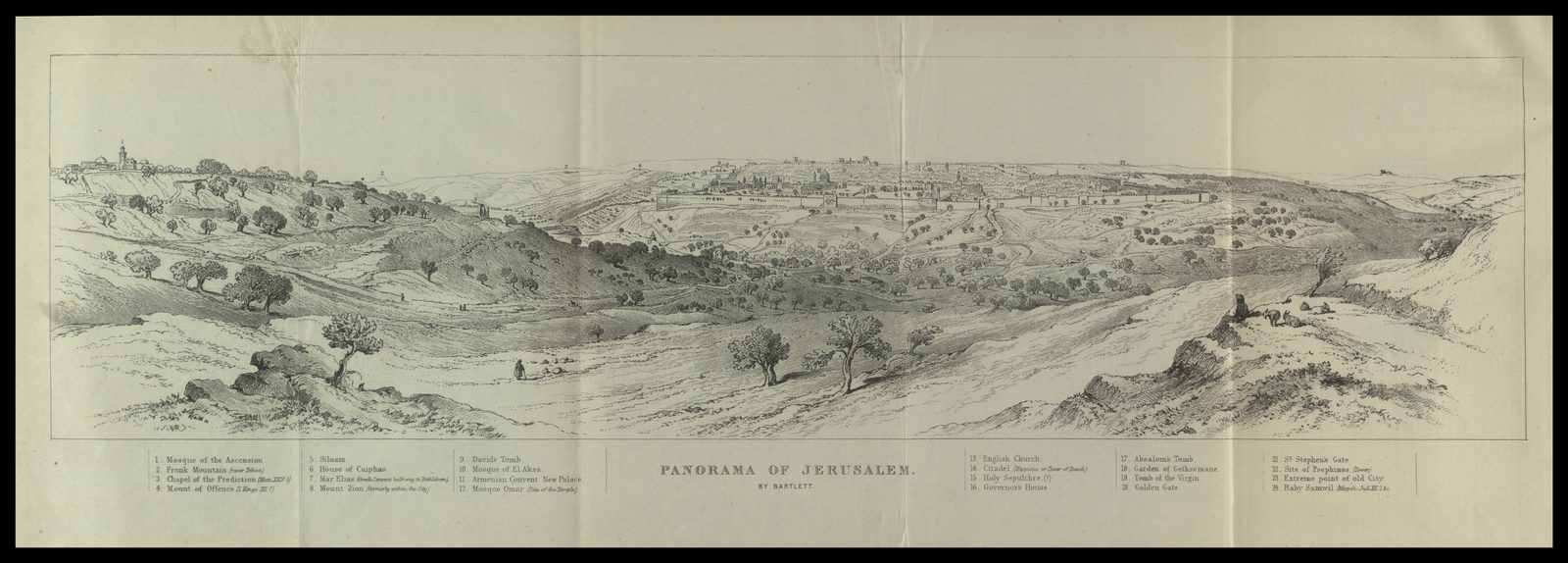
His foundation is in the holy mountains - Jerusalem was founded on the mountains or hills of Zion and Moriah. The after increase of the population obliged the inhabitants to inclose all the contiguous hills; but Zion and Moriah were the principal. We know that ancient Rome was built on seven hills.
A commentator
Albert Barnes1798–1870
Notes, Explanatory and Practical, on the Old and New Testaments (1832-1869)
proposed
His foundation - This is an abrupt commencement of the psalm. The adjective “his” has been supposed by some to refer to the psalm itself, and this expression has been considered to be a part of the title to the psalm, meaning that the foundation of the psalm is the holy mountain where the praises of God were celebrated; that is Zion. This, however, is a forced and unnatural interpretation. The most obvious explanation is to refer it to God, and the meaning is, that his “foundation,” or that which he had founded and established, to wit, the place for his worship, or for the institutions of religion, was in the holy mountains of Jerusalem. It would seem that the psalmist was contemplating the city - looking on its walls, and its palaces, and especially on the place which had been reared for the worship of God, and that he breaks out in this abrupt manner, by saying that this was what God had founded; that here he had established his home; that here was the place where he was worshipped, and where he dwelt; that this was the place which he loved more than all the other places where the descendants of Jacob dwelt. Is in the holy mountains - The mountains of Jerusalem. Jerusalem is surrounded by hills, and within the city itself there were the hills of Zion, Moriah, Acra, and Bezethah; See the notes at Mat 2:1. These sacred hills God had selected as the place of his solemn worship - of his own abode. Compare the notes at Psa 48:1-2.
How the passage was read
What the Jewish commentators add
whose foundation is on the mountains of the Sanctuary The foundation of this psalm; the Psalmist founded it on the mountains of Zion and Jerusalem.
This section is reception history: how the passage was read and kept in the Jewish tradition. Where a reading parts from an essential of the Christian faith, the section says so at that point.
Texts and citation data: Sefaria; each excerpt follows its version’s licence. 4 further sources are cited on this chapter that carry no English text this site may quote or only restate the verse.
The words behind it
3 Hebrew wordsEvery Hebrew word of this verse in the order it stands, with what it means and the door to its own study. The last column counts the times a word stands in the whole Bible: the rarer the word, the more the places it appears belong together.
| Hebrew | Sound | Meaning | Word study | In the Bible |
|---|---|---|---|---|
| יְ֝סוּדָת֗וֹ | yesudato | foundation his | H3248 → | |
| בְּהַרְרֵי־ | beharei- | [is] among [the] mountains of | H2042 → | 12 times |
| קֹֽדֶשׁ׃ | kodesh | holiness | H6944 → | 469 times |
יְ֝סוּדָת֗וֹfoundation his
yesudatoH3248 →
בְּהַרְרֵי־[is] among [the] mountains of
beharei-H2042 →12 times
קֹֽדֶשׁ׃holiness
kodeshH6944 →469 times
A shaded row is a word that stands 400 times or fewer in the Bible.
The walk
8 stopsEach card is a verse this one points to, and under it the verses that one points to in turn. Where several paths arrive at the same place, that place is listed first: the text keeps returning to it.
Through
Isaiah 28:16So this is what the Lord GOD says: “See, I lay a stone in Zion, a tested stone, a precious cornerstone, a sure foundation; the one who believes will never be shaken.
it leads to
- Psalms 118:22
The stone the builders rejected has become the cornerstone.
- Acts 4:11–12
This Jesus is ‘the stone you builders rejected, which has become the cornerstone.’
- 1 Peter 2:6–8
For it stands in Scripture: “See, I lay in Zion a stone, a chosen and precious cornerstone; and the one who believes in Him will never be put to shame.”
- Luke 20:17–18
But Jesus looked directly at them and said, “Then what is the meaning of that which is written: ‘The stone the builders rejected has become the cornerstone’?
- Romans 9:33
as it is written: “See, I lay in Zion a stone of stumbling and a rock of offense; and the one who believes in Him will never be put to shame.”
- Psalms 118:22
Through
Isaiah 56:7I will bring them to My holy mountain and make them joyful in My house of prayer. Their burnt offerings and sacrifices will be accepted on My altar, for My house will be called…
it leads to
- Mark 11:17
Then Jesus began to teach them, and He declared, “Is it not written: ‘My house will be called a house of prayer for all the nations’? But you have made it ‘a den of…
- Isaiah 2:2–3
In the last days the mountain of the house of the LORD will be established as the chief of the mountains; it will be raised above the hills, and all nations will stream to…
- Malachi 1:11
For My name will be great among the nations, from where the sun rises to where it sets. In every place, incense and pure offerings will be presented in My name, because My name…
- Mark 11:17
Where this verse is studied
On this page
About Psalms
This page draws on 9 works. Open the list of works
This page draws on Adam Clarke, Commentary on the Bible; Albert Barnes, Notes, Explanatory and Practical, on the Old and New Testaments (1832-1869); Augustine of Hippo, Exposition on Psalm 87; Charles Spurgeon, The Treasury of David, Vol. 4; Charles Spurgeon, The Treasury of David; Jamieson, Fausset & Brown, Commentary Critical and Explanatory on the Whole Bible; Jerome, Homily 18, on Psalm 86; John Gill, Exposition of the Old Testament (1748-1763) and Matthew Henry, Commentary on the Whole Bible.