
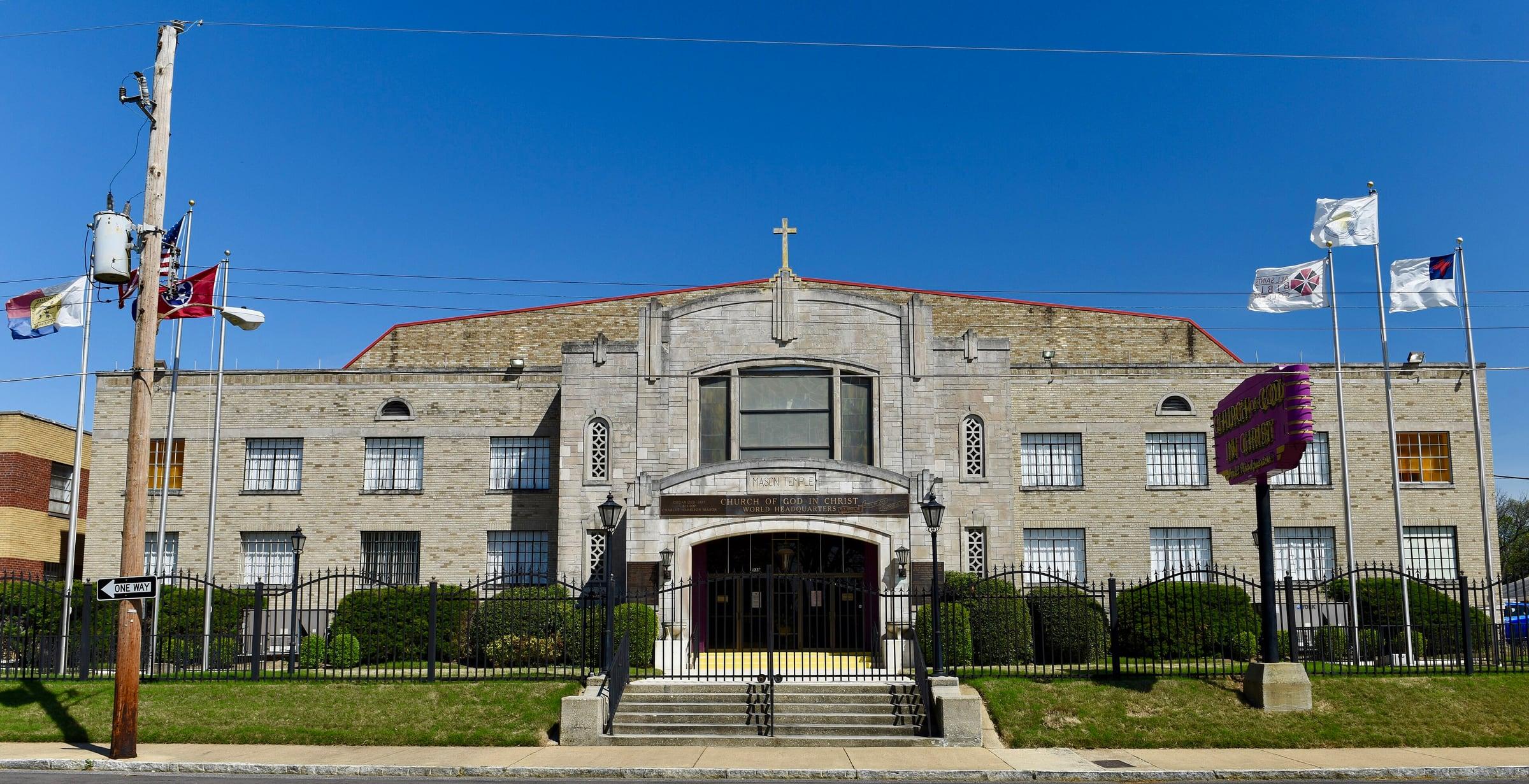
Mason Temple, Church of God in Christ, Memphis, Jim Roberts, 2017. CC BY-SA 4.0.
Los Angeles to Memphis · Story · Featured Study
The Colour Line: 1906, 1914 and 1994
The movement's own historians record how it split by race and what it tried at Memphis.
- Where
- Los Angeles, Hot Springs, Des Moines, Memphis
- Who
- William J. Seymour, Frank Bartleman, Ithiel Clemmons, Bernard E. Underwood
- When
- From 1906 to the 1990s
In 2023, Darrin Rodgers reports, Black people were 10.9 percent of the Assemblies of God's adherents and 3.3 percent of its ministers.
For He Himself is our peace, who has made the two one and has torn down the dividing wall of hostility
Summary
The first Pentecostal meetings crossed the line of race. In twenty years most of the churches drew the line again. Their leaders met at Memphis, where a white body gave way to a mixed one and a written confession.
- Darrin Rodgers says two founders of the Assemblies of God were Cherokee.
- Oral Roberts and other evangelists would not seat the races apart in their tent services.
- Billy Joe Daugherty asked that the new name should say Charismatic.
The Texts on One People in Christ
The Memphis Manifesto cites a prayer of Jesus and a command of Paul, and two other verses stand beside them.
This study asks how a movement that began across the line of race came to divide by it. It also asks what its churches confessed when they met at Memphis. It gives the dates in order with the witness for each, the story from Azusa Street to Des Moines and the law and teaching around it. It then gives the three days at Memphis and the words of those who took part. Two questions stay open, whether the line was ever gone and what Memphis achieved.
There is neither Jew nor Greek, slave nor free, male nor female, for you are all one in Christ Jesus.
The divisions this story tells are of the kind this verse sets aside in Christ.
that all of them may be one, as You, Father, are in Me, and I am in You. May they also be in Us, so that the world may believe that You sent Me.
Article IX of the Manifesto cites this prayer for its pledge to exchange pulpits.
John 17:21BSB
Be devoted to one another in brotherly love. Outdo yourselves in honoring one another.
Article VI of the Manifesto cites this command, in another translation's words.
Romans 12:10BSB
After this I looked and saw a multitude too large to count, from every nation and tribe and people and tongue, standing before the throne and before the Lamb. They were wearing white robes and holding palm branches in their hands.
The gathering John saw is the picture against which the divided churches of this story stand.
John 17:21, Romans 12:10, Revelation 7:9
Three Dates and the Years Between
Two of the movement's historians give most of the rows, and Bartleman and Seymour's constitution give the rest.
Eight rows run from the Azusa Street mission of 1906 to the new body at Memphis.
| When | What happened | The witness |
|---|---|---|
| 1906 to 1909 | People of all races met at the Azusa Street mission under William J. Seymour, a Black pastor | Synan; Bartleman (1925) |
| 1908 to 1924 | Church after church divided along the line of race | Synan |
| April 1914 | The first General Council met at Hot Springs, Arkansas | Rodgers |
| 1915 | Seymour's mission set its bishop and trustees by race, and the Assemblies ordained its first African-American minister | Seymour's constitution; Rodgers |
| 1939 to 1962 | Black ministers could not be ordained nationally in the Assemblies of God | Rodgers |
| 1948 | The Pentecostal Fellowship of North America formed at Des Moines and invited no Black churches | Synan |
| 18 October 1994 | That fellowship voted at Memphis to dissolve itself | Synan; Rodgers |
| 19 October 1994 | The Pentecostal and Charismatic Churches of North America took its name and adopted the Manifesto | Synan; Rodgers |
18 October 1994, 19 October 1994
From Azusa Street to Des Moines
Synan and Rodgers, historians of the movement, trace the division from the first churches to Des Moines.
Vinson Synan, a Pentecostal historian, writes that at Azusa Street "Often black hands were laid upon white heads". Frank Bartleman took part in those meetings and wrote of the colour line nineteen years later, in 1925.
Synan then writes that "from 1908 to 1924, one by one, most churches bowed to the American system of segregation". He gives the movement's first churches as interracial, many with thriving Black leaders.
Rodgers writes that the 300 ministers at the founding Council of the Assemblies of God in April 1914 "were mostly white", and that Ellsworth S. Thomas became its first African-American minister in 1915.
Charles Harrison Mason of the Church of God in Christ spoke at that Council. A largely white body used a like name. Rodgers writes that it "appears to have been structurally separate" from Mason's church and that a formal relationship "has not been demonstrated".
Seymour's own mission wrote a rule by race into its constitution in 1915. The rule spoke of trouble with some white members and still welcomed them.
Rodgers writes that the Assemblies adopted a policy in 1939 that denied ordination at the national level to African Americans. Bob Harrison, he writes, was the catalyst for rescinding it in 1962. The General Council's Minutes of 1939 print no such policy under the words colored or negro.
In 1948 the Pentecostal Fellowship of North America was formed at Des Moines, Iowa. Synan writes that "no black churches were invited".
Jim Crow and Parham
The law of the land kept the line, and so did the man who taught Seymour.
Synan sets the division against its country: "In Jim Crow America, segregation in all areas of life ruled the day."
Charles Parham turned on the revival. In 1912, as Cecil M. Robeck Jr. quotes him, he called it "a cross between the Negro and Holy Roller form of worship".
Synan writes that the civil rights movements and laws of the 1950s and 1960s swept away legal segregation, while most churches remained segregated.
The Three Days at Memphis
Synan, who gave one of the papers, is the fullest witness, and the Assemblies' archivist confirms the dates.
Bernard E. Underwood of the International Pentecostal Holiness Church was elected to head the Fellowship in 1991. With Bishop Ithiel Clemmons of the Church of God in Christ he laid the groundwork. On 6 March 1992 the board voted unanimously to pursue reconciliation.
Four meetings followed. The last, at Memphis in the January before the conference, brought together 20 white and 20 Black leaders to plan it.
The delegates arrived on 17 October at the Cook Convention Center. Synan gives more than 3,000 at the evening sessions and 1,000 or more leaders at the morning papers.
Robeck, Leonard Lovett, William Turner and Synan gave those papers, and Synan says they laid bare "the sad history of separation, racism, and neglect".
On the afternoon of 18 October, Synan writes, Bishop Charles Blake spoke to the delegates in tears. A young Black man gave a message in tongues. Jack Hayford gave an interpretation, and Synan prints it with the words "I, by My Spirit, am flowing the two streams into one".
Donald Evans, a white Assemblies of God pastor from Tampa, then came forward with a towel and a basin. He washed Clemmons's feet and begged forgiveness for the sins of whites against Black Christians.
Blake then washed the feet of Thomas Trask, general superintendent of the Assemblies of God. It was a sign of repentance for any animosity Black Christians had held against whites.
That afternoon the members of the Fellowship met for the last time and dissolved it. A release of the new body says less exactly that this came "After the conference".
On 19 October the delegates voted unanimously for the name Pentecostal and Charismatic Churches of North America.
They adopted the Racial Reconciliation Manifesto in eleven articles, drafted by Clemmons, Robeck, Lovett and Harold D. Hunter. They elected Clemmons chairman and Underwood vice-chairman, and Bishop Barbara Amos joined the board.
How the Key Verse Was Taught
Four writers, from the third century to the nineteenth, read the verse of Jew and Gentile and of the wall between them.
Tertullian (died 220)
Against Marcion Book V
A treatise of the third century, against Marcion, cites the verse to show whose peace Christ announced.
“For the Creator's righteousness no less than His peace was announced in Christ, as we have often shown already. Therefore he says: ‘He is our peace, who hath made both one’ -that is, the Jewish nation and the Gentile world.”
on Ephesians 2:14Patristic
Theodore of Mopsuestia (died 428)
CATENA 2.13
A commentary of the fifth century ties the end of the division to the resurrection.
“Christ, conferring immortality on us through his resurrection, has put an end to this division [between Jew and Gentile], for there can be no circumcision of an immortal nature.”
on Ephesians 2:14Patristic
Gregory the Dialogist (died 604)
Forty Gospel Homilies, Homily 14
A homily on the sheep of another fold applies the verse to the Gentiles of its own day.
“The Lord was looking upon our redemption, we who come from the Gentile people, when he said he would bring other sheep also. This you see happening daily, brethren; this you see accomplished today with the reconciled Gentiles. For he makes one fold, as it were, from two flocks, because he unites the Jewish and Gentile peoples in his faith, as Paul attests, who says: ‘He is our peace, who has made both one.’ For while he chooses the simple from both nations for eternal life, he leads his sheep to their proper fold.”
on Ephesians 2:14Patristic
Jamieson, Fausset & Brown (1802 to 1910)
Commentary Critical and Explanatory on the Whole Bible
A commentary of 1871 asks what the wall of the verse was.
“Thus this twofold wall represented the Sinaitic law, which both severed all men, even the Jews, from access to God (through sin, which is the violation of the law), and also separated the Gentiles from the Jews. As the term ‘wall’ implies the strength of the partition, so ‘fence’ implies that it was easily removed by God when the due time came.”
on Ephesians 2:14Reformed
In Their Own Words
A mission's rule, a memoir, a bishop's words at Memphis and the Manifesto adopted there.
William J. Seymour (1870 to 1922)
The Doctrines and Discipline of the Azusa Street Apostolic Faith Mission, the Constitution, Article C
People of color
“The bishop, vice bishop and trustees must be people of color.”
Pentecostal
About this saying1 paragraph
A later transcription prints this article of 1915, which puts race into the mission's offices.
Frank Bartleman (1871 to 1935)
How Pentecost Came to Los Angeles, page 54
Washed away in the blood
“The ‘color line’ was washed away in the blood.”
Pentecostal
About this saying1 paragraph
This sentence of 1925 is Bartleman's own narration of what he saw.
Charles Blake
Words at Memphis, printed in Vinson Synan, Memphis 1994: Miracle and Mandate, the section The Memphis Miracle
I commit my love to you
“I commit my love to you. There are problems down the road, but a strong commitment to love will overcome them all.”
Church of God in Christ
About this saying1 paragraph
Blake's words at Memphis on 18 October 1994 look past the day to the problems ahead, as Synan records them.
The Racial Reconciliation Manifesto Committee
Racial Reconciliation Manifesto (Memphis, 1994), article III
Racism is sin
“With complete bold and courageous honesty, we mutually confess that racism is sin and as a blight in the Fellowship must be condemned for having hindered the maturation of spiritual development and mutual sharing among Pentecostal-Charismatic believers for decades.”
Pentecostal
About this saying1 paragraph
Article III of the Manifesto, adopted on 19 October 1994, makes the confession in the churches' common voice.
Was the Line Ever Gone, and What Was Memphis?
Bartleman, Seymour and Synan wrote of what they took part in, and later writers test their account.
Was the line ever gone?2 paragraphs
Bartleman held that the line was gone at Azusa Street, and Synan writes that the movement inherited the "interracial ethos of the Holiness Movement". Seymour's rule of 1915 stands against that.
The historians differ on the Fellowship of 1948: Synan calls it all-white, and Rodgers calls it predominantly white.
Was Memphis a miracle?1 paragraph
Those gathered called the event the Memphis Miracle, Synan writes, and Paul Walker of the Church of God named it the "Miracle in Memphis" in a speech the day after the foot washing. Synan calls the foot washing the moment everyone sensed as the "final seal" of the Spirit's approval.
What did Memphis change?2 paragraphs
The Manifesto itself admits "that there is no single solution to racism in the Fellowship". Clemmons, as chair in 1996, said church leaders must get beyond "feel-good" meetings to the underlying issues of racism.
Murray Hohns wrote in 2000 that the Manifesto "will remain nice words on paper until every believer can endorse the excellence of mixed marriage".
Books to Read Next
How Pentecost Came to Los Angeles
Frank Bartleman · 1925
Bartleman took part in the meetings and printed this memoir himself.
Read Bartleman free at CCELFully Committed: 100 Years of the Assemblies of God
Darrin J. Rodgers · 2014
Rodgers, the archivist of the Assemblies of God, wrote this history for its hundredth year.
Read Rodgers free at the iFPHCWhat the Colour Line Left
The colour line left the Pentecostal churches a written confession in their own Manifesto and a new interracial body to keep it.
Sources
Scripture is the Berean Standard Bible.
- The Holy Bible, Berean Standard Bible (read 2026)
- Frank Bartleman, How Pentecost Came to Los Angeles: As It Was in the Beginning (Los Angeles: F. Bartleman, 1925), page 54.
- Vinson Synan, Memphis 1994: Miracle and Mandate (undated, after 1997)
- Racial Reconciliation Manifesto (Memphis, 1994), articles I to XI, by the Manifesto Committee.
- Darrin J. Rodgers, Fully Committed: 100 Years of the Assemblies of God, Assemblies of God Heritage 34 (2014)
- Darrin J. Rodgers, The Memphis Miracle at 30, Influence (18 September 2024)
- William J. Seymour, The Doctrines and Discipline of the Azusa Street Apostolic Faith Mission (1915), in the azusastreet.org transcription.
- Leilani Haywood, PCCNA to Celebrate Memphis Miracle (11 February 2019), a release of the Pentecostal and Charismatic Churches of North America posted by the International Pentecostal Holiness Church.
- The General Council of the Assemblies of God, Minutes 1939, searched for the words colored and negro.
- Cecil M. Robeck Jr., "The Past: Historical Roots of Racial Unity and Division in American Pentecostalism", Cyberjournal for Pentecostal-Charismatic Research 14 (2005), quoting Parham's Apostolic Faith (Baxter Springs, January 1912), page 6.
- Pentecostals: Youth Leaders Launch Racial Reconciliation Network, Christianity Today (November 1996)
- H. Murray Hohns, The Memphis Manifesto: Five Years Later, Pneuma Review (21 February 2000)
Keep Studying
Read it5
Studies1
People and groups14